Tesla and Waymo duel in the robotaxi race — but the company spending the most builds no cars at all
- Published
- Source
- YahooFinance
Tesla and Waymo are competing in the rapidly evolving robotaxi market, with Tesla focusing on its own fleet of autonomous vehicles while Waymo continues to expand its ride-hailing services. As of spring 2026, Tesla has deployed approximately 20 driverless Model Y vehicles in Texas cities like Austin, Dallas, and Houston, but its ambitious Cybercab project is still in the early stages of production, with significant revenue not expected until 2027. Meanwhile, Waymo has achieved a notable milestone with half a million weekly rides, highlighting the disparity in progress between the two companies.
Investors are increasingly scrutinizing the financial viability of these ventures, as both Tesla and Uber, which is pursuing a different strategy by investing in autonomous technology rather than owning the vehicles, have made substantial commitments to self-driving initiatives. Uber recently invested nearly $500 million in the startup Nuro, aiming to integrate autonomous taxis into its network. This investment is part of a broader strategy that includes partnerships with various companies to deploy thousands of autonomous vehicles in the coming years.
As the market evolves, the competition between Tesla's vertically integrated approach and Uber's model of leveraging partnerships raises questions about the future of robotaxis and the potential for profitability in this emerging sector. With both companies facing challenges and delays, the race for dominance in the robotaxi space is far from over.
Original report
Tesla and Waymo duel in the robotaxi race — but the company spending the most builds no cars at all
YahooFinanceThis briefing is an independently written summary based on publicly available reporting and is provided for industry information and news discovery. The original report and source publication are credited and linked where applicable. RobotToday does not claim ownership of third-party source material.
Rights concerns? Contact [email protected] with the relevant URL and details. We will review the matter and take appropriate action where warranted.
More related news
- 1
- 2
- 3
- 4
- 5
- 6
- 7
- 8
-
9
ROBOTTODAY Weekly October 19 – 23, 2026 RobotToday · 6 days ago
- 10
- 11
- 12
Related Suppliers

Drone Delivery Canada
Canada
Vaughan, Ontario drone logistics developer merged with Volatus Aerospace in August 2024; the combined company trades as FLT in Toronto.
Duckietown Robotics
United States
Educational robotics platform provider offering autonomous vehicle kits and AI curricula used by 250+ universities worldwide.
EasyMile
France
Toulouse, France autonomous-vehicle software company founded 2014; EZTow and EZDolly systems automate industrial tow tractors and cargo movers at airports.
Yuanqi Innovation (Xiamen) Robot Co., Ltd. 元启创新(厦门)机器人有限公司
China
Xiamen-based AgiBot VAP partner founded 2025; resells and customises AgiBot humanoids, Genie wheeled robots and D1 quadrupeds with turnkey service.
OM Robot Technology Co. Ltd. 东莞全向机械科技有限公司
China
Chinese manufacturer of mecanum wheels, omnidirectional wheel bases, and mobile robotic platforms for AGV applications.
Techman Robot Inc. (TM Robot) 達明機器人股份有限公司
Taiwan
Techman Robot is a Taiwanese cobot maker producing AI-powered collaborative robots with integrated built-in vision for manufacturing automation.
E-COBOT
France
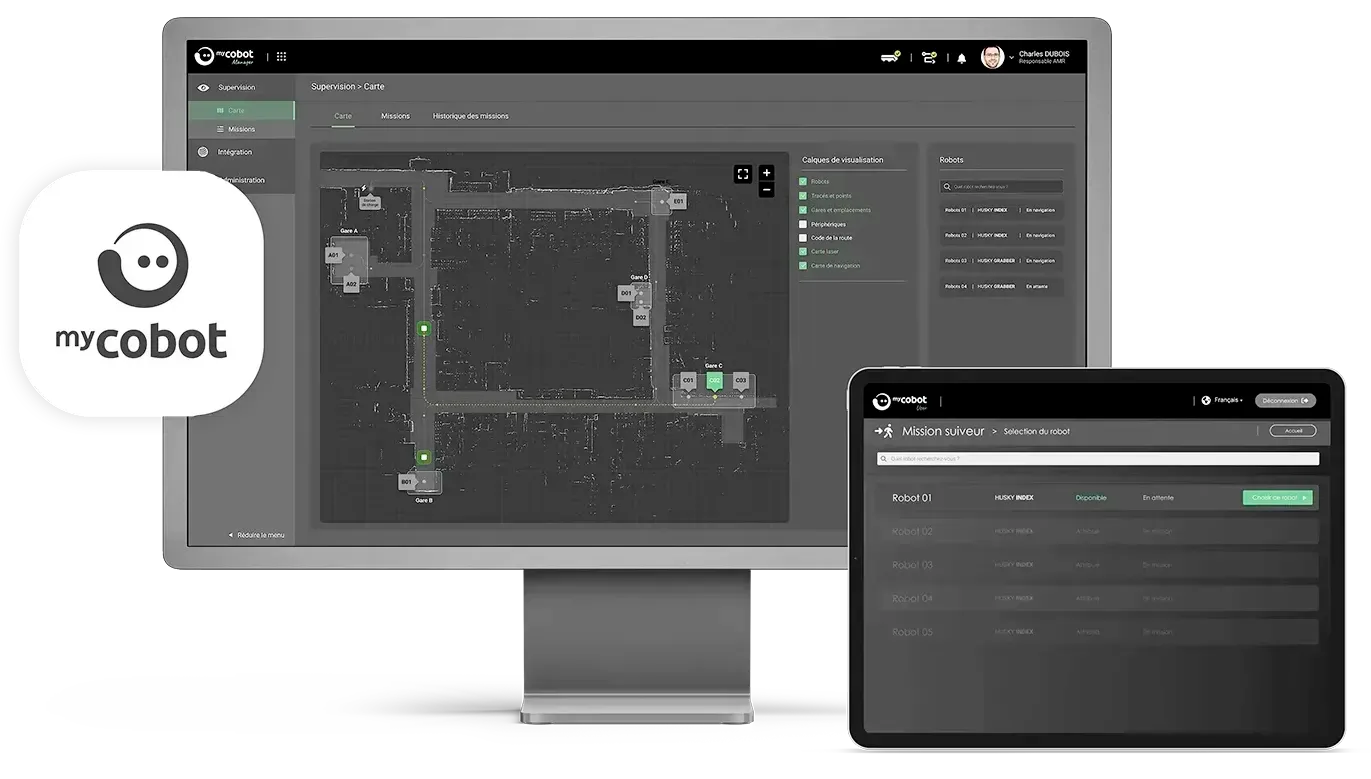
French AMR manufacturer and system integrator offering the HUSKY robot range and MyCobot fleet management software.

Filics
Germany
Munich-based robotics startup making ultra-flat omnidirectional AMRs that drive under Euro pallets for space-efficient intralogistics.

Human in Motion Robotics
Canada
Vancouver, Canada medical-robotics company founded 2016 builds the XoMotion self-balancing exoskeleton for people with spinal cord injury or stroke.
LG Display
Korea, Republic of (South)
Seoul display maker (KRX:034220, NYSE:LPL), formed 1999, that launched plastic OLED humanoid-robot face panels for industrial settings in 2026.

Roboblock System Co., Ltd.
Korea, Republic of (South)
South Korean robotics distribution and development company founded in 1997; supplies AI robots, drones, humanoid kits, and VR/AR systems internationally.
Robotics needs a service framework.
RSF defines a common language for robot service capability, lifecycle operations, certification pathways, and service-provider networks.
Join the RobotToday community on LinkedIn
Daily robotics news, in-depth analysis, conference highlights, and discussions with professionals worldwide.