


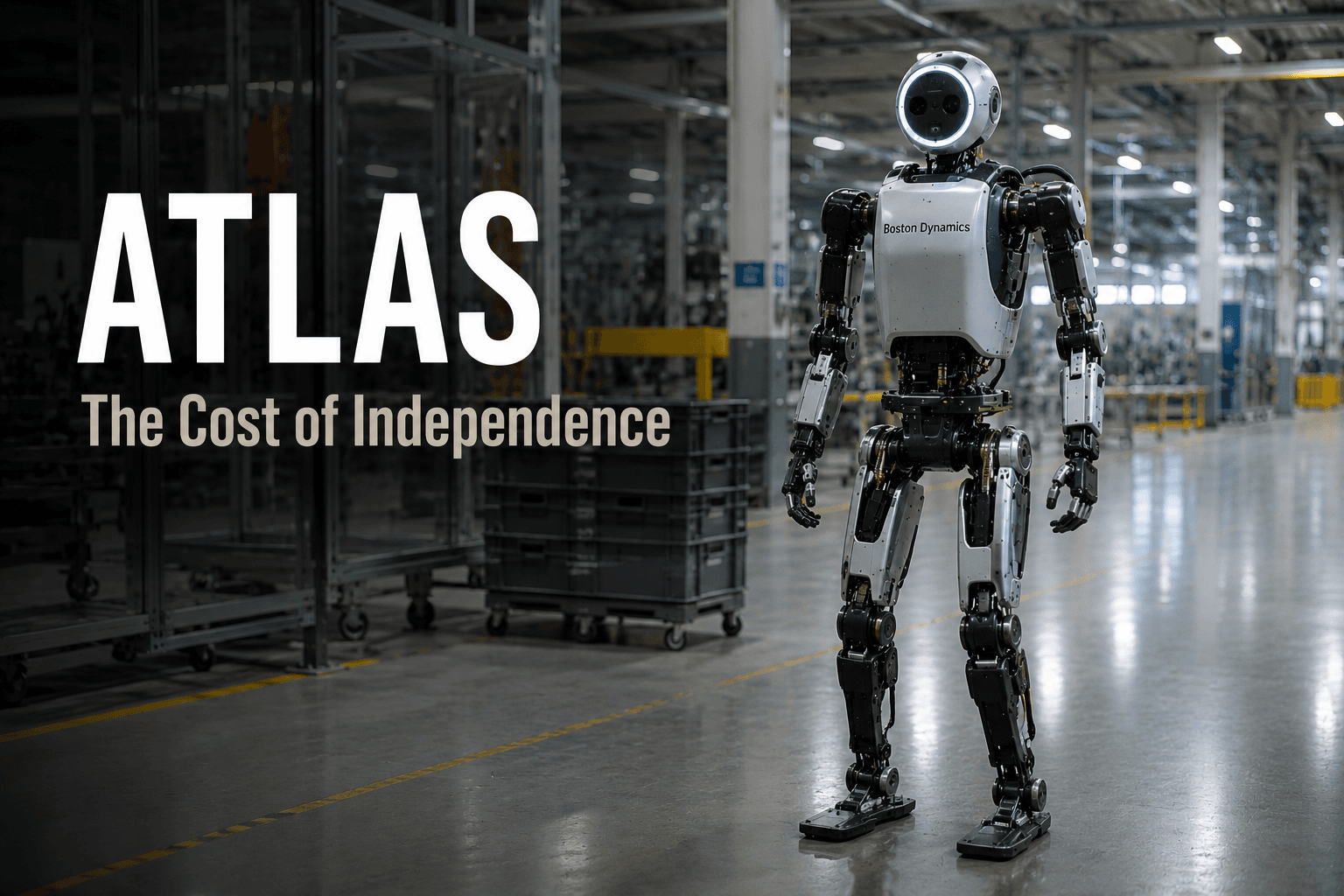
Atlas 'De-Sinification' Strategy vs. Tesla Optimus 'China-Embrace' Strategy — A Data-Driven Verdict
Our previous report closed with iRobot's tragedy — and as of this writing in June 2026, that tragedy has already fully resolved into historical fact. In Q1 2026, Picea Robotics of Shenzhen quietly acquired all of iRobot's assets out of Chapter 11 bankruptcy. Thirty years of American consumer-robotics brand equity was stamped out in a single transaction — and the buyer was the very supply chain iRobot had spent years trying to escape. Picea's Q1 acquisition is the final seal on an old business model's coffin: a Western robotics company that mistook geographic relocation for strategic transformation. This is not an isolated failure. It is a repeatable, systemic trap. The question this report answers: how does Boston Dynamics stay out of it? We compare Atlas and Tesla Optimus across two radically different supply chain philosophies — with numbers — and lay out a viable survival architecture.
Chapter 1 | The Numbers: Atlas and Optimus's Cost Cliff
1.1 Pricing Reality — A Number That Chokes Factory Managers
Boston Dynamics announced Atlas's commercial debut at CES in January 2026. According to KED Global's January report, Boston Dynamics set its pricing strategy at 'below the cost of two US manufacturing workers for two years,' placing the official commercial ceiling at approximately $320,000. (Some analysts cite figures up to $420,000 for early pre-production and custom-configuration units; for this analysis we use $320,000 as the stated commercial standard price ceiling.)
By comparison, Tesla Optimus's official long-term price target is $20,000–$30,000 at mass-production scale — roughly 1/15th to 1/10th of Atlas. China-made Unitree G1 already sells for as low as $16,000. This is not a difference in product tier — it is a difference in market access survival.
FIGURE 1 | Humanoid Robot Price Positioning (2026)
| Robot | Price Comparison (proportional scale, max = $320K commercial ceiling) |
| Atlas (est.) | ███████████████████████████ $320K (ceiling) |
| Figure 02 | ██████ $70K (est.) |
| Tesla Optimus | ██ $25K (target) |
| Unitree G1 | █ $16K |
| XPeng IRON | █ $16.5K (target) |
Bar length is proportional to the $320K commercial ceiling announced at CES 2026 (KED Global). Note: Some analyst estimates cite up to $420K for early pre-production units; $320K represents the official Boston Dynamics stated commercial price ceiling. Sources: KED Global Jan 2026; Robozaps; Unitree official; XPeng AI Day 2025.
TABLE 1 | Humanoid Robot Competitive Snapshot (2026)
| Robot / Platform | 2026 Price Range | Production Target | Supply Chain | Core Competitive Weakness |
| Boston Dynamics Atlas | $150K–$320K (commercial ceiling*) | 30,000 units/yr by 2028 | Korea/US, zero China content | Extremely high cost; zero external sales in 2026 |
| Tesla Optimus | Target $20K–$30K at scale | 50K–150K units (2026 target) | ~70% China-sourced | Mass production still unproven; internal use only |
| Unitree G1/H1 | $16K–$40K | 75,000 units/yr (declared cap.) | Shenzhen/Yangtze Delta 100% | Capability limits; low global brand trust |
| XPeng IRON | Target ¥120K (~$16.5K) | Mass production by end 2026 | Guangzhou full-chain 100% | Weak international brand recognition |
| AgiBot Expedition A3 | Undisclosed (B2B) | 5,100 units shipped 2025 (#1 globally) | Shanghai Lingang base 100% | Low global visibility; B2B focused |
Sources: KED Global Jan 2026; AI2.work; TrendForce April 2026; XPeng AI Day Nov 2025; AgiBot production reports.
1.2 Production Ramp Speed — Who Is Actually Running?
Boston Dynamics plans to reach 30,000 units per year at its Savannah, Georgia facility by 2028. However, all 2026 production is already reserved for Hyundai and Google DeepMind — meaning zero units are available for external customers in 2026.
Meanwhile, the Chinese camp achieved scale in 2025. AgiBot alone shipped more than 5,100 units — roughly 40% of the global market. Unitree shipped ~4,200. AgiBot rolled out its 10,000th unit in March 2026. TrendForce projects China's humanoid robot output will grow 94% in 2026.
Tesla Optimus, despite Elon Musk's March all-hands target of 50,000–150,000 units in 2026, remains internally deployed only. No public sales have launched.
FIGURE 2 | Production Ramp Comparison: China vs. US vs. Korea
| Company | 2024 Output | 2025 Output | 2026 Target | 2028 Target | Ramp Speed |
| AgiBot (China) | < 500 | 5,100 ✦ | ~30,000 | N/A | 10× in 12 mo. |
| Unitree (China) | ~1,000 | 4,200 | 75,000 cap. | N/A | ~4× in 12 mo. |
| Tesla Optimus | < 100 (internal) | ~1,000 (internal) | 50K–150K target | N/A | TBD — unproven |
| Boston Dynamics Atlas | 0 (R&D only) | < 100 (pilot) | Reserved (Hyundai+Google) | 30,000/yr | Slowest — but most validated |
Sources: TrendForce April 2026; AgiBot press releases; Tesla Q1 2026 earnings; Boston Dynamics CES 2026.
Boston Dynamics is not merely facing a cost problem. It faces a market-access window that is closing at an exponential rate.
Chapter 2 | Supply Chain Anatomy: Red vs. Hybrid vs. Pure
2.1 Optimus's 'China-Embrace' Strategy: The Triumph of Pragmatism
According to supply chain research from multiple Chinese securities firms, Tesla has completed factory audits for its third-generation Optimus, with Chinese suppliers capturing approximately 70% of component value.
This was not accidental. Tesla's BOM (Bill of Materials) cost target is to compress Optimus from ~$43,000 per unit in low-volume production to under $20,000 at mass scale. The arithmetic only works with China's supply chain.
Key Chinese suppliers in Optimus's ecosystem:
Tuopu Group: Tesla Tier-0.5 supplier for linear/rotary actuator assemblies; Mexico factory live, Q2 2026 capacity target 300,000 sets
Sanhua Intelligent Controls: Core joint module supplier; robotics revenue +320% YoY in H1 2025; gross margin held above 35%
Suzhou Green Harmonic (STAR Market): Primary harmonic reducer supplier; 30–40% cheaper than Japanese rivals; new Suzhou plant capable of 500,000 units/year by 2026
Shuanghuan Transmission, Wuzhou Xinchun: Ball screws and planetary roller screws — already in Tesla's verified supply chain
2.2 Atlas's 'De-Sinification' Strategy: The Price of National Security Logic
Boston Dynamics chose a fundamentally different path — designating Hyundai Mobis (Korea) as the primary actuator supplier, paired with US and Japanese partners to build a supply chain with zero Chinese content.
This decision has a coherent internal logic: Atlas's launch customers include Hyundai Motor factories and Google DeepMind, both of which have explicit DoD compliance requirements. Actuators account for more than 60% of humanoid robot BOM cost (Hyundai Mobis's own figure) — which is precisely why Atlas costs what it costs.
The problem: Hyundai Mobis is an automotive veteran entering the robot actuator market for the first time. Building robotics-grade precision manufacturing capabilities from scratch takes time — and every month of that learning curve gets reflected in Atlas's price tag.
TABLE 2 | Component-by-Component Supply Chain Comparison
| Component | Atlas Source | Optimus China Source | Cost Multiple | Atlas Risk |
| Actuators / Joint Modules (~60% of BOM) | Hyundai Mobis (Korea) — new entrant | Sanhua, Tuopu Group, Shuanghuan Transmission (Yangtze Delta) | ~3–4× | CRITICAL ● |
| Harmonic Reducers | Harmonic Drive (Japan/US) | Suzhou Green Harmonic — 30–40% cheaper, 500K unit/yr Suzhou plant (2026) | ~2–3× | HIGH ▲ |
| Frameless Torque Motors | US/European suppliers | Moons' Electric, Inovance Technology | ~2× | MEDIUM ◆ |
| Ball / Planetary Roller Screws | THK / NSK (Japan) | Wuzhou Xinchun, Beston (in Tesla supply chain) | ~2–3× | MEDIUM ◆ |
| 6-Axis Force/Torque Sensors | ATI (USA) | Yuli Instruments (in mass production) | ~2× | LOW ○ |
| AI Compute (NVIDIA) | NVIDIA (USA) — shared | NVIDIA (identical) | 1× (same) | LOW ○ |
Sources: Hyundai Mobis CES 2026; BigGo Finance April 2026; Tesla Optimus supply chain research (36Kr, Humanoids Daily); NotebookCheck Jan 2026.
FIGURE 3 | Supply Chain Risk Heat Map — Atlas vs. Chinese Alternatives
| Component Layer | Atlas Dependency | China Alternative | Cost Delta | Risk Level |
| Actuators (60% of BOM) | Hyundai Mobis (new entrant) | Sanhua / Tuopu (proven) | 3–4× higher | CRITICAL |
| Harmonic Reducers | Japan HD (premium) | Green Harmonic (proven) | 2–3× higher | HIGH |
| Motors & Sensors | US/EU suppliers | Moons'/Inovance | ~2× higher | MEDIUM |
| Ball Screws | THK/NSK (Japan) | Wuzhou/Beston | 2–3× higher | MEDIUM |
| Force/Torque Sensors | ATI (USA) | Yuli Instruments | ~2× higher | LOW |
| AI Chips | NVIDIA (shared) | NVIDIA (identical) | No difference | NONE |
Darker shading = higher cost multiple and risk to Atlas competitiveness.
Core conclusion: On actuators — the component that represents 60% of cost — Atlas's chosen supplier is 3–4× more expensive than Optimus's Chinese alternatives. That single procurement decision has already structurally disqualified Atlas from competing on price in open commercial markets.
Chapter 3 | iRobot Post-Mortem: Seven Death Signals Boston Dynamics Must Decode
3.1 iRobot Death Timeline
| Year | iRobot Decision | Outcome & Cost |
| 2019 | Fled to Malaysia / Jabil under banner of 'de-Sinification' | Logistics cost +15%; components still imported from Shenzhen — double overhead with no savings |
| 2021–23 | Amazon acquisition ($1.7B) blocked by FTC | Lost only path to scale; cash began burning |
| 2024 | Revenue fell 35%; Chinese rivals attacked with identical products at half the price | Market share collapsed from ~70% to ~30%; 400 layoffs |
| 2025 Q4 | Filed Chapter 11 bankruptcy protection | 30-year American consumer-robotics pioneer wiped out |
| 2026 Q1 ✓ DONE | Picea Robotics (Shenzhen) completes acquisition of all iRobot assets — confirmed and closed | American brand becomes a subsidiary of the very Chinese supply chain it tried to escape — the ultimate irony |
3.2 The Seven Fatal Mistakes — and Boston Dynamics's Mirror
Mistake 1: Confusing Geographic Relocation with Supply Chain Diversification
iRobot moved to Malaysia, believing this constituted an escape from Chinese dependency. In reality, its motors, sensors, and precision plastic components continued to arrive from Shenzhen and Dongguan — with an extra, pointless logistics step added in. Costs rose; delivery cycles lengthened; zero cost advantage was gained.
Boston Dynamics's equivalent danger: If Hyundai Mobis's Korean actuator factory still imports precision bearings and NdFeB magnets from Japan and Europe, Atlas is simply another 'Malaysia Illusion.' The structural risk runs further upstream than most analysts acknowledge: building a genuinely clean supply chain for Hyundai Mobis — in Korea or in Georgia — is not primarily an assembly challenge. The real difficulty is upstream: NdFeB rare-earth magnet refining (where China controls over 85% of global capacity), and non-standard precision bearing lead times measured in months rather than days. If Mobis ultimately follows the same quiet path Tesla took — defaulting to 'offshore Chinese-chain' suppliers operating legally out of Mexico (Tuopu, Sanhua) — then Atlas's premium pricing is reduced to a pure political compliance surcharge, paid for optics rather than engineering performance. For industrial buyers with rigorous two-year ROI requirements, a political premium with no corresponding capability advantage is simply a dealbreaker.
Mistake 2: Fighting a Price War on the Competitor's Home Court
Roborock, Dreame, and Ecovacs are embedded in the Shenzhen/Dongguan cluster — upstream and downstream suppliers within 50km; iteration cycles measured in weeks. iRobot in Malaysia was measuring the same cycles in quarters.
Boston Dynamics's equivalent risk: AgiBot and Unitree have already built similar clusters in Shanghai Lingang and Shenzhen. Atlas's design iteration and supplier-coordination velocity will be systemically slower than its competitors.
Mistake 3: Mistaking 'DoD Compliance' for a Commercial Moat
iRobot also pinned hopes on government procurement and data-safety narratives. But consumers buying a robot vacuum care about suction power and price — not data governance.
Boston Dynamics's nuanced position: Atlas's DoD compliance IS a genuine moat — but only for the government and defense sub-market. In commercial manufacturing (automotive plants, logistics warehouses), Optimus and Chinese brands are not blocked by this threshold. Two separate markets require two separate strategies.
Mistake 4: Ignoring Ecosystem Network Effects
When Roborock leveraged Tuya Smart's cloud platform and Ecovacs used Xiaomi's distribution, they didn't just gain sales channels — they gained the entire smart-home ecosystem's traffic. iRobot's app was a standalone island.
Boston Dynamics's corresponding advantage (a rare bright spot): The Google DeepMind strategic partnership and Gemini Omni AI integration is exactly the ecosystem leverage iRobot never possessed. This is Atlas's most valuable moat — and must be treated as a core strategic asset, not an accessory feature.
Mistake 5: Failing to Build a Transition Path Before the Price Cliff Arrived
By 2023, iRobot could already see the Chinese price erosion — but its pivot to enterprise services and cloud subscriptions was embryonic, and cash had run out. Transformation requires time; bankruptcy does not wait.
Boston Dynamics's time window: Atlas's current B2B industrial positioning — justifying price through ROI (payback within two years) rather than unit price — is the correct approach. But this logic holds only if Atlas builds sufficiently deep moats in premium industrial markets BEFORE Optimus goes on sale commercially. The window is likely 2–3 years.
Mistake 6: Over-Relying on a Single Capital Rescue with No Plan B
iRobot's fate was sealed the moment the Amazon acquisition was blocked by the FTC. Without independent production scale, without an independent path to profitability, the only exit was permanently closed.
Boston Dynamics's corresponding insurance: Hyundai's $26 billion US investment commitment and its pledge to deploy 30,000+ Atlas units internally across Hyundai/Kia factories provides a floor that iRobot never had. Even if the external market fails, Hyundai's own factories serve as a validation platform and anchor customer. This is a critical structural advantage.
Mistake 7: Turning 'Exit China Supply Chain' Into a PR Campaign Rather Than a Business Decision
iRobot's Malaysia relocation was largely a political gesture for Washington's consumption — not a decision subjected to rigorous cost-benefit analysis. When PR narrative collides with commercial reality, the market only reads one of them.
Chapter 4 | Boston Dynamics's Survival Path: Tiered Supply Chain Architecture
4.1 Not Either/Or: The 'Barbell' Supply Chain Model
Boston Dynamics does not need to choose between 'fully embrace China' and 'absolute de-Sinification.' The iRobot lesson is clear: rejecting China's supply chain while being unable to replicate its cost efficiency is a death sentence. The viable path is:
'Brain and data controlled by the US/Korea; bones and muscles open to non-sensitive Chinese components'
FIGURE 4 | Atlas Tiered Supply Chain Architecture ('A-B-C Layer' Framework)
Layer | Zone | What Goes Here | Rule |
| A | National Security Lock | AI software, motion algorithms, spatial data, final assembly (Georgia), core IP | NEVER compromise. US/Korea only. |
| B | Technology-Neutral Zone | Harmonic reducers, motors, sensors — benchmark China prices; dual-source from Japan+Taiwan+Korea | Selective. Audit for DoD compliance per customer type. |
| C | Commodity Open Zone | Fasteners, connectors, wiring harness, packaging, structural aluminum enclosures | Embrace lowest global cost. No security data involved. |
Each layer carries a distinct compliance requirement and cost optimization opportunity. Layer A is non-negotiable. Layer C is actively encouraged.
Layer A — National Security Lock (Non-Negotiable):
AI algorithms and control software: Boston Dynamics motion planning, Google DeepMind Gemini integration
Spatial perception and mapping data: all RMAC data assets must remain on US soil
Core patents and intellectual property: US/Korea controlled
Final assembly: Georgia factory (DoD-compliant, 'Made in America' narrative satisfied)
Layer B — Technology-Neutral Zone (Selective Execution):
Harmonic reducers: triangle sourcing from Japan + Taiwan + Korea, with Chinese pricing as benchmark leverage
Motors and sensors: dual-source strategy — Western for medical/defense grade; competitive open bidding for industrial standard grade
Aluminum structural parts and thermal management modules: no data content, no security risk, maximum cost optimization potential
Procurement isolation via Hyundai Glovis (the 'White Glove' buffer): Hyundai's global logistics entity — Hyundai Glovis — can act as the arm's-length procurement intermediary for all Layer B components. Glovis conducts competitive tendering and compliance auditing of non-sensitive parts (including offshore Chinese-chain suppliers in Mexico and Thailand), then delivers consolidated, fully auditable packages to Boston Dynamics in Georgia. This structure allows Atlas to capture Chinese manufacturing cost advantages on non-data components without Boston Dynamics having any direct contractual relationship with Chinese suppliers — satisfying both DoD traceability requirements and financial controllers demanding aggressive BOM cost reduction.
Layer C — Commodity Open Zone (Actively Embrace):
Standard fasteners, connectors, wiring harness: source at global lowest cost
Logistics and packaging: Hyundai Glovis optimization
Non-proprietary electrical components: global commodity specification
4.2 The Mirror of iRobot Safe Corp: 'Atlas Clean Corp'
As noted in our previous article, after Picea's acquisition of iRobot, the company established 'iRobot Safe Corp' to satisfy US regulators — a US-citizen-managed subsidiary handling all data governance and spatial mapping, while hardware and manufacturing were fully optimized by Shenzhen. Boston Dynamics can apply this architecture in reverse:
Establish 'offshore factories' for Chinese Tier-1 suppliers (Sanhua, Tuopu) in Mexico or Thailand, bypassing the political sensitivity of direct Chinese content — Tesla Optimus already uses this path (Sanhua's Mexico factory is delivering as of 2026)
Route all Layer B component procurement through Hyundai Glovis as a white-glove intermediary: Glovis conducts the supplier tendering, compliance auditing, and consolidated delivery to the Georgia factory — Boston Dynamics maintains zero direct contractual exposure to Chinese suppliers while still capturing their cost efficiency
For government/defense customers: enforce Layer A + B sourcing only. For commercial factory customers: offer a commercial-tier Atlas with Layer C cost optimization built in
Strategic target: Through this tiered approach, compress Atlas's commercial-tier target cost from the current $300,000+ to the $80,000–$120,000 range — creating differentiated competition against Optimus rather than a direct price war.
4.3 Boston Dynamics's Real Moats — The Irreplicable Assets
In all the supply chain anxiety, we must not lose sight of what Atlas possesses that no competitor can replicate in the short term:
30 years of motion control IP: no emerging competitor has this time depth — full stop
Google DeepMind strategic binding: Gemini Omni AI integration gives Atlas a 2–3 year cognitive lead that Chinese manufacturers cannot close quickly
Hyundai 'internal demand floor': 30,000+ unit internal deployment commitment across Hyundai/Kia plants — a scale-validation platform that any independent robotics company would trade anything for
Industrial-grade reliability validation: Atlas has already been tested on Hyundai's Georgia plant floor. This trust accumulation is where Chinese newcomers are still catching up
Chapter 5 | Conclusion: The First Law of the Robot Wars
The First Law of the Robot Wars is not which robot jumps higher — it is who can consistently deliver these robots onto factory floors at a price factory managers can justify.
iRobot tells us: an ideologically correct supply chain is defenseless against unit economics. Optimus tells us: Chinese supply chain muscles carrying American AI brains is currently the closest thing to a winning formula.
Boston Dynamics's real question is not 'whether to use China' — it is 'where to use China, and where to never use China.' Atlas's software is priceless. Atlas's aluminum housing does not need a $3,000 American component to do what a $300 Chinese component can do equally well.
In 2028, when Hyundai's Georgia factory runs Atlas at scale, when Optimus opens for commercial sale, when Unitree G2 walks into German automotive plants — we will have our answers. But by then, the window for those who hesitated may have permanently closed.







Leave a comment