

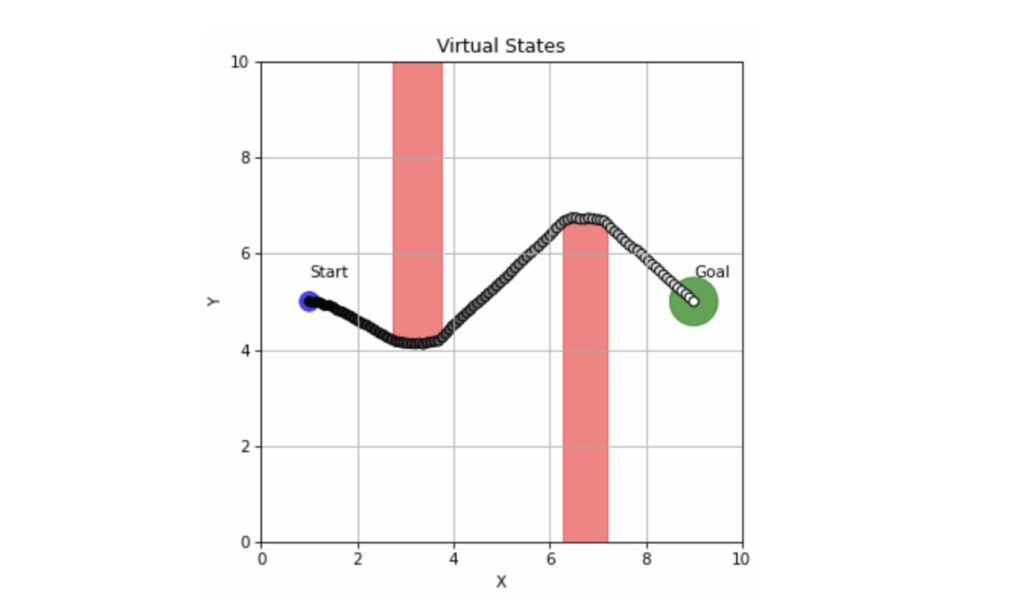
A team of researchers, including Mike Rabbat, Aditi Krishnapriyan, Yann LeCun, and Amir Bar, has introduced GRASP, a new gradient-based planning method designed for learned dynamics in world models. This innovative approach addresses the challenges of long-horizon planning, which has proven to be fragile and inefficient with existing models. GRASP enhances planning by lifting trajectories into virtual states, allowing for parallel optimization across time, and incorporating stochastic elements to facilitate exploration.
The development of GRASP comes in response to the limitations of current world models, which, despite their ability to predict complex sequences in high-dimensional spaces, struggle with optimization and can easily fall into local minima. The researchers emphasize that while powerful predictive models exist, effective control and planning remain significant hurdles.
By utilizing a collocation-based approach, GRASP optimizes both actions and states, improving computational efficiency and robustness against adversarial vulnerabilities inherent in state gradients. The method also introduces exploration through Gaussian noise in state updates, enhancing the ability to navigate complex planning landscapes.
Preliminary results indicate that GRASP significantly outperforms traditional methods in success rates and time efficiency for long-horizon planning tasks. The researchers view GRASP as a foundational step towards more advanced world model planners, with future work aimed at integrating the method into reinforcement learning systems and exploring diffusion-based world models. The full details of the study can be found in their published paper.





























Leave a comment