

Industrial automation is entering a new stage. Traditional robots—designed with single functions, fixed sensors, and pre-programmed tasks—lack the real-time analysis and adaptability needed for today’s manufacturing. As factories demand higher precision, multi-scenario adaptability, and cross-device collaboration, China’s DOBOT Robotics, known as the first publicly listed “cobot company,” is positioning itself at the forefront with a bold vision: “Embodied Industry.”
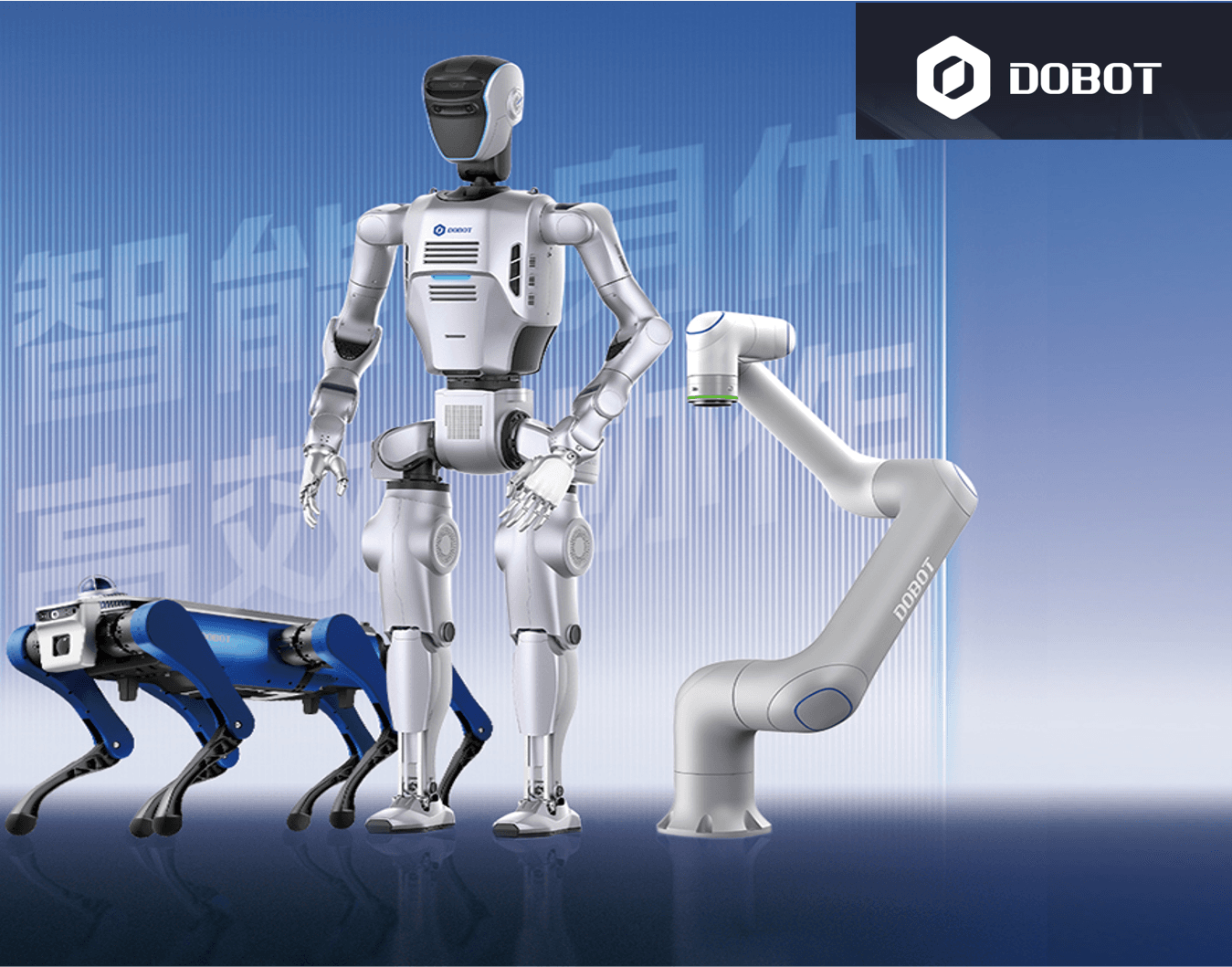
At the 2025 China International Industry Fair (CIIF), DOBOT unveiled the world’s first multi-form embodied intelligence “Super Factory” platform. The showcase featured collaborative robotic arms, bipedal humanoids, quadruped robots, and wheeled humanoids—all coordinated under a central “factory intelligence hub.” Together, they executed tasks such as material handling, visual inspection, logistics, and precision assembly—demonstrating a seamless orchestration of robotic forms rarely seen in industrial environments.
From Cobots to Embodied Intelligence: A Decade of Deep Investment
DOBOT’s launch of the multi-form “Super Factory” was not a one-off stunt but the result of nearly ten years of steady investment. The company’s trajectory—from collaborative robotic arms to multi-form embodied intelligence—has always revolved around a simple formula: in-house core R&D plus real-world deployment.
-
Hardware foundation: DOBOT has invested heavily in servo drives, motors, controllers, and integrated joints—the “muscles” and “cerebellum” of robots. These components now power humanoid dexterity and wheeled robot mobility.
-
AI integration: Advances in vision perception, force control, and imitation learning have transformed its robots from repetitive tools into intelligent agents capable of sensing, deciding, and acting.
-
Productization and engineering: The bridge from lab prototypes to mass-market products is notoriously difficult, but DOBOT has built full-scale production lines, strict quality control, and a mature supply chain. Its humanoid robot components have endured over one million hours of industrial-grade testing while keeping costs competitive.
This three-pronged advantage—hardware, intelligence, and engineering discipline—has allowed DOBOT to leap from a cobot maker to a true embodied intelligence company, building high barriers to entry and opening trillion-yuan opportunities in humanoid and industrial robotics.
Inside the “Super Factory”: Multi-Form Robots in Coordinated Production
The Super Factory is built on a centralized–distributed architecture. The “factory intelligence hub” serves as the central brain, using multimodal sensing (vision, tactile, force feedback) to create a holistic digital twin of the environment. Industrial foundation models enhance planning, and tasks are distributed to different robot forms for execution.
-
Wheeled humanoids: handle cross-zone logistics and precision operations with mobility and dexterity.
-
Bipedal humanoids: perform human-like actions in hazardous or complex tasks, offering fine-grained coordination.
-
Quadruped robots: take on inspections and material handling in unstructured environments.
-
Collaborative robotic arms: deliver high-speed, high-precision force-controlled operations in assembly lines.
Together, the four forms cover the full spectrum of factory operations, from inspection and transport to precision assembly.
The Core Forces: Bipedal and Wheeled Humanoids
Bipedal humanoid robots (DOBOT ATOM)
ATOM has achieved China’s first multi-task, cross-scenario industrial application, mapping human actions to robotic motions with multimodal sensing. It can autonomously open factory doors, conduct anomaly inspections, and complete fault diagnosis-to-recovery loops in warehousing systems.
Using an innovative Action Chunking with Transformers (ACT) prediction model, ATOM executes tasks with low latency and high reliability, consuming far less compute than traditional VLA models. Rigorous industrial-grade reliability tests—high-temperature and heavy-load stress—ensure its suitability for real factories.
Wheeled humanoid robots (ATOM-M)
Debuting at CIIF, ATOM-M combines industrial-grade dexterity with high-speed wheeled mobility. With ±10mm positioning accuracy, dual-arm precision operations, and six-axis force sensing, ATOM-M can solder electronics, calibrate instruments, or even handle cherries without damage. Its high-performance chassis allows stable navigation through 500mm narrow passages in dynamic industrial settings.
With a one-stop embodied data toolchain and VR data collection suite, ATOM-M lowers barriers for customers to train and deploy models. Its design showcases DOBOT’s focus on practical deployment over lab demos.
From China’s Factory Floors to the Global Stage
DOBOT stands out as the only embodied intelligence firm that grew directly from industrial frontlines. Over the past decade, it has deployed more than 100,000 robots in over 100 countries, serving industries from automotive and electronics to semiconductors, batteries, logistics, and education. Its client roster includes more than 80 Fortune Global 500 companies.
This breadth of deployments has provided DOBOT with deep “process decoding” know-how—an advantage that strengthens its ability to productize embodied intelligence for diverse industrial scenarios.
Toward a Platform Ecosystem
The Super Factory is designed as a scalable, plug-and-play platform. Enterprises don’t need to overhaul their production lines; instead, they configure the “factory intelligence hub” and deploy multi-form robots that can learn and adapt quickly. This shortens commissioning cycles and lowers adoption barriers.
For the broader ecosystem, the Super Factory provides a testbed for embodied AI innovation—accelerating not only DOBOT’s own robots but also advancing industry-wide research. By bridging robotics, AI, and traditional manufacturing, the platform fosters upstream–downstream collaboration and creates new markets and business models.
DOBOT has also launched a “Collaborative Action” initiative with 300 enterprises and industry experts to accelerate deployment-ready solutions. The initiative emphasizes co-creation and rapid commercialization, positioning embodied robotics as a driver of the next phase of global manufacturing upgrades.
Outlook
For DOBOT, the debut of the multi-form embodied Super Factory may be just the beginning. As humanoid and embodied robotics advance, more players will rush into the field. But with a decade of technical depth, strong industrial roots, and a platform-based approach, DOBOT is well positioned to be a defining force in the industrial embodied intelligence era.








Leave a comment