Industry Briefing
A single destination for timely, editor-curated robotics news from around the world.

Kall Morris Inc Tests REACCH System for Space Debris Removal on ISS
Kall Morris Inc (KMI) has successfully tested its robotic system, the Responsive Engaging Arms for Captive Care and Handling (REACCH), aboard the International Space Station (ISS). This innovative technology aims to capture and remove space debris, addressing a critical challenge in the space industry as the amount of non-functional objects in orbit continues to rise. The significance of this development lies in its potential to enhance satellite servicing and debris removal efforts. Space debris, which travels at speeds up to 10 times faster than a bullet, poses a serious threat to operational satellites and future missions. KMI's REACCH system, described as an orbital 'tow truck,' utilizes tentacle-like robotic arms with gecko-inspired adhesive pads to maneuver larger objects without needing to fully grasp them. Looking ahead, KMI is preparing for further testing beyond the ISS, with aspirations to deploy REACCH for operational missions focused on satellite life-extension and debris removal. As the number of satellites in low Earth orbit increases, the demand for effective debris management technologies is expected to grow significantly.
News Space aerospace autonomous robotics commercial space debris removal
SpaceX's Starmind Faces Feasibility Challenges for 1 Million Satellite Deployment
On January 30, 2026, SpaceX submitted a request to the FCC to launch up to 1 million satellites as part of its Starmind orbital compute constellation. This ambitious plan is unprecedented, as the total number of satellites ever launched globally is in the low tens of thousands. The proposal seeks a waiver from standard deployment milestones, citing reliance on the Starship's full reusability for success. The significance of this request lies in the technical and logistical challenges it presents. Experts warn that low Earth orbit may not support the proposed number of active satellites without risking a debris cascade. SpaceX's own IPO prospectus acknowledges unresolved dependencies related to Starship's launch cadence and reusability, which are critical for the orbital AI compute strategy. Looking ahead, the timeline for achieving the necessary launch cadence and manufacturing capacity remains uncertain. SpaceX's Gigasat facility in Texas aims for volume production by late 2027, but this would require unprecedented output levels. No further timeline was disclosed at the time of publication, leaving the feasibility of the Starmind project in question.

SpaceX's Starmind Plans 1 Million AI Satellites Amid Collision Risks
SpaceX has announced its ambitious Starmind project, which aims to deploy 1 million AI satellites in orbits between 500 and 2,000 km. This initiative, confirmed by Elon Musk on June 23, 2026, follows a merger with xAI, valuing the combined entity at $1.25 trillion. The satellites will function as orbital data centers, processing AI workloads powered by solar arrays and linked by optical lasers. The significance of Starmind lies in its potential to add 100 gigawatts of AI compute capacity annually, contingent on the successful operation of the Starship launch system. However, the project raises concerns regarding space debris, as the current orbital environment is already congested, with a 20% increase in collision risk reported since 2024. The European Space Agency has highlighted that the density of debris in low Earth orbit is now comparable to that of active satellites, complicating the operational landscape for new entrants like Starmind. Looking ahead, the first operational orbital AI deployments are targeted for 2028, with test launches expected in early 2027. However, the project faces scrutiny regarding its impact on space debris, as even a 1% failure rate could significantly increase the number of uncontrollable objects in orbit, exacerbating existing risks. No further timeline was disclosed at the time of publication.
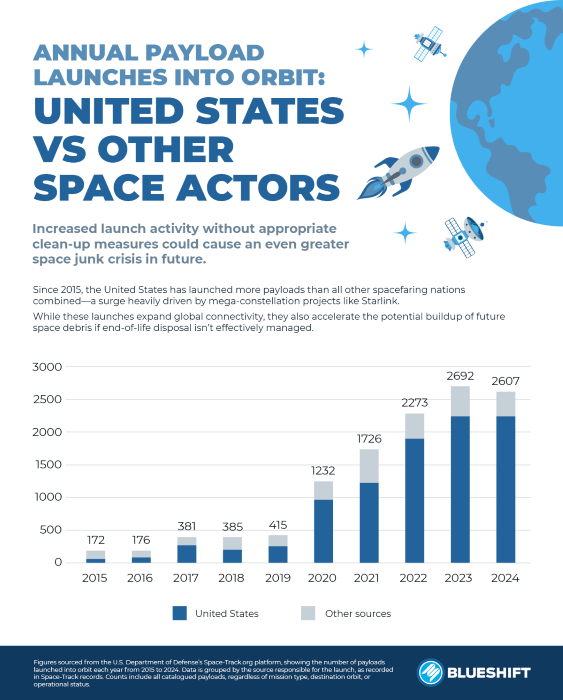
Billionaire Space Race Fuels 5,000% Surge in Launches – Who Clears Up the Debris?
Recent research indicates that the number of objects launched from the United States has skyrocketed by over 5,000% compared to a decade ago. This dramatic increase is primarily attributed to the rise of private spaceflight companies, which have significantly expanded their operations and capabilities in recent years. The findings highlight a transformative shift in the space industry, showcasing how private ventures are reshaping the landscape of space exploration and satellite deployment. This surge in launches reflects a growing trend towards commercialization in space, as private entities take on roles traditionally held by government agencies. The study underscores the evolving dynamics of the space sector and raises questions about the implications for regulation, sustainability, and international cooperation in outer space activities.
Robotics needs a service framework.
RSF defines a common language for robot service capability, lifecycle operations, certification pathways, and service-provider networks.
Join the RobotToday community on LinkedIn
Daily robotics news, in-depth analysis, conference highlights, and discussions with professionals worldwide.