

Industry Briefing
A single destination for timely, editor-curated robotics news from around the world.
Agibot Leads Global Humanoid Robot Shipments in First Half of 2026
Agibot achieved the top position in global humanoid robot shipments during the first half of 2026, delivering approximately 9,700 units. This accounted for over 43 percent of the global market, as reported by Counterpoint Research. The total global shipments of humanoid robots exceeded 22,000 units, marking a nearly 300 percent increase compared to the same period in 2025. This significant growth highlights the increasing demand for humanoid robots, driven by advancements in technology and the progression of pilot projects into broader commercial deployments. Counterpoint Research anticipates that global shipments will surpass 50,000 units by the end of the year, indicating a robust market for humanoid robotics. Agibot's expansion in various sectors, including industrial, commercial, and research applications, positions it as a leader in this emerging market. Looking ahead, the focus will be on how Agibot continues to innovate and expand its humanoid robot portfolio, particularly with its A3 full-size humanoid and G2 industrial robot. As the demand for industrial and service applications grows, Agibot's technology, which integrates locomotion, interaction, and manipulation intelligence, will likely play a crucial role in shaping the future of humanoid robotics. No further timeline was disclosed at the time of publication.
Financials & Investments Humanoids News agibot AGIBOT A3 Agibot G2
Digua Robotics Raises $400 Million in Series C Funding; Surya Chip Shipments Surpass 8 Million Units
On September 17, Digua Robotics announced the completion of $400 million in Series C funding, led by Mirae Asset, with participation from various institutional investors including Meituan and government-backed platforms. This funding round highlights the growing interest in robotics and AI technologies, particularly in consumer-grade robots. The significance of this funding lies in Digua Robotics' impressive growth trajectory, with revenue in the first half of 2026 projected to multiply compared to the previous year. The company has shipped over 8 million units of its Surya series chips, indicating a strong market presence in consumer robots like vacuum and lawn-mowing robots, rather than humanoid robots. This shift underscores the demand for practical applications of robotics in everyday life. Looking ahead, no further timeline was disclosed at the time of publication. However, Digua Robotics is expected to continue iterating on its Surya chip series and expanding its developer ecosystem, which includes over 500 small and medium-sized enterprises and 100,000 developers globally. The involvement of government platforms suggests a strategic focus on industrial deployment in regions like Hefei and Shenzhen, while Meituan's investment may indicate a push towards integrating robotics into its delivery services.
Robotics Chip Technology AI Consumer Robotics
Humanoid Robot Shipments Expected to Reach 26 Million Annually by 2040
A recent report from Berg Insight indicates that the humanoid robotics sector is poised for significant growth. The firm projects that annual shipments of humanoid robots will increase from 16,000 units in 2026 to an impressive 26 million units by 2040, marking a substantial compound annual growth rate. This anticipated surge in shipments highlights the growing demand for humanoid robots across various applications, signaling a shift towards broader adoption in commercial markets. As industries increasingly recognize the potential of humanoid robots, this growth could lead to advancements in technology and new use cases. Looking ahead, stakeholders should monitor developments in the humanoid robotics market, including technological innovations and shifts in consumer demand. No further timeline was disclosed at the time of publication.
Humanoids News 1x technologies agibot agility robotics apptronik
Humanoid Robotics Industry Expected to Achieve 26 Million Annual Shipments by 2040
A recent report from Berg Insight indicates that the humanoid robotics sector is poised for significant long-term commercial growth. This growth is expected to culminate in annual shipments reaching 26 million units globally by 2040. The anticipated increase in shipments highlights the rising demand for humanoid robots across various applications, signaling a shift in market dynamics. As the industry evolves, it is crucial for stakeholders to adapt to these changes and explore new opportunities in humanoid robotics. Looking ahead, industry participants should monitor advancements in technology and shifts in consumer preferences that could influence the trajectory of humanoid robot adoption. No further timeline was disclosed at the time of publication.

China Secures Over 97% Market Share in Global Humanoid Robot Shipments
China has established a commanding lead in the humanoid robot market, with over 97% of global shipments in the first half of 2026, according to Smart Analytics Global (SAG). This marks a significant increase from 5,100 units in the same period last year, totaling approximately 19,100 units shipped globally. The dominance of Chinese manufacturers, particularly Shanghai-based Zhiyuan Robotics and Hangzhou-based Yushu Technology, is evident as they collectively account for nearly 75% of the global market. This early advantage positions China ahead of American competitors like Tesla and Agility Robotics, who are lagging behind in shipment volumes. Looking ahead, SAG forecasts that global humanoid robot shipments will rise to around 60,000 units by 2026 and reach 500,000 units by 2030. However, potential regulatory uncertainties and geopolitical risks could impact future growth. The key question remains whether Chinese robots can penetrate more markets amid increasing global regulatory barriers.
Humanoid Robots Robotics Industry Market Analysis Automation Technology
ZhiYuan Leads in Humanoid Robot Shipments, While Key Supplier Gains Market Attention
In mid-August, Guotai Junan issued a report covering the Hong Kong-listed robotics company, Lashi (03752.HK), giving it a 'buy' rating with a target price of HKD 87.4. The valuation logic is notable as it is based not on the number of traditional industrial arms sold, but on the number of upper limb actuation systems produced for ZhiYuan's humanoid robots. ZhiYuan surpassed YuShu in global humanoid robot shipments in the first half of this year, marking a significant achievement. Lashi, as a core supplier of ZhiYuan's robotic arms, is positioned to benefit from this growth. The report highlights that Lashi's revenue from the intelligent segment is expected to exceed 50% by 2027, indicating a shift from being an industrial robot manufacturer to a general-purpose operational platform. Looking ahead, the market is expected to focus on the integration of 'small brains' and limbs as the true bottleneck for mass production and cost efficiency. The report suggests that the components such as joints and robotic arms account for over 60% of the hardware costs in humanoid robots. As the competition among manufacturers intensifies, suppliers like Lashi are poised to secure orders and improve their profit margins, reflecting a structural shift in the industry.
Humanoid Robots Robotic Arms Supply Chain Dynamics Industrial Robotics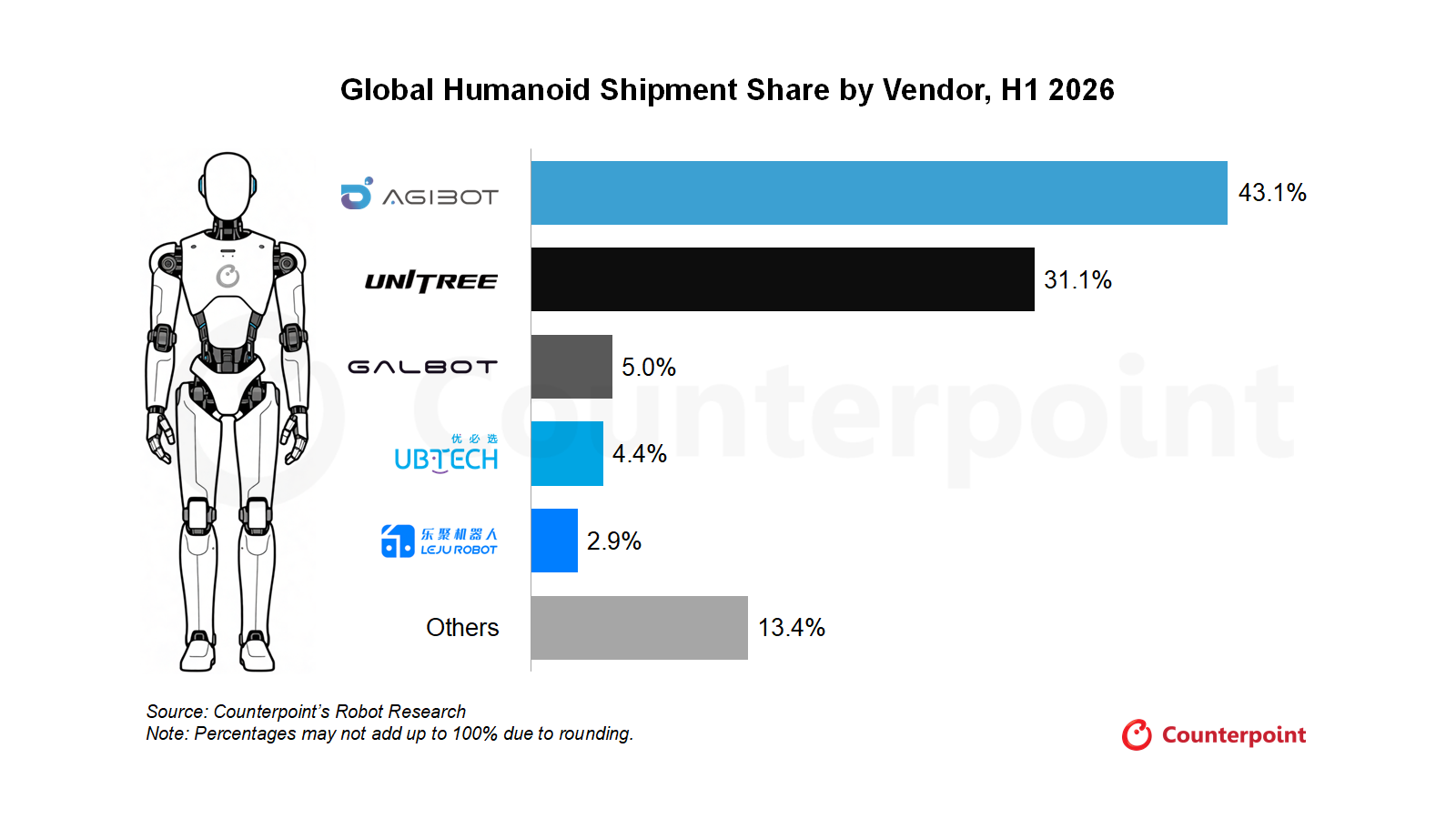
AGIBOT Leads Global Humanoid Robot Shipments in H1 2026 with 9,700 Units Delivered
AGIBOT has secured the leading position in global humanoid robot shipments for the first half of 2026, delivering around 9,700 units and achieving over 43% market share, according to Counterpoint Research. This remarkable growth reflects a nearly 300% increase in the humanoid robot market year-on-year, highlighting the rising demand and deployment of these robots beyond initial pilot projects. Looking ahead, the market is projected to exceed 50,000 units by the end of 2026, indicating a significant expansion in the adoption of humanoid robots across various sectors. No further timeline was disclosed at the time of publication.
Humanoid Robots Robotics Industry AI Technology Manufacturing Commercial Applications
AgiBot and Unitree Dominate Global Humanoid Robot Shipments in H1 2026
According to Smart Analytics Global, global humanoid robot shipments reached 1.91 million units in the first half of 2026, marking a significant increase of 274 percent compared to the previous year. Chinese manufacturers accounted for an impressive 97 percent of these shipments, with AgiBot leading at 44 percent and Unitree following closely with 30.9 percent. This surge in shipments highlights the growing dominance of Chinese companies in the humanoid robot market, reflecting advancements in technology and production capabilities. The substantial market share captured by AgiBot and Unitree indicates a strong competitive landscape, particularly as the US imposed restrictions on Chinese robots in late July. Looking ahead, the impact of US restrictions on Chinese robot exports may influence future shipment trends and market dynamics. No further timeline was disclosed at the time of publication.

Chinese Manufacturers Dominated Global Humanoid Robot Shipments with 97% Share in H1 2026
In the first half of 2026, Chinese manufacturers were responsible for over 97% of global humanoid robot shipments, totaling approximately 19,100 units. This marks a significant increase from about 5,100 units shipped during the same period in the previous year. Notably, AgiBot contributed around 8,400 units, representing 44% of the global total, while Unitree shipped approximately 5,900 units. The surge in shipments indicates a growing demand for humanoid robots, particularly in industrial and commercial sectors, which accounted for more than 70% of total shipments, compared to around 50% a year earlier. This trend highlights the increasing integration of humanoid robots into various applications, reflecting advancements in technology and market acceptance. Looking ahead, the market is projected to reach 60,000 shipments by the end of 2026 and is expected to grow significantly, with forecasts estimating 500,000 shipments by 2030. No further timeline was disclosed at the time of publication.
News Feed
Domestic Brands Capture 55% of China's Industrial Robot Shipments Led by Estun
Domestic brands in China have now secured approximately 55% of the industrial robot shipments, indicating a significant shift towards local capabilities. Estun has emerged as the leader in volume, while Inovance has made notable advancements in SCARA robots and servo systems. However, the high-end automotive and semiconductor process software sectors continue to pose challenges for these domestic brands. This shift is crucial as it reflects China's growing emphasis on self-reliance in technology and manufacturing. The dominance of local brands like Estun and Inovance highlights the potential for innovation and competitiveness within the domestic market. Despite these advancements, the difficulty in replacing high-end software solutions indicates that there is still a reliance on foreign technology in certain critical areas. Looking ahead, it will be important to monitor how domestic brands continue to evolve and address the challenges posed by high-end software in the automotive and semiconductor industries. No further timeline was disclosed at the time of publication.

Diguo Robotics Raises $400 Million in Series C Funding to Enhance Intelligent Robotics Infrastructure
On September 17, 2026, Diguo Robotics announced the completion of $400 million in Series C funding. This round was led by Future Asset, with participation from major investors including Meituan, Hefei Guotou, and several prominent venture capital firms. The funding aims to strengthen the product layout of Xuri chips and develop a comprehensive software platform that integrates data collection, model training, simulation verification, and inference deployment. The significance of this funding is underscored by Diguo Robotics' impressive revenue growth in the first half of 2026, which saw multiple increases compared to the previous year. The cumulative shipment of Xuri series chips surpassed 8 million units, marking a transition to mass production for their embodied intelligence business. The Xuri S600 chip has gained traction with over 20 leading clients, achieving over 50% customer coverage in the embodied intelligence sector. Looking ahead, Diguo Robotics is poised to play a crucial role in the advancement of embodied intelligence across various applications. Their upgraded DGP Gravity Plan aims to incubate innovative robotics products and support startups throughout the product development lifecycle. No further timeline was disclosed at the time of publication.
Robotics AI Chip Technology Embodied Intelligence
Hesai Group Reports Significant Growth in Robotics Lidar Shipments and Revenue
On August 18, Hesai Group (NASDAQ:HSAI) announced its second quarter earnings, revealing a 22% year-over-year increase in total net revenues to RMB 861 million. Notably, robotics lidar shipments surged by 193.4% to 142,371 units, marking a pivotal moment in the company's transition into robotics. The company also recorded its first commercial revenue from its actuation and spatial intelligence businesses. This growth is significant as it indicates Hesai's commitment to expanding beyond its core automotive lidar market, where it holds a 44% share of China's long-range ADAS lidar segment. The company has secured new design wins with major automotive players, including Volkswagen and Great Wall Motor, which enhances its competitive position. Despite the positive revenue growth, Hesai's gross margin decreased to 40.1%, attributed to a higher contribution from lower-margin products. Looking ahead, Hesai has raised its full-year guidance for its Strategic Growth Initiatives segment to between RMB 200 million and RMB 300 million, with a target of $100 million in revenue by 2027. However, the company faces challenges, including an operating loss in its SGI segment and potential risks from a price war in the lidar industry. No further timeline was disclosed at the time of publication.

Surge in Humanoid Robot Shipments in 2026, Yet Work Penetration Remains Low
In 2026, shipments of humanoid robots are experiencing significant growth, according to industry executives. However, despite this surge, the majority of these robots are primarily utilized in entertainment and research and development sectors, with actual deployment in 'work' environments remaining below 20%. This indicates a gap between production capabilities and practical applications in the workforce. The low penetration of humanoid robots in real work scenarios highlights the challenges faced by the industry in transitioning from manufacturing to effective deployment. While the increase in shipments suggests a growing interest and investment in humanoid robotics, the limited use in operational settings raises questions about the technology's readiness and acceptance in various industries. Looking ahead, it will be crucial to monitor how companies address the barriers to integrating humanoid robots into everyday work environments. The industry must focus on enhancing the functionality and reliability of these robots to increase their adoption beyond entertainment and R&D applications. No further timeline was disclosed at the time of publication.
HumanoidRobotics
China's Humanoid Robot Manufacturers Dominate Global Shipments with 97% Control
China's humanoid robot manufacturers have achieved a remarkable milestone by controlling 97% of global shipments, positioning the country ahead of its US competitors. This dominance was highlighted at the World Robot Conference in Beijing, where various humanoid robots showcased their capabilities in sorting boxes, handling laundry, and bagging clothes. This significant lead in the humanoid robotics sector underscores China's commitment to advancing technology and innovation. The ability of these robots to perform everyday tasks raises questions about their potential integration into daily life and their role in transforming industries. The advancements made by Chinese manufacturers could reshape the competitive landscape in robotics and automation. Looking ahead, the key focus will be on whether these humanoid robots can transition from novelty items to practical tools for everyday use. The ongoing developments in this sector will be crucial to watch, as they may influence future trends in robotics and automation. No further timeline was disclosed at the time of publication.

China's Humanoid Robot Manufacturers Dominate 97% of Global Shipments
China's humanoid robot manufacturers have achieved a remarkable milestone by controlling 97% of global shipments, positioning Beijing ahead of U.S. competitors in the technology race. This dominance was highlighted at the World Robot Conference, where various robots demonstrated their capabilities in sorting boxes, handling laundry, and bagging clothes. The significance of this development lies in the potential for these humanoid robots to become integral tools in everyday life. As the technology advances, the challenge will be to determine whether these robots can transition from demonstrations to practical applications that enhance daily tasks for consumers and businesses alike. Looking ahead, the focus will be on the ongoing evolution of humanoid robots and their integration into various sectors. No further timeline was disclosed at the time of publication.

Global Humanoid Robot Shipments Surge Nearly 300% in H1 2026 Amidst Industry Evolution
During the 2026 World Robot Conference, attendees witnessed robots performing tasks such as grasping cups and folding clothes. However, significant advancements in robotics are occurring beneath the surface. Global shipments of humanoid robots reached over 22,000 units in the first half of 2026, marking an increase of nearly 300%. Despite this growth, only about 20% of these robots are being utilized in smart manufacturing and warehousing sectors, highlighting a competitive race among companies to enhance generalization and copying capabilities. This surge in humanoid robot shipments indicates a growing interest and investment in robotics technology, particularly in applications that extend beyond traditional roles. The limited adoption in smart manufacturing and warehousing suggests that while the market is expanding, the integration of these robots into more complex environments remains a challenge. Companies are focusing on developing robots that can generalize tasks and replicate human abilities, which is crucial for broader acceptance in industrial applications. Looking ahead, it will be important to monitor how companies address the challenges of integrating humanoid robots into smart manufacturing and warehousing. The ongoing evolution of robotics technology, particularly in terms of generalization and adaptability, will be key to unlocking new opportunities in various sectors. No further timeline was disclosed at the time of publication.
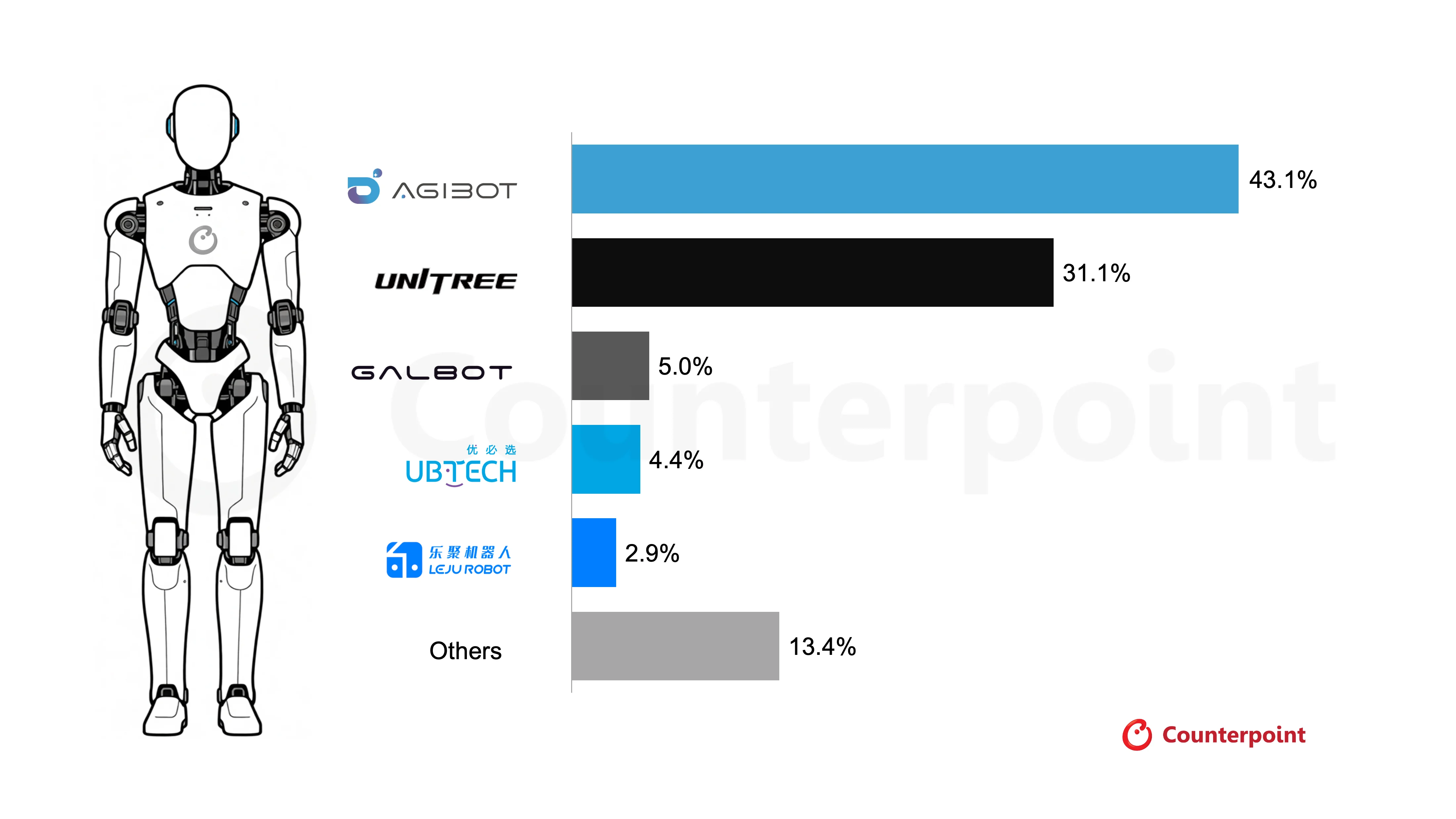
Humanoid Robot Shipments Exceed 22,000 in H1 2026, AGIBOT Leads Market
Global humanoid robot shipments surpassed 22,000 units in the first half of 2026, marking a nearly 300% increase from the previous year, according to Counterpoint Research. AGIBOT led the market with 9,700 units, capturing a 43.1% share, while Unitree Robotics followed with over 7,000 units, representing 31.1% of the market. This surge in shipments highlights a rapidly evolving market landscape, with the top five manufacturers accounting for approximately 86% of total deliveries. AGIBOT's diverse product strategy, including its A-series, X-series, and G-series, has contributed to its leading position. However, the industry faces ongoing debates regarding the definition of humanoid robots, particularly concerning the inclusion of hybrid and wheeled systems. Looking ahead, the competition among manufacturers is intensifying, with Unitree focusing on bipedal humanoids and planning to expand its production capabilities. Other players like Galbot and UBTECH are also diversifying their offerings to enhance their market presence. No further timeline was disclosed at the time of publication.
Unitree Robotics Leju Robot Galbot Business China AGIBOT
Agibot Leads Global Humanoid Robot Shipments with 8,400 Units in H1 2026
According to a recent report by Smart Analytics Global (SAG), global shipments of humanoid robots reached 19,100 units in the first half of 2026, marking a 272% year-on-year increase. Chinese manufacturers accounted for over 97% of the global market share, with the domestic market absorbing more than 85% of the demand. Agibot, based in Shanghai, shipped 8,400 units in the first half of the year, a significant 562% increase, elevating its global market share from 25% to 44%, surpassing Yushu Technology. Yushu Technology shipped 5,900 units, a 170% increase, securing a 31% market share and falling to second place. Together, these two companies represent 75% of global shipments. The report highlights that industrial and commercial applications have become the core deployment scenarios, accounting for over 70% of shipments, up from 50% the previous year. SAG forecasts that global shipments will approach 60,000 units in 2026, generating approximately $1.6 billion in revenue, with expectations of reaching 500,000 units by 2030. No further timeline was disclosed at the time of publication.
Humanoid Robots Market Analysis Robotics Industry AI Technology
Surge in Humanoid Robot Shipments Creates New Job for Orthopedic Technicians in China
A recent increase in humanoid robot shipments in China has led to the emergence of a new job role focused on repairing and training these robots. Trainees, such as Zhao Xin in Ordos, are now earning approximately six thousand yuan per month by disassembling knee joints and diagnosing App error codes, with the Unitree Go2 being the most frequently serviced model. This development is significant as it highlights the growing demand for skilled technicians in the robotics sector, particularly in the realm of humanoid robots. The rise in shipments indicates a robust market for these technologies, which could lead to further job creation and training opportunities in related fields. Looking ahead, it will be important to monitor how this trend evolves and whether it leads to the establishment of formal training programs or certifications for technicians. No further timeline was disclosed at the time of publication.

Chinese Humanoid Robot Manufacturers Dominate Global Shipments with 97% Market Share
In the first half of 2026, Chinese humanoid robot manufacturers achieved over 97% of global shipments, highlighting their significant lead in the market. This data underscores China's early dominance in the humanoid robotics sector compared to competitors in the United States. The substantial market share indicates a robust growth trajectory for China's robotics industry, showcasing advancements in technology and production capabilities. The report emphasizes the competitive landscape, where US firms are striving to catch up with their Chinese counterparts in this rapidly evolving field. Looking ahead, industry stakeholders will be keen to monitor how US manufacturers respond to this challenge and whether they can innovate to reclaim market share. No further timeline was disclosed at the time of publication.

From Collaborative Leader to Embodied Intelligence Pioneer: Yuejiang's 25-Year Journey to Become the Global Leader in Collaborative Robot Shipments!
In 2025, Yuejiang Technology achieved a remarkable 31.7% increase in revenue, solidifying its position as the leading global supplier of collaborative robots. The company successfully shipped over 100,000 units, reflecting its commitment to innovation in the field of embodied intelligence. By drawing on its extensive manufacturing expertise, Yuejiang Technology aims to address the practical needs of various industries, driving advancements in automation and robotics. This growth underscores the company's strategic focus on developing solutions that enhance productivity and efficiency in real-world applications.
Collaborative Robots Embodied Intelligence Industrial Automation Robotics Technology
China’s AgiBot leads global humanoid robot shipments in 2025, Omdia says
AgiBot, a Chinese manufacturer of humanoid robots, has emerged as the global leader in shipment volume for 2025, delivering 5,168 units and capturing 39% of the worldwide market share. This information comes from a recent report by market research firm Omdia, which highlighted the rapid growth phase of the global humanoid robot market. The report, titled General-Purpose Embodied Robotics Market Radar, indicates a significant surge in demand and production within this sector, reflecting advancements in technology and increasing applications for humanoid robots across various industries.
News Feed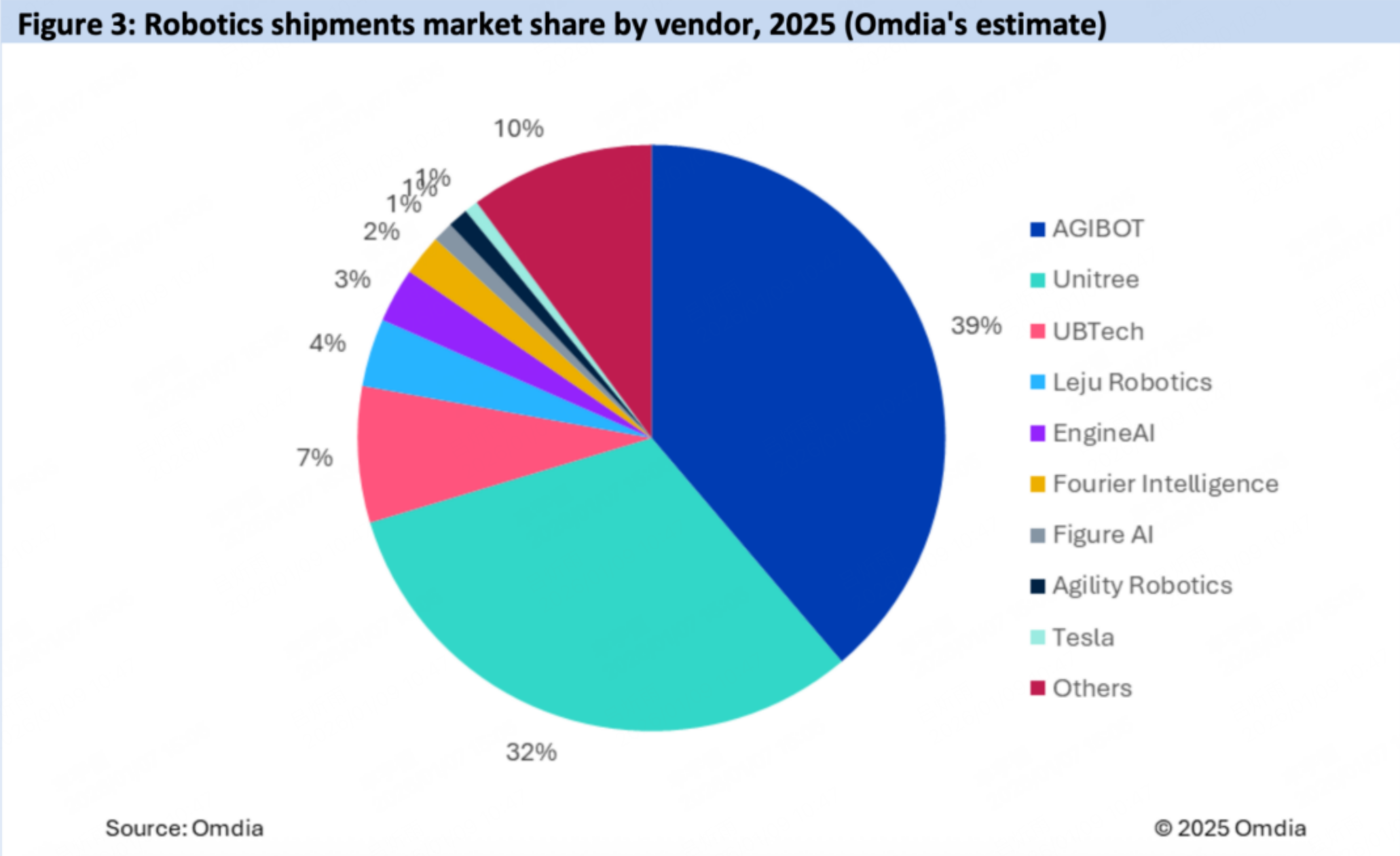
Omdia Ranks AGIBOT No.1 Worldwide in Humanoid Robot Shipments in 2025
AGIBOT has achieved the top position globally in humanoid robot shipments and market share for 2025, according to a recent report by Omdia. The company shipped over 5,100 units, securing a significant 39% share of the worldwide market. This ranking underscores the rapid expansion of the humanoid robot sector and highlights AGIBOT's advanced capabilities across diverse application scenarios. The company's leadership is further emphasized by its competitive standing alongside other prominent developers in the industry.
Humanoid Robots Robotics Industry AI Integration Market Analysis Technology Trends
Global robotic vacuum shipments reach 5.1 million in Q1, top four Chinese brands hold 54.1% market share
Global shipments of smart robotic vacuum cleaners reached 5.096 million units in the first quarter of 2023, according to data from market research firm IDC. This figure represents an 11.9% increase compared to the same period last year, continuing a trend of robust growth with shipment rates exceeding 20% for two consecutive quarters. The surge in demand for these devices reflects a growing consumer preference for automated cleaning solutions, driven by advancements in technology and increased awareness of home automation benefits. Leading brands in the market, including Roborock, Ecovacs, Dreame, and Xiaomi, have contributed significantly to this growth, showcasing their competitive edge in innovation and market reach.
News FeedRobotics needs a service framework.
RSF defines a common language for robot service capability, lifecycle operations, certification pathways, and service-provider networks.
Join the RobotToday community on LinkedIn
Daily robotics news, in-depth analysis, conference highlights, and discussions with professionals worldwide.






