Industry Briefing
A single destination for timely, editor-curated robotics news from around the world.
Appetronix Acquires Cibotica to Expand Food Robotics & AI Ecosystem
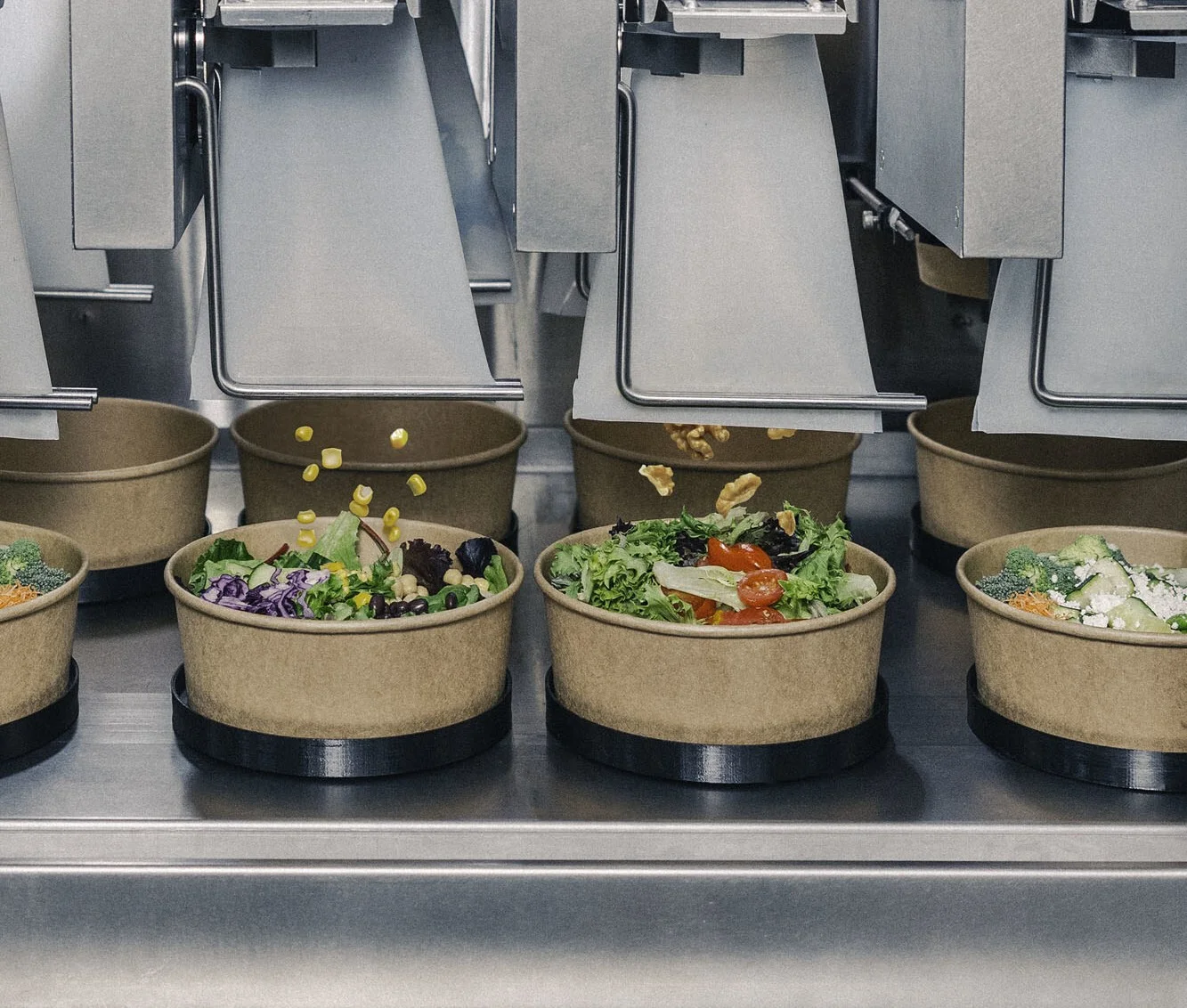
Appetronix, a leading robotics company specializing in foodservice automation, has announced its acquisition of Cibotica, known for its innovative ingredient dispensing and portioning technology. The transaction, the financial details of which remain undisclosed, will enhance Appetronix's offerings by integrating Cibotica's advanced automated bowl and salad assembly system. This strategic move aims to further Appetronix's mission of revolutionizing the foodservice industry through intelligent automation solutions.
AI Capital Markets Robotics acquisition Appetronix Cibotica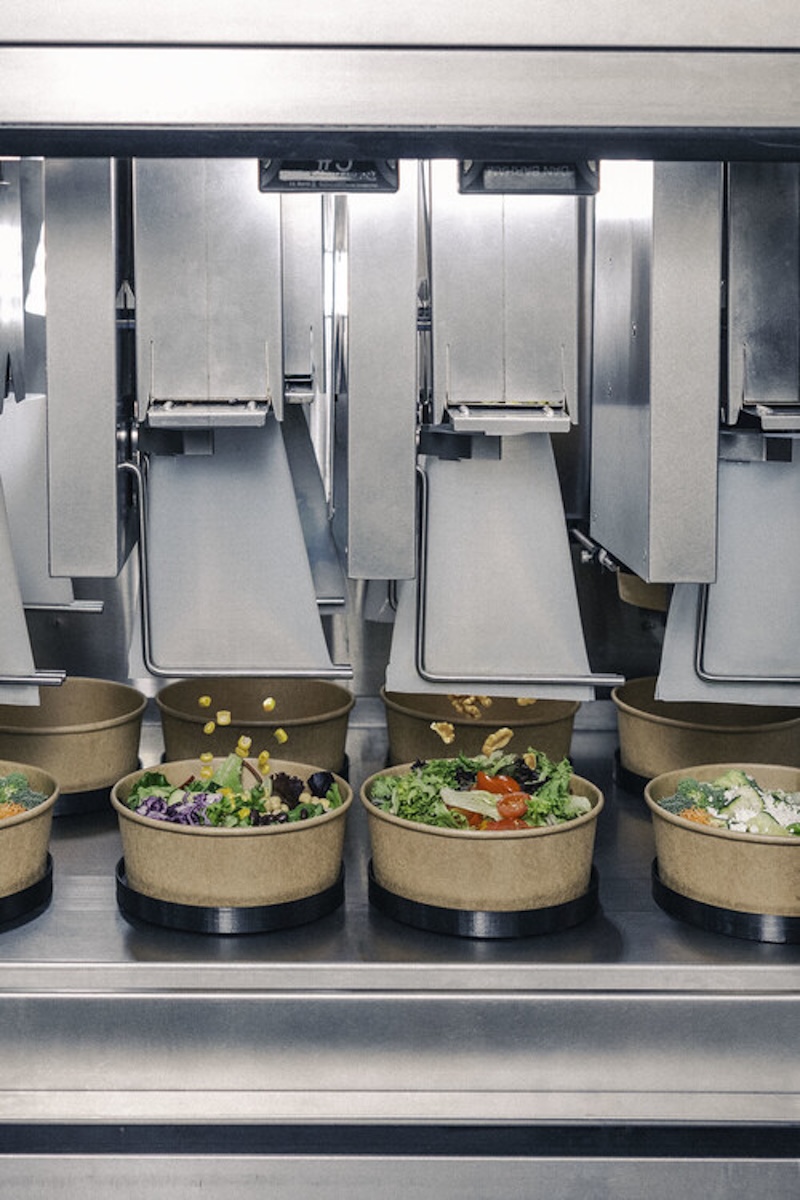
Appetronix acquires Cibotica to expand robotic foodservice automation beyond pizza
Appetronix, a developer specializing in robotic kitchen systems, has acquired Cibotica, a company focused on food robotics, to enhance its automation platform by incorporating a wider range of food categories beyond pizza. The financial details of the acquisition remain undisclosed. This strategic move allows Appetronix to integrate Cibotica’s advanced automated ingredient dispensing and portioning technology into its existing offerings, including the Remy robotic system. The acquisition is part of Appetronix's ongoing efforts to innovate and expand its capabilities in the food service industry.
Engineering AI in foodservice appetronix automation news autonomous kitchens Cibotica
Chef Robotics Expands into Component Assembly for CPG Manufacturing
Chef Robotics has announced an expansion into component assembly for consumer packaged goods (CPG) manufacturing, enabling automation of secondary packaging and kitting processes. This development, revealed on May 11, 2026, allows Chef robots to efficiently handle a variety of items, including sauce sachets, seasoning packets, and even non-food inserts like cutlery kits and instruction cards. Historically, CPG assembly lines have relied heavily on manual labor due to the challenges posed by lightweight and deformable items. Chef Robotics aims to address this issue by utilizing AI-powered computer vision, which enables robots to assess and manipulate items in real time, ensuring precise placement without damage. The technology adapts to the variability of items in unstructured bins, eliminating the need for pre-sorting. The new assembly application features three key capabilities: detecting and reorienting items mid-pick for accurate placement, picking and placing multiple components simultaneously, and ensuring correct item allocation in multi-compartment products. This innovation promises higher throughput, reduced labor dependency, and consistent item placement across production shifts. Chef's CPG assembly application is available in the US, Canada, the UK, and Germany, and operates on existing robotic hardware and software, allowing for seamless integration into current manufacturing setups. The service is offered under Chef's robotics-as-a-service (RaaS) pricing model, further solidifying the company's position as a leader in AI-driven food robotics solutions.

Physical AI Company Chef Robotics Completes 100 Million Servings in Production
A leading company in food robotics has announced that it now possesses the largest dataset of in-production deformable material training data among all physical AI firms. This significant achievement comes as the company continues to advance its technology, enhancing the capabilities of its robotic systems. The data, which has been compiled and refined up to October 2023, is expected to improve the efficiency and effectiveness of food preparation processes. By leveraging this extensive dataset, the company aims to set new standards in the industry, driving innovation and potentially transforming how food is produced and handled.

Serve Robotics expands beyond food delivery with autonomous laundry service
Serve Robotics has entered into a partnership with NoScrubs, an emerging on-demand laundry service, to expand its delivery offerings beyond prepared food. This collaboration, which marks Serve's inaugural venture into urban delivery for laundry, will kick off this week in select neighborhoods across Los Angeles. Utilizing Serve's fleet of autonomous sidewalk robots, the pilot program aims to deliver laundry orders directly to customers' doorsteps, enhancing convenience and efficiency in urban logistics.
Logistics News ai robotics automation news autonomous commerce autonomous delivery
Chef Robotics Advances Bi-Manual Physical AI System for Prep Table Food Assembly Powered by a Food Foundation Model
Chef Robotics has announced the development of a bi-manual physical AI system aimed at enhancing food assembly tasks on prep tables, such as burger and burrito preparation. This innovative system, which is set to launch on May 19, 2026, will cater to various sectors including ghost kitchens, fast-casual restaurants, and catering services, focusing on lower-volume yet more complex meal assembly compared to traditional food manufacturing processes. The new AI system utilizes two robotic arms for coordinated and dexterous manipulation, mimicking human-like capabilities to handle a variety of food items and utensils. It is powered by Chef's Food Foundation Model (FFM), which employs imitation learning to adapt quickly to diverse tasks and environments, overcoming the limitations of existing robotic systems that struggle with the variability of food materials. Chef Robotics aims to automate manual prep table assembly, a critical area in the food industry that has remained largely reliant on human labor. By leveraging the FFM, the system is designed to learn from demonstrations, allowing it to generalize across different tasks and robotic platforms. This advancement is expected to improve operational efficiency, yield, and consistency in food preparation, ultimately transforming how food assembly is approached in various culinary settings.
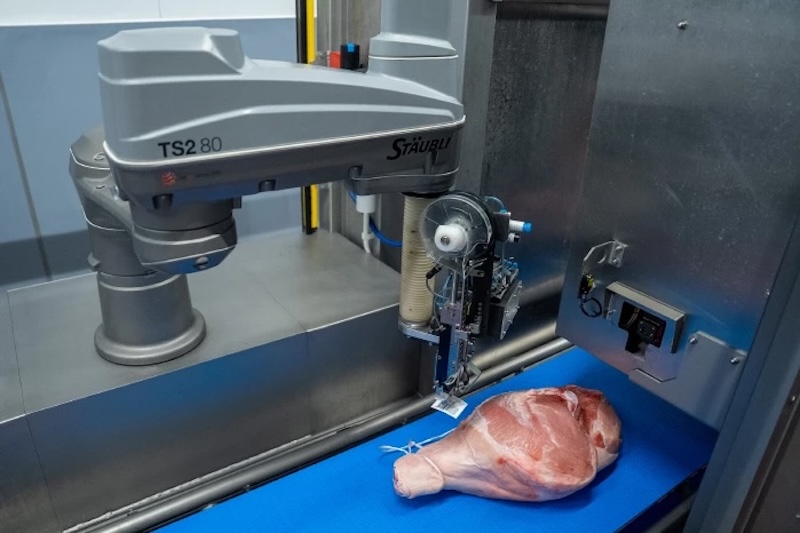
AI-powered robot automates Serrano ham labeling for the first time
A Spanish systems integrator has introduced an innovative AI-based robotic system that revolutionizes the labeling process for Serrano hams, a crucial step in their aging and drying. Previously, this task required significant human labor due to the challenges posed by the presence of bones in the hams, which robots could not detect. The new technology, unveiled recently, enhances efficiency and accuracy in the labeling process, streamlining production in the ham industry. This advancement not only reduces the reliance on manual labor but also ensures that the hams are properly categorized for optimal aging, ultimately benefiting producers and consumers alike.
Manufacturing News ai artificial intelligence food automation Food industry
Chef Robotics Successfully Deploys Physical AI in Food Manufacturing
A technology company has developed a system utilizing physical artificial intelligence to automate various tasks. This innovative approach relies on models that have been trained using real-world production data, allowing for enhanced efficiency and accuracy in operations. The initiative aims to streamline processes across different sectors, addressing the growing demand for automation in the workforce. By leveraging data collected up to October 2023, the company is positioned to implement cutting-edge solutions that respond effectively to industry needs. This advancement not only promises to reduce manual labor but also to improve productivity, making it a significant development in the realm of AI-driven automation.
Process / Analytics
Interview with Jun Wu of GMEX Robotics: ‘We provide an integrated terminal + brain closed-loop system’
As artificial intelligence continues to capture public attention, experts emphasize that the future of robotics hinges on more than just advanced software. While numerous companies are focused on creating sophisticated AI systems and foundation models, there is a growing consensus that the true challenge lies in integrating this intelligence with reliable hardware capable of functioning effectively in the physical environment. This perspective highlights the need for a holistic approach to robotics, where both software and hardware advancements are essential for achieving practical and efficient robotic solutions.
Features Robotics AI platforms ai robotics artificial intelligence automation news
Rockwell Automation, Inc. (ROK): One of the Best Robotics Stocks to Buy, Helping Manufacturers Move from Fragmented Automation
Rockwell Automation, Inc. (NYSE: ROK) has emerged as a leading player in the robotics sector, particularly after the launch of its FactoryTalk Orchestration software on June 22, 2026. This innovative solution is designed to streamline material flow and production processes, addressing the needs of manufacturers seeking to enhance automation and robotics capabilities. By standardizing connectivity across various systems, the software aims to facilitate a shift from fragmented automation to more cohesive and autonomous operations. The introduction of FactoryTalk Orchestration is expected to significantly improve manufacturing efficiency, allowing companies to increase throughput, minimize bottlenecks, and adapt swiftly to market changes. Notably, Cranswick Plc, a prominent British gourmet food manufacturer, has already adopted Rockwell's Autonox robotics for automated packaging, further illustrating the practical applications of this technology in creating interconnected production lines. As the world's largest company focused solely on industrial automation and digital transformation, Rockwell Automation continues to innovate by providing hardware, software, and services that enhance the efficiency and sustainability of manufacturing processes. While there are discussions about the investment potential of ROK, some analysts suggest that other AI stocks may offer higher returns in a shorter timeframe.
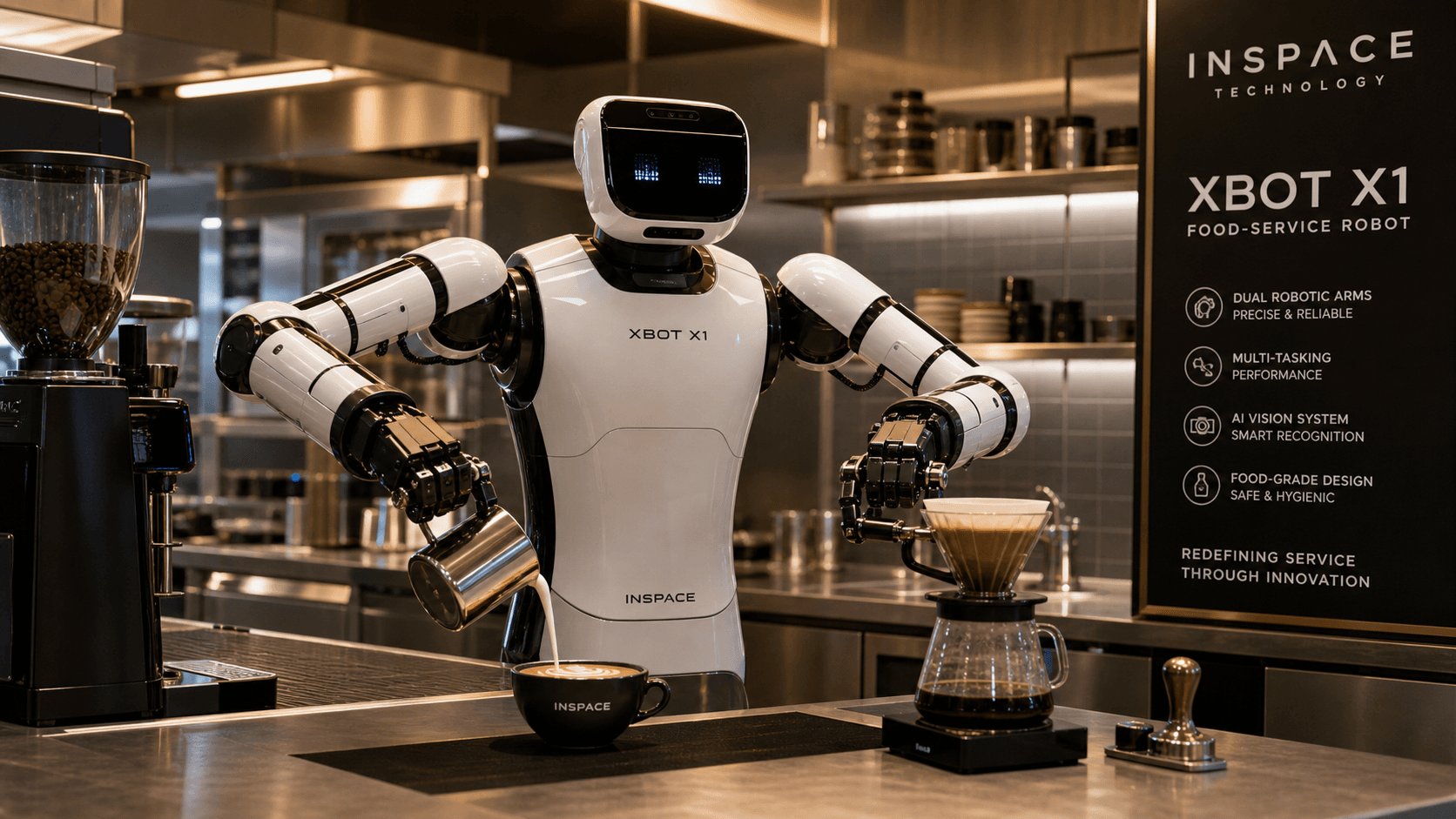
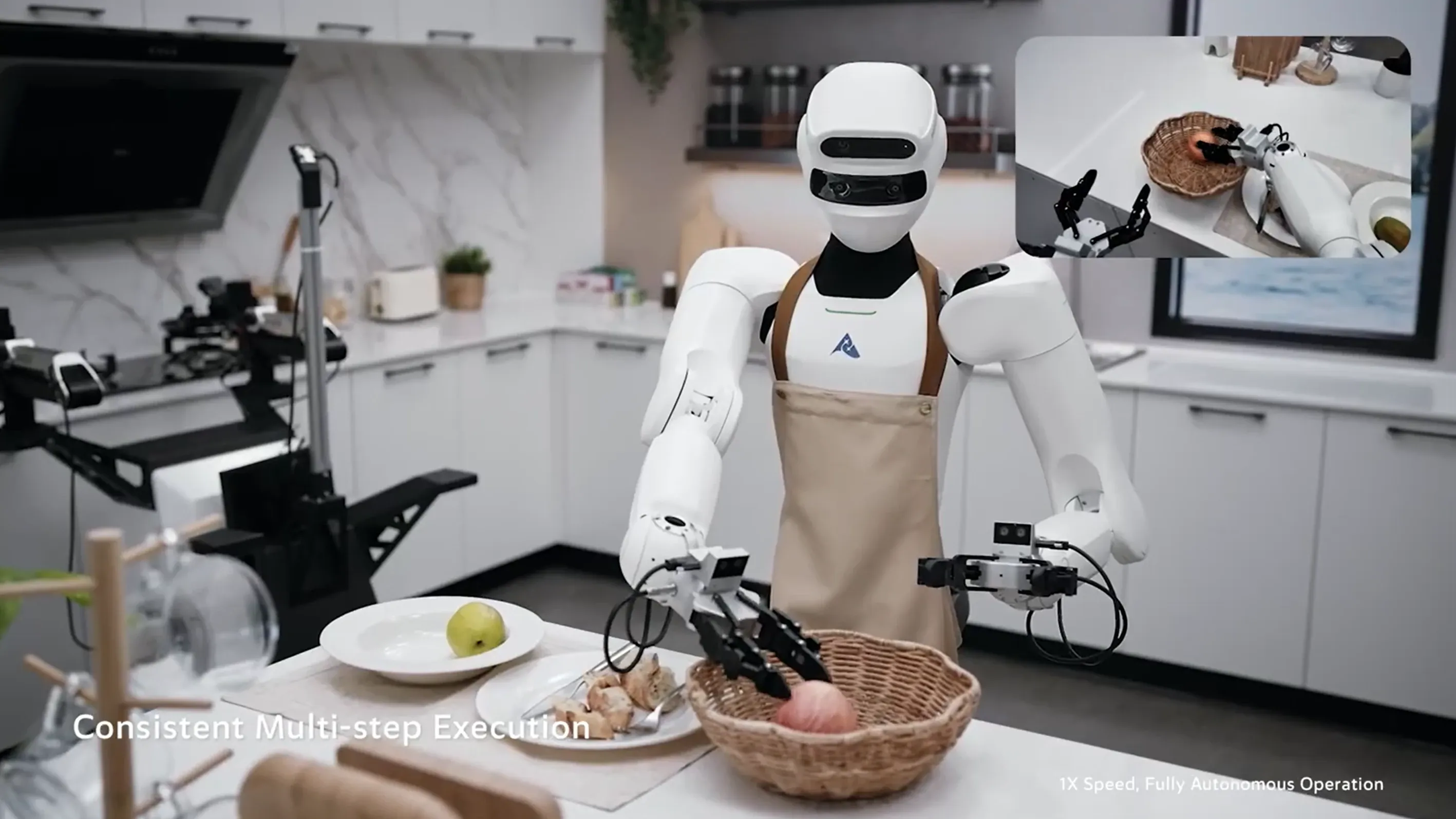
Ex-Xiaomi Executive Tang Mu Launches Food Service Humanoid Robot, Targets Year-End Production
InSpace Technology, a robotics company established by former Xiaomi executive Tang Mu, introduced three innovative food-service robots during a product launch event held on June 30. The unveiling took place in a bid to enhance efficiency in the food service industry, addressing the growing demand for automation in restaurants and catering services. These robots are designed to streamline operations, reduce labor costs, and improve customer service by delivering food and beverages directly to tables. The launch event showcased the robots' advanced features and capabilities, highlighting their potential to revolutionize the way food service is conducted.
Robotics
Serve Robotics (SERV) Expands AI-Powered Robot Delivery Into Laundry Services Through NoScrubs Deal
Serve Robotics Inc. has announced a significant expansion of its AI-powered robot delivery services to include laundry, following a deal with NoScrubs. This partnership, revealed on June 2, 2026, allows Serve Robotics to utilize its fleet of approximately 2,000 autonomous sidewalk robots to pick up and deliver laundry orders in addition to its existing food delivery services. NoScrubs, which operates in seven major metropolitan areas, provides a comprehensive laundry service that includes washing, drying, and folding clothes. The collaboration aims to optimize delivery operations by scheduling laundry pickups and returns during off-peak hours for food deliveries. Orders will be assigned to Serve Robotics based on their availability and storage requirements. This move marks Serve Robotics' entry into a new vertical, with plans to explore further opportunities in grocery, pharmacy, retail, and dry cleaning markets. Despite a 45% decline in its stock value this year, analysts view this as a potential buying opportunity, projecting a 190% increase over the next year. The company continues to focus on expanding its delivery capabilities while serving thousands of restaurants across major cities in the U.S.
US robotics installations rebounded in 2025, on track for more growth: IFR
Global demand for robotics is surging, particularly driven by the automotive and electronics sectors, with significant deployments occurring primarily in China, Japan, and South Korea. Meanwhile, the United States is experiencing an increase in robotics applications, particularly in food production and supply chain services. This trend highlights the growing reliance on automation across various industries, as companies seek to enhance efficiency and productivity in response to evolving market needs.
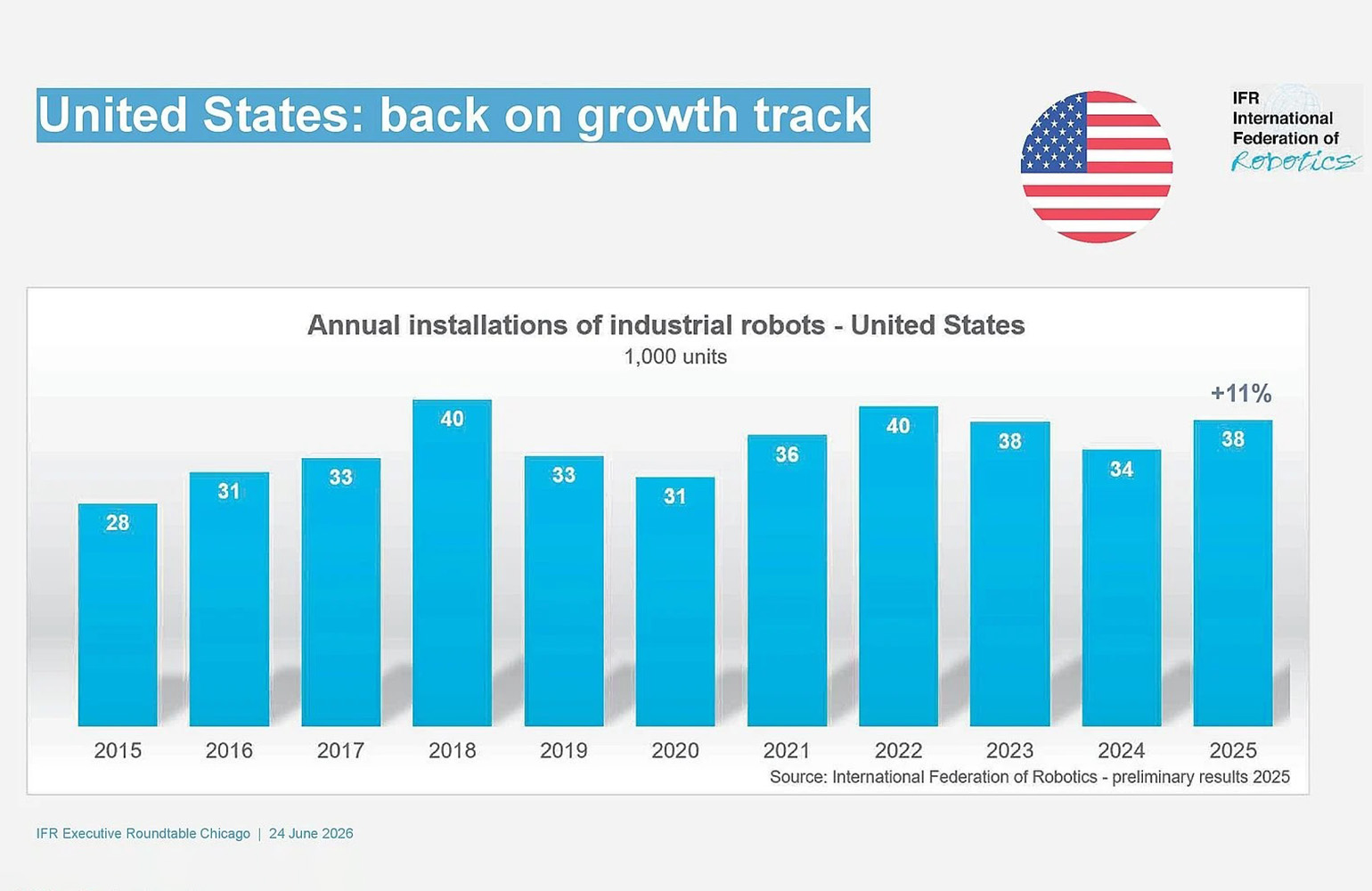
U.S. robotics industry saw double-digit growth in 2025, says IFR
The International Federation of Robotics (IFR) has reported that the U.S. robotics industry experienced significant recovery, marked by double-digit growth in 2025. This resurgence is attributed to strong performance in the food industry and other non-manufacturing sectors, which have played a crucial role in driving demand for robotics solutions. The findings highlight the increasing integration of automation technologies across various industries, underscoring a broader trend towards modernization and efficiency in the U.S. economy.
Automotive China Food / Beverage Industrial Robots Manufacturing Markets / Industries
Serve Robotics (SERV) Reveals Latest Collaboration with NoScrubs
Serve Robotics Inc. has announced a new collaboration with NoScrubs, marking its first commercial urban delivery partnership beyond food services. This initiative, which began on June 2, 2026, will utilize Serve's fleet of automated sidewalk robots to deliver laundry service orders directly to consumers in select neighborhoods of Los Angeles. The collaboration aims to expand Serve's last-mile delivery capabilities into a new sector of local commerce. Despite a recent downgrade from Freedom Broker, which shifted its rating from Buy to Hold due to concerns over increased dilution and execution risks, the company maintains a price target of $18, suggesting a potential upside of over 158%. Freedom Broker noted that while Serve Robotics demonstrated operational growth in its first quarter report, it also faced financial challenges. Serve Robotics specializes in AI-powered, low-emission delivery robots designed to enhance the efficiency and cost-effectiveness of delivery services. The partnership with NoScrubs reflects the company's strategy to diversify its service offerings and tap into the growing demand for automated delivery solutions in urban areas.

Why Richtech Robotics’ (RR) Latest Collaboration Could Change The Conversation
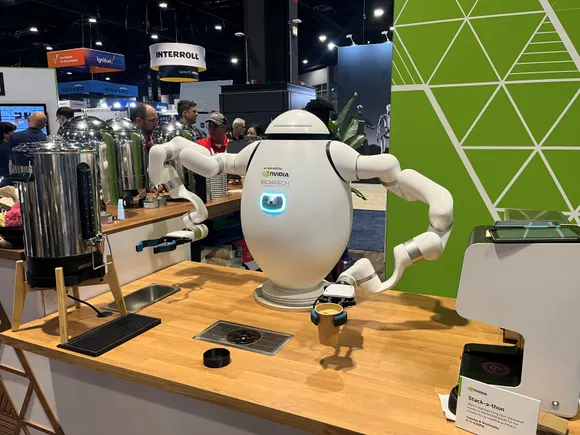
Richtech Robotics Inc. (NASDAQ: RR), currently valued at $3.02 per share, has announced a potential partnership with SoundHound AI (SOUN) as of May 7, 2026. This collaboration aims to integrate SoundHound’s advanced voice AI technology into Richtech’s robotic systems, enhancing human-robot interactions in hospitality and service sectors. The partnership will kick off with a demonstration of Richtech’s Scorpion robot utilizing SoundHound’s voice capabilities in an interactive beverage service setting. Earlier, on April 8, Richtech secured a distribution agreement with NewConsultancy, a Netherlands-based firm, to distribute its robotic solutions across the Netherlands and the European Union. This agreement is expected to bolster Richtech’s international presence and customer support capabilities. Founded in 2016 and headquartered in Las Vegas, Richtech Robotics specializes in developing AI-powered robots designed to automate labor-intensive tasks across various industries. Its product lineup includes robotic food runners, autonomous cleaning systems, and robotic bartenders, all aimed at improving operational efficiency and addressing labor shortages. While Richtech shows promise as an investment, analysts suggest that other AI stocks may present greater potential for growth with less risk.

Pudu Robotics Founder & CEO Felix Zhang at BEYOND Expo 2026: Globalizing Physical Al: Building a Multi-Billion Dollar Robotics Powerhouse from Shenzhen
Pudu Robotics has announced that it now operates 130,000 Pudu robots across more than 80 countries and regions as of October 2023. This significant milestone highlights the company's growth and the increasing global demand for robotic solutions in various sectors, particularly in hospitality and healthcare. The widespread adoption of these robots is driven by their ability to enhance efficiency and service quality, addressing labor shortages and improving operational workflows. Pudu's robots are designed to assist with tasks such as food delivery and sanitation, showcasing their versatility and adaptability in different environments. The expansion into diverse markets demonstrates the company's commitment to innovation and its role in shaping the future of service automation.
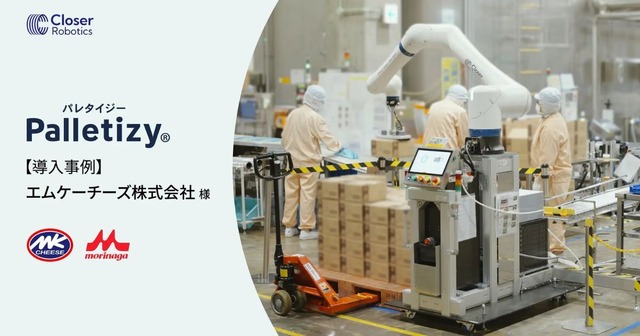
森永乳業グループのチーズ工場にCloser Roboticsの小型パレタイズロボット「Palletizy」導入
Closer Robotics has announced the installation of two units of its compact palletizing robot, "Palletizy," at MK Cheese, a company within the Morinaga Milk Industry Group that specializes in cheese production. This deployment aims to enhance operational efficiency in the cheese manufacturing process. The introduction of these robots is part of a broader trend towards automation in the food industry, driven by the need for increased productivity and reduced labor costs. The integration of Palletizy is expected to streamline the palletizing process, allowing MK Cheese to better meet growing consumer demand while maintaining high standards of quality and safety.

ABB Robotics launches PickMaster Lite to simplify & accelerate robotic picking
ABB Robotics has introduced PickMaster® Lite, a simplified version of its robotic picking software, aimed at packaging OEMs and system integrators. Launched on May 5, 2026, this new software is designed to accelerate the development of high-speed, vision-guided robotic picking solutions. By offering essential features for common picking tasks, PickMaster Lite reduces engineering efforts by 30% and commissioning time by 25%, while ensuring reliable performance. The motivation behind this launch stems from the increasing demand for automation in manufacturing, driven by labor shortages and consumer expectations for personalized products. Craig McDonnell, Business Line Managing Director at ABB Robotics, emphasized the need for quick and reliable automation solutions to enhance production flexibility. PickMaster Lite employs an intuitive, task-based interface with pre-configured templates, eliminating the need for specialized programming skills. It integrates seamlessly with existing machine control architectures, allowing for easy communication with PLC and HMI systems. This capability enables machine builders to manage key functions directly through their preferred control systems, thus minimizing development risks. The software is particularly suited for high-volume, cost-sensitive applications in sectors such as consumer goods, food and beverage, pharmaceuticals, electronics, and e-commerce. As part of the broader PickMaster family, it offers a scalable solution that can evolve alongside production needs, with options for more advanced functionalities through PickMaster and PickMaster Twin. For additional details, interested parties can visit ABB's robotics website.

SoftBank Robotics Debuting Autonomous Cooking Robots ‘STEAMA’ and ‘FLAMA’ in the US
SoftBank Robotics is set to introduce its autonomous cooking robots, the “STEAMA” and “FLAMA” systems, to the U.S. market. This announcement comes as the company aims to expand its food automation business beyond Japan. The robots will make their debut at the National Restaurant Association Show 2026, scheduled to take place in Chicago later this month. The introduction of these innovative cooking systems reflects SoftBank's commitment to enhancing efficiency in the food industry and meeting the growing demand for automation in restaurant operations.
AI AI Use Cases Robotics autonomous cooking robots FLAMA Japan
Exploring the Use and Impact of Composite Materials in Robotics: A Systematic Review
A recent study published in the Journal of Field Robotics highlights the advancements in autonomous robotic systems designed for agricultural applications. Conducted by a team of researchers from various universities, the study was released in early October 2023. The research focuses on the increasing need for efficient farming solutions amid growing global food demands and labor shortages. The team developed a series of robotic prototypes capable of performing tasks such as planting, weeding, and harvesting with minimal human intervention. These innovations aim to enhance productivity and sustainability in agriculture, addressing critical challenges posed by climate change and population growth. By utilizing advanced sensors and artificial intelligence, the robots can navigate complex environments and make real-time decisions, significantly improving operational efficiency. The findings underscore the potential of robotics to transform traditional farming practices and contribute to food security. This research not only showcases the technological capabilities of modern robotics but also emphasizes the importance of integrating such systems into agricultural practices to meet future demands. The implications of this work could lead to widespread adoption of robotic solutions in farming, ultimately benefiting both producers and consumers.
FIELD REPORT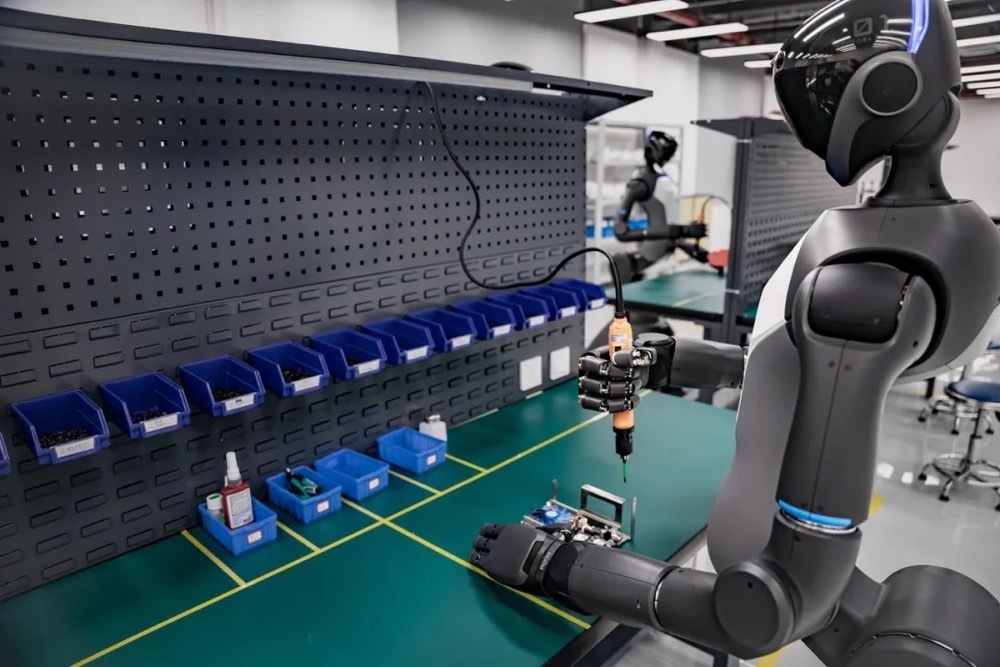
The Shifting Paradigms of Disaster Robotics Three Decades of Research
A recent study published in the Journal of Field Robotics highlights advancements in robotic technology aimed at improving agricultural efficiency. Researchers from a leading university conducted experiments over the past year, focusing on the integration of autonomous robots in crop monitoring and management. The trials took place in various agricultural settings across the Midwest, where the team sought to address the growing challenges of labor shortages and the need for sustainable farming practices. The motivation behind this research stems from the increasing demand for food production and the necessity to optimize resource use in agriculture. By employing cutting-edge robotics, the researchers aimed to demonstrate how these machines can enhance precision in tasks such as planting, watering, and pest control. The study involved deploying multiple robotic prototypes equipped with advanced sensors and AI algorithms to gather data and perform tasks autonomously. Results from the trials indicate that the use of these robots not only improved operational efficiency but also reduced the environmental impact of farming activities. The findings suggest that integrating robotics into agricultural practices could be a viable solution to meet the demands of a growing population while promoting sustainable farming methods. As the agricultural sector continues to evolve, this research paves the way for further innovations in the use of robotics to support food production and resource management.
RESEARCH ARTICLE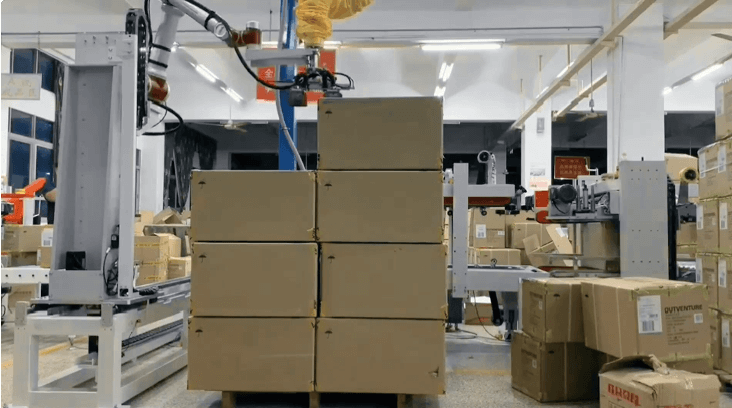
Cobots: Best Practices for Food and Beverage Packaging
JAKA, a leader in robotics and manufacturing, is addressing the challenges of hygiene and flexibility in food and beverage packaging through innovative collaborative robot technology. As the demand for efficient and adaptable production processes grows, JAKA has developed robotic arms designed to withstand rigorous cleaning protocols, featuring an IP54 waterproof and dustproof rating. This design ensures that hygiene standards are met without compromising functionality. The company emphasizes user-friendly operation, allowing packaging line technicians to easily reprogram robots for quick adjustments between multiple product SKUs. JAKA’s intuitive graphical programming interface enables rapid mold changes and adaptations to various package sizes, significantly reducing downtime and making advanced robotics accessible to a wider range of team members. In high-speed production environments, precision is critical. JAKA’s robotic arms are equipped with high-precision hardware and adaptive control algorithms to maintain consistent accuracy throughout long production runs. This capability ensures that every package is handled correctly, preserving product quality and line efficiency. By focusing on hygiene, ease of use, and precision, JAKA aims to integrate collaborative robots seamlessly into packaging processes, enhancing both quality and flexibility on the production floor. The company’s commitment to addressing the unique demands of the food and beverage sector positions it as a key player in advancing robotics and manufacturing solutions.
KPI Solutions™ Announces Partnership With Hai Robotics
KPI Solutions has formed a strategic partnership with Hai Robotics to improve warehouse operations through advanced automation and operational design. This collaboration, announced recently, seeks to optimize storage, retrieval, and fulfillment processes, with a particular focus on enhancing productivity in the food and beverage industry. By implementing these innovations, the partnership aims to reduce reliance on manual labor, ultimately streamlining operations and increasing efficiency in a sector that is increasingly turning to automation to meet growing demands.
Warehouse Automation Supply Chain Consulting Operational Design Logistics Food and Beverage Industry
KPI Solutions™ Announces Partnership With Hai Robotics
KPI Solutions has formed a strategic partnership with Hai Robotics to improve warehouse operations by leveraging advanced automation and operational design. Announced recently, this collaboration is set to optimize storage, retrieval, and fulfillment processes, with a particular focus on the food and beverage industry. The initiative aims to boost productivity while decreasing the dependence on manual labor, addressing the growing demand for efficiency in logistics. By integrating innovative technologies, the partnership seeks to transform traditional warehouse practices and enhance overall operational effectiveness.
Warehouse Automation Supply Chain Consulting Logistics Automation Solutions Operational Efficiency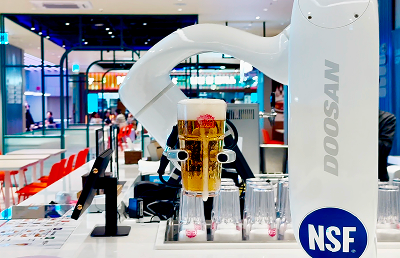
Doosan Robotics diversifies collaborative robot F&B solutions to speed up customer acquisition
Doosan Robotics is advancing its business by developing innovative food and beverage solutions utilizing collaborative robots for tasks such as beer dispensing and cocktail making. On October 23, the company announced the deployment of its collaborative robot beer dispensing solution at the Airbot Bar in Culinary Square, located in Terminal 2 of Incheon International Airport. This initiative follows a memorandum of understanding signed with Incheon International Airport Corporation in May 2022, aimed at fostering digital transformation and creating unique attractions for both domestic and international tourists. The beer dispensing solution employs the E-series robot, certified by the U.S. National Sanitation Foundation for food safety, which efficiently handles the entire process—from dispensing beer to washing cups. It can store up to eight kegs and pour a 14-ounce beer in approximately 43 seconds, ensuring an optimal beer-to-foam ratio. Additionally, on October 15, Doosan Robotics introduced an AI-driven cocktail-making robot at Lotte Duty Free in Gimpo International Airport. This system uses advanced technology to analyze customers' facial expressions and emotions, allowing it to recommend and prepare cocktails tailored to their mood. The robot can create 19 different cocktails based on recipes learned from professional bartenders. Doosan Robotics aims to expand its customer base by diversifying its F&B solutions, which also include a barista solution currently piloted in six Mega MGC Coffee stores and a noodle-making solution for VIPS restaurants. These innovations not only enhance efficiency but also improve safety and reduce the physical strain on workers in the food service industry.

Beijing issues first food operating license to AI robot company EncoSmart
This week, Beijing's Haidian District granted the city's inaugural food operating license to EncoSmart for its embodied AI robots, marking a significant advancement in the integration of AI technology within the food industry. The state media outlet People’s Daily reported that this license represents a pivotal moment for the application of advanced robotics in food service. EncoSmart intends to launch a pilot program utilizing these AI robots, which are designed to enhance efficiency and innovation in food operations. This development highlights the growing trend of incorporating artificial intelligence into various sectors, aiming to improve service delivery and operational capabilities.
News Feed
Robotics firm Eternal and seed breeder Rijk Zwaan partner to optimize tomato varieties for greenhouse automation
Eternal.ag and Rijk Zwaan have announced a collaboration focused on identifying tomato varieties that can enhance robotic crop work in greenhouses. This initiative seeks to leverage the expertise of both companies to gain insights into plant characteristics that would facilitate the automation of greenhouse operations. The partnership aims to pave the way for a future where crop management is fully automated, thereby improving efficiency and productivity in agricultural practices. By combining Rijk Zwaan's extensive global experience in fruit cultivation with eternal.ag's innovative technologies, the two organizations are working together to explore the potential of various tomato strains in supporting advanced robotic systems.
Agriculture News agri robotics agricultural automation agricultural innovation agricultural robotics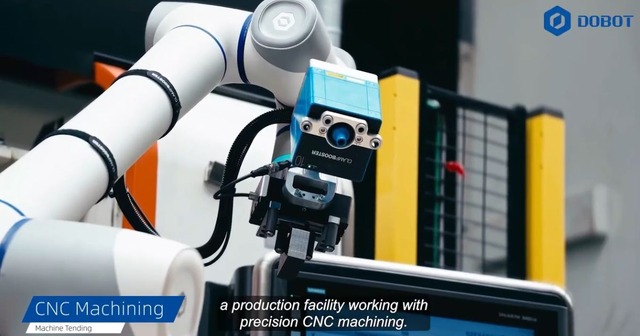
Dobot to showcase collaborative robot use cases in automotive, food, and education at "Automate 2026."
Dobot Robotics has unveiled a promotional video showcasing its products in preparation for the upcoming Automate 2026, one of North America's largest industrial automation trade shows. The video was released on YouTube on June 16, 2026, as part of the company's efforts to highlight its innovations and engage with potential customers ahead of the event. This strategic move aims to enhance visibility and demonstrate the capabilities of Dobot's automation solutions in a competitive market.

US$1b windfall: how Meituan’s bets on AI, robotics outshine quarterly loss
Meituan, the Chinese food-delivery giant, is poised to benefit significantly from its investments in emerging technologies, particularly in the rapidly growing artificial intelligence sector, including a stake in Zhipu AI. This development comes at a crucial time for the company, which reported an adjusted net loss of 4.97 billion yuan (approximately US$735 million) for the first quarter of 2023, marking its third consecutive quarter of losses. The strategic investments are seen as a potential lifeline for Meituan, aiming to enhance its financial performance and stabilize its market position. The company’s focus on frontier tech reflects a broader trend in the industry, as firms seek to leverage innovative solutions to drive growth and profitability amidst challenging economic conditions.

Chef Robotics Physical AI Models Can Now Automate Baked Goods Packing
A new application has been developed to streamline the packaging process for various baked goods, including burger buns, chocolate chip cookies, biscotti, butter cookies, biscuits, fortune cookies, granola bars, rusks, and shortbreads. This innovative technology automates the placement of these products into trays and packaging containers, followed by sealing to ensure freshness and quality. The application aims to enhance efficiency in production lines, reducing manual labor and minimizing the risk of contamination. By implementing this system, bakeries and food manufacturers can improve their operational workflow and meet increasing consumer demand for packaged baked items. The rollout of this application is expected to take place in the coming months, with trials already underway in select facilities.

Chef Robotics Physical AI Models Can Now Automate Baked Goods Packing
A new application has been developed to streamline the packaging process for various baked goods, including burger buns, chocolate chip cookies, biscotti, butter cookies, biscuits, fortune cookies, granola bars, rusks, and shortbreads. This innovative technology automates the placement of these products into trays and packaging containers, followed by sealing to ensure freshness and quality. The application aims to enhance efficiency in production lines, reducing manual labor and minimizing the risk of contamination. By implementing this system, manufacturers can improve their output and maintain high standards in food safety. The rollout of this application is expected to significantly benefit the baking industry, particularly as demand for packaged baked goods continues to rise.
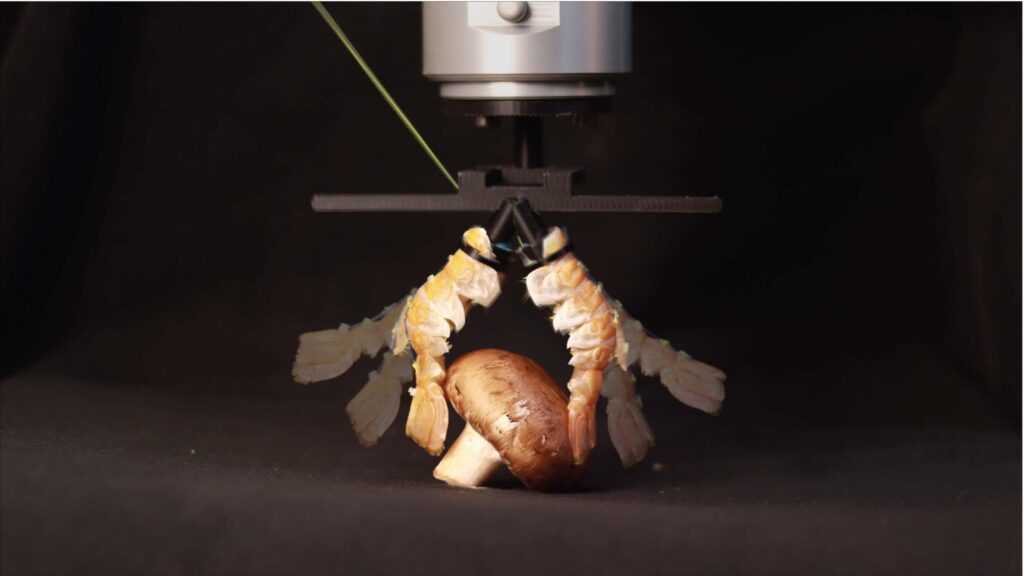
Bio-hybrid robots turn food waste into functional machines
Researchers at the CREATE Lab of the École Polytechnique Fédérale de Lausanne (EPFL) have unveiled a groundbreaking robotic gripper crafted from langoustine tails. This innovative design, showcased in 2025, marks a significant departure from traditional robotic components typically made from metals and plastics. By drawing inspiration from nature, the team aims to enhance the functionality and adaptability of robotic systems. The use of organic materials not only aligns with sustainable practices but also offers unique advantages in terms of flexibility and grip. This development highlights a growing trend in robotics, where natural elements are increasingly influencing technological advancements.

Marc Lore says that AI will soon enable anyone open a restaurant
Wonder, a company specializing in robotic kitchens, is set to transform its operations by launching AI-powered “restaurant factories.” This innovative initiative aims to enable individuals to create virtual food brands simply by providing a prompt. The announcement comes as part of Wonder's strategy to leverage artificial intelligence in the culinary space, enhancing accessibility and creativity in food entrepreneurship. By utilizing advanced technology, the company seeks to streamline the food production process, making it easier for aspiring restaurateurs to enter the market. The rollout of these virtual brands is expected to begin in the coming months, with Wonder's facilities serving as the backbone for this new model. This move not only reflects the growing trend of automation in the food industry but also addresses the increasing demand for diverse dining options in a rapidly evolving market.
AI Commerce Startups TC Cooking food
A Survey of Dynamic Wireless Power Transfer for Persistent UAV Transportation in Low‐Altitude Economy: The Field–Motion Framework
A recent study published in the Journal of Field Robotics highlights advancements in robotic technology aimed at enhancing agricultural efficiency. Researchers from various universities collaborated to develop an innovative robotic system designed to automate crop monitoring and management tasks. This study, released in early October 2023, emphasizes the growing need for sustainable farming practices amid increasing global food demands. The robotic system utilizes advanced sensors and artificial intelligence to assess crop health, optimize irrigation, and reduce pesticide usage. By integrating these technologies, the researchers aim to support farmers in making data-driven decisions that can lead to higher yields and lower environmental impact. The project was conducted in various agricultural settings, showcasing its adaptability to different crops and farming methods. The motivation behind this initiative stems from the challenges faced by the agricultural sector, including labor shortages and the need for more efficient resource management. By automating routine tasks, the robotic system not only addresses these issues but also promotes sustainable agricultural practices that are essential for future food security. As the agricultural landscape continues to evolve, this research represents a significant step towards the integration of robotics in farming, potentially transforming how crops are cultivated and managed in the years to come.
SURVEY ARTICLE
FLSea: Underwater Visual–Inertial and Stereovision Forward‐Looking Data Sets
A recent study published in the Journal of Field Robotics highlights advancements in autonomous robotic systems designed for agricultural applications. Researchers from various institutions collaborated to develop innovative algorithms that enhance the efficiency and effectiveness of robots in crop monitoring and management. The findings, released in early October 2023, demonstrate how these technologies can significantly reduce labor costs and improve yield predictions, addressing the growing demand for sustainable farming practices. The research was conducted in various agricultural settings, showcasing the robots' adaptability to different environments and crops. By integrating machine learning and real-time data analysis, the team aims to provide farmers with tools that not only optimize their operations but also contribute to environmental sustainability. This study marks a significant step forward in the integration of robotics into agriculture, promising to transform traditional farming methods and support food security in the face of global challenges.
RESEARCH ARTICLE
A Vision‐Guided Docking Method for Autonomous Underwater Vehicle From Ice Hole
A recent study published in the Journal of Field Robotics highlights advancements in autonomous robotic systems designed for agricultural applications. Researchers from a leading university conducted experiments to evaluate the efficiency of these robots in crop monitoring and management. The study, released in early October 2023, took place in various agricultural settings across the Midwest. The motivation behind this research stems from the increasing need for sustainable farming practices amid rising global food demands. By integrating advanced robotics and artificial intelligence, the team aimed to enhance productivity while minimizing environmental impact. The robots utilized cutting-edge sensors and machine learning algorithms to collect and analyze data on crop health, soil conditions, and pest activity. Through a series of field trials, the researchers demonstrated that these autonomous systems could significantly reduce labor costs and improve yield predictions. The findings suggest that the implementation of such technology could revolutionize traditional farming methods, making them more efficient and environmentally friendly. This study not only underscores the potential of robotics in agriculture but also paves the way for further innovations that could address the challenges faced by the agricultural sector in the coming years.
RESEARCH ARTICLE
Effectiveness Assessment of Underwater Area Cruise Based on the ADC Method
The Journal of Field Robotics has recently published an article in its EarlyView section, highlighting advancements in robotic technology. Researchers from various institutions collaborated to explore innovative applications of field robotics, focusing on enhancing efficiency in agricultural practices. The study, released in October 2023, emphasizes the growing importance of robotics in addressing global food security challenges. The research team conducted extensive field tests to evaluate the performance of new robotic systems designed for tasks such as planting, harvesting, and monitoring crops. By integrating artificial intelligence and machine learning, these robots aim to optimize resource use and reduce labor costs in farming operations. The findings indicate that implementing these technologies can significantly improve yield and sustainability. This initiative is driven by the urgent need to increase agricultural productivity in the face of a rising global population and climate change impacts. The researchers advocate for further investment in robotic solutions to support farmers and ensure food supply chains remain resilient. The article serves as a call to action for stakeholders in the agricultural sector to embrace technological advancements that can transform traditional farming methods.
RESEARCH ARTICLE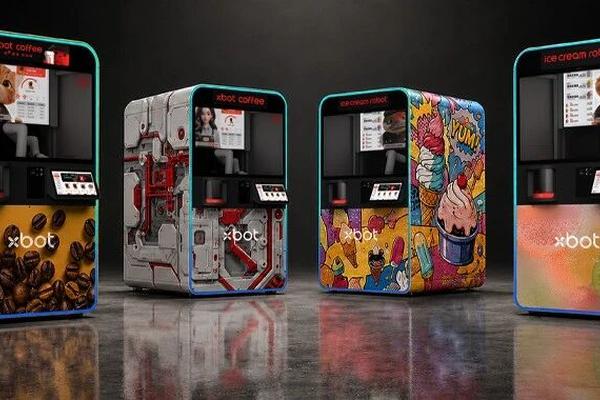
Xiaomi's former executive Tang Mu raises hundreds of millions for coffee robot startup, backed by Lin Bin and Li Wanqiang.
The robotics company Yingshi XBOT has successfully secured hundreds of millions in funding through two rounds of financing, with the Series A round raising 200 million yuan from Hong Kong's Jian Kun Capital and the Series B round expected to bring in 300 to 500 million yuan from various government and industry investors. This marks one of the largest investments in the restaurant-focused robotics sector to date. Founded in 2022 by Tang Mu, a former product manager with extensive experience in tech firms like Tencent and Xiaomi, Yingshi XBOT aims to revolutionize the food service industry by deploying robots for tasks such as coffee making in commercial spaces. The company’s technology is built around a specialized operating system, XOS 3.0, designed for the restaurant sector. This system features a multi-layered architecture that optimizes performance and efficiency while addressing common challenges in the industry. Yingshi XBOT has launched several product lines, including coffee and ice cream robots, which have already been deployed in over 1,000 locations worldwide, producing more than 4 million cups of coffee. With a focus on commercial applications rather than household or industrial settings, Yingshi XBOT has adopted a "Robot as a Service" (RaaS) model, allowing businesses to benefit from robotic solutions without the burden of ownership. The company has established partnerships with various brands and is exploring international markets, projecting significant revenue growth in the coming years.

Path Tracking Control for Crawler Robots With Track Slippage and Signal Time Delay Based on Pure Pursuit and Look‐Ahead Heading Error Compensation
A recent study published in the Journal of Field Robotics highlights advancements in autonomous robotic systems designed for agricultural applications. Conducted by a team of researchers from various institutions, the study was released in early October 2023. The research focuses on the integration of artificial intelligence and machine learning to enhance the efficiency and effectiveness of farming practices. The motivation behind this study stems from the increasing demand for sustainable agricultural solutions amid global food security challenges. By employing innovative robotic technologies, the researchers aim to address labor shortages and improve crop management. The study outlines the development of a prototype robot capable of performing tasks such as planting, monitoring, and harvesting crops with minimal human intervention. Field tests were conducted in diverse agricultural settings to evaluate the robot's performance and adaptability. The findings indicate that the robotic systems can significantly reduce operational costs and increase yield, offering a promising solution for modern farming challenges. This research not only contributes to the field of robotics but also provides valuable insights for farmers seeking to adopt new technologies for enhanced productivity.
RESEARCH ARTICLE
Linear System Identification and Control of a Low‐Cost High‐Performance Omnidirectional Marine Surface Vehicle for Swarming Applications
The Journal of Field Robotics has published an early view article highlighting advancements in robotic technology aimed at enhancing agricultural efficiency. Researchers from various institutions collaborated on this study, which was released in October 2023. The article focuses on the development of autonomous robots designed to optimize crop management and reduce labor costs in farming practices. This initiative is driven by the increasing demand for sustainable agricultural solutions amid a growing global population. The team employed cutting-edge artificial intelligence and machine learning techniques to enable robots to perform tasks such as planting, monitoring crop health, and harvesting with minimal human intervention. Field tests conducted in diverse agricultural settings demonstrated the robots' effectiveness in improving yield while minimizing resource usage. The findings suggest that integrating robotics into farming could significantly address labor shortages and enhance food production efficiency. As the agricultural sector faces mounting pressures from climate change and economic constraints, this research underscores the potential of technology to transform traditional farming methods and promote sustainability.
RESEARCH ARTICLE
Research on the Application of SSG‐RRT Path Planning Algorithm Integrated With Dynamic Obstacle Avoidance in Wheeled Picking Robot
A recent study published in the Journal of Field Robotics highlights advancements in robotic technology aimed at improving agricultural efficiency. Researchers from various institutions conducted the study to explore how autonomous robots can enhance crop management and reduce labor costs. The findings, released in early October 2023, indicate that these robots can perform tasks such as planting, monitoring, and harvesting with greater precision than traditional methods. The research was conducted in diverse agricultural settings, showcasing the robots' adaptability to different crops and terrains. By integrating advanced sensors and machine learning algorithms, the robots can analyze soil conditions and plant health, allowing for timely interventions that can lead to increased yields. This initiative is driven by the growing need for sustainable farming practices in response to global food demands and labor shortages in the agricultural sector. The study emphasizes that implementing robotic solutions could not only optimize resource use but also address environmental concerns associated with conventional farming techniques. As the agricultural industry faces mounting challenges, the deployment of these innovative robotic systems represents a significant step forward in modernizing farming practices and ensuring food security for the future.
RESEARCH ARTICLE
Chassis Pose Kinematic Model and Control for Terrestrial Mobile Robots With Active Flippers
The Journal of Field Robotics has published an EarlyView article highlighting recent advancements in robotic technology. Researchers from various institutions have collaborated to explore innovative applications of robotics in fields such as agriculture, search and rescue, and environmental monitoring. This study, released in October 2023, emphasizes the growing importance of autonomous systems in enhancing efficiency and safety across these sectors. The research team conducted extensive field tests to demonstrate how robots can perform complex tasks, such as crop monitoring and disaster response, with minimal human intervention. By integrating artificial intelligence and machine learning, the robots are designed to adapt to dynamic environments, showcasing their potential to revolutionize traditional practices. The motivation behind this research stems from the increasing demand for automation in response to labor shortages and the need for more effective solutions to global challenges. The findings underscore the necessity for continued investment in robotic technology to address pressing issues such as food security and disaster management. As the field of robotics continues to evolve, this publication serves as a critical resource for professionals and researchers aiming to leverage these advancements for practical applications. The collaborative effort reflects a commitment to pushing the boundaries of what is possible in robotics, paving the way for future innovations that could significantly impact various industries.
RESEARCH ARTICLE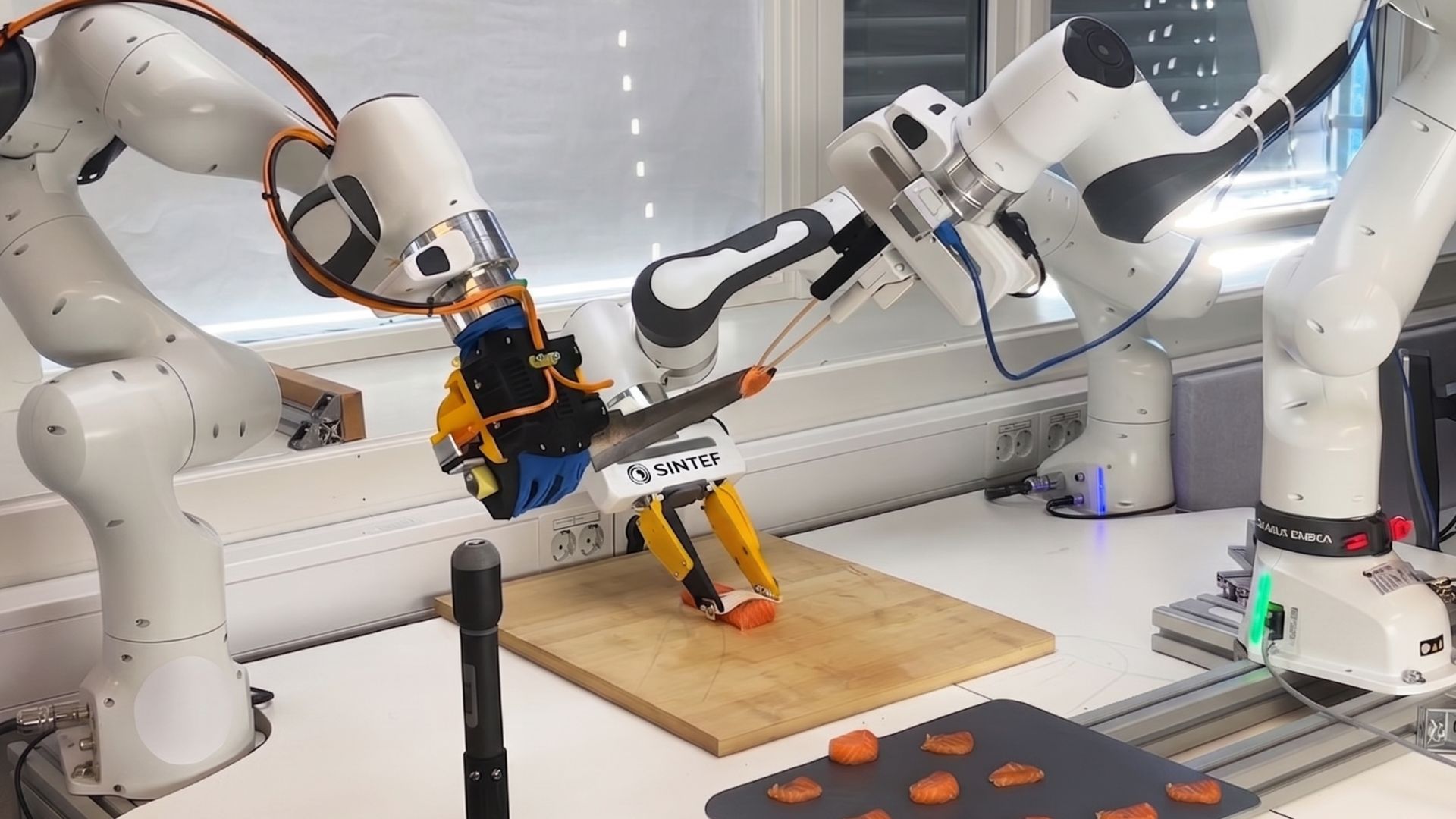
Three-armed kitchen robot cuts raw salmon with 95% touch-sensing accuracy
In a notable development within the robotics industry, researchers and engineers are grappling with the complexities of programming industrial robots to prepare sashimi, a task that has proven to be unexpectedly challenging. Despite advancements in automation and robotics, the intricate nature of slicing raw fish with precision and artistry has eluded machines, highlighting the limitations of current technology in replicating skilled human techniques. This ongoing effort reflects a broader trend in the food industry, where automation is increasingly sought after to enhance efficiency and consistency. As of October 2023, experts are exploring innovative approaches to overcome these hurdles, aiming to integrate advanced sensory feedback and machine learning algorithms that could enable robots to mimic the nuanced movements of experienced chefs. The pursuit of automating sashimi preparation not only underscores the demand for robotics in culinary applications but also raises questions about the future of traditional food preparation methods in an era of rapid technological advancement.
AI and Robotics
Three-armed Sashimi-Bot learns to slice and serve fish like a pro
A new three-armed robot has been developed to assist with the challenging task of cutting fish into bite-sized pieces, addressing a significant hurdle in culinary robotics. Unlike traditional robots that excel at handling rigid objects, this innovative machine is designed to manage the complexities of slippery and shape-shifting materials like fish. The robot's advanced capabilities allow it to adapt to the changing form of the fish during both handling and slicing, making it a valuable tool for chefs and home cooks alike. This breakthrough in robotic technology aims to enhance efficiency and precision in food preparation, reflecting ongoing advancements in automation within the culinary industry.
Robotics
Outracing a National Level Model Racing Car Champion: A Hybrid Model‐Based Data‐Driven Approach
A recent study published in the Journal of Field Robotics highlights advancements in autonomous robotic systems designed for agricultural applications. Conducted by a team of researchers from various universities, the study was released in early October 2023. The research focuses on the development of robots capable of performing tasks such as planting, harvesting, and monitoring crops with minimal human intervention. The motivation behind this innovation stems from the increasing demand for efficient agricultural practices to address food security challenges and labor shortages in the farming sector. By utilizing advanced sensors and artificial intelligence, these robots can navigate complex terrains and adapt to varying environmental conditions, enhancing productivity and sustainability in agriculture. The researchers conducted extensive field trials to validate the robots' effectiveness, demonstrating their ability to operate autonomously while maintaining high levels of accuracy and efficiency. The findings suggest that integrating these robotic systems into farming operations could significantly reduce labor costs and improve crop yields, paving the way for a more sustainable future in agriculture.
RESEARCH ARTICLE
A Review on Search and Rescue Robots in Complex Scenarios: Key Technologies of Simultaneous Localisation and Mapping
A recent study published in the Journal of Field Robotics highlights the advancements in autonomous robotic systems designed for agricultural applications. Researchers from various institutions collaborated to explore innovative technologies that enhance efficiency and sustainability in farming practices. The findings, released in early October 2023, emphasize the growing need for automation in agriculture to address labor shortages and improve crop yields. The research team conducted extensive field tests to evaluate the performance of these robotic systems in real-world farming scenarios. By integrating artificial intelligence and machine learning, the robots demonstrated the ability to perform tasks such as planting, monitoring, and harvesting with remarkable precision. This technological progress aims to support farmers in overcoming challenges posed by climate change and increasing food demand. The study underscores the importance of developing reliable and cost-effective robotic solutions that can be easily adopted by farmers. As the agricultural sector faces mounting pressures, the implementation of these advanced technologies could significantly transform traditional farming methods, leading to more sustainable practices and enhanced productivity.
SURVEY ARTICLE
Heavy‐UUV Docking System for a Fixed Seabed Station Based on Differential Optical‐Guidance Beacons
The Journal of Field Robotics has recently published an early view article highlighting advancements in robotic technology. Researchers from various institutions have collaborated to develop a new autonomous navigation system that enhances the efficiency and safety of field operations. This innovative system was tested in agricultural settings in California during the summer of 2023, where it demonstrated significant improvements in crop monitoring and resource management. The motivation behind this research stems from the growing need for precision agriculture, which aims to optimize farming practices and reduce environmental impact. By integrating advanced sensors and machine learning algorithms, the team was able to create a robotic platform capable of navigating complex terrains while collecting valuable data on soil health and crop conditions. The successful implementation of this technology could revolutionize the agricultural sector, providing farmers with tools to make informed decisions and increase productivity. The findings are expected to contribute to ongoing discussions about sustainable farming practices and the role of robotics in addressing global food security challenges.
RESEARCH ARTICLE
Design and Verification of a Multi‐Feature Wind Field Generation Device Based on Array‐Type Rotors
A recent study published in the Journal of Field Robotics explores advancements in robotic technology aimed at enhancing agricultural efficiency. Conducted by a team of researchers from various universities, the study highlights the development of autonomous robots capable of performing tasks such as planting, weeding, and harvesting crops. This research, which was initiated in early 2023, took place at agricultural fields across multiple locations in the Midwest United States. The motivation behind this initiative stems from the growing need for sustainable farming practices and the increasing labor shortages faced by the agricultural sector. By integrating advanced robotics into farming operations, the researchers aim to reduce reliance on manual labor while simultaneously increasing productivity and minimizing environmental impact. The study details the design and implementation of these robots, which utilize machine learning algorithms to navigate fields and make real-time decisions based on environmental conditions. Initial trials have shown promising results, indicating that these robots can significantly improve crop yields while reducing resource consumption. As the agricultural industry faces mounting challenges, this research represents a critical step toward the future of farming, showcasing how technology can play a pivotal role in addressing food security and sustainability. The findings are expected to influence future developments in agricultural robotics and encourage further investment in this innovative sector.
RESEARCH ARTICLE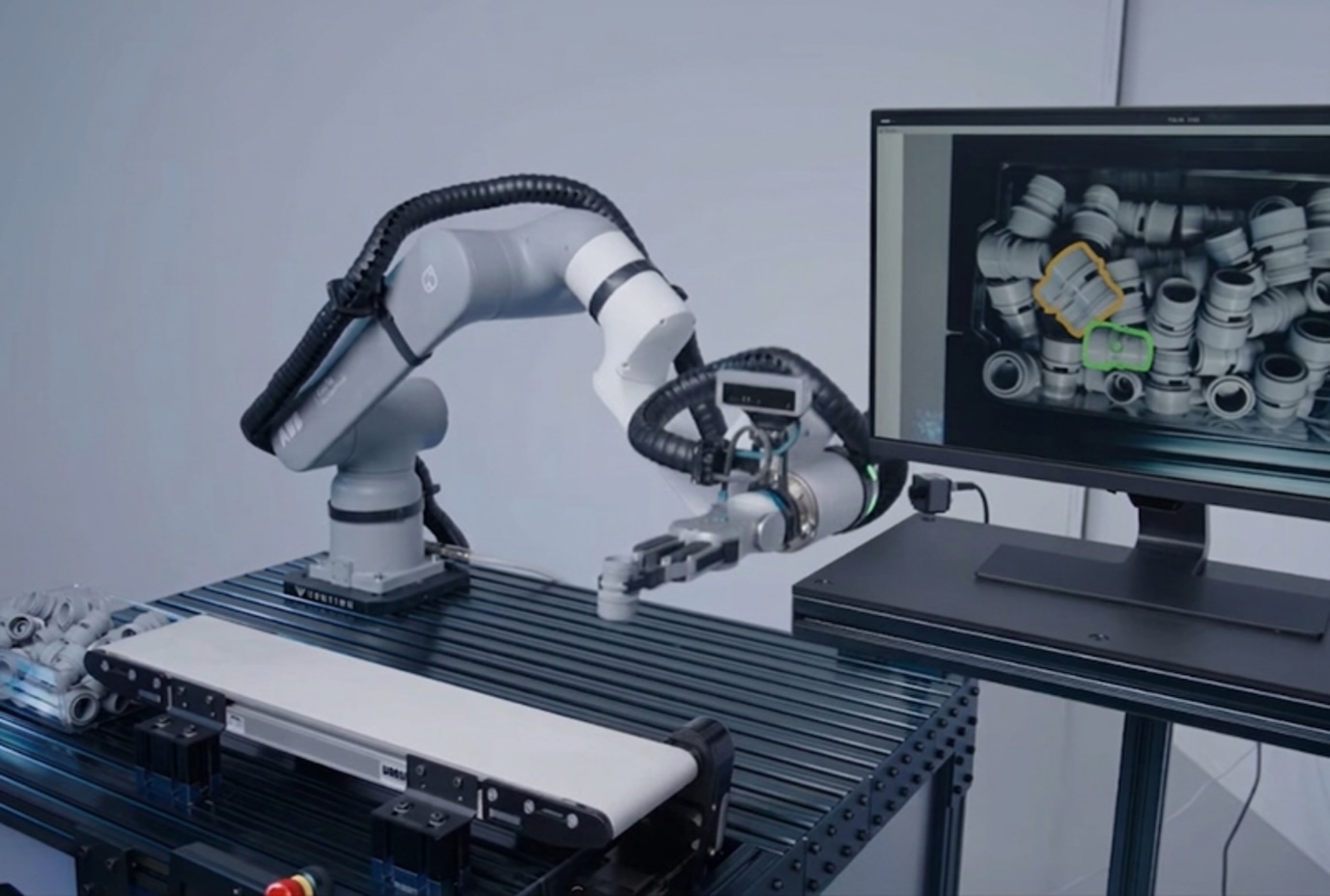
Research on Orchard Navigation Path Planning Based on 3D LiDAR SLAM Considering Terrain Roughness
A recent study published in the Journal of Field Robotics highlights advancements in autonomous robotic systems designed for agricultural applications. Researchers from a consortium of universities and tech companies conducted the study to address the growing need for efficient farming solutions amid rising labor costs and food demand. The research, which began in early 2023, took place across various agricultural sites in California, focusing on the integration of robotics in crop monitoring and harvesting. The team developed a prototype robot equipped with advanced sensors and machine learning algorithms, enabling it to navigate fields and collect data on crop health. This innovation aims to enhance productivity and reduce the reliance on manual labor, which has become increasingly scarce. The researchers conducted extensive field tests to evaluate the robot's performance and adaptability to different farming conditions. The findings suggest that these autonomous systems could significantly improve yield and reduce waste, addressing both economic and environmental challenges in agriculture. The study underscores the potential of robotics to transform traditional farming practices, paving the way for more sustainable and efficient food production methods in the future.
RESEARCH ARTICLERobotics needs a service framework.
RSF defines a common language for robot service capability, lifecycle operations, certification pathways, and service-provider networks.