Industry Briefing
A single destination for timely, editor-curated robotics news from around the world.

Military Selects First Bases for Directed-Energy Counter-Drone Program
The U.S. Department of Defense has unveiled the first five military installations chosen to participate in a directed-energy counter-drone program aimed at enhancing defenses against unmanned aircraft systems (UAS). This initiative, announced by the Joint Interagency Task Force 401, seeks to bolster national security by developing advanced drone defense technologies. The selected bases will play a crucial role in testing and implementing these systems, reflecting the growing need to address the evolving threats posed by drones. The program underscores the military's commitment to adapting to modern warfare challenges and ensuring effective countermeasures against potential aerial threats.
Anti-drone technology Applications C-UAS Defense defense Drone News
US robotic combat vehicles add directed-energy weapons to defeat multi-drone threats
Aurelius Systems has partnered with American Rheinmetall to integrate a directed-energy counter-drone system onto robotic...
Military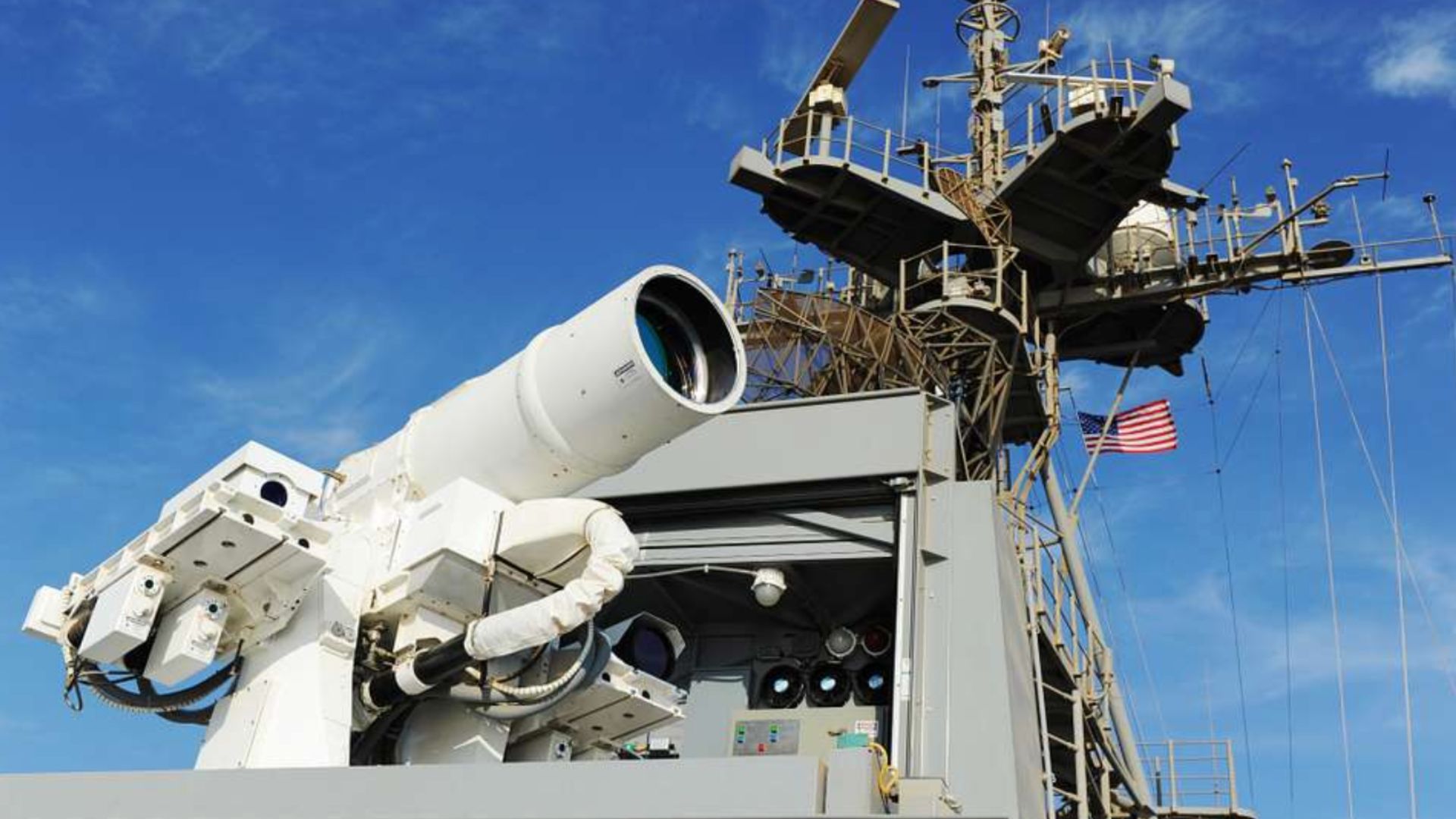
Nine US Navy destroyers that carry laser weapons for drone defense
The U.S. Navy has officially deployed laser weapons aboard its destroyers, marking a significant advancement from previous experimental demonstrations. This deployment, which occurred in October 2023, aims to enhance the Navy's defensive capabilities against various threats, including drones and small boats. The integration of laser technology is part of a broader strategy to modernize military assets and improve operational efficiency. By utilizing directed energy systems, the Navy seeks to provide a cost-effective and precise alternative to traditional munitions, thereby reducing logistical burdens and increasing response times in combat situations. The successful implementation of these systems aboard destroyers underscores the Navy's commitment to innovation and maintaining a technological edge in maritime operations.

These American Destroyers Are Equipped With Laser Weapons
The U.S. Navy has equipped nine of its surface combatants with directed energy systems, including advanced laser weapons, as part of an initiative to enhance naval capabilities. This move, aimed at bolstering defense mechanisms against various threats, reflects the Navy's commitment to integrating cutting-edge technology into its fleet. The expansion of testing and potential deployment of these systems is expected to occur in the near future, signaling a strategic shift towards modern warfare tactics. The initiative underscores the Navy's focus on improving operational effectiveness and readiness in an evolving security landscape.
Sea Destroyers Directed Energy Lasers Naval Directed Energy Weapons Navies
President Trump should secure America’s nuclear future by taking weapons out of DoE
In a recent commentary, Franklin C. Miller and Frank A. Rose assert that the management of America’s nuclear weapons arsenal should not be relegated to the Department of Energy. They argue that the arsenal plays a crucial role in national defense and should instead be overseen by the Department of Defense to ensure its strategic importance is recognized and prioritized. The discussion highlights concerns about the current organizational structure and its implications for national security. By advocating for a shift in oversight, Miller and Rose emphasize the need for a more robust and focused approach to nuclear deterrence, particularly in light of evolving global threats. Their position calls for a reevaluation of how the United States manages its nuclear capabilities to better align with its defense strategy.
Congress Opinion Department of Energy National Nuclear Security Administration (NNSA) nuclear nuclear weapons
DeepCtrls Secures Hundreds of Millions in Funding to Revolutionize Global Energy Infrastructure with Physical AI
DeepCtrls, a Chinese physical AI company, has successfully secured hundreds of millions in Series B funding, with JinkoSolar leading the investment round alongside other contributors. This significant financial boost will be directed towards enhancing the company’s proprietary PhyAI engine and expanding its DeepBot product into international markets. DeepCtrls is committed to integrating physical mechanisms with artificial intelligence, aiming to revolutionize energy infrastructure and enhance industrial AI applications. The company has already established a strong client base, including major players such as TSMC and Tencent, and is poised for substantial revenue growth as it continues to innovate in the sector.
Physical AI Energy Infrastructure Industrial AI Automation Global Expansion
Unusual Machines, 6K Energy, CRG Defense, SES AI take steps to be NDAA compliant
Drone and battery cell manufacturers are adjusting their production practices in response to the Department of Defense's recent ban on acquiring batteries for weapons and support systems that contain materials sourced from foreign entities deemed a security risk. This decision, aimed at enhancing national security, reflects growing concerns over reliance on foreign supply chains for critical military components. The alignment of these companies with the new regulations is expected to take place immediately, as they work to ensure compliance and maintain their contracts with the government. By sourcing materials domestically or from trusted allies, these manufacturers aim to mitigate potential vulnerabilities and bolster the integrity of defense operations.

$4.1 Billion Deal Shows Why Ferrari and Tesla Are Ditching Copper for a Substitute
$4.1 Billion Deal Shows Why Ferrari and Tesla Are Ditching Copper for a Substitute $4.1 Billion Deal Shows Why Ferrari and Tesla Are Ditching Copper for a Substitute Stjepan Kalinic Sun, July 5, 2026 at 8:31 AM PDT 6 min read RACE.MI TSLA Benzinga and Yahoo Finance LLC may earn commission or revenue on some items through the links below. Substitution is one of the fundamental economic forces. If a product goes up in price, consumers have a direct incentive to switch to a cheaper substitute. While branding power dictates some price flexibility, such calculations are more straightforward for fungible commodities. When copper costs about $15,000 a metric ton, manufacturers have every right to ask – does every wire really need to be copper? With data centers, grid upgrades and green-energy projects tightening supply, the answer from automakers is increasingly no. Aluminum, trading at $3,100 per ton, is being promoted wherever physics allows. Don't Miss: A single bad hire can set a startup back years. Here are the 5 hires founders most often misjudge — and why Still Learning the Market? These 50 Must-Know Terms Can Help You Catch Up Fast Driving Investment and Corporate Consolidation Aside from being much cheaper, the metal is lighter and good enough for many vehicle applications. The appeal to save on weight is just a bonus for range-anxious electric vehicles. Ferrari has used aluminum in bodies, engines, and chassis for years and has recently begun using aluminum power cables in the 296 hybrid and other models. The payoff can be meaningful: wiring weight savings of up to 20%. "We are not choosing aluminum because it's cheaper; we choose the material that has better performance," the firm's communications executive Dario Esposito said per Reuters. Market interest is driving asset transactions, as Alcoa Corp. has just signed a binding agreement to acquire most of South32 Ltd.'s aluminum value chain for $4.1 billion. These include assets in Australia, South Africa and Brazil, but not the Mozal operation in Mozambique. The largest domestic aluminum producer expects the transaction will generate about $900 million in synergies. JPMorgan estimates the aluminum substitution could affect about 2% of global copper demand this year, and potentially as much as 6% by 2030. Trending: Avoid the #1 Investing Mistake: How Your 'Safe' Holdings Could Be Costing You Big Time A Partial Substitute Still, aluminum is not copper with a discount sticker. It is less electrically conductive, meaning cables often must be thicker to carry the same current. Those properties create problems in tight spaces – shared by both data centers and automobiles. For high-performance systems and specialized applications, copper's efficiency still remains ahead. Story Continues Then, there are environmental and geopolitical complications. The final phase of aluminum production is energy-intensive, often generating a much larger carbon footprint than copper. Energy prices have squeezed domestic producers and closed smelters, while trade frictions, including U.S. tariffs, further complicate sourcing. Cable makers provide some guidance on the issue. Xavier Mathieu, VP of Nexans, the second-largest global cable manufacturer, said buyers typically start switching when copper costs about 3.5 times as much as aluminum. The current ratio exceeds 4.2. The math means aluminum will keep swallowing market share where weight and space permit, but copper's performance edge still means it is the hedge, not the heir. Photo by laowaika via Shutterstock Read Next: Skip the Regrets: The Essential Retirement Tips Experts Wish Everyone Knew Earlier. Think you're saving enough for your kids? You might be dangerously off — see why Building Wealth Across More Than Just the Market Building a resilient portfolio means thinking beyond a single asset or market trend. Economic cycles shift, sectors rise and fall, and no one investment performs well in every environment. That's why many investors look to diversify with platforms that provide access to real estate, fixed-income opportunities, precious metals, and even self-directed retirement accounts. By spreading exposure across multiple asset classes, it becomes easier to manage risk, capture steady returns, and create long-term wealth that isn't tied to the fortunes of just one company or industry. Arrived Backed by Jeff Bezos, Arrived Homes makes real estate investing accessible with a low barrier to entry. Investors can buy fractional shares of single-family rentals and vacation homes starting with as little as $100. This allows everyday investors to diversify into real estate, collect rental income, and build long-term wealth without needing to manage properties directly. FarmTogether Farmland has historically held its value through market volatility and delivered returns uncorrelated to stocks and bonds. For accredited investors, FarmTogether offers direct access to high-quality U.S. farmland starting at $15,000 — fully ma

UK industry team looks to miniaturize DragonFire laser for Type 45 destroyer debut
The United Kingdom is poised to become the first European NATO member to operationally deploy advanced laser directed energy technology by 2027. This initiative reflects the UK's commitment to enhancing its defense capabilities in response to evolving security challenges. The deployment aims to provide a cutting-edge solution for military operations, improving efficiency and effectiveness on the battlefield. The move underscores the UK's leadership role within NATO and its dedication to modernizing its armed forces in line with contemporary technological advancements.
Global Naval Warfare Army DragonFire Drones Europe
New Archimedes laser weapon system for low-cost drone kill trialed for Pentagon
Aurelius Systems, a US-based technology firm, has successfully completed live testing of its Archimedes autonomous directed-energy system. This significant milestone was achieved recently, showcasing the system's capabilities in real-world scenarios. The testing took place at a designated facility, where the system demonstrated its potential applications in defense and security. The motivation behind developing the Archimedes system is to enhance military operations by providing advanced directed-energy solutions that can effectively neutralize threats. The testing process involved rigorous evaluations to ensure the system's reliability and effectiveness in various conditions, marking a crucial step towards its deployment in operational settings.
Military
ThinKom Develops Self-Funded Mobile HPM Weapon to Counter Drone Swarms
ThinKom Solutions, a company based in Hawthorne, California, has introduced Alecto, a self-funded mobile high-power microwave (HPM) directed energy weapon aimed at neutralizing swarms of unmanned aircraft systems (UAS). Announced on May 4, 2026, the development of Alecto leverages ThinKom's proprietary Variable Inclination Continuous Transverse Stub (VICTS) antenna technology. This innovation is specifically designed to meet the Counter-UAS (C-UAS) needs of the Department of Defense, addressing growing concerns over the increasing use of drone swarms in military and security operations. The introduction of Alecto represents a significant advancement in directed energy capabilities, providing a new tool for defense against aerial threats.

Here’s how the Army plans to spend nearly $1 billion in procuring small counter drone tech
The U.S. government has proposed a budget allocation of $994 million for small counter-unmanned aerial systems (c-UAS) in its fiscal year 2027 budget request. This funding, entirely sourced from discretionary funds, aims to enhance the nation's capabilities in addressing the growing threat posed by small drones. The decision reflects an increasing recognition of the need for advanced technologies to safeguard airspace and protect critical infrastructure. The budget request underscores the government's commitment to investing in innovative solutions to counter aerial threats effectively.
Air Warfare Land Warfare Air Force Army Counter UAS cUAS Defense Budget 2027Robotics needs a service framework.
RSF defines a common language for robot service capability, lifecycle operations, certification pathways, and service-provider networks.