Industry Briefing
A single destination for timely, editor-curated robotics news from around the world.
US robotics installations rebounded in 2025, on track for more growth: IFR
Global demand for robotics is surging, particularly driven by the automotive and electronics sectors, with significant deployments occurring primarily in China, Japan, and South Korea. Meanwhile, the United States is experiencing an increase in robotics applications, particularly in food production and supply chain services. This trend highlights the growing reliance on automation across various industries, as companies seek to enhance efficiency and productivity in response to evolving market needs.
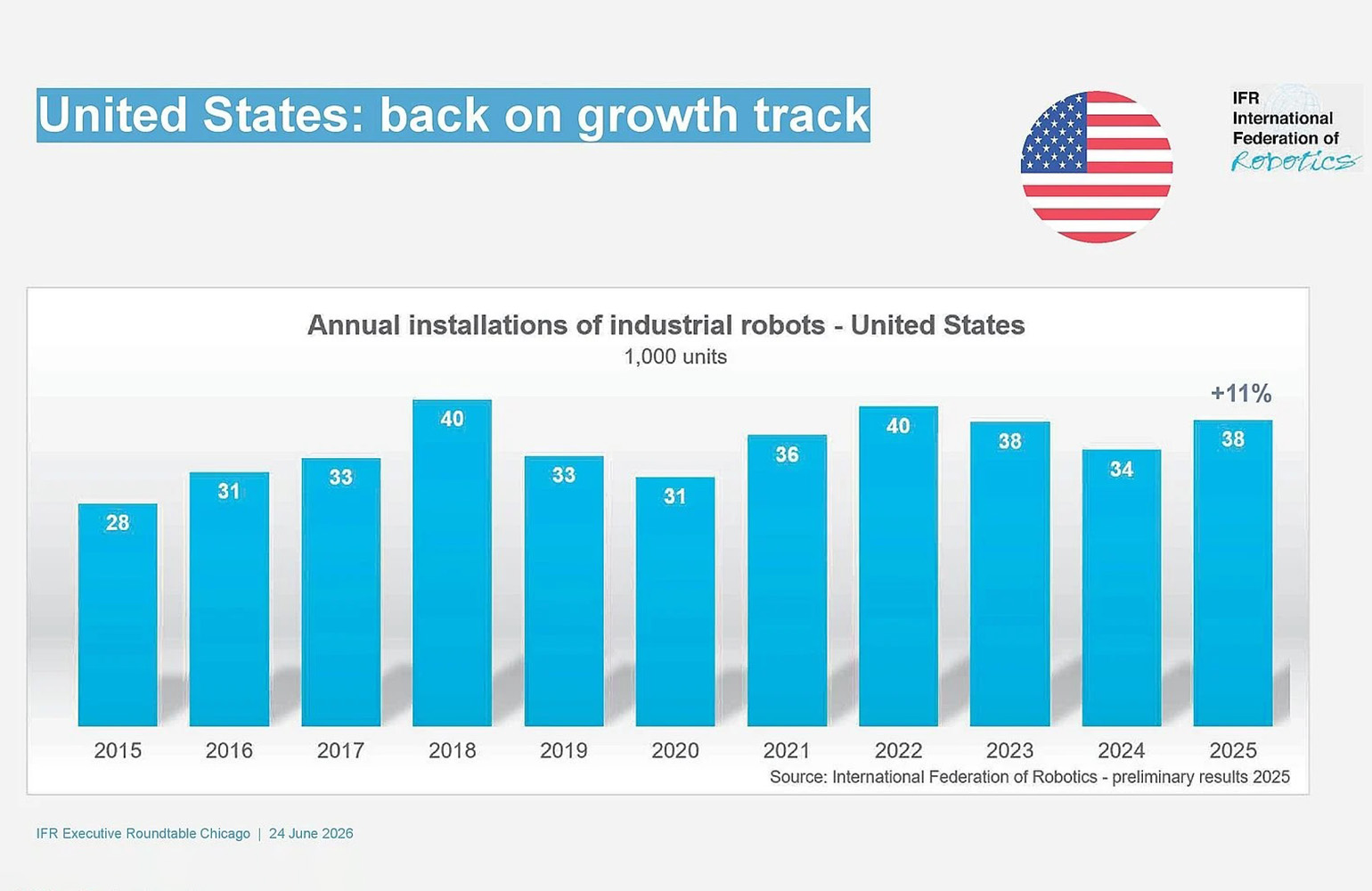
U.S. robotics industry saw double-digit growth in 2025, says IFR
The International Federation of Robotics (IFR) has reported that the U.S. robotics industry experienced significant recovery, marked by double-digit growth in 2025. This resurgence is attributed to strong performance in the food industry and other non-manufacturing sectors, which have played a crucial role in driving demand for robotics solutions. The findings highlight the increasing integration of automation technologies across various industries, underscoring a broader trend towards modernization and efficiency in the U.S. economy.
Automotive China Food / Beverage Industrial Robots Manufacturing Markets / Industries
IFR Reports China Making ‘AI-Powered Robots’ Core of National Strategy
China has officially initiated its 15th Five-Year Plan, emphasizing the integration of robotics into its modern industrial framework. This strategic move aims to advance artificial intelligence research, focusing on practical applications where robots will play a crucial role in driving economic growth. The plan marks a significant progression in China's ongoing efforts to enhance automation within its manufacturing sector. By prioritizing robotics, the Chinese government seeks to bolster its position in the global economy and foster innovation across various industries.
AI AI Policy & Regulation Robotics China embodied intelligence humanoid robots
ARGOS-X from Forssea Robotics Performs Resident ROV Demo at IFREMER Pools
The RESIDENT R&D program, initiated two years ago in partnership with IFREMER, is focused on developing and qualifying technological components for remotely operated vehicles (ROVs) to ensure their long-term residency on the seabed. This innovative project aims to enhance the capabilities of ROVs for underwater exploration and research by improving their durability and functionality in challenging marine environments. The collaboration seeks to address the growing need for advanced underwater technology as industries increasingly rely on ROVs for tasks such as environmental monitoring, resource exploration, and scientific research. The program is set to continue its efforts into 2024, with ongoing testing and evaluation of the technologies being developed.
argos-x forssea robotics resident rov demo ifremer
France 2030: Ifremer entrusts ALSEAMAR with the design of a deep-sea glider capable of reaching 3,500m
Ifremer has awarded a contract to French company ALSEAMAR for the design and development of a deep-sea underwater glider, following a call for proposals under the “Deep Seabed” priority of the France 2030 investment plan. This initiative, funded by the French National Research Agency (ANR) on behalf of the French government, aims to enhance France’s capabilities in deep-ocean exploration and observation, addressing significant global scientific and societal challenges. The project, led by Ifremer in collaboration with CNRS and Shom, will involve a scientific user group that will play a crucial role in defining the necessary sensors for the glider, ensuring that the system aligns with the evolving needs of ocean research.
france 2030 ifremer alseamar deep-sea glider
Gerald Mies, CEO of Estun Robotics Europe, Elected to Executive Board of International Federation of Robotics (IFR)
Gerald Mies, the CEO of Estun Robotics Europe, has been elected to the Executive Board of the International Federation of Robotics (IFR). This appointment reflects Mies' leadership role within Estun Robotics Europe, a subsidiary of ESTUN Automation, where he has been instrumental in driving the company's initiatives in the robotics sector. The election took place recently, marking a significant milestone in Mies' career and highlighting his contributions to the industry. His new position on the IFR board will enable him to influence global robotics standards and practices, furthering the development and adoption of robotics technology worldwide.
ESTUN AUTOMATION ROBOTICS SERVO SYSTEMSRobotics needs a service framework.
RSF defines a common language for robot service capability, lifecycle operations, certification pathways, and service-provider networks.
Join the RobotToday community on LinkedIn
Daily robotics news, in-depth analysis, conference highlights, and discussions with professionals worldwide.