Industry Briefing
A single destination for timely, editor-curated robotics news from around the world.

Lantronix and Swarmer Develop New Edge-Computing Platform for Military Drones
U.S. defense technology firms Lantronix and Swarmer are collaborating to create a compact computing platform that enhances small military drones' onboard processing power by four times. This new system integrates Lantronix’s Open-Q 6490CS System-on-Module with Swarmer’s autonomy software, aiming to improve autonomous operations for Group 1 unmanned aircraft systems. The significance of this development lies in its potential to enable small, cost-effective drones to perform complex tasks such as visual navigation, automated target recognition, and object tracking without relying on cloud computing. This capability is particularly crucial for military operations in environments with disrupted GPS signals and electronic warfare, as highlighted by the ongoing needs of Ukraine and allied forces. Looking ahead, the collaboration aims for a production commitment exceeding 10 years, ensuring the platform's adaptability for future defense programs. No further timeline was disclosed at the time of publication.
Military
NVIDIA and MediaTek Strengthen Partnership for Advanced AI Edge to Cloud Platforms
NVIDIA and MediaTek have announced an expansion of their collaboration to develop next-generation AI computing platforms, focusing on AI infrastructure, local AI computing, and automotive applications. MediaTek will integrate NVIDIA's NVLink Fusion™ platform to facilitate the creation of custom XPUs for hyperscalers and cloud service providers. This partnership is significant as it combines NVIDIA's strengths in accelerated computing and AI software with MediaTek's expertise in custom silicon and power-efficient system-on-chip design. The collaboration aims to enhance the development of AI systems that can scale across various markets, as highlighted by NVIDIA CEO Jensen Huang. Looking ahead, the NVLink Fusion platform will serve as a foundation for customers to create custom AI accelerators, streamlining the transition from silicon to production-ready systems. No further timeline was disclosed at the time of publication.

Chinese firm hits one million monthly micro SSD production milestone for edge computing
China’s Longsys has achieved a significant milestone by stabilizing its monthly production capacity at one million micro solid-state drives. This accomplishment comes as the company aims to meet the growing demand for advanced storage solutions in various sectors, including consumer electronics and data centers. The ramp-up in production reflects Longsys' commitment to innovation and efficiency in manufacturing, positioning itself as a key player in the competitive tech landscape. The company has implemented streamlined processes and advanced technologies to enhance its output, ensuring that it can cater to both domestic and international markets effectively. This development marks a crucial step for Longsys as it seeks to expand its footprint in the global semiconductor industry.
AI and Robotics
US Air Force validates Japanese edge computing chip for battlefield missions
A Japanese semiconductor company has showcased its advanced edge AI platform during a recent demonstration for the U.S. Air Force. This event took place as part of ongoing efforts to enhance military technology and operational efficiency. The platform is designed to process data at the edge, enabling faster decision-making and improved performance in various defense applications. By leveraging cutting-edge artificial intelligence capabilities, the company aims to support the Air Force's mission to modernize its technological infrastructure. The demonstration highlights the growing collaboration between private tech firms and military organizations in the pursuit of innovative solutions to meet national security challenges.
Military
XYZ Embodied AI Launches BotPack B Series Edge Computing Backpack
XYZ Embodied AI has launched the BotPack B Series, a cutting-edge edge computing backpack designed to enhance the capabilities of robots by allowing them to run artificial intelligence models locally. This innovation significantly reduces latency, enabling more efficient processing and quicker response times for robotic applications. The introduction of the BotPack B Series marks a notable advancement in robotics technology, aimed at improving performance in various fields such as manufacturing, logistics, and service industries. By equipping robots with this portable computing solution, XYZ Embodied AI seeks to address the growing demand for real-time data processing and decision-making in autonomous systems. The product is expected to be available in the market shortly, promising to transform how robots operate in dynamic environments.
News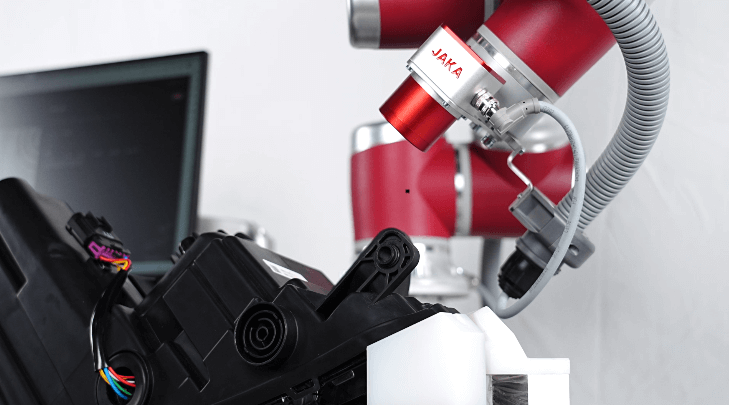
Comparing Cloud-Based and Edge Computing for Robotic Automation Control
JAKA, a leader in collaborative robotic solutions, emphasizes the importance of control system architecture in industrial automation, particularly the choice between cloud-based and edge computing. This decision significantly influences a system's capabilities, response times, and reliability. The company highlights that there is no one-size-fits-all solution; rather, the optimal setup depends on the specific demands of each task. The key distinction between the two computing paradigms lies in data processing locations. Cloud computing centralizes data in remote servers, providing analytical power and scalability for tasks like predictive maintenance and fleet management. In contrast, edge computing processes data locally, reducing latency crucial for real-time operations, especially in safety-sensitive environments where collaborative robots operate alongside humans. JAKA advocates for a hybrid approach that combines both paradigms. Their collaborative robots utilize edge computing for real-time motion control and immediate sensor responses, ensuring high precision and safety. Simultaneously, these robots can stream operational data to the cloud for broader analysis, allowing for continuous improvement without compromising immediate performance. The choice between cloud and edge computing should be based on application specifics. Tasks requiring ultra-low latency favor edge computing, while cloud resources excel in complex data aggregation and non-time-critical processes. JAKA's systems, like the Zu series, are designed for easy integration into either architecture, enabling manufacturers to tailor their setups for optimal performance. Ultimately, JAKA aims to create resilient and intelligent robotic systems that balance real-time autonomy with long-term intelligence, addressing the evolving needs of modern manufacturing.
Robotics needs a service framework.
RSF defines a common language for robot service capability, lifecycle operations, certification pathways, and service-provider networks.
Join the RobotToday community on LinkedIn
Daily robotics news, in-depth analysis, conference highlights, and discussions with professionals worldwide.