Industry Briefing
A single destination for timely, editor-curated robotics news from around the world.
Cyborg Cockroaches Developed as Potential Rescue Robots for Disaster Relief
Researchers have created cyborg cockroaches, named Paraborgs, designed to assist in delivering emergency medical care to individuals trapped in hazardous environments such as collapsed buildings. These insects are equipped with miniature electronics that enable remote monitoring and interaction, enhancing their role from mere search tools to potential rescue platforms. The significance of this technology lies in its ability to combine the natural navigation skills of cockroaches with lightweight electronics, allowing them to traverse difficult terrains while keeping critical medical decisions under human control. The Paraborgs can be fitted with either cameras or auto-injection devices, achieving a 95 percent success rate in close-range injections during proof-of-concept experiments. Looking ahead, researchers aim to deploy swarms of these specialized cyborg insects, each with distinct roles such as locating survivors or transporting medical supplies. While the current results are promising, further development and field testing are necessary before this innovative approach can be utilized in real emergency situations.
AI and Robotics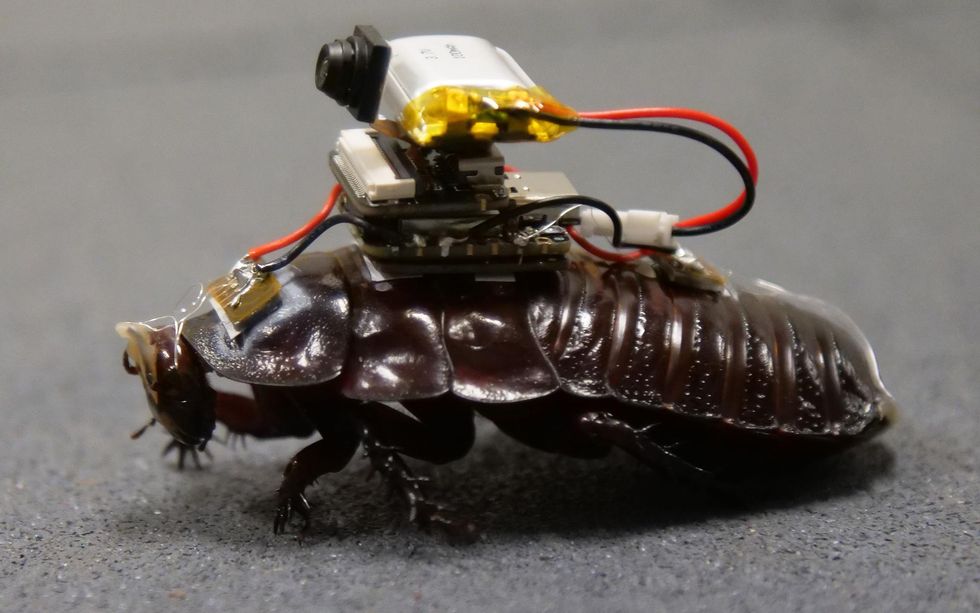
University of Queensland Develops Paraborgs: Cyborg Cockroaches for Disaster Relief
Researchers at the University of Queensland have developed a prototype paramedic cyborg, known as the Paraborg, which utilizes giant cockroaches to deliver aid in disaster scenarios. These cyborgs can navigate complex terrains and inject medications, potentially reaching victims trapped under rubble. The significance of this innovation lies in its ability to leverage the natural mobility of insects, addressing challenges in robotics by using living creatures equipped with electronic interfaces. This approach could enhance search-and-rescue operations, providing timely assistance to those in need. Looking ahead, the researchers aim to improve the autonomy and communication of the Paraborgs, ensuring they can operate effectively in chaotic environments. Future developments will focus on enhancing their capabilities to navigate and assist in real disaster situations, although the technology is not yet ready for practical deployment.
Robotics Insects Disaster-robots CyberneticsRobotics needs a service framework.
RSF defines a common language for robot service capability, lifecycle operations, certification pathways, and service-provider networks.
Join the RobotToday community on LinkedIn
Daily robotics news, in-depth analysis, conference highlights, and discussions with professionals worldwide.