Industry Briefing
A single destination for timely, editor-curated robotics news from around the world.
Kodiak AI Partners with AMD to Enhance Computing Power for Autonomous Trucking
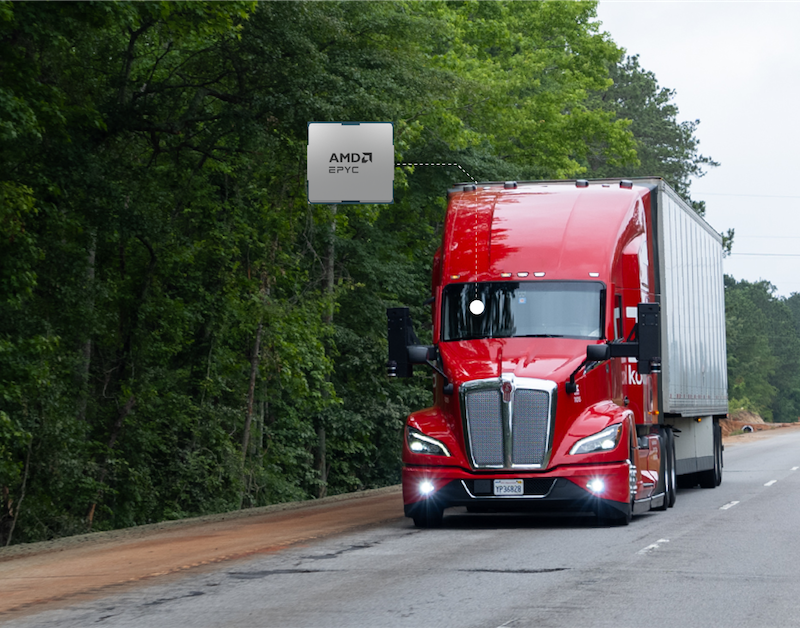
Kodiak AI has announced a collaboration with AMD to integrate AMD EPYC Series processors into its seventh-generation autonomous truck platform. This partnership marks Kodiak as the first company to utilize these advanced processors in driverless trucking, enabling the efficient processing of vast sensor data essential for safe operation. The collaboration is significant as it combines Kodiak's autonomous driving technology with AMD's high-performance computing capabilities. According to Wayne Lyons from AMD, this partnership demonstrates the potential of advanced autonomous driving software when paired with powerful computing resources, facilitating the transition of driverless trucking from innovation to large-scale implementation. Looking ahead, the integration of AMD EPYC CPUs is expected to enhance the Kodiak Driver's ability to handle complex environments through improved sensor data aggregation and preprocessing. No further timeline was disclosed at the time of publication.
Autonomous Vehicles Computing News amd amd epyc autonomous driving
AMD Launches X100 Series Processors for Humanoid Robot Brain Development
In late July, AMD unveiled its X100 series processors at the Advancing AI conference in Santa Clara, marking a significant entry into the humanoid robot brain market. This initiative aims to leverage AMD's expertise in real-time control and sensor integration, competing against NVIDIA's established Jetson ecosystem. The introduction of the X100 series, which includes the Kria AI SOM module and Spartan UltraScale+ FPGA, is crucial as it addresses the industry's need for integrated solutions that combine processing power with low latency. AMD's strategy focuses on providing a unified memory architecture and industrial-grade reliability, which are essential for applications in robotics and automation. Looking ahead, AMD's X100 series is expected to face stiff competition from NVIDIA, which currently dominates the humanoid robot brain market. However, AMD's unique offering of integrated solutions may attract industrial clients seeking reliable and long-term partnerships. No further timeline was disclosed at the time of publication.
Humanoid Robots AI Processors Industrial Automation FPGA Technology
AMD Establishes Comprehensive AI Solutions for Robotics to Compete with NVIDIA Jetson
AMD has laid a solid foundation for robotics, introducing a complete ecosystem from silicon to systems. At the Advancing AI 2026 conference in late July, AMD showcased 'Physical AI,' highlighting embedded products like the Ryzen AI Embedded X100, Kria AI SOM, and the Kria robotics development platform. This initiative marks AMD's first comprehensive approach to robotics, integrating chips, modules, development platforms, software, and an ecosystem. The X100 series, featuring the Strix Halo chip, is designed for industrial applications with enhanced temperature resilience and low latency firmware, making it suitable for demanding robotics tasks. AMD's strategy includes a ten-year lifecycle commitment for the X100, ensuring stable supply for industrial clients. The Kria AI SOM module represents a significant leap to high-performance x86 processors, aiming to rival NVIDIA Jetson products. The Kria AI Robotics platform further enhances this offering, providing developers with a ready-to-use solution, while AMD maintains control over design and standards through certified partners.
Robotics AI Solutions Embedded Systems High-Performance Computing
Sapphire Technology Introduces EDGE+ Apex Robotics Platform Powered by AMD Ryzen AI Processors
Sapphire Technology has launched the EDGE+ Apex System-on-Module (SOM) and Carrier Robotics Platform, which is powered by AMD Ryzen AI Embedded X100 Series processors. This production-ready hardware platform is designed to enhance the development and deployment of physical AI in autonomous robotics, showcased at AMD Advancing AI 2026 in San Francisco. The EDGE+ Apex platform is engineered for rugged, always-on robotics applications, featuring a COM-HPC module with up to 128GB of LPDDR5x memory. It combines CPU, GPU, and NPU acceleration to support real-time perception and autonomous decision-making, making it suitable for demanding edge AI deployments. Sumit Shah from AMD emphasized that this platform unifies AI and industrial reliability, enabling the next generation of autonomous systems. Developers can leverage an open software ecosystem with familiar AI frameworks while utilizing AMD ROCm and Ryzen AI software. Paul Smith from Sapphire noted that the EDGE+ Apex aims to provide a complete foundation for robotics builders, facilitating a faster transition from prototype to production in challenging environments. No further timeline was disclosed at the time of publication.
Computing Robotics ai at the edge amd amd ryzen ai embedded x100 amd ultrascale+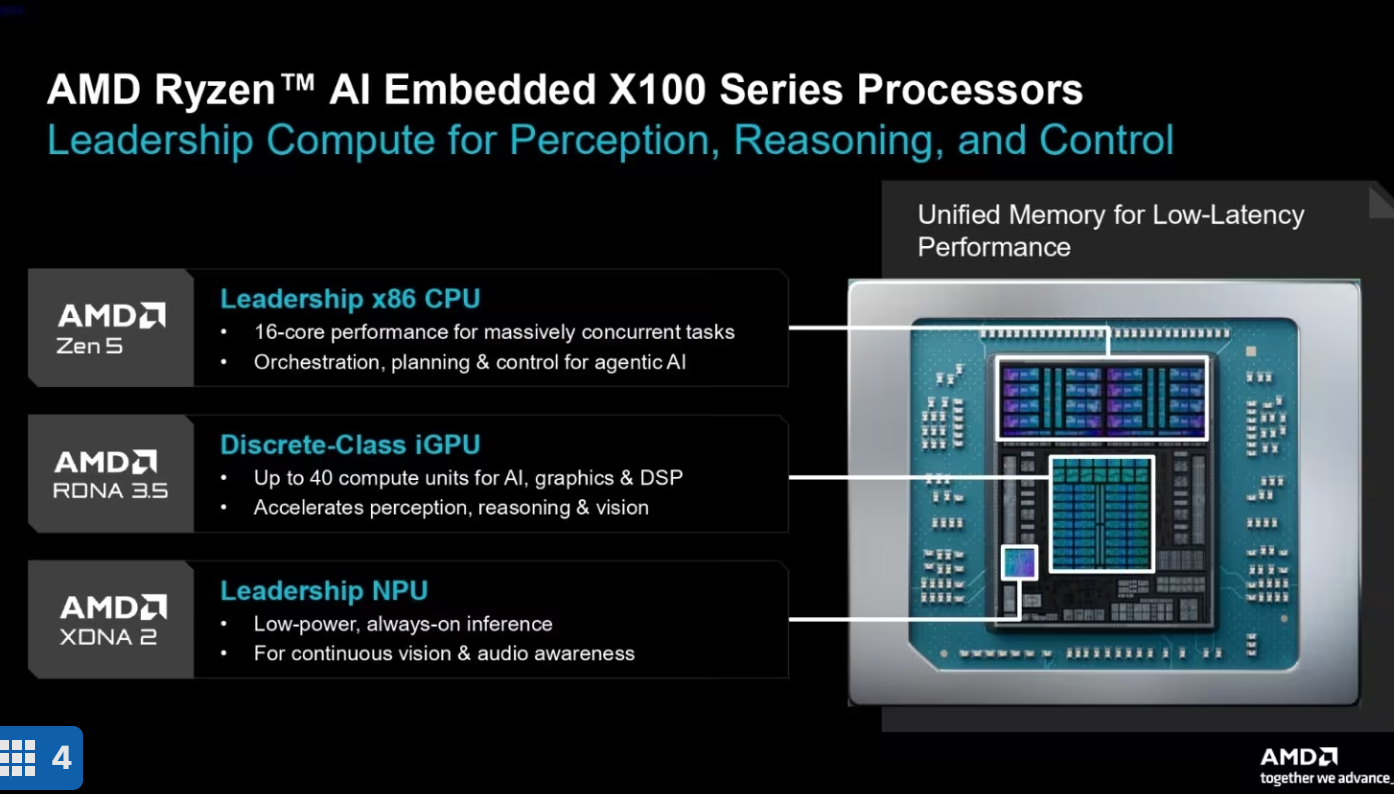
AMD Launches Advanced 16-Core Zen 5 Processor for Robotics and AI Applications
On July 23, AMD unveiled the Ryzen AI Embedded X100 series processors at the Advancing AI 2026 conference, designed specifically for physical AI and autonomous robotics. This system-on-chip integrates a 16-core Zen 5 CPU, a 40-unit RDNA 3.5 GPU, and an XDNA 2 NPU, enhancing the capabilities of robotic 'brains' for perception, reasoning, and decision-making. The X100 series significantly boosts performance metrics, achieving up to 2.1 times higher multi-threaded CPU performance compared to Intel's Core Ultra series, and 3.4 times better real-time performance than NVIDIA's Jetson Thor. The unified memory architecture allows for shared memory among CPU, GPU, and NPU, enabling over 8000 control decisions per second with latency under 100 milliseconds, bringing robotic response times closer to human instinct. The X100 series includes six SKUs, with industrial-grade reliability for continuous operation over ten years. AMD's Kria AI solutions will leverage this technology, supporting a wide range of applications from humanoid robots to industrial automation. Samples are currently being provided to customers, with mass production expected in Q4 2026.
Robotics AI Processors Embedded Systems Autonomous Robots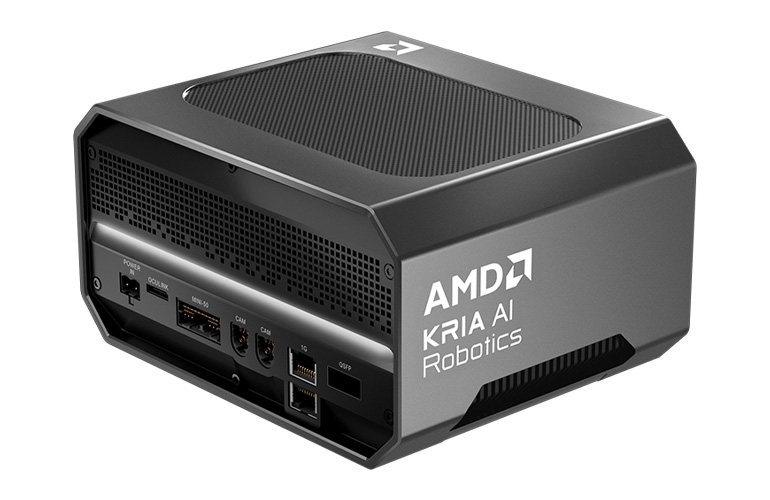
AMD Launches Kria Module and Ryzen AI Embedded X100 for Robotics Control
AMD has introduced the Kria module and Ryzen AI Embedded X100 series, aimed at enhancing real-time control and processing for robotics applications. The new platform promises deterministic performance with unified memory architecture, targeting both firm and hard real-time control through advanced optimizations. This development is significant as it positions AMD as a competitive alternative to NVIDIA in the robotics sector, particularly for physical AI applications. The unified CPU-GPU-NPU memory architecture is designed to reduce latency and improve efficiency in tasks such as perception and sensor fusion, which are critical for robotic operations. Looking ahead, AMD's offerings, including the open-source AMD Robotics Sophie Suite and a curated Robotics Partner Network, will be crucial for developers seeking scalable solutions for various robotic applications. No further timeline was disclosed at the time of publication.
Artificial Intelligence Controllers Microprocessors / SoC Microprocessors / SoCs Motion Control News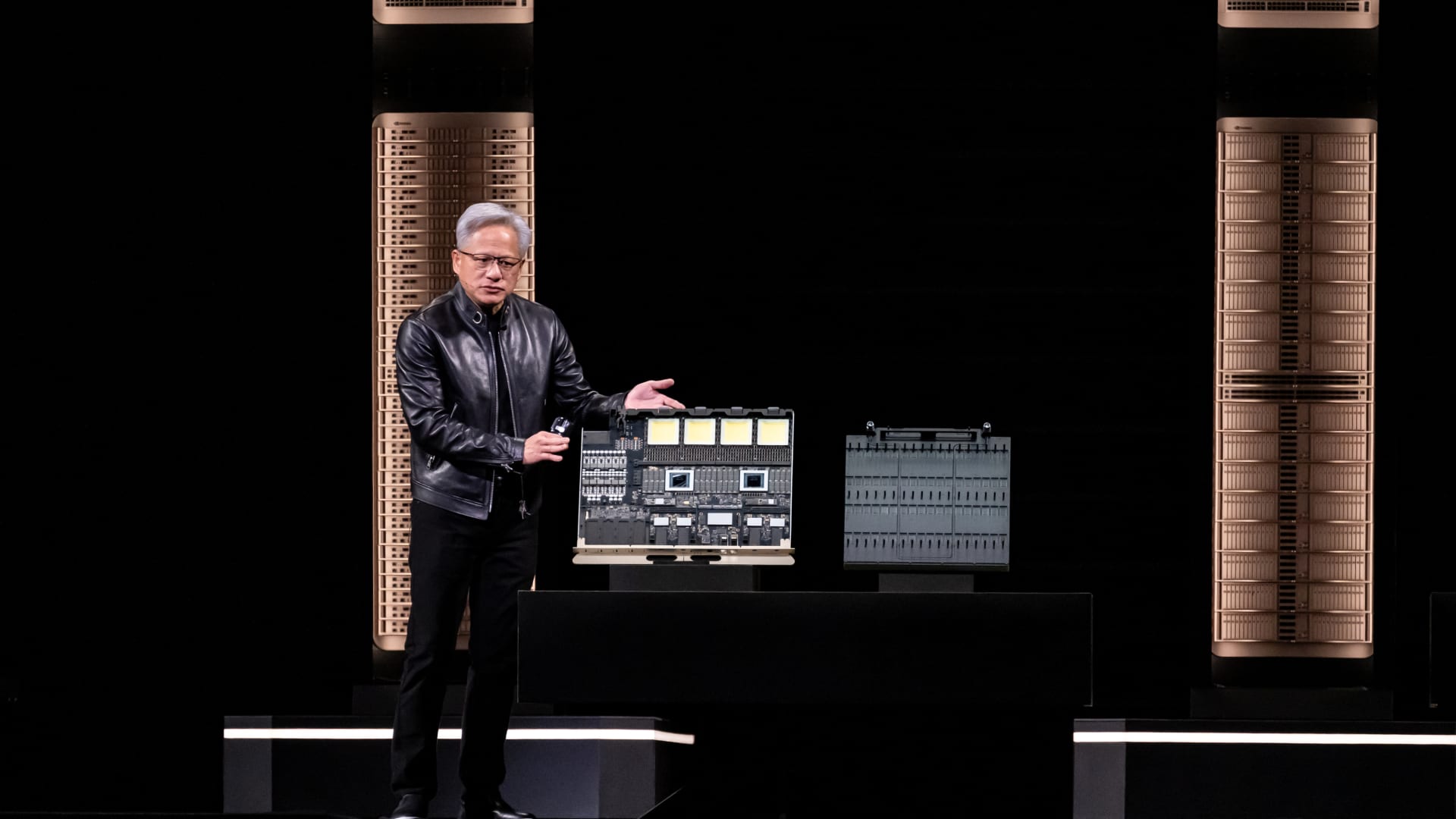
Nvidia Unveils Vera CPU for AI, Challenging AMD and Intel in Server Market
Nvidia has introduced its next-generation CPU, Vera, designed specifically for AI applications, marking its entry into the CPU market. This strategic move positions Nvidia to compete directly with established players AMD and Intel in the AI server sector. The company has begun shipping Vera chips to clients such as OpenAI, Anthropic, and SpaceX, highlighting its commitment to vertical integration in technology. The significance of this launch lies in Nvidia's aim to redefine server architecture by focusing on single-core performance rather than core count, which has been the traditional approach by competitors. With the server CPU market projected to reach $200 billion, Nvidia's Vera chip is expected to play a crucial role in enhancing AI agent performance, offering 50% better efficiency compared to existing x86 chips from Intel and AMD. Looking ahead, Nvidia's strategy to sell complete computing systems rather than just individual chips could reshape the competitive landscape in AI servers. As the demand for AI capabilities continues to grow, the performance and pricing of the Vera CPU will be critical factors to monitor in the evolving market dynamics.
AMD and Microsoft Expand Strategic Partnership with Large-Scale Deployment of AI Rack Scale 'Helios' on Azure
On July 20, 2026, AMD announced an expansion of its strategic partnership with Microsoft, focusing on the large-scale deployment of the AMD Helios rack-scale AI product on Azure. This collaboration encompasses GPUs, CPUs, networking, and software, with Helios being utilized for inference processing of frontier AI models by Microsoft and its AI customers. The significance of this partnership lies in the integration of AMD's Helios, which combines the AMD Instinct MI455X GPU, the sixth-generation EPYC CPU, and Pensando's networking technology into a cohesive AI system designed for extensive AI learning and inference. Microsoft plans to deploy Helios across three new Azure virtual machine series, enhancing its infrastructure offerings for next-generation AI applications. Looking ahead, AMD is set to begin shipping Helios to customers, including Microsoft, in late 2026. The collaboration is expected to broaden the scope of AMD's AI solutions, with potential implications for other major companies already adopting AMD's Instinct series, such as Meta and OpenAI. No further timeline was disclosed at the time of publication.
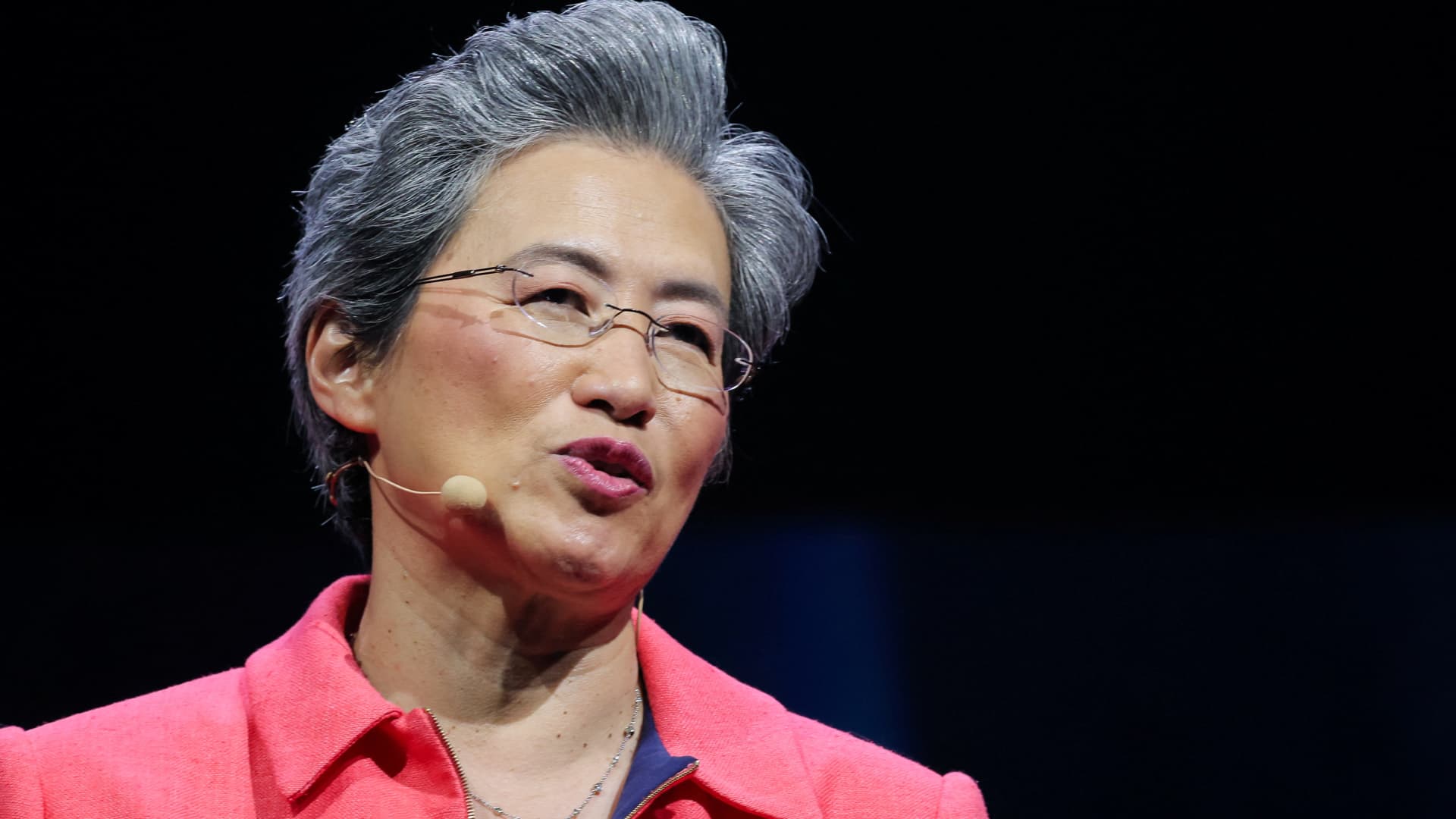
AMD Introduces Helios, Its First AI Rack System, Securing Microsoft as a Key Customer
AMD has launched Helios, its inaugural rack-scale system for artificial intelligence, with Microsoft announcing its deployment in Azure data centers. This move positions AMD as a competitor to Nvidia's established AI systems, including Grace Blackwell and Vera Rubin, as it aims to capture a larger share of the AI computing market. The significance of Helios lies in its potential to disrupt Nvidia's dominance in the data center GPU market, where it currently holds over 95%. With Microsoft, Meta, OpenAI, and Oracle among its early adopters, AMD is poised to enhance its market presence, which currently stands at approximately 4.5%. The system is designed to support advanced AI applications and improve overall performance and cost efficiency. Looking ahead, AMD plans to begin shipping Helios later this year, with customizable configurations available for various applications. As major companies increasingly turn to AMD for AI acceleration, the success of Helios could significantly impact AMD's market share and revenue potential in the competitive landscape of AI technologies. No further timeline was disclosed at the time of publication.

AMD Achieves 30% Productivity Boost with AI in Software Development
AMD has reported a significant 30% productivity boost in software development through AI integration, surpassing its initial target of 25%. This achievement is attributed to advancements in Large Language Models (LLMs) that enhance code generation, debugging, and testing processes. The company is now rethinking the software development lifecycle (SDLC) to incorporate collaborative AI agent swarms that can independently identify solutions, moving beyond traditional human-defined workflows. The implications of this development are profound, as AMD's AI systems are not only automating tasks but also reshaping the entire SDLC structure. By enabling AI to generate over 20% of source code, with some components reaching 80%, AMD is setting a new standard for productivity in software engineering. This shift towards agentic AI allows engineers to scale their expertise and focus on defining problems rather than solutions, paving the way for a future where AI can autonomously generate and evaluate multiple solutions. Looking ahead, AMD aims to further enhance its AI capabilities by fostering collaborative learning among agents, which will enable them to improve continuously across projects. The company has already seen success in its Radeon Software eXperience (RSX), where AI agents have increased their issue resolution rate from 6% to 75% in less than a year. No further timeline was disclosed at the time of publication.
Agentic-ai Software-engineering Amd Large-language-models
Chip Stocks Rally as Lam Research and Microsoft Report Strong Earnings
Chip stocks experienced a significant rebound on Thursday, driven by strong earnings reports from Microsoft and Lam Research. Lam Research's shares surged 20%, marking its best performance since 1999, following positive guidance linked to AI-driven demand. Microsoft also saw a 15% increase in its stock price, buoyed by growth in its Azure business and increased capital expenditures. The resurgence in chip stocks is notable as these companies have been major beneficiaries of the AI data center and infrastructure expansion. Memory stocks like Micron and Sandisk also saw substantial gains, with increases of 13% and 21%, respectively. This rally comes after a period of decline due to disappointing results from SK Hynix and concerns over the sustainability of spending in the sector. Looking ahead, the semiconductor market remains dynamic, with ongoing investments in memory and CPUs to support AI infrastructure. However, there are concerns that the current spending surge may be nearing its peak. No further timeline was disclosed at the time of publication.
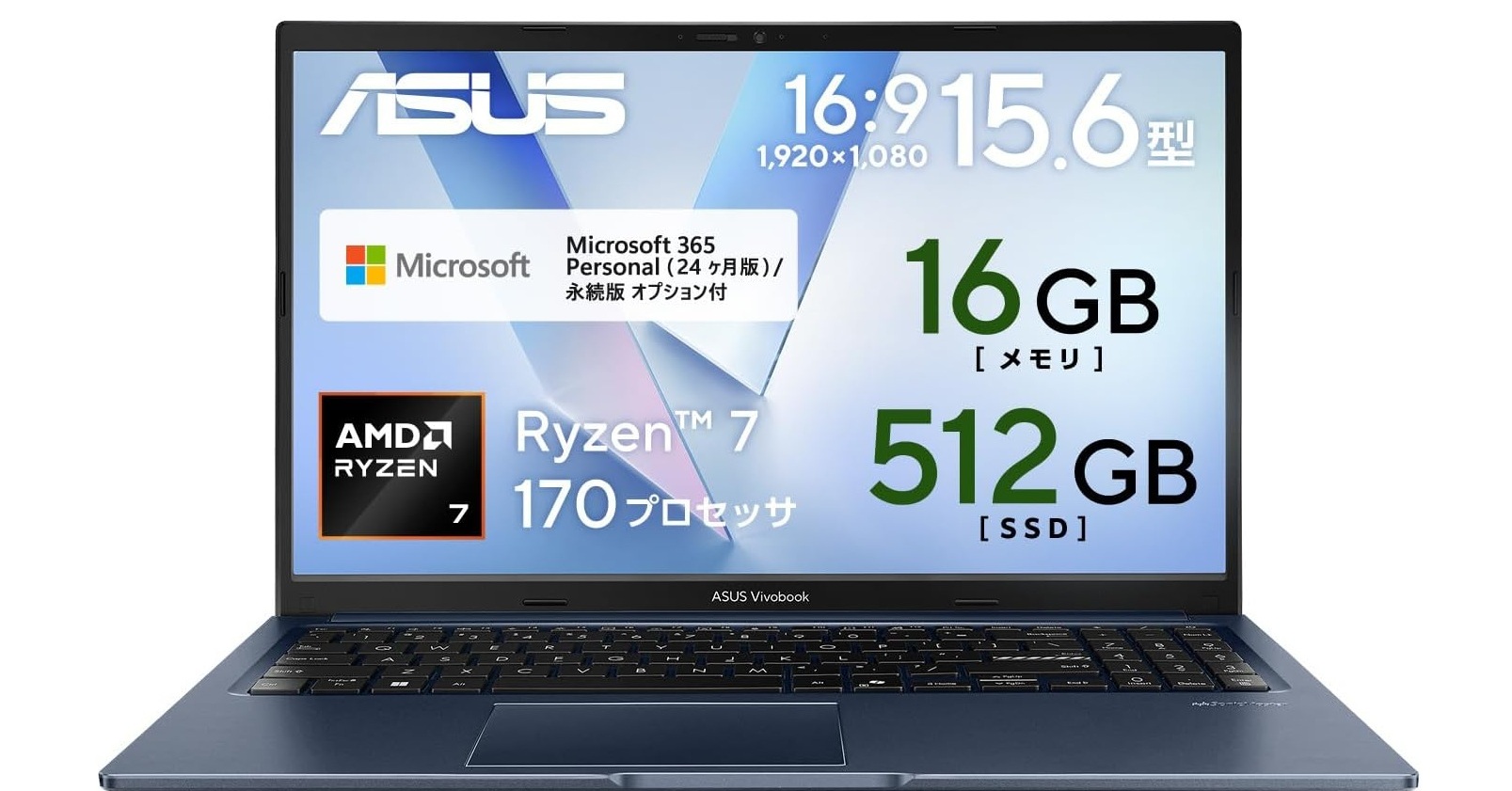
ASUS Launches Discounted Ryzen 7 Laptop with Enhanced Features for $1,088
ASUS has announced a limited-time offer for its Vivobook 15 M1502NAQ, featuring an AMD Ryzen 7 processor, now available for $1,088, a 22% discount from its original price of $1,398. This 15.6-inch laptop boasts a non-glare display with a resolution of 1920x1080 pixels and includes 16GB of RAM and a 512GB SSD, making it suitable for everyday tasks. The significance of this offer lies in the laptop's advanced features, including a blue light reduction function to ease eye strain during prolonged use and a unique antibacterial treatment that inhibits the growth of viruses and bacteria by approximately 99%. Additionally, it supports Wi-Fi 6E for fast wireless connectivity, enhancing the user experience in both productivity and online communication. Looking ahead, ASUS's Vivobook 15 M1502NAQ is bundled with a 24-month subscription to Microsoft 365 Personal, allowing users to start working immediately upon purchase. No further timeline was disclosed at the time of publication regarding the duration of this promotional offer.

$310 Million Series B Funding: Why Amazon and AMD Invest in AI Unicorn Odyssey?
Odyssey, an artificial intelligence startup specializing in world models, has successfully secured $310 million in Series B funding, elevating its valuation to $1.45 billion. The funding round was spearheaded by Natural Capital, with significant contributions from Amazon, AMD Ventures, and other prominent investors. Founded with the goal of improving robots' comprehension of the physical environment, Odyssey is developing innovative data collection methods and advanced modeling techniques. This initiative aims to tackle the difficulties associated with training AI systems in real-world settings, ultimately enhancing their operational capabilities.
AI World Models Robotics Data Collection Machine Learning
Haier's Thunderobot Launches 10 AI Workstations Powered by AMD Across Tower, Mini, and Mobile Lines
Haier's Thunderobot has introduced a new line of 10 AMD-powered AI workstations, which include tower, mini PC, and mobile configurations. This launch is strategically timed to meet the growing demand for local AI computing solutions in the current agent-era. By leveraging advanced AMD technology, Thunderobot aims to enhance productivity and efficiency for users who require robust AI capabilities in various settings. The workstations are designed to cater to a diverse range of applications, ensuring that both businesses and individual users can benefit from improved performance and versatility in their computing tasks.
Newsflash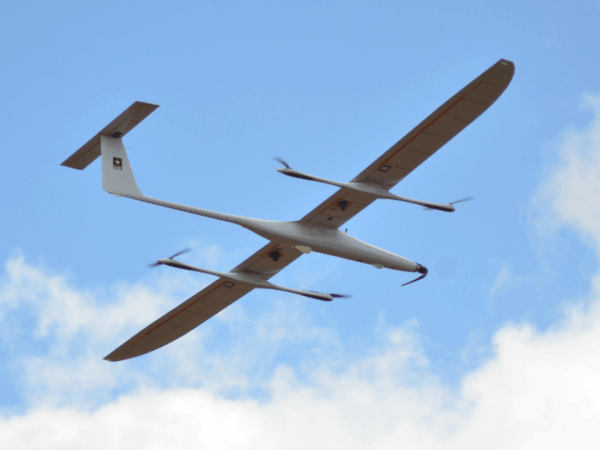
Kraus Hamdani Aerospace Demonstrates Wireless Power Beaming to K1000ULE at Shaw AFB
Kraus Hamdani Aerospace (KHA) and PowerLight Technologies successfully demonstrated their innovative wireless power beaming technology for the K1000ULE drone at Shaw Air Force Base. This event, hosted by the AFCENT Battle Lab, showcased the capability to sustain continuous intelligence, surveillance, and reconnaissance (ISR) operations without the need for ground recovery. The demonstration highlights the potential of laser-based power transmission to enhance operational efficiency for military applications, aligning with CENTCOM's focus on advancing operational energy innovation.
Defense Drone News Drone News Feeds Long Range News aerial surveillance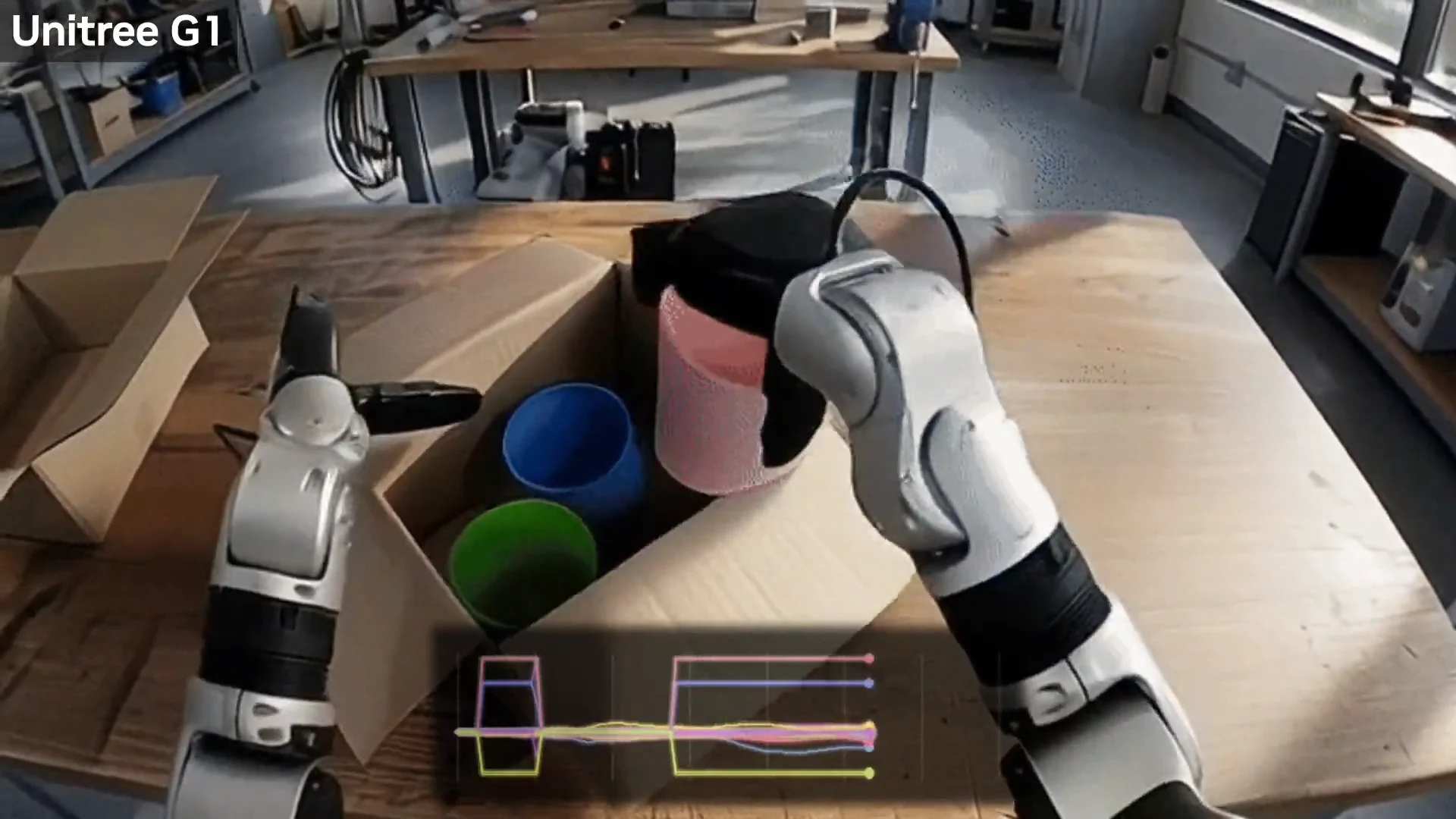
NVIDIA Open-Sources DreamDojo: A 44,000-Hour "Dream" to Solve the Robotics Data Gap
NVIDIA GEAR Lab has unveiled DreamDojo, an innovative open-source world model that leverages a substantial dataset of 44,000 hours of human egocentric videos. This advanced model employs "latent actions" to effectively connect human movements with robotic actions, enabling it to achieve zero-shot generalization and real-time controllability for applications in teleoperation and planning. The release of DreamDojo marks a significant advancement in the field of robotics, enhancing the potential for seamless interaction between humans and machines.
Dr Jim Fan NVIDIA World-Models open-source world-model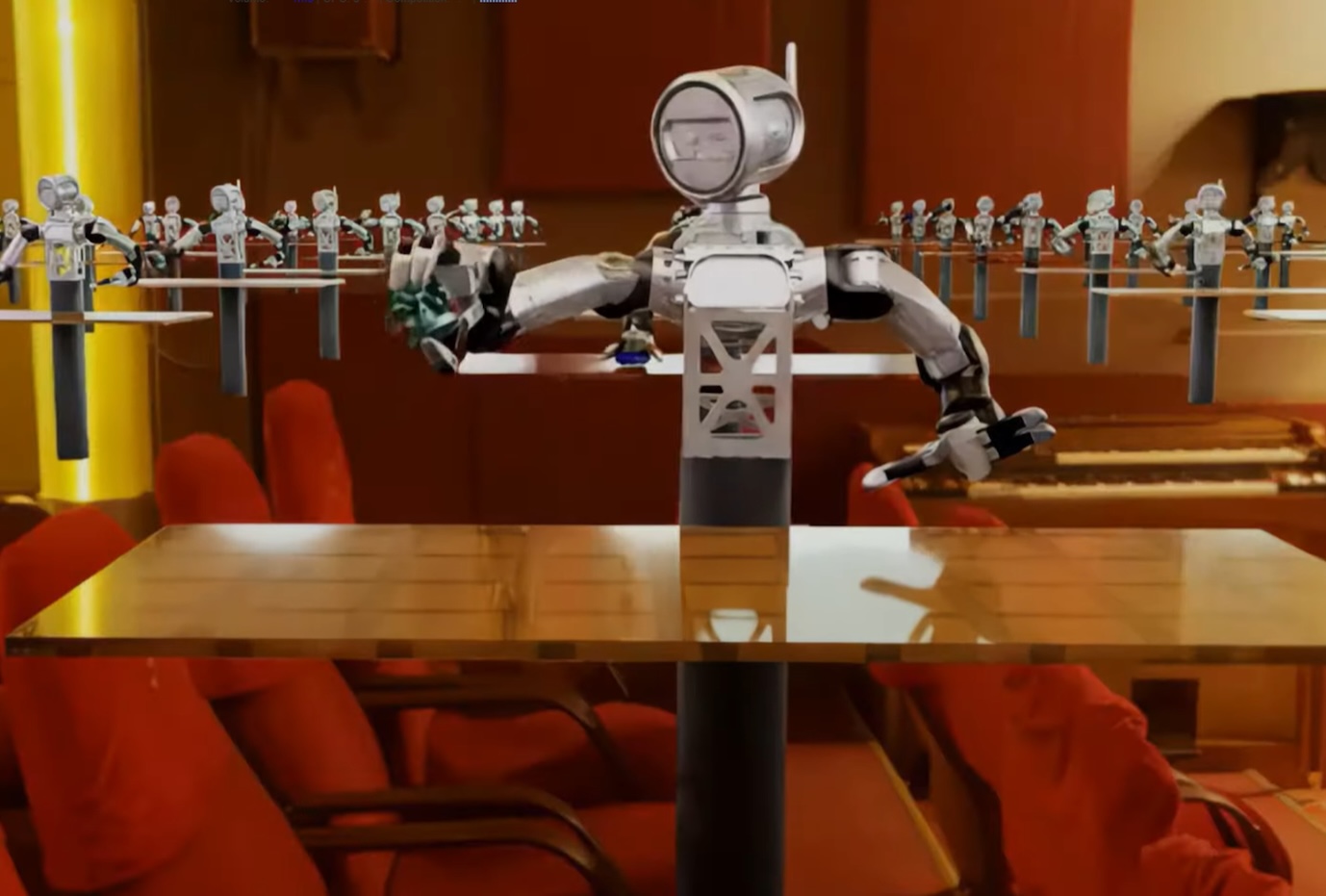
AMD CEO Lisa Su visits Lenovo Beijing headquarters
Lisa Su, the CEO of AMD, recently visited Lenovo Group's global headquarters in Beijing, where she led a delegation of senior executives. The visit included a tour of Lenovo's latest technological innovations, showcasing products such as humanoid robots. This trip marks Su's first stop in a series of engagements aimed at strengthening partnerships and exploring collaborative opportunities in the tech industry. The meeting underscores AMD's commitment to fostering relationships with key players in the market, particularly in the rapidly evolving landscape of technology and artificial intelligence.
News FeedRobotics needs a service framework.
RSF defines a common language for robot service capability, lifecycle operations, certification pathways, and service-provider networks.
Join the RobotToday community on LinkedIn
Daily robotics news, in-depth analysis, conference highlights, and discussions with professionals worldwide.