AI’s Volatile Power Use Quietly Tests Grid Limits
- Published
- Source
- IEEESpectrumAI
The rapid growth of artificial intelligence infrastructure is reshaping electricity demand dynamics, posing new challenges for grid operators. As data centers are projected to consume 3 to 4 percent of global electricity by the end of the decade, their energy consumption patterns are becoming increasingly unpredictable. Unlike traditional industrial loads, AI workloads can fluctuate dramatically within milliseconds, driven by synchronized computational tasks and varying user demands. This unpredictability complicates grid management, as it creates abrupt demand spikes that can stress local infrastructure, particularly in regions like Northern Virginia, known as "Data Center Alley," where data centers are concentrated.
Utilities, including Dominion Energy, are adjusting their forecasts to account for this rapid growth, but existing regulatory frameworks often fail to address the complexities introduced by high-density compute clusters. These facilities not only require significant power but also generate unique challenges related to thermal management and power quality. As a result, grid operators are exploring new demand response mechanisms and flexible scheduling to mitigate the impact of these fluctuating loads.
The Electric Reliability Council of Texas (ERCOT) has acknowledged the implications of large flexible loads for grid stability and planning. As AI infrastructure continues to expand, it is crucial for regulatory and operational frameworks to adapt, focusing not just on total energy consumption but also on the volatility and geographic concentration of demand. Understanding these new consumption patterns will be essential for maintaining grid resilience in the face of evolving energy needs.
Original report
AI’s Volatile Power Use Quietly Tests Grid Limits
IEEESpectrumAI · Matt HasanThis briefing is an independently written summary based on publicly available reporting and is provided for industry information and news discovery. The original report and source publication are credited and linked where applicable. RobotToday does not claim ownership of third-party source material.
Rights concerns? Contact [email protected] with the relevant URL and details. We will review the matter and take appropriate action where warranted.
More related news
-
1
SRS 2027 – Rome, Jun 23–27, 2027 RobotToday · 11 months from now
- 2
- 3
- 4
- 5
- 6
- 7
- 8
- 9
- 10
- 11
-
12
RobotToday Weekly October 12 – 16, 2026 RobotToday · 5 days ago
Related Suppliers

BioRobotics Laboratory, Korea University of Technology and Education
Korea, Republic of (South)
South Korean university research laboratory focusing on haptics, exoskeletons, rehabilitation robotics, and autonomous ground vehicles.

McMaster Manufacturing Research Institute
Canada
Hamilton, Ontario applied manufacturing research center at McMaster University; runs a 21,000 sq ft facility with seven research labs.

Robotics Education & Competition Foundation
United States
The REC Foundation is a US nonprofit that runs VEX-based robotics and drone competitions reaching 1.1 million students across 70 countries.
E-COBOT
France
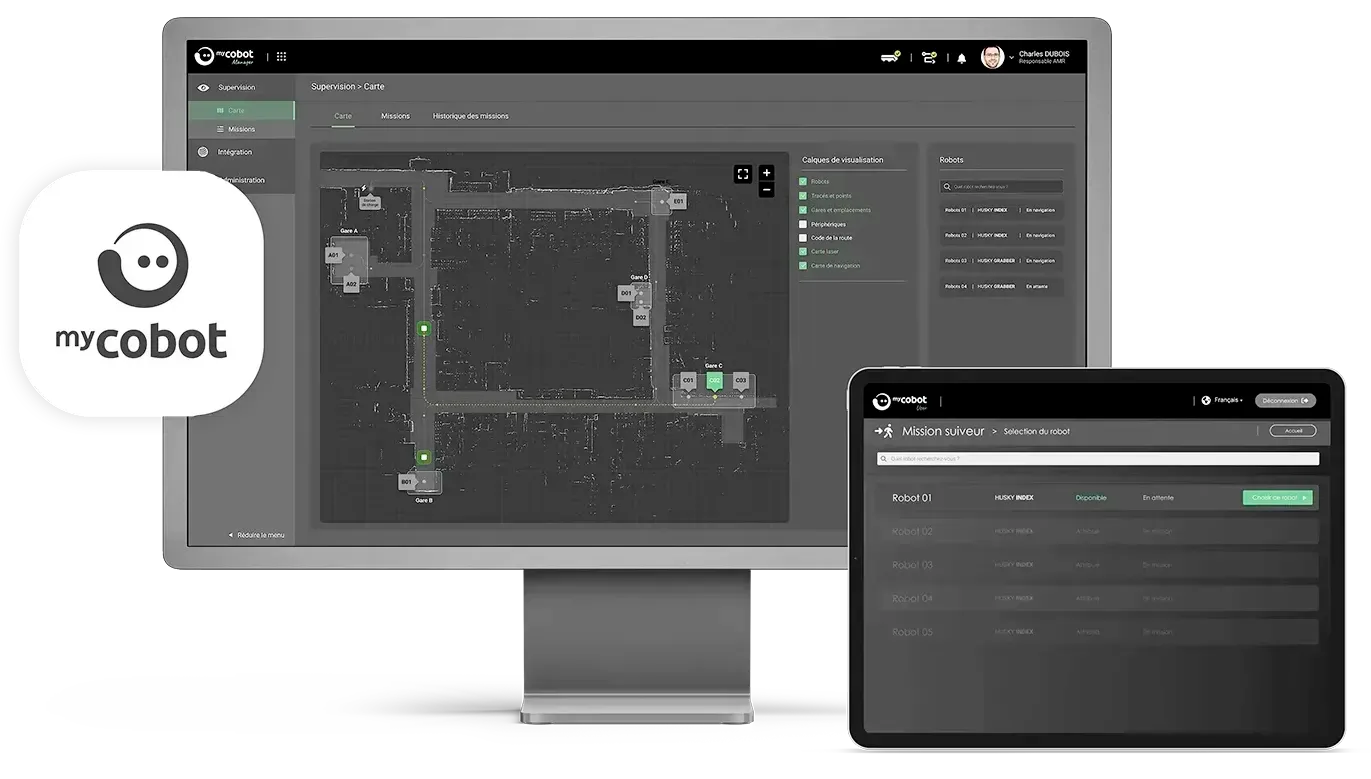
French AMR manufacturer and system integrator offering the HUSKY robot range and MyCobot fleet management software.
EasyMile
France
Toulouse, France autonomous-vehicle software company founded 2014; EZTow and EZDolly systems automate industrial tow tractors and cargo movers at airports.

Filics
Germany
Munich-based robotics startup making ultra-flat omnidirectional AMRs that drive under Euro pallets for space-efficient intralogistics.

ADEK Industrial Computers
United States
US-based industrial PC manufacturer building custom rugged rack-mount, panel, and embedded computers for robotics, SCADA, and HMI applications since 1993.

Aichi Robot Industrial Promotion Council
Japan
Japanese industry council promoting robotics development and diffusion in Aichi Prefecture, one of Japan's largest robot manufacturing hubs.

Arctek Robótica Industrial
Brazil
Brazilian industrial robotics system integrator in Curitiba, Parana, specializing in robotic welding, automated handling, palletizing, and custom automation.

Datanomix
United States
No-Operator-Input production monitoring software that turns CNC machine data into real-time visibility and prescriptive coaching for manufacturers.
Datatang 数据堂(北京)科技股份有限公司
China
Beijing AI training-data supplier founded 2010 and quoted on NEEQ; its Nexdata arm sells egocentric, teleoperation and hand-pose datasets for robot learning.
Anyscale
United States
Anyscale is a San Francisco AI infrastructure firm behind Ray, the open-source engine for large-scale model training; Nscale agreed to buy it for $1.65B.
Robotics needs a service framework.
RSF defines a common language for robot service capability, lifecycle operations, certification pathways, and service-provider networks.
Join the RobotToday community on LinkedIn
Daily robotics news, in-depth analysis, conference highlights, and discussions with professionals worldwide.