

Executive Summary
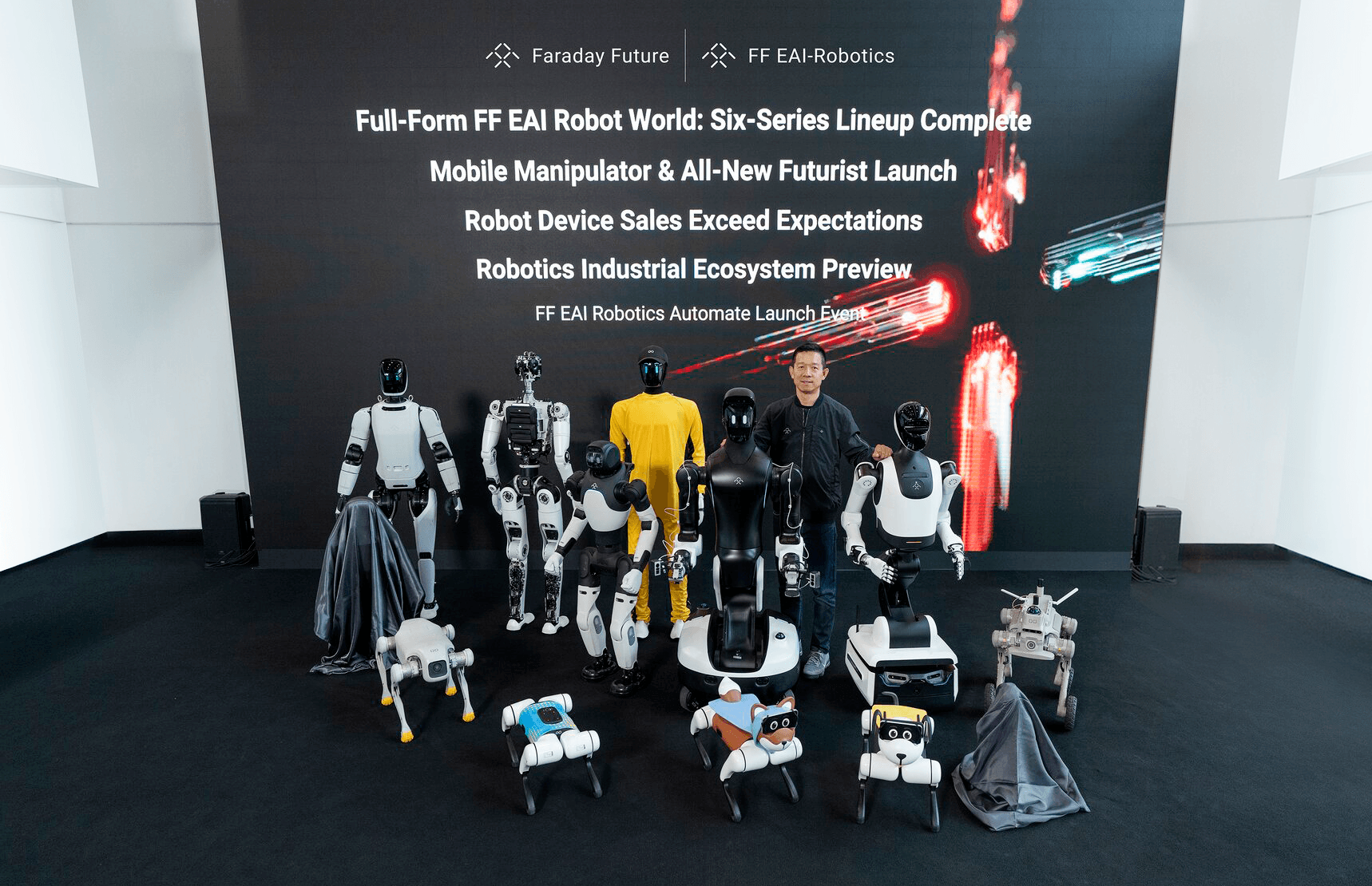
Faraday Future Intelligent Electric Inc. (NASDAQ: FFAI) used the Automate trade show in Chicago to present the second half of its “EAI Robot World,” the company’s term for an embodied-AI robot portfolio spanning six product series. The event followed a June 16 launch in Los Angeles and, according to FF, completes a lineup of three form factors: humanoids (Futurist, Master, Nova), quadrupeds (Aegis, Navi), and a newly introduced mobile manipulator series, Faber.
Two announcements carry the most weight for engineers and integrators: a production price of $89,900 for the All-New Futurist full-size humanoid, and the commercial release of the Faber mobile manipulator, which FF positions as a single platform combining fixed-arm precision, autonomous mobile-robot (AMR) navigation, and dual-arm coordination. The company also previewed an industrial deployment strategy and reported preliminary shipment figures.
Industry Context
Automate is North America’s largest robotics and automation exhibition, which makes it a deliberate venue for a company trying to move from a single-product narrative to a portfolio one. Most humanoid developers — including the better-funded U.S. and Chinese entrants — have concentrated on one general-purpose biped. FF is instead pursuing what it calls a “one brain, multiple forms” approach, reusing a common software stack (a VLA-plus-World-Model architecture FF brands as its EAI Brain) across many body types.
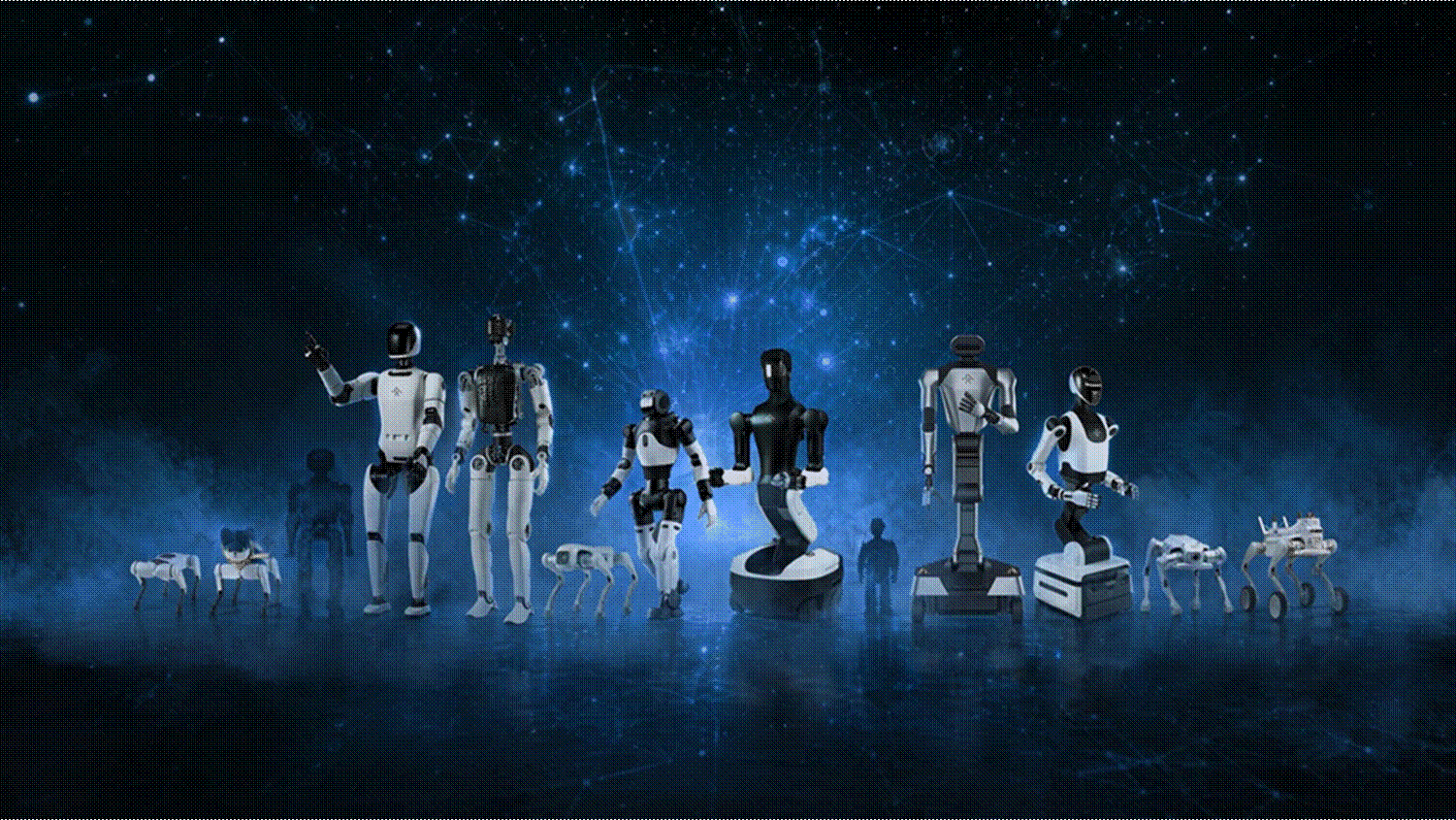
The strategic bet is that a shared brain and a wider range of body types shorten the path to task-specific deployment. The engineering risk is the inverse: maintaining, validating, and certifying six hardware lines simultaneously is materially harder than iterating on one.
Technology: All-New Futurist
The All-New Futurist is a full-size humanoid that FF says natively supports NVIDIA’s Sonic whole-body motion-control system as its “cerebellum.” Published specifications place it at roughly 5 ft 8 in tall and about 121 lb — approximately 14% lighter than the prior generation — with 31 degrees of freedom excluding the hands and a peak knee-joint torque of 320 N·m. FF cites a top speed near 11 mph and a 1,152 Wh dual-battery system rated for about six hours of runtime, three times the previous generation. A planned Ultra variant, due later in 2026, is to run on NVIDIA’s Jetson Thor compute platform and add autonomous docking and recharging.
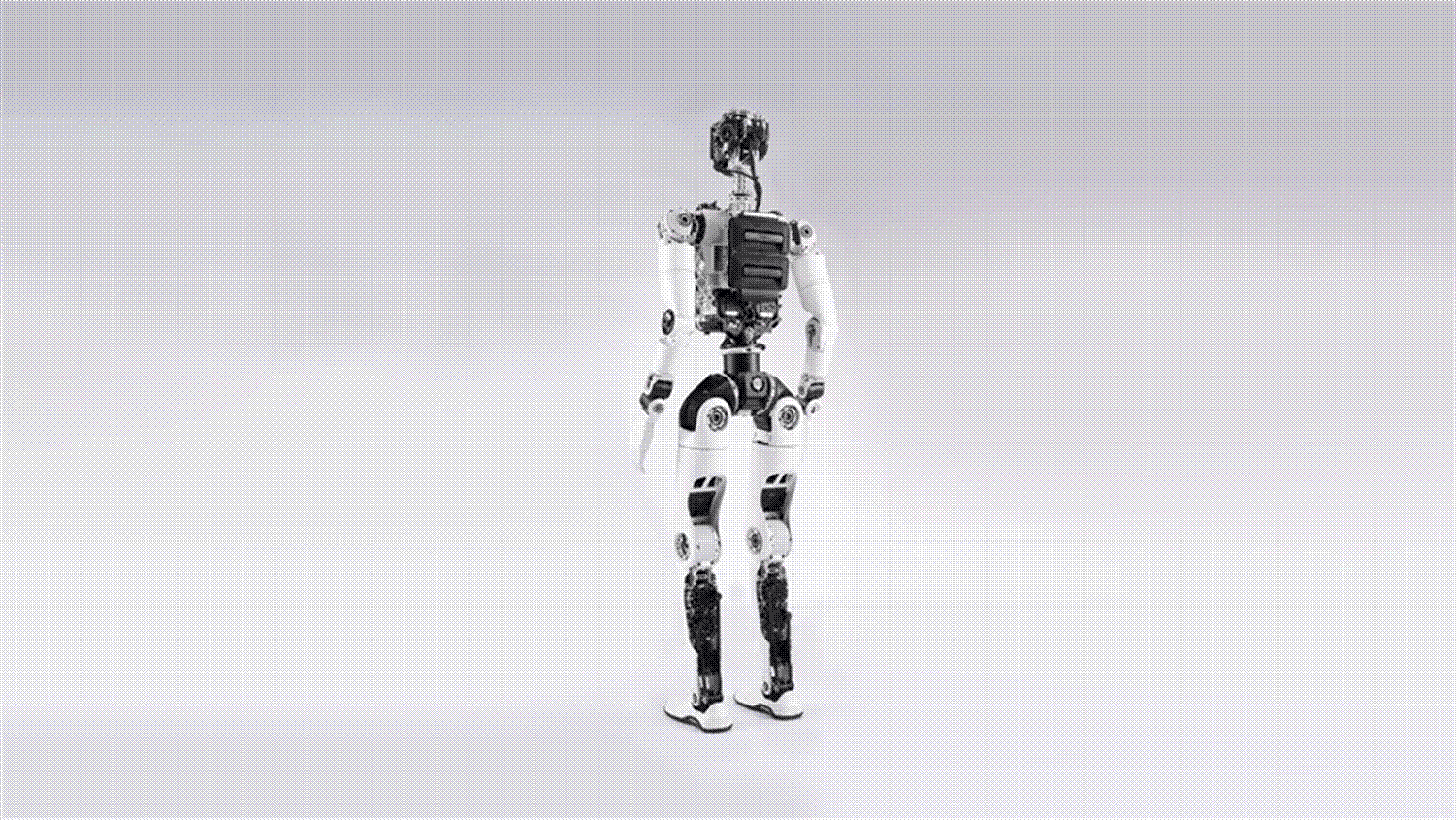
The headline number is commercial rather than technical: $89,900, inclusive of a $10,000 premium skills package. FF frames the platform as well suited to motion-control research and academic publication, given the native Sonic integration. That positioning is plausible — a documented, off-the-shelf whole-body-control target lowers the barrier for reproducible research — but the 320 N·m torque and 11 mph figures are vendor-stated peaks and have not been independently benchmarked under load.
Technology: Faber Mobile Manipulator
Faber is the more technically interesting release. FF describes it as the first U.S. industrial-grade EAI mobile manipulator series ready for commercial sale, built to merge three capabilities that usually live in separate machines: the repeatability of a fixed robotic arm, the mobility of an AMR, and the bimanual coordination of a humanoid. Quoted figures include single-arm payload up to 11 lb, an operating envelope from floor level to about 6.6 ft, and force-control resolution better than 0.5 N.
The series splits into three configurations. Faber U is the high-end build, with Jetson Thor compute, dual LiDAR, and multi-camera fusion. Faber T is aimed at power inspection, energy infrastructure, and data centers, and FF says it can take over higher-risk manual tasks such as operating electrical switchgear. Faber S offers the largest reach and ships with an embodied-AI data-collection toolchain; FF scheduled its debut for ISTE Live 26 on June 30. Faber bodies are available for purchase as of the launch.
Engineering Analysis
Of the two launches, Faber is the cleaner engineering story. Combining AMR mobility with force-controlled manipulation addresses a real gap on factory floors, where fixed arms cannot relocate and AMRs cannot grasp. Sub-0.5 N force control, if it holds in production, is a credible figure for assembly and insertion tasks. The harder questions — cycle-time stability, localization accuracy during manipulation, and safety certification for shared human workspaces — were not quantified at the event and will determine whether Faber moves beyond pilots.
For the All-New Futurist, leaning on NVIDIA’s Sonic and Jetson Thor is a pragmatic choice that offloads the hardest controls and compute problems to a maturing third-party stack. It also creates supplier dependency and means FF’s differentiation rests more on integration, skills, and pricing than on core locomotion research.
Commercial Progress
FF stated that June shipments of robot devices were expected to exceed 100 units and that first-half shipments would surpass an original target of 220 units. These are company projections rather than audited results, and the unit definition spans very different products — from the sub-$2,000 Navi quadruped to the $89,900 Futurist — so aggregate counts should be read with care. Pricing disclosed across the lineup ($1,990 for Navi, $89,900 for the All-New Futurist) does at least give integrators concrete reference points, which many humanoid competitors still withhold.
Market Perspective: Industrial Ecosystem
Alongside Faber, FF outlined an “industrial ecosystem” as its second focus after education, targeting factory production support, warehouse logistics, facility inspection and security, and equipment maintenance. The stated value drivers — efficiency, cost reduction, removing workers from hazardous environments, and using operational data to retrain the EAI Brain — are the standard industrial-robotics arguments. FF said a dedicated industrial launch would follow in roughly six months. Separately, affiliate AIxC announced an “EAI ecosystem plus Web3” robot-sharing concept; that proposal is early-stage and largely unproven, and warrants skepticism until a working platform exists.
Challenges
The most significant risks sit outside the hardware. FF’s own filings disclose substantial financial uncertainty, including questions about its ability to continue as a going concern, Nasdaq minimum-bid-price compliance, and reliance on a single OEM for most of its robotics products. Many B2B figures depend on nonbinding preorders. For a buyer evaluating multi-year deployments, vendor financial stability and supply continuity are as material as torque curves and payload ratings.
On the technical side, the central unknown is whether one shared brain can genuinely generalize across six body types without per-platform engineering eroding the claimed efficiency. None of the autonomy claims — whole-body control, autonomous docking, or Faber’s manipulation accuracy — were demonstrated with independent, repeatable benchmarks at the event.
RobotToday Analysis
Automate gave FF a coherent portfolio narrative and, more usefully, real prices. The Faber mobile manipulator is the announcement most likely to matter to integrators, because it targets a concrete, underserved task class rather than the crowded general-purpose-humanoid race. The $89,900 Futurist is aggressive on price and could find a niche as a motion-control research platform given its NVIDIA Sonic integration.
But breadth is a double-edged claim. Sustaining six hardware lines, certifying them for shared human workspaces, and proving cross-platform brain generalization are unsolved problems, and they sit on top of disclosed financial fragility. The roadmap is ambitious and the pricing is real; the open question is execution and durability. RobotToday will track Faber pilot results, independent benchmarks of the All-New Futurist, and FF’s shipment and financial disclosures over the coming quarters.
Primary source: Faraday Future press materials, Automate launch (June 22, 2026) and June 16, 2026 launch. Specifications and shipment figures are company-stated and not independently verified. Company filings: Form 10-Q (Q1 2026) and Form 10-K (2025).
More: ff.com








Leave a comment