

EXECUTIVE SUMMARY
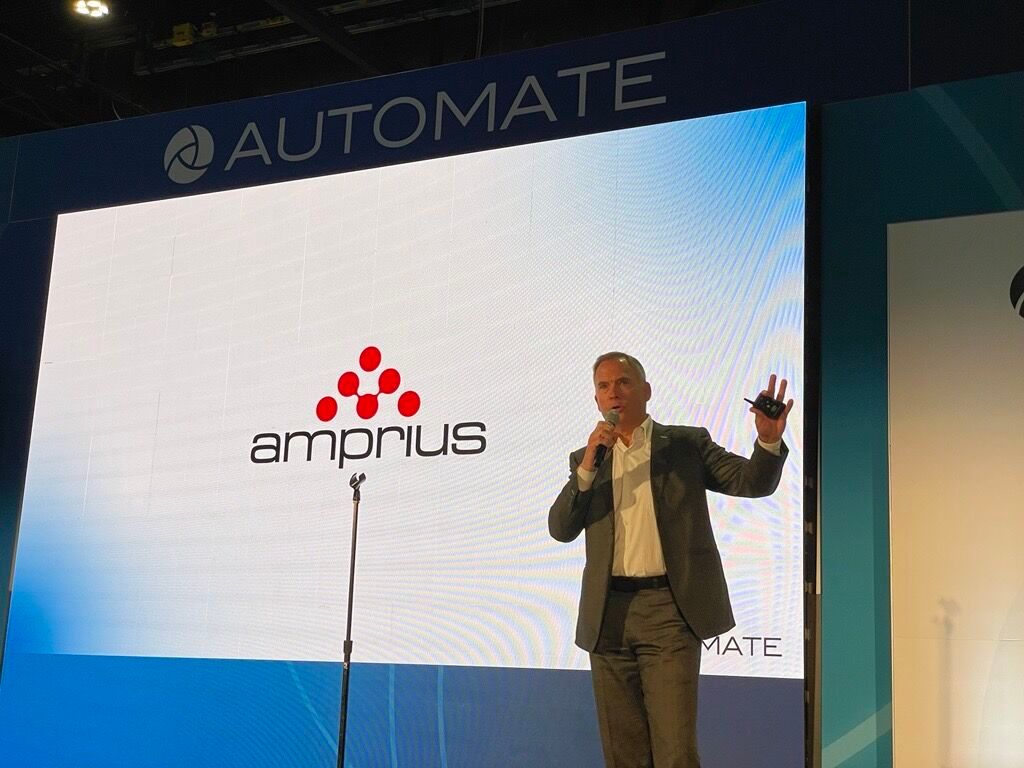
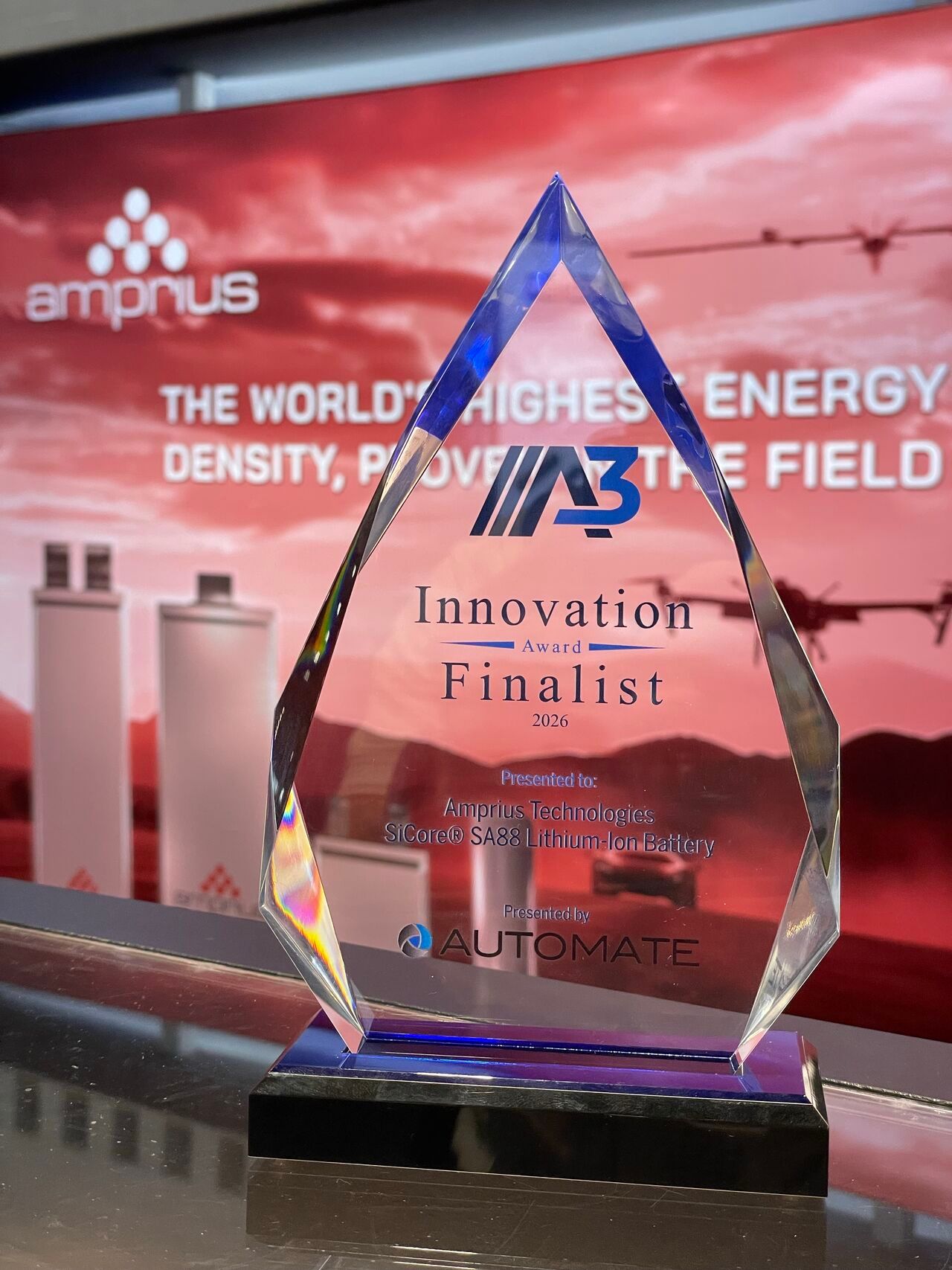
Amprius Technologies (NYSE: AMPX) exhibited at Automate 2026 (June 22–25, McCormick Place, Chicago) at booth 36017, presenting its SiCore SA88 silicon-composite anode pouch cell. The SA88 was named one of three finalists in the Components, Hardware & Enabling Technologies category at the Automate Innovation Awards ceremony held on June 23. The cell delivers 358 Wh/kg and 750 Wh/L at C/5 discharge rate, with a 10 Ah nominal capacity and a maximum continuous discharge rate of 3C. Amprius positions the SiCore platform as a commercially available, scalable alternative to graphite-anode lithium-ion cells for robotics, AMR, UAV, and aerial mobility applications where mass budget is a primary system constraint.
Industry Context
Conventional graphite-based lithium-ion cells used in autonomous mobile robots (AMRs) and unmanned aerial vehicles (UAVs) typically deliver 250–280 Wh/kg. At this energy density, payload capacity, mission endurance, and operational cycle time impose practical limits on deployment economics. For AMR platforms running 16- to 20-hour warehouse shifts, battery weight directly affects the trade-off between counterweight requirements, floor load ratings, and effective payload. For multirotor UAVs, battery mass constrains hover time and sensor payload simultaneously.
The Automate Innovation Awards, administered by A3 (Association for Advancing Automation), recognize components and systems that demonstrably advance automation capability. The Components, Hardware & Enabling Technologies category covers drives, motors, metrology tools, cables, connectors, and enabling infrastructure. The appearance of a battery cell as a finalist in this category reflects growing recognition among automation engineers that energy storage architecture is a first-class design variable in mobile robotics.
Technology
SiCore Platform
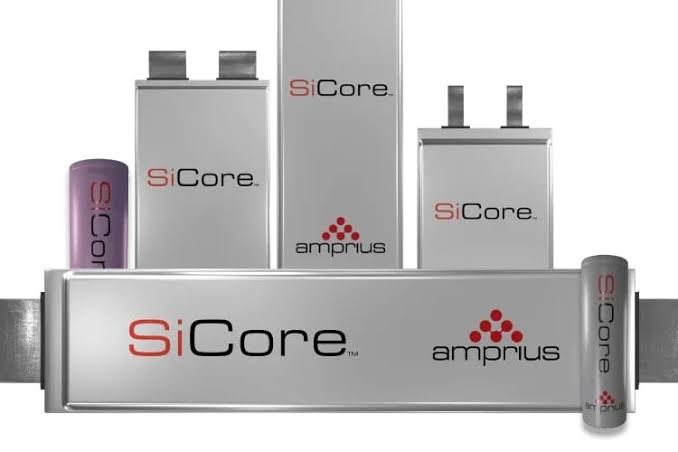
Amprius markets two silicon-anode product lines. SiMaxx uses 100% silicon nanowire anodes grown directly on copper foil substrates via roll-to-roll chemical vapor deposition (CVD). SiCore uses silicon-composite anode materials — silicon blended with carbon matrices — offering lower energy density than SiMaxx but improved cycle life and scalability at commercial volumes.
The SA88 is the current commercial flagship of the SiCore line. Published specifications from Amprius' product page and confirmed via the About:Energy Voltt database state an energy density of 358–370 Wh/kg at C/5 and 750 Wh/L volumetric density. Capacity is 10 Ah in a pouch cell form factor. Maximum continuous discharge is 3C, with a 1C charge rate.
Table 1: Amprius Cell Portfolio — Verified Specifications
| Product | Chemistry | Energy Density (Wh/kg) | Volumetric (Wh/L) | Capacity | Max Discharge |
| SiCore SA88 | Silicon-composite anode | 358 Wh/kg @ C/5 | 750 Wh/L | 10 Ah | 3C continuous |
| SiCore platform (max) | Silicon-composite anode | Up to 450 Wh/kg | Up to 1,150 Wh/L | Multiple SKUs | Up to 6C |
| SiMaxx (flagship) | 100% silicon nanowire | Up to 520 Wh/kg | Up to 1,300 Wh/L | Multiple SKUs | Up to 10C (pulse) |
| Typical graphite Li-ion | Graphite anode (reference) | ~250–280 Wh/kg | ~600–700 Wh/L | — | 1–3C typical |
Sources: Amprius product pages (amprius.com/products/sa88, amprius.com/solutions/sicore); CTO presentation slides (HAPS Conference 2025); Amprius X/Twitter post referencing About:Energy Voltt listing. Note: SiMaxx 520 Wh/kg specification is the CES 2026 Best of Innovation submission; commercial SiMaxx cells in production are listed at 450–500 Wh/kg range.
Silicon Volume Expansion — Engineering Approach
Silicon anodes store approximately 10 times more lithium per unit mass than graphite, but undergo volumetric expansion of up to 300% during lithiation. Unmanaged, this expansion causes particle fracture, loss of electrical contact, and rapid capacity fade. Amprius addresses this through nanoscale geometry: in SiMaxx, individual nanowires are rooted to the copper substrate at one end, with free lateral space to accommodate expansion without delamination. In SiCore, silicon particles are embedded in carbon matrices with engineered porosity to buffer volume change. The company reports up to 1,300 full-depth discharge cycles for SiCore, compared to 300–500 cycles for early silicon-composite approaches.
Drone Flight Time — Benchmarking
In May 2026, Amprius reported that in a head-to-head comparative test, its high-energy silicon anode cell extended drone flight time by more than 80% versus a comparable graphite-based cell of equivalent pack volume. The company attributed this improvement to both higher gravimetric energy density and the ability to discharge at useful C-rates without significant energy density penalty.
Engineering Analysis
Relevance to AMR Platforms
For warehouse and logistics AMRs, the primary energy storage metrics are Wh/kg (mass efficiency), cycle life (total cost of ownership), and charge rate (fleet utilization). At 358 Wh/kg, the SA88 offers approximately 25–40% more energy per kilogram than high-performance graphite cells. For a 24 kg AMR battery pack, this translates to approximately 3–5 additional kilowatt-hours per charge cycle at equivalent mass — extending shift coverage or enabling a smaller, lighter pack for the same endurance target.
The 3C continuous discharge rate of the SA88 is compatible with the power profiles of AMR drive systems in the 2–5 kW range. However, integrators should note that the SA88 charge rate is specified at 1C, which constrains opportunity-charging window length versus some graphite cells rated at 2–3C charge. Battery management system (BMS) design and thermal management at the pack level are not public for the SA88; integrators will need to characterize these parameters during qualification.
Relevance to UAV and Aerial Platforms
For multirotor UAVs, hovering efficiency scales inversely with total system weight. A 30% reduction in battery pack mass at constant capacity directly translates to either longer endurance or increased sensor payload. At 750 Wh/L, the SA88 also enables more compact pack geometries, which can improve aerodynamics and reduce mechanical complexity in tight airframe designs.
The 3C continuous discharge rate supports typical UAV cruise power draws but may constrain platforms requiring sustained high-C transient power for vertical takeoff and landing (VTOL) maneuvers. Amprius' SiMaxx cells, which support up to 10C pulse discharge, are better suited for VTOL and eVTOL applications with high instantaneous power demands. The SiCore SA88 is positioned for fixed-wing and hybrid VTOL platforms where cruise endurance dominates the power profile.
NDAA Supply Chain Considerations
Amprius manufactures silicon anodes and pilot-production cells at its Fremont, California facility. Volume production is handled through a contract manufacturing strategy. In its June 2026 UAV webinar (June 17), CTO Dr. Ionel Stefan addressed NDAA (National Defense Authorization Act) compliance considerations for defense UAV integrators. Amprius has publicly disclosed it partners with contract manufacturers across Asia and the US. Customers procuring for U.S. government or NDAA-sensitive programs should conduct supply chain due diligence accordingly.
Commercial Progress
Automate 2026 Context
Amprius entered Automate 2026 with a well-documented pre-show commercial calendar. The company had participated in the William Blair 46th Annual Growth Conference (June 3), the Jefferies Innovative Aerospace Virtual Summit (June 8), and Eurosatory (June 15–19, Paris) in the month prior. The UAV-focused webinar on June 17, co-presented with Leo Flight and Titan Batteries, positioned the company's technology in front of defense UAV integrators ahead of the Chicago show.
Matternet Partnership (May 2026)
On May 19, 2026, Amprius and Matternet announced a strategic battery supply collaboration. Matternet is the only drone delivery company to hold both FAA Type Certification and Production Certification for a commercial delivery platform. The Matternet M2 aircraft has accumulated more than 60,000 commercial flights across the U.S. and Europe. Amprius cells are currently deployed in the M2 fleet. The companies are jointly developing battery solutions optimized for Matternet's next-generation platform, with Amprius targeting volume production readiness aligned with Matternet's fleet expansion beginning in early 2027. Optimization work covers cell selection, form factor, thermal management, charge rate, and cycle life — parameters that directly affect cost per delivery at commercial scale.
Nokia and Other Customers
Nokia selected Amprius SiCore cells for its drone-in-a-box 5G industrial UAV platform, marking what both companies described as the first deployment of silicon-anode technology in Nokia's drone fleet. The integration was showcased at CES 2026 in January. Amprius' customer base includes Airbus subsidiary AALTO HAPS (stratospheric HAPS platforms), the U.S. Army (Conformal Wearable Battery program), and multiple pack integrators including Titan Batteries and Upgrade Energy.
Q1 2026 Financial Highlights
In Q1 2026, Amprius reported securing a $21 million order from a light electric vehicle customer in China — the largest single order in the company's history at the time of announcement. The company reported more than 550 active customers globally and highlighted a transition from vertically integrated manufacturing to a contract manufacturing model designed to scale production with lower capital intensity. CFO Ricardo Rodriguez noted that this model allows the company to expand capacity without the fixed-asset constraints of traditional battery manufacturers.
Market Perspective
The robotics and automation sector is entering a phase where battery performance is a meaningful differentiator rather than a commodity input. As warehouse AMR fleets scale toward 24/7 operation and commercial drone delivery networks expand service areas, the economics of battery mass, cycle life, and charge time compound at the fleet level. A 30% improvement in Wh/kg does not simply extend a single robot's shift — across a 200-unit fleet, it can reduce the number of charging stations, the floor space allocated to charging infrastructure, and the number of battery swap events per week.
Amprius is competing in a market segment where graphite-cell manufacturers from Japan, South Korea, and China have decades of process optimization advantage. The company's differentiation depends on maintaining the energy density gap against improving graphite-cell designs while reducing cell cost through contract manufacturing scale. The SiCore platform's 1,300-cycle specification is competitive with high-quality NMC graphite cells but below the 2,000+ cycles some automotive-grade cells achieve. For AMR applications with one to three full cycles per day, 1,300 cycles implies a cell service life of roughly 1.2 to 3.5 years — a range that aligns with typical industrial equipment refresh cycles but warrants verification for 24/7 high-throughput deployments.
RobotToday Analysis
Amprius' presence at Automate 2026 as an Innovation Award finalist signals an important structural shift in how the automation industry is beginning to categorize battery technology — not as a purchased commodity, but as a system-level design variable that engineers should evaluate on the same basis as motors, drives, and sensors.
The SiCore SA88's verified specification of 358 Wh/kg and 750 Wh/L positions it meaningfully above commercial graphite-cell performance. For robotics integrators evaluating this cell, the relevant engineering questions are pack-level, not cell-level: what does the BMS architecture look like, what is the thermal management requirement at 3C discharge in a sealed enclosure, and what is the degradation curve in the specific depth-of-discharge window their application requires.
The Matternet partnership is the most operationally significant commercial data point from this period. It places Amprius cells in a certified, commercially operating drone network — providing real-world cycle accumulation data under known operating conditions. This is qualitatively different from laboratory validation or prototype deployments. If Amprius can demonstrate consistent cell performance across Matternet's fleet at scale, it will substantially de-risk the technology for other UAV and AMR integrators.
The primary open questions for the robotics market remain: (1) cost-per-kWh at volume production compared with NMC and NCA graphite alternatives, (2) cycle life performance at partial depth of discharge representative of AMR operation, and (3) contract manufacturing supply chain transparency for programs requiring NDAA compliance. These are engineering due-diligence questions, not objections — and they are answerable through normal procurement qualification processes. RobotToday will track cell-level qualification data as it becomes available from integrators deploying the SA88 in commercial robotics programs.
Key Sources
Amprius Technologies IR: June 2026 Events Schedule (Business Wire, June 1, 2026)
Amprius / Matternet Partnership Announcement (Business Wire, May 19, 2026)
Automate Innovation Awards 2026 Finalists List — automateshow.com
Amprius SA88 Product Page — amprius.com/products/sa88
Amprius SiCore Platform Page — amprius.com/solutions/sicore
CTO Ionel Stefan presentation: Lithium-Ion Batteries for Perpetual Stratospheric Platforms (HAPS Conference 2025)
Amprius Q1 2026 Financial Results (May 6, 2026)
Amprius CES 2026 Best of Innovation Award (UST / CTA, January 2026)










Leave a comment