


The 2026 labor showdown that Amazon, the Teamsters, and humanoid robotics can't avoid
Series: Robots vs. Labor | Article 1 of 3
The warehouse never sleeps. There is a moment, sometime around 3:00 AM in a fulfillment center outside of Robbinsville, New Jersey, when the gap between what a warehouse needs and what it can hire becomes impossible to ignore. The loading dock doesn't care that it's the middle of the night. The sorting machines don't pause because the overnight shift is down six pickers again. And the algorithms — the relentless, optimized algorithms that orchestrate every box, every scan, every route — just keep pushing the pace higher.
This is the quiet crisis at the heart of American logistics. Not a dramatic headline. Not a single dramatic event. Just a slow, grinding mismatch between explosive demand and a workforce that is shrinking, aging, and increasingly unwilling to show up.
And now, for the first time, there is a credible technological answer. It just happens to be a six-foot-tall humanoid robot — and the people who stand to lose the most from its arrival are already drawing battle lines.
The Labor Shortage Is Real
The U.S. warehouse and fulfillment industry employs roughly 1.5 million workers. On paper, that sounds like plenty. In practice, it is not close to enough. According to data from the U.S. Bureau of Labor Statistics, the logistics sector has been running at a persistent labor deficit for the better part of a decade. Annual turnover rates at major fulfillment centers routinely exceed 150% — meaning the average worker leaves before completing a full year. Recruiting firms report that warehouse positions in competitive markets now sit unfilled for an average of 90 days before being filled, if they are filled at all.
The problem is not wages alone, though wages are part of it. Starting pay at the largest fulfillment centers has climbed above $19 an hour in most U.S. markets — a figure that would have seemed generous a decade ago. The deeper issue is the work itself. Ten-hour shifts on concrete floors, repetitive scanning motions that erode joints over months, and a relentless productivity clock that leaves almost no room for error or rest. Generation Z, the demographic cohort now entering the workforce in the largest numbers, has made its preferences clear: this is not the kind of work they want to do.
The International Federation of Robotics flagged this dynamic in its Top 5 Global Robotics Trends for 2026, identifying labor shortages as a primary driver of new automation investment. The IFR noted that employers are "struggling to find people with the specialized skills required," and that "unfilled jobs leave existing staff covering extra shifts, with rising stress and fatigue across all sectors."
Logistics, with its 24/7 operational demands and its brutal seasonal swings, is where that stress is most acute.
Enter the Humanoid
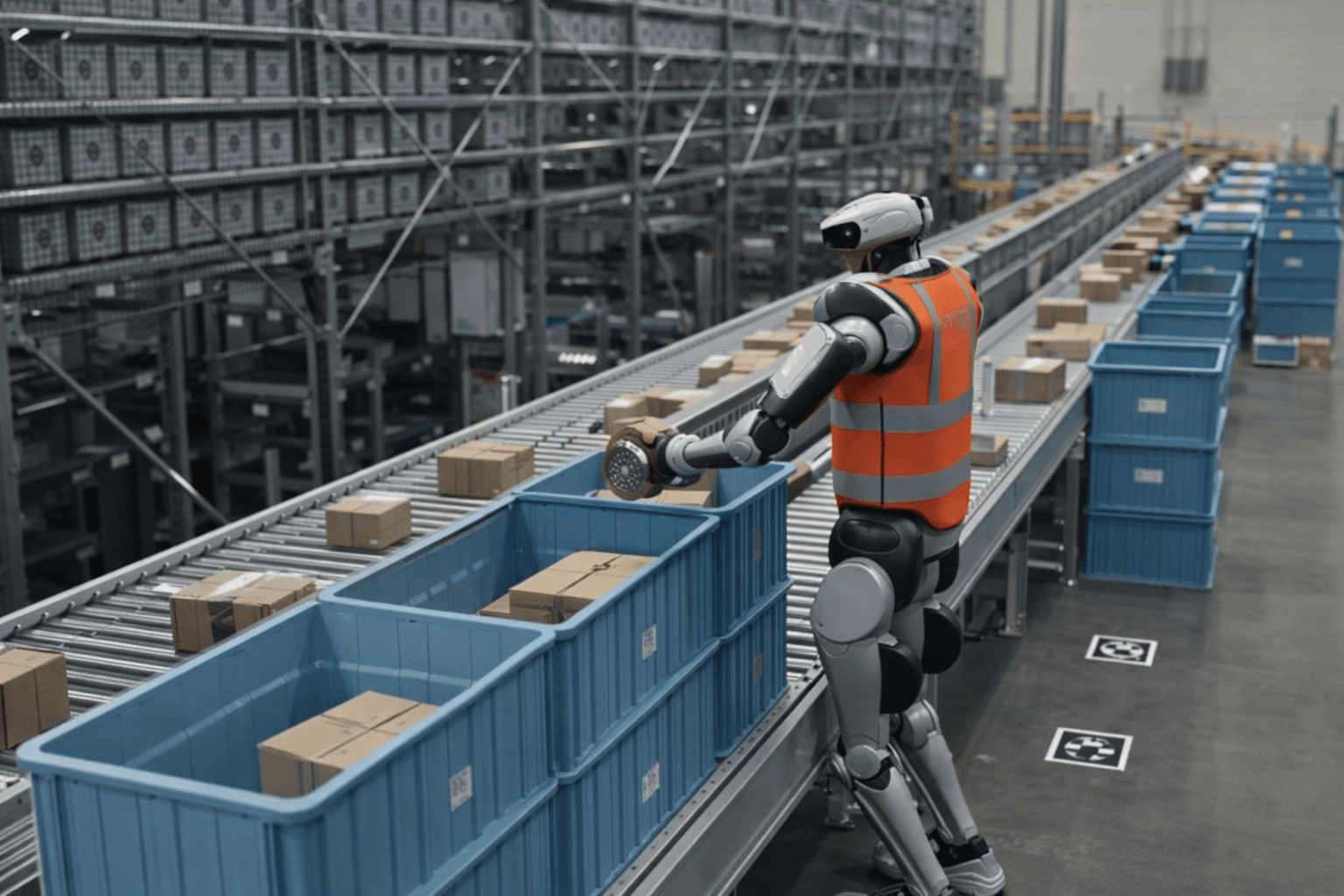
For years, warehouse automation meant conveyor belts, barcode scanners, and stationary robotic arms bolted to the floor. These systems are effective — but they are also inflexible. They work well when the task is predictable and the environment is engineered around them. A humanoid robot promises something fundamentally different: a machine that can operate in spaces designed for humans, using tools designed for humans, performing tasks that require the kind of adaptive, general-purpose intelligence that traditional industrial robots simply cannot replicate.
The most visible example right now is Amazon's deployment of Agility Robotics' Digit humanoid in its fulfillment centers, alongside its own investment in Boston Dynamics' Atlas platform. These robots are not yet replacing workers at scale. But they are doing something arguably more significant: they are proving that the concept works outside of a lab.
Digit, a bipedal humanoid weighing roughly 100 pounds, can walk between aisles, pick up totes, and transport them to designated locations — tasks that sound simple but have defeated dozens of wheeled and fixed-base robots over the past decade. The key is not raw speed. It is adaptability. When a bin is in the wrong place, or a path is blocked, or the task changes mid-shift, Digit adjusts. A conveyor belt cannot.
The IFR's 2026 trends report underscored this shift, noting that "humanoid robots for industrial use are seen as a promising technology where flexibility is required, typically in environments designed for humans." The report added that companies are now "moving beyond prototypes to deploy humanoids in real life," with reliability and efficiency as the critical benchmarks. In logistics, those benchmarks are being tested in real time.
The Union Wakes Up
But here is where the story gets complicated — and, for many in the industry, genuinely alarming.
In late January 2026, Hyundai Motor Group's labor union in South Korea issued a statement that sent a shockwave through the global manufacturing and robotics community. The union declared that "not a single robot will be allowed onto the factory floor without a labor-management agreement." The target of that warning was Atlas, Boston Dynamics' humanoid robot, which Hyundai plans to deploy at its new Metaplant in Georgia starting in 2028. The union's concern was not abstract. Its members ran the math. Operating a 24-hour production line requires three workers across shifts, at a combined annual cost of roughly $208,000. A humanoid robot, once purchased, requires only maintenance and electricity. The economics, the union argued, create an unavoidable incentive for workforce reduction — not immediately, but inevitably.
the union stated.
"For capital seeking long-term profit maximization, robots offer a compelling rationale,"
This is not a Korean story. It is a preview.
In the United States, the Teamsters — the largest private-sector union in the country, representing over 300,000 warehouse and logistics workers — have been watching the humanoid robotics wave with increasing attention. The union's official position, as articulated by senior advisors, is not outright opposition to automation. The Teamsters are not Luddites. But they are demanding a seat at the table — specifically, contractual provisions that guarantee advance notice before any new automation is deployed, transition funds for displaced workers, and retraining pathways into supervisory and maintenance roles.
The United Auto Workers (UAW) has taken a similar stance. Jason Wade, a senior advisor to UAW President Shawn Fain, stated that the union "doesn't object to automation, especially if it makes jobs safer or less taxing," but insists on a say in how robots are implemented. The union wants to "protect paychecks and ensure workers whose jobs are replaced by robots are retrained to oversee them."
These are not unreasonable demands. They are, in fact, the kind of structured negotiation that labor relations experts say is necessary for automation to succeed without social disruption. But they are also demands that take time — and in logistics, time is the one resource that is perpetually in short supply.
How Companies Bypass the Unions
So how do companies respond when the technology is ready, the labor shortage is acute, and the union negotiations are slow?
They go around.
Hyundai's plan to pilot Atlas in Georgia — a right-to-work state with no union presence at the new plant — is the most visible example. But it is far from the only one. Amazon has quietly expanded its robotics testing at facilities in countries where labor regulations and union density are significantly lower. DHL has built fully automated sorting centers in Eastern Europe, where the workforce dynamics are fundamentally different from Western Europe.
The pattern is familiar to anyone who has studied industrial history. As the Korea Herald noted in its analysis of the Hyundai situation, "overseas facilities often become testing grounds. By the time technologies reach domestic plants, they're already proven."
This is not a conspiracy. It is rational corporate strategy. But it carries a significant risk: if humanoid robots are validated in non-union environments first, the negotiating dynamic shifts. Unions lose leverage when the technology is no longer theoretical. A company can point to a functioning, profitable, fully automated facility and say: "This works. The question is not whether we adopt it. The question is the terms."
Harvard Business Review flagged this dynamic explicitly, arguing that unions like the UAW, Teamsters, and the International Warehouse and Longshore Union "appear to be stuck in the past" in their approach to AI and automation negotiations. The core problem, HBR argued, is that unions are still negotiating over wages and hours when the more consequential battle — over the pace and terms of technological displacement — is already underway.
What Comes Next
The logistics industry will not wait for this debate to resolve itself neatly. The pressures are too immediate. Peak season doesn't negotiate.
But the outcome is not predetermined. There are three possible trajectories, and which one materializes will depend largely on decisions being made right now — in boardrooms, in union halls, and in state legislatures.
-
Scenario one: Rapid deployment. Companies move fast, deploy humanoids in non-union facilities, prove the economics, and present unions with a fait accompli. Negotiations happen, but from a position of strength for management. This is the Tesla path — Elon Musk has targeted commercial deployment of Optimus by late 2026, entirely unburdened by union constraints.
-
Scenario two: Structured transition. Companies and unions negotiate proactively — not to block automation, but to shape it. Workers are retrained as robot supervisors, fleet managers, and maintenance technicians. The workforce shrinks, but more slowly, and with a safety net. This is the path that labor policy experts advocate, and the one that several European governments are quietly encouraging.
-
Scenario three: Stalemate. Negotiations drag on. Companies invest overseas. Domestic fulfillment centers remain understaffed and under-automated. The labor shortage worsens. Eventually, the gap becomes so large that deployment happens anyway — but without the transition infrastructure that scenario two would have provided.
The IFR's 2026 report offered a pointed observation on this dynamic: "The close cooperation with employees in implementing robots plays a crucial role to ensure acceptance." It is a diplomatic way of saying what the Hyundai union already knows: the battle over humanoid robots in logistics is not primarily a technology fight. It is a negotiation. And the side that comes to the table first — with the better data, the clearer vision, and the more compelling alternative — will shape the outcome for a generation.
The warehouse doesn't sleep. The robots are ready. The question now is whether the humans running the industry are.
Next in this series: Manufacturing Intelligence — When the machine sees what 40 years of human experience cannot. How AI is becoming the brain behind modern manufacturing, and why quality control may be the quietest battleground for automation.
Sources referenced:
- International Federation of Robotics — Top 5 Global Robotics Trends 2026 https://ifr.org/ifr-press-releases/news/top-5-global-robotics-trends-2026
- Korea Herald — "Hyundai Motor's humanoid push meets labor wall" (Jan. 30, 2026) https://www.koreaherald.com/article/10666647
- U.S. Bureau of Labor Statistics https://www.bls.gov
- Harvard Business Review — "The UAW and Other Unions Must Focus More on AI and Automation in Their Negotiations" https://hbr.org/2023/09/the-uaw-and-other-unions-must-focus-more-on-ai-and-automation-in-their-negotiations
- Axios (general coverage — UAW, labor, automation) https://www.axios.com
- BGR — "Hyundai Union Is Fighting Humanoid Robots Joining the Workforce" https://www.bgr.com/2087161/hyundai-union-fighting-robots-joining-workforce/
- MIT Technology Review — "Why the humanoid workforce is running late" https://www.technologyreview.com/2025/05/06/1116108/why-the-humanoid-workforce-is-running-late/







Leave a comment