


Executive Summary
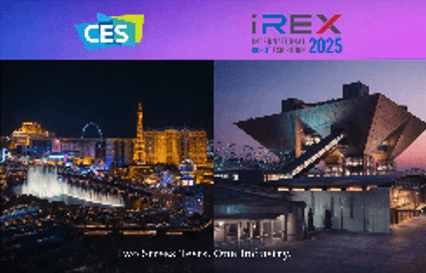
Two consecutive global events—iREX 2025 in Tokyo and CES 2026 in Las Vegas—offer a compressed stress test for the robotics industry as it enters 2026. iREX focuses on whether robots can be manufactured, integrated, and operated at scale. CES focuses on whether robots can be understood, financed, and adopted by global markets. The contrast highlights diverging regional strategies across Japan, Korea, China, and the US. Together, the two events reveal where robotics is moving from narrative momentum to industrial reality.
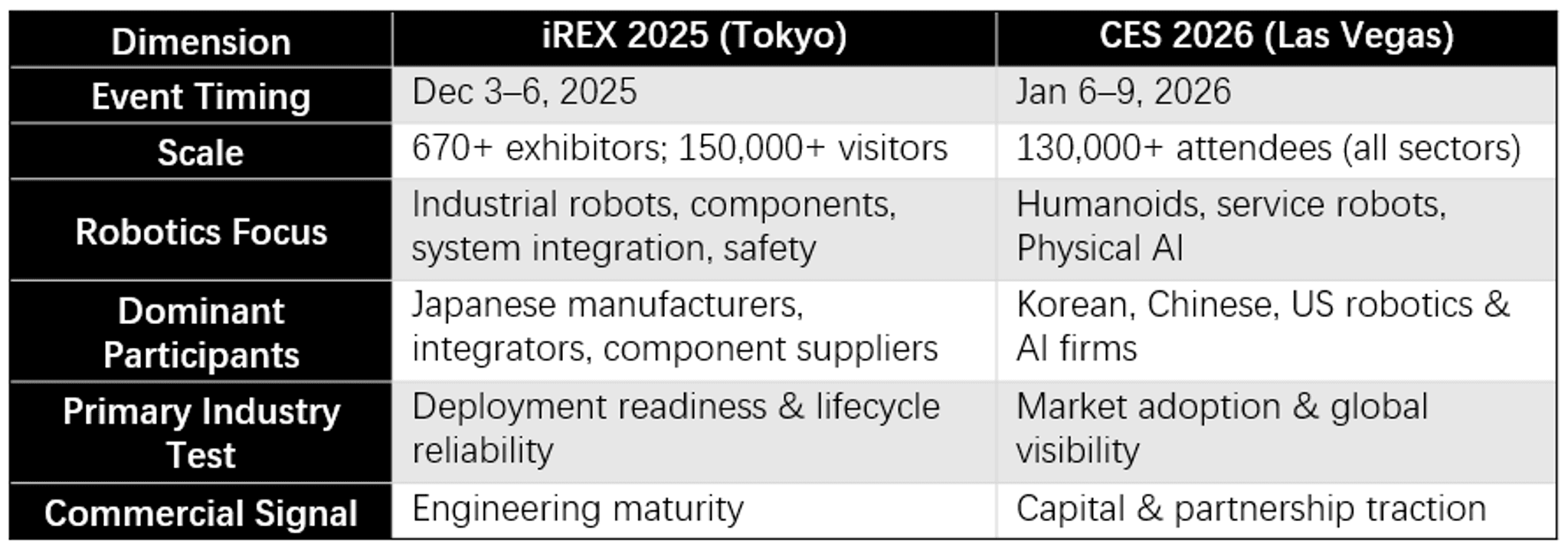
1. Key Event Data Snapshot
2. CES 2026: Where Robotics Competes for Global Attention
CES plays a fundamentally different role from industrial exhibitions. As CES 2026 opens in early January, robotics is positioned within a broader narrative dominated by AI, Physical AI, and intelligent systems, rather than by manufacturing or deployment metrics. The exhibition rewards companies that can translate complex engineering into clear, scalable stories that resonate with global investors, partners, and media.
In this environment, success at CES is less about operational maturity and more about conceptual clarity and narrative coherence. Companies that perform well are those able to articulate how their robots fit into larger platform strategies—AI stacks, data ecosystems, developer tools, or service models—rather than presenting robots as isolated hardware products.
This is precisely why CES has become strategically critical for non-Japanese robotics companies. For many Korean and Chinese firms, CES is no longer optional; it functions as a primary gateway to global markets, particularly the US and Europe. CES does not ask whether a robot is fully deployable today. It asks whether the market can understand it, believe in it, and imagine adopting it at scale.
3. Regional Behavior Shift:
What the Two Events Reveal Japan: Build First, Speak Later
Japanese robotics companies remain structurally anchored to iREX rather than CES, reflecting long-standing priorities rooted in advanced manufacturing culture. Their focus remains on production maturity, integration depth, and lifecycle reliability—factors that matter most once robots leave the demo stage and enter real operating environments.
At CES, Japanese participation tends to concentrate on subsystems, components, and enabling technologies—motion control, sensing, safety, precision parts—rather than headline-driven humanoid narratives. These contributions are often less visible to mainstream audiences, but they quietly underpin many of the systems showcased by other regions. This posture should not be read as conservatism or lack of ambition. It reflects strategic consistency: Japanese firms prioritize building technologies that can survive long deployment cycles, regulatory scrutiny, and service demands before amplifying their presence through global marketing platforms.
Korea: CES as a Coordinated National Showcase
Korea’s behavior across iREX and CES reflects a sharply different strategy. At iREX, Korean participation is selective and exploratory, often focused on benchmarking technologies and understanding industrial requirements. CES, by contrast, is treated as a high-visibility national stage. Korean robotics companies increasingly appear at CES through coordinated pavilions and alliance-driven presentations.
This approach mirrors how Korea previously scaled industries such as semiconductors and displays: first establish a clear ecosystem identity, then accelerate global adoption through visibility and partnerships.
Within this framework, humanoids and service robots are positioned less as standalone products and more as national capability platforms. The emphasis is on signaling ecosystem readiness—hardware, software, manufacturing, and policy alignment—rather than on individual company breakthroughs.
China: CES as Market Access, Not Just Branding
Chinese robotics companies show the most pronounced contrast between iREX and CES. Participation at iREX remains limited and highly selective, while presence at CES continues to expand rapidly, both in scale and diversity of exhibitors. This shift reflects a deeper strategic recalibration. CES is increasingly viewed by Chinese firms as a commercialization testbed, rather than merely a branding opportunity. The exhibition provides direct exposure to overseas buyers, integrators, regulators, and potential partners—feedback that is difficult to obtain through domestic channels alone. At CES, Chinese companies actively test distribution models, explore pilot deployments, gauge compliance expectations, and collect buyer responses to pricing and service structures. The underlying urgency is clear: global market access cannot be deferred, and learning must happen in real time, even before products
United States: Platform Gravity Over Hardware Density
US robotics presence at CES continues to center on platform influence rather than hardware density. While fewer American firms focus on full-scale humanoid manufacturing, their strength lies in AI platforms, autonomy software, developer ecosystems, and enterprise-oriented robotics applications. These companies shape how robotics systems are built, integrated, and operated by controlling key layers of the technology stack—compute, AI models, middleware, and developer tools. As a result, even when hardware originates elsewhere, deployment often depends on US-led software and infrastructure frameworks.
At CES, this platform gravity becomes especially visible. US firms dominate the narrative around how robots connect to data, cloud services, and enterprise systems, reinforcing their role as architects of the broader robotics operating environment.
Europe: Deployment Depth Over Exhibition Velocity
European robotics companies remain underrepresented at CES 2026 compared with their visibility at iREX, Hannover Messe, or Automatica. This reflects not weakened competitiveness, but a strategic mismatch between CES’s narrative-driven format and Europe’s deployment-oriented robotics model.
Most leading European firms are optimized for long-cycle industrial environments—regulated factories, brownfield integration, and safety-critical automation—where compliance, system integration, and lifecycle reliability matter more than exhibition visibility. As a result, CES offers lower immediate ROI than industrial trade fairs where buyers and integrators are directly present.
4. The Real Industry Target in 2026 Is Not “Humanoids”
Across both iREX and CES, one conclusion becomes increasingly unavoidable: form factor is no longer the primary competitive frontier. The decisive battleground in 2026 is operational credibility.
The companies that matter most will not be those with the most striking demos, but those able to demonstrate credible answers to safety and compliance, serviceability, integration cost, and reliability economics. These factors determine whether robots can transition from experimental deployments to scalable, repeatable operations
Japan builds for these requirements by default. Korea is beginning to systematize them at an ecosystem level. China is racing to confront them directly through global market exposure. Together, these approaches define the contours of robotics’ next industrial phase.
5. What CES 2026 Will Actually Decide
CES 2026 will not determine who “wins” humanoids. It will determine which companies are capable of moving beyond prototype narratives toward deployable systems supported by real ecosystems. The exhibition will surface which players can sustain robots after the demo ends—through service networks, compliance strategies, and integration partnerships—and which regional strategies align most closely with buyers, operators, and regulators. In this sense, CES is less a celebration of robotics progress than a stress test of commercial readiness. The outcomes may not be immediately visible on the show floor, but they will shape investment, partnerships, and deployment decisions throughout 2026.
Why This Matters for RobotToday Readers
For industry professionals, investors, engineers, and system integrators, reading iREX 2025 and CES 2026 together provides unusual clarity. Robotics is entering a phase defined less by imagination and more by execution.
Narratives are converging toward engineering discipline, service infrastructure, and economic realism. Those who recognize this shift early will be better positioned than those still optimizing for spectacle rather than survivability. did you see similar discussions in history and today's Tech media?
Related coverage from RobotToday:
- CES 2026 Robotics: From Physical AI to Real Deployment
Why humanoid development paths diverged sharply in readiness and execution - From iREX 2025 to CES 2026, Two Consecutive Stress Tests for the Global Robotics Industry
Why consecutive flagship events exposed structural pressure across the industry - CES 2026 Exposes a Structural Divide in Humanoid Robotics
The overarching framework connecting Physical AI concepts with real deployment






Leave a comment