


A domain-by-domain benchmark of China and the international field across on-orbit servicing, lunar robotics, space station manipulation, ISAM, and embodied AI — mapping where each side leads, where the race is open, and what the asymmetries mean for industry strategy.
Published March 2026 · RobotToday.com Space Robotics Series
INTRODUCTION: NOT A RACE — A MAP OF ASYMMETRIC STRENGTHS
The competitive landscape in space robotics is defined by genuine asymmetries — neither side holds a uniform advantage, and gaps are moving in different directions across domains. China leads in operational lunar surface robotics; no other nation has an active rover on the Moon. The West leads in commercial on-orbit servicing, ISAM, and deep space autonomy built on decades of JPL heritage. The two sides are at parity in active debris removal and large-arm space station manipulation. And in the domain most consequential for the decade ahead — embodied AI on space-grade hardware — neither side has a deployable product. The domains covered below are drawn from the RobotToday.com Space Robotics Series; each assessment identifies the structural driver of the gap, not just its current position.
Verdict colour key: ■ China Leads ■ Parity / Mixed ■ West Leads ■ Open Race
DOMAIN-BY-DOMAIN COMPETITIVE MATRIX
The matrix below benchmarks China and the international field across ten space robotics domains. 'West / International' encompasses NASA, ESA, JAXA, and the commercial Western ecosystem collectively.
DOMAIN | CHINA POSITION | WEST / INTERNATIONAL | VERDICT | STRATEGIC IMPLICATION |
| On-Orbit Servicing — Satellite Refuelling & Life Extension | Early-stage; no commercial OOS service yet. CASC demonstrated docking TRL (Shijian-21). Sanyuan Aerospace (三垣航天) targeting commercial debris-capture & life-extension via flexible robotic arm tech-demo. | Northrop (MEV-1/2 in commercial service since 2020); Astroscale active debris demos; D-Orbit, Exolaunch ecosystem growing. | West Leads | First commercial OOS revenue already booked in the West. China has time-limited window to close gap before entrenched network effects favour incumbents. |
| Active Debris Removal (ADR) | Shijian-21 demonstrated grappling and deorbit of defunct satellite (2022). CASC leading nationally. Sanyuan Aerospace (三垣航天) planning Xiyuan-0 tech-demo satellite for low-cost flexible-arm capture. | Astroscale ADRAS-J; ClearSpace-1 (ESA contracted); D3 (NRL). Commercial models still emerging. | Parity | China demonstrated ADR in orbit before most Western commercial players. Regulatory and business model questions unsettled on both sides. Genuine race. |
| Lunar Surface Rovers — Exploration | Yutu-2: world longevity record on far side. Strong teleoperation & thermal management heritage. | NASA VIPER (cancelled 2024); ESA PROSPECT instrument; Lunar Trailblazer (science orbit). No Western crewed rover yet deployed. | China Leads | China has the only active lunar surface programme with flight heritage. Advantage is operational, not merely programmatic. |
| Lunar ISRU & Construction Robotics | Chang'e-8 (2028) will carry first ISRU construction robot. Deep Space Exploration Tech (Shanghai) / DSEL running commercial deep space ground stations and lunar resource survey systems. | NASA MOXIE (Mars O2 demo); Blue Origin / Intuitive Machines concepts; ESA PERIOD study. No flight hardware yet. | China Leads (programmatically) | China has a funded, scheduled ISRU robot mission. West has promising concepts but no equivalent near-term flight commitment. |
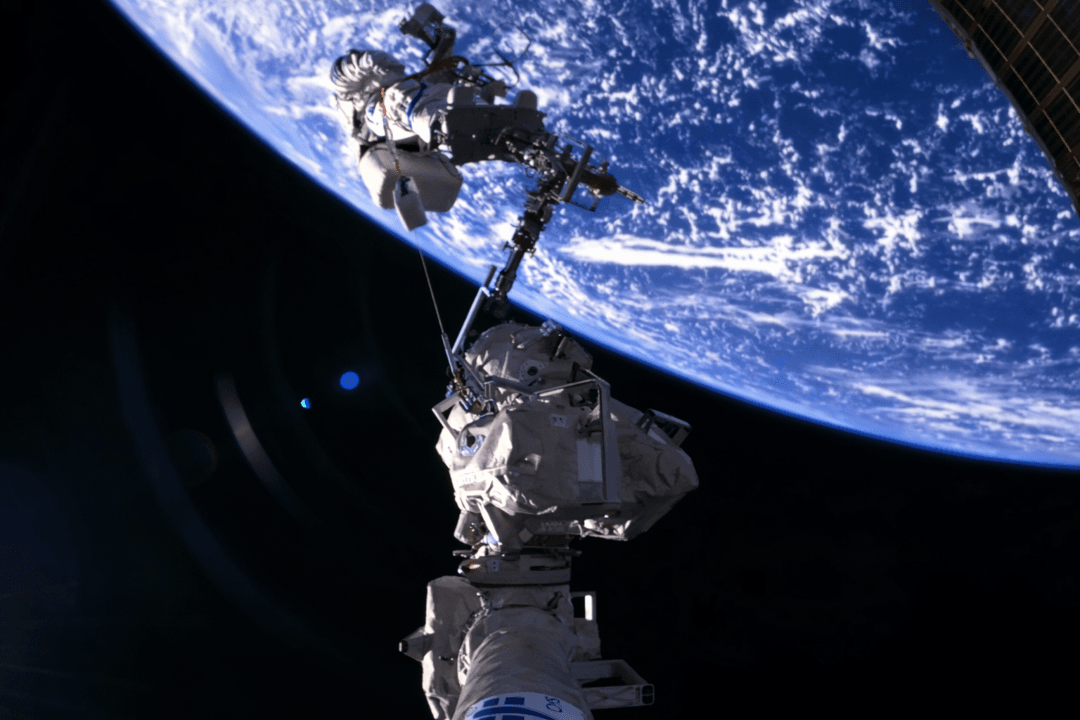
| Space Station Robotic Arms — Large Payload | Tianhe large arm: 10.2 m, 25-tonne capacity, world-leading positioning accuracy. In service. Longshen Tech (隆盛科技) supplying flight-qualified arm core components; 2nd-gen parts in development. | Canadarm2 (ISS): 17.6 m, 116-tonne capacity, 25+ years in service. ERA on Nauka module. | Parity / Heritage | Both systems are mature and operational. Western advantage is accumulated flight hours and multi-decade maintenance data; Chinese arm leads on mass-to-capacity ratio. |
| In-Orbit Dexterous Manipulation (fine tasks) | TRL 4–5. Tianhe 2 demonstrated basic tool use in 2016. Gap vs. Dextre is openly acknowledged. | Dextre (SPDM, ISS): operational since 2008 — multi-arm coordinated fine work, fuel line cutting, connector change-out. | West Leads | 15+ year operational gap. China's stated priority for next station upgrade cycle. Largest near-term opportunity for technology transfer or domestic development. |
| Embodied AI / Space-Grade Autonomous Reasoning | Terrestrial VLA capability world-class: Unitree, Zhiyuan, Qianxun, Zhipingtang (GOVLA model), Zeroth (dexterous manipulation), Xinton AI (space-oriented embodied AI platform). Space-grade version: TRL 2–3. | NASA Astrobee (ISS free-flyer); DARPA programmes; no commercial space embodied AI product deployed. | Open Race | Neither side has solved radiation-hardened AI inference for space robotics. First mover advantage is enormous. Ground-level Chinese AI investment may translate faster than expected. |
| In-Space Assembly & Manufacturing (ISAM) | Research stage. No commercial ISAM company. Academic interest at HIT, Zhejiang, BIT. | Maxar (SSL heritage); Nanoracks / Voyager; Made In Space / Redwire; NASA OSAM-1 programme. US has a 10-year head start in ISAM commercial ecosystem. | West Leads Clearly | ISAM is the one domain where the US commercial ecosystem is both older and deeper. Chinese equivalents are nascent. Largest structural gap in the competitive landscape. |
| Multi-Robot Coordination / Swarm Systems (Space) | Strong terrestrial swarm research (Zhejiang Univ.). Space application TRL 2–3. | NASA distributed systems research; DARPA Mosaic Warfare (terrestrial). No deployed space swarm. | Open Race | Neither side has deployed space swarms operationally. ILRS build phase is China's forcing function. West has no equivalent near-term mission driver. |
| Deep Space Autonomous Navigation & Fault Recovery | Zhurong: supervised autonomy on Mars. Deep Space Exploration Tech (Shanghai) / DSEL active in deep space intelligent vision. Sample return missions will require full autonomy. TRL gap acknowledged. | Perseverance / Ingenuity: highest demonstrated autonomy of any planetary mission. Decades of JPL heritage. | West Leads (JPL heritage) | NASA/JPL leads by a full Mars mission generation. China's sample return timeline (2030s) creates urgency to close gap. Academic programs at DSEL are active but early. |
Sources: RobotToday.com series analysis; Northrop Grumman MEV programme data; Astroscale mission reports; CNSA and CASC technical briefings; NASA OSAM-1 programme documentation; JPL Mars rover mission archives; engineering.org.cn.
DOMAIN ANALYSIS: WHERE THE GAPS COME FROM
On-Orbit Servicing: The West's Commercial Head Start
On-orbit servicing is where the asymmetry is most commercially consequential. Northrop Grumman's MEV-1 docked with Intelsat 901 in February 2020 — the first commercial life-extension service in history — and MEV-2 followed in 2021. Astroscale secured the ADRAS-J debris inspection contract from JAXA; ClearSpace-1, contracted by ESA, targets a 2026 removal demonstration. The Western ecosystem has customers, contracts, and booked revenue. China has the underlying capability — Shijian-21 demonstrated rendezvous, grappling, and controlled deorbit in 2022 — but lacks the commercial infrastructure: standard interface definitions, third-party liability frameworks, and multi-operator servicing agreements. On the startup side, Sanyuan Aerospace (三垣航天) is the first Chinese commercial entrant explicitly targeting ADR and life-extension via flexible robotic arm capture. China's window to compete on equal terms before Western interface standards become entrenched defaults is roughly 2026–2029.
Northrop Grumman booked its first commercial on-orbit servicing revenue in 2020. China demonstrated equivalent technical capability in 2022. The gap is now commercial, not technical — commercial gaps are harder to close by decree.
Active Debris Removal: A Genuine Race with Regulatory Wildcard
Active debris removal is the one domain where China and the West are genuinely at parity — and where the winner may ultimately be determined by regulatory frameworks rather than engineering. Shijian-21 went beyond Japan's ADRAS-J inspection mandate: it demonstrated physical grappling and controlled relocation of a defunct satellite in 2022, a step no Western commercial entity has replicated. Sanyuan Aerospace (三垣航天) is now pursuing the commercial angle with its Xiyuan-0 tech-demo satellite, targeting low-cost flexible-arm capture. The Western ecosystem has more invested capital and mission diversity across Astroscale, ClearSpace-1, and NRL's D3 programme, but no booked ADR revenue. The decisive variable is who shapes the emerging international norms: debris ownership transfer, cross-registry liability, and the diplomatic question of who may remove whose objects. These frameworks are nascent everywhere, and the coalition that defines them will hold an advantage that engineering alone cannot replicate.
Lunar Surface Robotics: China's Operational Lead
China's lunar advantage is operational, not merely programmatic. Yutu-2 holds the longevity record for any planetary surface vehicle; Chang'e-5 demonstrated autonomous surface sampling without teleoperation. The contrast with the Western field is stark: NASA's VIPER programme was cancelled in 2024 after more than $450 million spent; ESA contributes primarily at the instrument level; the commercial lander ecosystem (Intuitive Machines, ispace) has reached the surface but not yet deployed extended mobile rovers. China is not merely ahead — it is the only active operational lunar surface programme. Chang'e-7 (2026) and Chang'e-8 (2028) will extend that lead into a qualitatively new domain: robotic ISRU construction. No Western mission has a funded, scheduled equivalent.
Space Station Robotics: Operational Parity, Different Trajectories
At the large-arm level, China and the ISS are at genuine parity: the Tianhe arm leads on payload-to-mass ratio; Canadarm2 leads on 25+ years of accumulated fault heritage. The domestic supply chain is maturing — Longshen Technology (隆盛科技) has delivered flight-qualified core arm components and is developing second-generation parts. The dexterous manipulation gap is real and openly acknowledged: Dextre has performed fine in-orbit servicing tasks since 2008; China's equivalent is TRL 4–5, a gap that will persist into the late 2020s regardless of investment because it requires accumulated flight time, not just hardware. The trajectories diverge sharply, however: ISS is scheduled for deorbit no earlier than 2030, while Tiangong's planned life extends into the 2040s with multiple robotic upgrade cycles ahead. Meanwhile Guoxing Aerospace (国星宇航) is building a parallel capability: its Xingcuan programme targets a 2,800-satellite on-orbit AI computing network, with general-purpose AI models already validated in orbit — pointing toward a future where the compute substrate for space robotics is itself distributed in LEO.
Embodied AI for Space: The Most Open Race
In terrestrial embodied AI, China is at the global frontier. Qianxun Intelligence's Spirit v1.5 outperformed Physical Intelligence's Pi0.5 on the RoboChallenge benchmark; Zhipingtang / 智平方's GOVLA full-body VLA model ranks among the most capable whole-body architectures domestically; Zeroth / 元点智能 has demonstrated fingertip-level dexterous manipulation using heterogeneous dual arms with self-developed motors; Xinton AI / 辛顿 explicitly targets space-oriented embodied AI with an integrated sensing-driving-control platform. For space applications, however, neither China nor the West has a deployable product — NASA's Astrobee relies on pre-defined navigation maps that would be inadequate for lunar construction or non-cooperative servicing. The barriers are identical for both sides: no commercial-scale radiation-hardened AI inference chip exists; training data for extraterrestrial environments is radically scarce; space robot power budgets cannot support current VLA compute loads. China's manufacturing scale and practitioner base may accelerate the path to solutions, but the advantage remains potential rather than actual.
Neither China nor the West has solved radiation-hardened AI inference for space robotics. The first organisation to do so — whether a national lab, a defense-adjacent startup, or a university spin-out — will define the architecture for the next generation of autonomous space systems.
ISAM: The Domain Where the West Has the Clearest Lead
ISAM is the one domain where the Western advantage is both oldest and deepest. Made In Space conducted the first off-Earth additive manufacturing experiment in 2014; Redwire's Archinaut programme followed with multi-material in-space manufacturing; OSAM-1 remains the most ambitious integrated on-orbit fuel transfer and assembly mission attempted. The institutional knowledge embedded in these programmes — failure modes, vacuum materials behaviour, microgravity tool design — has no Chinese equivalent. China's research community is engaged (HIT, BIT, Zhejiang University all have active ISAM groups), but there is no Chinese Redwire, no commercial ISAM contract on the horizon, and the 15th Five-Year Plan does not name ISAM as a priority. This domain will remain Western-led through the current planning period and likely beyond.
KEY PLAYERS REFERENCE BY DOMAIN
The following table provides a condensed reference of the principal institutional and commercial players in each domain, with verdict summary.
DOMAIN | CHINA KEY PLAYERS | INTERNATIONAL KEY PLAYERS | DOMAIN STATUS |
| On-Orbit Servicing | CASC OOS division; Sanyuan Aerospace (三垣航天) — flexible-arm capture tech-demo; commercial ecosystem nascent | Northrop Grumman (MEV); Astroscale; ClearSpace; D-Orbit | West Leads |
| Active Debris Removal | CASC (Shijian-21); Sanyuan Aerospace (三垣航天) — Xiyuan-0 commercial ADR tech-demo planned | Astroscale (ADRAS-J); ClearSpace-1; NRL D3 | Parity |
| Lunar Rover / Exploration | CNSA; Deep Space Exploration Lab; CAST | NASA (VIPER cancelled); ESA PROSPECT; ispace (JP) | China Leads |
| Lunar ISRU Construction | CNSA Chang'e-8 team; Deep Space Exploration Tech (Shanghai) — lunar resource survey, ISRU systems, commercial deep space ground stations | NASA MOXIE (Mars); ESA PERIOD; Blue Origin concepts | China (prog.) |
| Space Station Arms | CAST Fifth Academy; HIT; Longshen Tech (隆盛科技) — flight-qualified arm core components supplier | MDA (Canadarm2/Dextre, Canada); SSTL; ESA ERA | Parity |
| Dexterous In-Orbit Tasks | HIT space robotics lab; Beihang Univ.; early startups | MDA Dextre (ISS); Northrop; NASA Robonaut (retired) | West Leads |
| Embodied AI for Space | Unitree; Zhiyuan; Qianxun; Zhipingtang / GOVLA (VLA frontier); Zeroth / 元点智能 (dexterous manipulation); Xinton AI / 辛顿 (space-oriented embodied AI); NUDT (rad-hard chips) | NASA Astrobee; DARPA programmes; no deployed product | Open Race |
| ISAM | No commercial entity; HIT / BIT / Zhejiang (research) | Redwire; Maxar; Nanoracks/Voyager; NASA OSAM-1 | West Leads |
| Multi-Robot Swarms (Space) | Zhejiang Univ.; HIT; theoretical frameworks only | NASA distributed systems; no deployed space swarm | Open Race |
| Deep Space Autonomy | Deep Space Exploration Lab (DSEL); Deep Space Exploration Tech Shanghai — intelligent vision, commercial ground stations; NSSC; early-TRL | NASA JPL (Perseverance); ESA ExoMars; JAXA Hayabusa | West Leads |
Note: 'China Leads (prog.)' = programmatic lead based on funded scheduled missions, not necessarily flight heritage. International players listed are illustrative, not exhaustive.
STRATEGIC IMPLICATIONS
The asymmetric landscape produces distinct positions for different types of actors. For component suppliers, the dual-use layer — harmonic drives, servo systems, precision actuators — is the most platform-agnostic position: it serves both Chinese state procurement (lunar, ISRU) and Western commercial customers (OOS, ISAM) regardless of which side leads in any given application.
For algorithm and software developers, space-grade embodied AI is the most geographically fluid opportunity: software architectures diffuse across competitive boundaries through academic publication and open-source channels in ways that flight hardware cannot, making the open-race status of this domain genuinely global rather than nationally segmented.
For investors, the risk profile splits three ways: Western-led commercial domains (OOS, ISAM) offer growth in an ecosystem that already has revenue but faces concentration risk; Chinese-led programmatic domains (lunar, ISRU) offer supply chain positioning against known state procurement but carry schedule slippage risk; open-race domains (space embodied AI, swarms) are binary bets on whoever solves a defined technical problem first.
For policy makers, the most urgent gap is ADR norm-setting — Shijian-21 demonstrated a capability that is simultaneously the most useful for orbital sustainability and the most dual-use sensitive, and the absence of internationally agreed frameworks risks freezing the entire domain in geopolitical paralysis.
CONCLUSION: COMPETING IN AN ASYMMETRIC LANDSCAPE
The space robotics landscape of 2026 resists any single-axis ranking. China holds a genuine operational lead in lunar surface robotics and is the only nation with a funded, scheduled ISRU construction robot mission. The West leads in on-orbit servicing revenue, in-space manufacturing heritage, and JPL-built deep space autonomy. The two sides are at rough parity in debris removal and large-arm manipulation, though on diverging trajectories as ISS approaches end-of-life and Tiangong extends into the 2040s.
The domain that cuts across all others — embodied AI on space-grade hardware — is genuinely open. Whoever solves radiation-hardened AI inference first gains a structural advantage in every application on this map, from lunar construction to satellite servicing to in-space manufacturing. The 2026–2030 window is when those positions get locked in.
The competitive map is not static. China's lunar operational lead will compound as Chang'e-7 and Chang'e-8 accumulate flight data. The West's ISAM heritage advantage will erode if Chinese institutions move from research to commercial entity formation. And in embodied AI for space, the next 24 months may determine whether this remains an open race or becomes a defining advantage for whoever crosses the finish line first.
Related articles:
China's 15th Five-Year Plan and the Space Robotics Imperative
China's 15th Five-Year Plan names aerospace a strategic pillar industry alongside semiconductors and sets hard mission schedules — Chang'e-7, Chang'e-8, crewed lunar landing — that make space robotics one of the most consequential engineering battlegrounds of the late 2020s.
Space Robotics: The 2026 Breakout
An inflection point in 2026 is expected to accelerate commercialization in space robotics, driven by satellite servicing demand, lunar missions, and in-orbit manufacturing.
Space Robotics' Killer App: The $30B Satellite Servicing Market
The projected $30 billion satellite servicing market is emerging as the primary revenue engine for space robotics, spanning life-extension, refueling, repair, and debris mitigation.
Space Robot- Lunar Rovers: Building Infrastructure on the Moon
Next-generation lunar rovers are transitioning from exploration tools to infrastructure enablers, supporting construction, resource extraction, and sustained operations on the Moon.
Space Station's AI Assistants: From Robotic Arms to Autonomous Partners
AI-enabled robotic systems aboard space stations are evolving from teleoperated manipulators into semi-autonomous partners that enhance crew productivity and operational resilience.
Space Robot- Building Skyscrapers in Space: ISMA's Industrial Revolution
Orbital assembly concepts, including ISMA-driven large-scale structures, signal the beginning of an industrial revolution in space construction and high-rise in-orbit manufacturing.







Leave a comment