


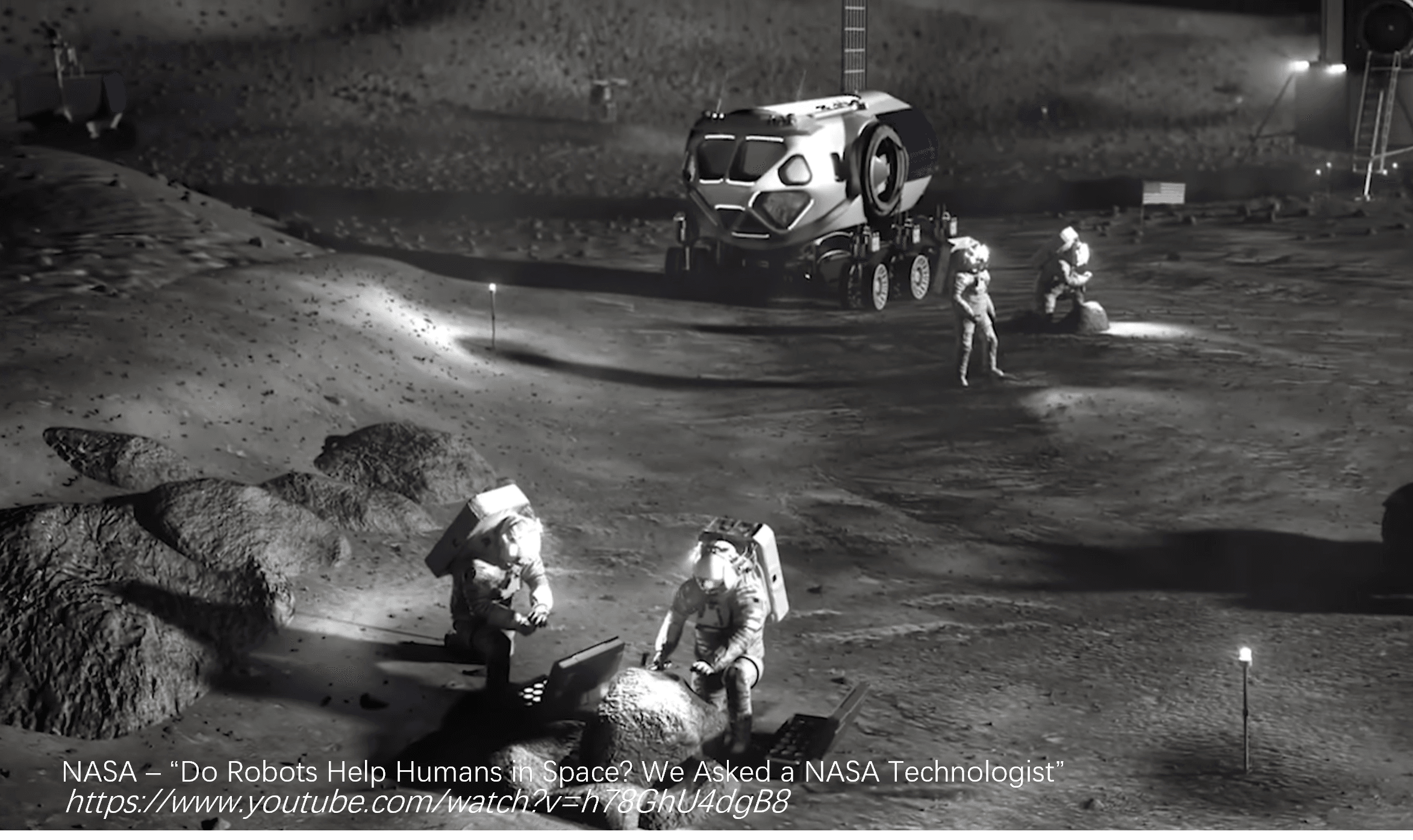
The aerospace 3D printing market reached $3.53 billion in 2024 and is projected to hit $14.53 billion by 2032. Behind these numbers lies a paradigm shift: we're moving from launching complete satellites to building them in orbit.
Breaking the Fairing Constraint
For decades, spacecraft design has been dictated by a simple limitation: everything must fit inside a rocket's nose cone. Current fairings max out at 5-7 meters in diameter. The International Space Station proved we could assemble large structures in space, but it took astronauts and 42 launches over 13 years.
In-Space Servicing, Assembly, and Manufacturing (ISAM) aims to change this through robotic automation. NASA's recent demonstrations show that modular assembly systems can position and join structural elements autonomously in vacuum conditions.
Three Capabilities, Different Maturity Levels
Servicing (most mature): Satellite life extension through refueling and component replacement. SpaceLogistics and Astroscale are already offering commercial services in geostationary orbit.
Assembly (emerging): Robotic construction of large structures from modular components. NASA's ARMADAS project demonstrated autonomous assembly of habitat structures and antenna arrays in 2024. ThinkOrbital claims it can build four times the ISS volume in eight weeks using a single Starship launch.
Manufacturing (experimental): On-demand production of components in microgravity. Varda has launched three missions manufacturing pharmaceuticals in space. In October 2024, a semiconductor manufacturing furnace aboard an experimental satellite reached temperatures above 1,000°C—proving orbital fabrication of advanced materials is feasible.
The Real Breakthrough: Zero-Gravity 3D Printing
Traditional 3D printing adds material layer by layer under gravity. In microgravity, engineers can print structures impossible on Earth—like 30-meter jointless truss beams or lattice structures with internal geometries that would collapse under their own weight.
The 2022 Outpost Mars Demo-1 demonstrated friction milling to cut metal in space. The Modular Space Foundry tested microgravity metal processing in 2024. These aren't lab experiments—they're building blocks for orbital factories.
Market Reality: The Chicken-and-Egg Problem
Despite technical progress, ISAM faces commercial challenges. Potential service providers hesitate to develop products without a user base. Users won't design serviceable satellites until services exist.
Current economics tell the story: aerospace 3D printing hardware dominated 63.6% of the market in 2023, but most purchases are for ground-based prototyping, not orbital manufacturing. The selective laser melting segment leads with 48.6% market share—primarily for engine components manufactured on Earth.
Government agencies are bridging the gap. NASA's OSAM-1 and OSAM-2 missions were canceled due to budget overruns, but the Space Force is actively contracting ISAM capabilities. Katalyst and Motiv Space Systems won a 2025 mission to retrofit satellites with sensors—satellites that weren't designed to be serviced.
Technical Challenges
Thermal management: 3D printers generate significant heat. In vacuum, heat dissipates only through radiation, not convection. Penn State and NASA Glenn developed titanium radiators with 50% weight reduction and 6× better deployed-to-stowed area ratios.
Material properties: Microgravity affects how metals solidify and crystallize. This creates opportunities (stronger alloys) and challenges (unpredictable material behavior).
Automation requirements: Assembly robots must operate with minimal latency from ground control. Autonomous systems need real-time decision-making for positioning, joining, and quality verification.
Comparing Capabilities: ISAM vs Traditional Launch
| Factor | Traditional Launch | ISAM |
|---|---|---|
| Size Limit | Fairing diameter (5-7m max) | Unlimited (assembled in orbit) |
| Design Flexibility | Must fold/deploy | Build native geometry |
| Spare Parts | Launch all components upfront | Manufacture on-demand |
| Mission Duration | Fixed at launch | Serviceable/upgradable |
| Cost per Launch | Full payload every time | Incremental components |
Technology Readiness Comparison
| Capability | Maturity Level | Commercial Status | Key Players |
|---|---|---|---|
| Satellite Refueling | TRL 8-9 | Operational (2024) | Orbit Fab, SpaceLogistics |
| Life Extension | TRL 7-8 | Early commercial | Astroscale, Northrop Grumman |
| Structural Assembly | TRL 5-6 | Ground demos only | NASA ARMADAS, ThinkOrbital |
| Metal 3D Printing | TRL 4-5 | Parabolic flight tests | Freeform, Modular Space Foundry |
| Pharmaceutical Mfg | TRL 6-7 | Flight-proven | Varda (3 missions) |
| Semiconductor Mfg | TRL 3-4 | Single test | Experimental (2024) |
Regional Development
North America dominates with 34.84% market share in aerospace 3D printing, driven by NASA, SpaceX, and defense contractors. The U.S. Air Force extensively uses additive manufacturing for rocket engines.
Germany leads Europe through companies like MTU Aero Engines and EOS GmbH. Japan focuses on AI-integrated 3D printing for space applications. China rapidly adopts the technology with government backing for large-scale space initiatives.
Future Applications
Space-Based Solar Power: Assembly of kilometer-scale solar arrays impossible to launch intact. Multiple proposals envision thousands of modular panels assembled robotically.
Deep Space Telescopes: The James Webb Space Telescope pushed deployment technology to its limits with its 6.5-meter mirror. ISAM could enable 50-meter observatories assembled from discrete segments.
Lunar/Martian Habitats: In-situ resource utilization combined with 3D printing could construct shelters from regolith, reducing Earth-to-Mars payload requirements by 90%. GRU Space, a Y Combinator-backed startup founded by Berkeley graduate Skyler Chan, plans to demonstrate this approach with a 2029 mission converting lunar soil into durable bricks using geopolymer technology. Their roadmap includes deploying an inflatable habitat enclosed by robotically-constructed lunar brick walls, targeting a first lunar hotel opening in 2032. The company's automated manufacturing process represents practical implementation of ISAM principles for surface construction.
Orbital Shipyards: The logical endpoint—facilities that build spacecraft entirely in space, never constrained by atmospheric launch.
Investment and Timeline
Freeform, a metal 3D printing startup founded by a former SpaceX engineer, raised $14 million from NVIDIA and aerospace investors in 2024. Their approach combines AI with real-time process control for aerospace and defense applications.
Orbit Fab launched its first propellant depot (Tanker-001 Tenzing) in 2021. Its Kamino fuel depot aims to offer commercial refueling services in 2026. SpaceX demonstrated transfer of 10 metric tons of liquid oxygen during Starship's third flight in 2024.
The U.S. released its National ISAM Strategy in April 2022, signaling government commitment. The 2025 NASA State of Play report tracks 50+ active ISAM projects across servicing, assembly, and manufacturing domains.
Why It Matters for Robotics Engineers
ISAM represents the ultimate unstructured environment for robotic systems. No gravity for stabilization. No atmosphere for convective cooling or aerodynamic forces. Extreme temperature swings. Communication latency measured in seconds to minutes.
The manipulation challenges mirror terrestrial problems at different scales: precision assembly, force control, sensor fusion, and path planning. But failure modes are catastrophic and irreversible.
Greg Richardson of the Consortium for Space Mobility notes: "We've done ourselves a disservice by putting servicing and assembly and manufacturing into one acronym. They are different types of missions with different timelines for availability."
He's right—but they share a common requirement: autonomous robotic systems capable of perception, planning, and manipulation in environments no human can directly supervise.
The Path Forward
Lee Rosen, CEO of ThinkOrbital, captured the challenge: "Right now, I don't know of too many customers for in-space assembly. We've got to figure out how to build things in outer space, and big things."
The technology demonstrations are working. The hardware is flight-testing successfully. What's missing is the economic trigger that makes orbital manufacturing cheaper than ground-based alternatives.
That inflection point may come from scale: when satellite constellations need 10,000+ units, building them in factories already in orbit starts making financial sense. Or from capability: when a mission absolutely requires a 100-meter antenna that cannot fold small enough to launch.
Either way, the robots being developed for ISAM today are writing the playbook for industrial operations beyond Earth. The aerospace industry is learning to manufacture without gravity, assemble without scaffolding, and maintain systems without human touch.
We're not just building bigger satellites. We're figuring out how to industrialize space itself.
Data Sources and Links:
- NASA ISAM State of Play 2025 Edition - https://ntrs.nasa.gov/citations/20250008988
- Fortune Business Insights: Aerospace 3D Printing Market - https://www.fortunebusinessinsights.com/industry-reports/aerospace-3d-printing-market-101613
- Grand View Research: Aerospace 3D Printing Market Report - https://www.grandviewresearch.com/industry-analysis/aerospace-3d-printing-market-report
- Precedence Research: Space 3D Printing Market - https://www.precedenceresearch.com/space-3d-printing-market
- NASA ISAM Official Page - https://www.nasa.gov/nexis/isam/
- Katalyst Space Technologies: ISAM Overview - https://www.katalystspace.com/in-space-servicing-assembly-and-manufacturing-isam
- GAO Report: In-Space Servicing, Assembly, and Manufacturing (GAO-25-107555) - https://www.gao.gov/assets/gao-25-107555.pdf
- Payload Space: The State of ISAM 2025 - https://payloadspace.com/the-state-of-isam-2025/
- White House: National ISAM Strategy (April 2022) - https://space.commerce.gov/national-strategy-for-in-space-servicing-assembly-and-manufacturing-released/
- New Space Economy: Overcoming Tyranny of Payload Fairing - https://newspaceeconomy.ca/2024/04/15/overcoming-the-tyranny-of-the-payload-fairing-enabling-new-space-capabilities/
- GRU Space: Lunar Hotel Project - https://www.gru.space/
- Y Combinator: GRU Space Company Profile - https://www.ycombinator.com/companies/galactic-resource-utilization-space-inc-gru-space
Explore related analysis across satellite servicing, lunar infrastructure, orbital manufacturing, and AI-enabled space systems.
Space Robotics: The 2026 Breakout
An inflection point in 2026 is expected to accelerate commercialization in space robotics, driven by satellite servicing demand, lunar missions, and in-orbit manufacturing.
Space Robotics' Killer App: The $30B Satellite Servicing Market
The projected $30 billion satellite servicing market is emerging as the primary revenue engine for space robotics, spanning life-extension, refueling, repair, and debris mitigation.
Space Robot- Lunar Rovers: Building Infrastructure on the Moon
Next-generation lunar rovers are transitioning from exploration tools to infrastructure enablers, supporting construction, resource extraction, and sustained operations on the Moon.
Space Station's AI Assistants: From Robotic Arms to Autonomous Partners
AI-enabled robotic systems aboard space stations are evolving from teleoperated manipulators into semi-autonomous partners that enhance crew productivity and operational resilience.
Space Robot- Building Skyscrapers in Space: ISMA's Industrial Revolution
Orbital assembly concepts, including ISMA-driven large-scale structures, signal the beginning of an industrial revolution in space construction and high-rise in-orbit manufacturing.








Leave a comment