
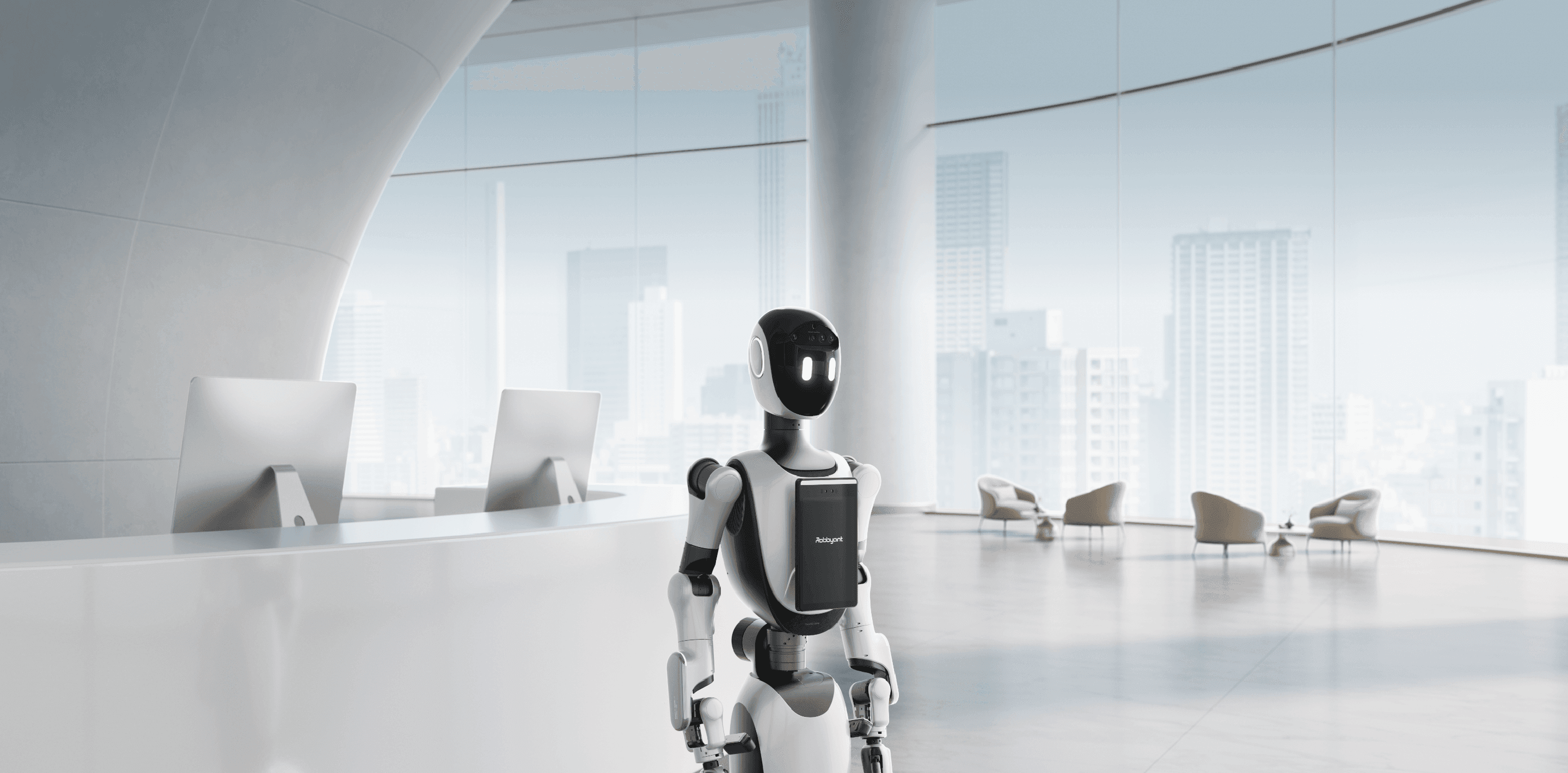
Ant Group's embodied intelligence unit building the R1 wheeled humanoid service robot and LingBot spatial-perception AI models.
Robbyant, registered as Shanghai Ant Lingbo Technology Co., Ltd., is an embodied intelligence company under Ant Group focused on humanoid robot research and development. It was founded in Shanghai at the end of 2024, formally launched in the Pudong District in early 2025, and established an additional subsidiary in Hangzhou, Zhejiang. The company's stated mission is to build a foundational embodied intelligence platform for the AGI era and to deliver lower-cost robotic service solutions for commercial, home and office settings. Its first product is the R1, a wheeled humanoid service robot unveiled in September 2025 at the INCLUSION Conference in Shanghai and at IFA 2025 in Berlin. The R1 weighs about 110 kg, stands roughly 1.6 to 1.75 metres tall, moves at under 1.5 metres per second, and has 34 degrees of freedom, using a wheeled base for stable indoor navigation paired with a humanoid upper body and two arms for manipulation. Robbyant demonstrated the R1 performing tasks such as simple cooking, acting as a tour guide and operating under remote control, and reported early deployments including the Shanghai History Museum.
Beyond hardware, Robbyant develops the LingBot family of AI models for embodied intelligence, including LingBot-Depth, an open-sourced high-precision spatial perception model for depth sensing and 3D understanding developed with Orbbec, and LingBot-Map, a streaming 3D reconstruction model for real-time spatial understanding. The company positions itself as both a humanoid robot maker and a provider of perception and mapping software for embodied AI.
Primary type & automation activities this supplier delivers:
Company Facts
Founded
2024
Primary Role
Manufacturer
Company Size
-
Primary Region
Asia-Pacific
Annual Sales
-
Funding Stage
-
Funding Total
-
Keywords
Robbyant, the embodied artificial intelligence division of Ant Group, has initiated its search for external funding, targeting approximately $222 million in its first fundraising round. This marks the fourth unit of Ant Group to pursue capital-raising efforts, as reported by LatePost. The significance of this funding initiative lies in Robbyant's recent advancements, including the launch of its second generation of the LingBot AI foundation model family. The new models, such as LingBot-Vision and LingBot-Depth 2.0, enhance robotic systems' capabilities in processing visual data and navigating physical environments, which is crucial for the development of embodied AI. Looking ahead, Robbyant aims to complete a second funding round by the end of this year. The progress of this funding effort and the continued development of its AI models will be critical to watch as they could significantly impact the robotics and AI landscape in the coming months.
SCMPTech Aug 03, 2026This week in robotics: Hyundai takes full ownership of Boston Dynamics, Xpeng targets 1,000 Iron humanoids a month, LimX Dynamics raises $200M pre-IPO, and Agility opens a Silicon Valley physical-AI hub. July 13–17, 2026.
ByKelly Stone Jul 18, 2026Robbyant, an embodied AI company under Ant Group, has released LingBot-World 2.0, an open-source interactive world model. This updated version supports hour-long real-time world generation, high-definition output, and enhanced interactive capabilities, marking a significant improvement over LingBot-World 1.0. The new model allows for continuous world generation sessions while maintaining visual quality and enabling real-time user interaction. It produces 720p video at 60 frames per second and is designed to generate, stream, and display content simultaneously, which reduces latency and enhances user engagement with the evolving environment. LingBot-World 2.0 features a dual-agent mechanism for dynamic interaction and supports multiple users in a shared virtual space. Additionally, Robbyant has open-sourced LingBot-Video, a video generation model aimed at robotics applications, which enhances efficiency and realism in AI-generated video for real-world robotic systems. No further timeline was disclosed at the time of publication.
RoboticsAndAutomationNews.com Jul 18, 2026 Robot simulation AI models ai simulation Ant Group artificial intelligence embodied aiRobbyant, a company specializing in embodied AI under Ant Group, has unveiled the upgraded LingBot-VLA 2.0 model. This next-generation vision-language-action model enhances morphological generalization, degrees of freedom support, and deployment efficiency, addressing a critical gap in the embodied AI industry. The significance of LingBot-VLA 2.0 lies in its extensive pre-training on 60,000 hours of real-world data, which includes interactions from 20 different robot morphologies. This upgrade allows for improved whole-body control and dual-arm manipulation, achieving leading scores on benchmarks, thus demonstrating its effectiveness in industrial-scale deployment. Looking ahead, the introduction of a version optimized for efficient post-training and a threefold increase in inference efficiency positions LingBot-VLA 2.0 as a strong contender for real-time commercial applications. No further timeline was disclosed at the time of publication.
RoboticsAndAutomationNews.com Jul 17, 2026 Computing Robot simulation artificial intelligence dual-arm robots embodied ai humanoid robotsRobbyant, a company under China's Ant Group, has introduced LingBot-VA 2.0, touted as the first embodied-native video-action world model specifically designed for robotics. Unlike traditional models adapted from digital content, LingBot-VA 2.0 is built from the ground up for physical-world tasks, enhancing physical accuracy and execution efficiency through its autoregressive architecture. This innovation is significant as it marks a departure from conventional robotics models that often compromise real-world performance by relying on video generation systems. Robbyant's approach allows for better prediction of how robot actions affect their environment, thus improving generalization and operational effectiveness in real-world applications. Looking ahead, Robbyant's LingBot-VA 2.0 is expected to advance the capabilities of robots in various tasks, demonstrated through its performance in complex scenarios such as preparing breakfast and unpacking deliveries. No further timeline was disclosed at the time of publication.
InterestingEngineering.com Jul 13, 2026 AI and RoboticsAnt Group's robotics subsidiary, Robbyant, has adopted a unique approach by prioritizing the development of a robot brain over hardware design. This strategy leverages the AI infrastructure behind Alipay, which processes billions of payment transactions daily, to enhance robots' ability to perceive their environment and make autonomous decisions. The introduction of the LingBot-VA 2.0 marks a significant advancement as it is the world's first embodiment-native pre-trained VA base model, specifically tailored for robots. In real-world tests, robots equipped with this model achieved a remarkable success rate of 93.6% in dual-arm tasks, showcasing the potential of this innovative technology. As hardware becomes increasingly standardized, the focus on software intelligence and data advantages is emerging as a new competitive edge. Ant Group's initiative to create a robot brain from its extensive payment data aims to bridge the gap between the digital and physical worlds, positioning Robbyant as a leader in the robotics field.
leaderobot.com Jul 13, 2026 Robotics AI Machine Learning AutomationChinese AI company Robbyant has launched LingBot-Depth 2.0, a next-generation spatial perception model designed to enhance robotic navigation in complex environments. This model builds on the previous LingBot-Depth, utilizing the Masked Depth Modeling technique and trained on 150 million samples, achieving top results in 12 out of 16 depth completion benchmarks. Notably, it reduces depth error by over 50%, improving accuracy in challenging indoor settings. The significance of LingBot-Depth 2.0 lies in its ability to accurately perceive transparent and reflective surfaces, areas where traditional depth cameras often struggle. The model's advancements are attributed to LingBot-Vision, a visual foundation model that employs a unique “boundary structure” pre-training objective, enabling sub-pixel-level boundary localization. Despite being trained on a smaller dataset of 160 million images, it demonstrates robust performance across various robotic vision applications, enhancing object boundary detection and tracking. Looking ahead, Robbyant's collaboration with Orbbec aims to integrate LingBot-Depth 2.0 into new hardware solutions for robotics data collection. The RGB-D EGO device, part of Orbbec’s Robot-Free Data Collection Hardware Platform, will feature a customized version of the model. Future updates are expected to further enhance depth completion and spatial structure understanding, providing a solid foundation for training embodied AI systems in real-world scenarios. No further timeline was disclosed at the time of publication.
InterestingEngineering.com Jul 11, 2026 AI and RoboticsAnt Group's Robbyant has introduced the LingBot-Vision model, a groundbreaking visual perception technology designed for robots. This innovative model, which operates with just 1.1 billion parameters, significantly outperforms traditional systems in depth estimation and object boundary recognition. By enhancing robots' ability to comprehend intricate environments, LingBot-Vision represents a major leap forward in the field of embodied intelligence. The technology has been made available as open-source, fostering further advancements and collaboration within the robotics community.
leaderobot.com Jul 09, 2026 Robotic Vision Depth Perception AI Technology Open Source Embodied IntelligenceRobbyant open-sources LingBot-VLA 2.0, a vision-language-action model trained on 60,000 hours of data for cross-morphology, whole-body robot control.
ByRobotToday Reporter Jul 08, 2026Ant Group's Robbyant has unveiled LingBot-Depth 2.0, an advanced spatial perception model designed to enhance robot vision in complex environments, such as those involving glass and mirrors. This innovative model, which operates with just 1.1 billion parameters, demonstrates superior performance compared to larger models while requiring less training data. The launch, which marks a significant milestone in artificial intelligence technology for robotics, reflects ongoing efforts to improve the capabilities of robots in navigating and interpreting their surroundings effectively.
leaderobot.com Jul 08, 2026 Robotics AI Computer Vision Depth PerceptionWhile the embodied AI industry is witnessing rapid advancements in hardware and control systems, the lack of a truly universal brain remains a primary bottleneck for industrial-scale deployment. LingBot-VLA 2.0 addresses this critical gap by dramatically expanding its pre-training data and architectural capabilities.
RoboticsTomorrow.com Jul 08, 2026Robbyant, the embodied artificial intelligence arm of Chinese fintech giant Ant Group, launched a new vision model that it claims can help robots overcome a long-standing challenge: accurately perceiving glass, mirrors and transparent objects. The unit of Hangzhou-based Ant Group on Tuesday unveiled its next-generation spatial perception model, LingBot-Depth 2.0, alongside a new foundational visual model called LingBot-Vision, as AI labs race to equip machines with the “brains” required to...
SCMPTech Jul 07, 2026This week in robotics: AGIBOT declares Deployment Year One with 5 platforms and 8 AI models at APC 2026, Physical Intelligence’s π0.7 solves unseen tasks, TARS raises a record $455M, and Siemens deploys humanoids in live factory operations. April 13–17, 2026.
ByRobotToday Reporter Apr 18, 2026



