

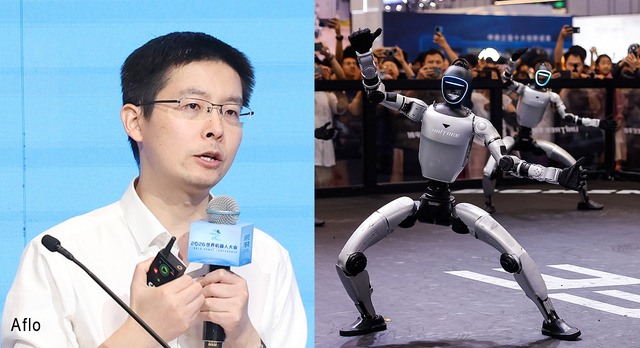
Wang Xingxing, founder and chairman of Unitree Robotics, spoke at the World Robot Conference 2026 in Beijing on August 20, 2026. He emphasized the current challenges of humanoid robots, particularly their 'generalization ability.' While robots can perform well in familiar environments with sufficient data, their success rate significantly drops in new settings.
Wang described a future where robots can execute tasks in unknown environments based solely on human verbal instructions, marking this as the 'ChatGPT moment' in Embodied AI. He proposed a benchmark of achieving 80% task execution in 80% of unfamiliar environments, with this transition potentially occurring in as little as 2 to 3 years, or possibly longer.
Unitree is known for its humanoid robots' impressive physical capabilities, but Wang stressed the importance of AI for practical applications. Starting in 2024, Unitree plans to collaborate with automotive factories to advance robot usability and is already testing robots in its own facilities. The focus is on enabling robots to work efficiently in diverse environments without needing extensive retraining for new tasks.
Editor's Note
The robotics industry is at a pivotal moment as companies like Unitree Robotics push for advancements in humanoid capabilities. The emphasis on AI integration for practical applications highlights the ongoing shift from demonstration to real-world utility. As the market evolves, understanding the balance between physical performance and intelligent adaptability will be crucial for future developments in robotics.
Copyright Notice
This briefing is an independently written summary based on publicly available reporting and is provided for industry information and news discovery. The original report and source publication are credited and linked where applicable. RobotToday does not claim ownership of third-party source material.
Rights concerns? If you believe any material in this briefing infringes your copyright or other rights, please contact [email protected] with the relevant URL and details. We will review the matter and take appropriate action where warranted.







Leave a comment