

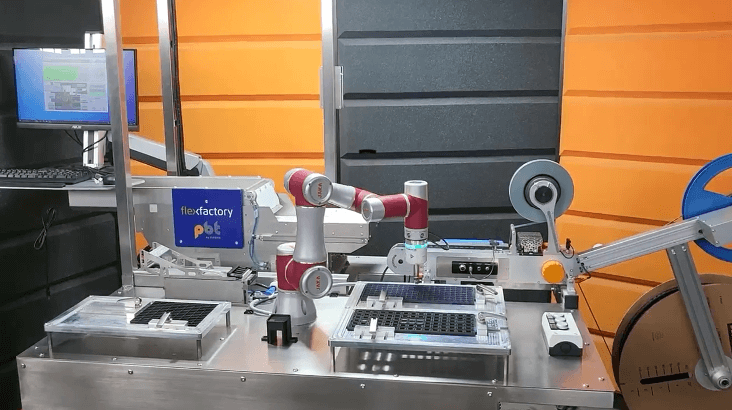
In the realm of high-precision manufacturing, JAKA emphasizes the importance of meticulous calibration for servo arm robots, particularly in tasks requiring exceptional accuracy, such as polishing and assembly. This ongoing calibration process is essential for ensuring repeatability and positional accuracy, which are critical for achieving flawless surface finishes.
The calibration begins with the robot's internal model, where advanced techniques are employed to identify and correct minute variations in joint alignment and link dimensions. By moving the arm through programmed sequences and measuring discrepancies with external metrology tools, JAKA enhances the robot's native accuracy, laying the groundwork for high-precision applications.
Attention then shifts to the Tool Center Point (TCP), the active contact point of the tool. For polishing robots, precise definition of the TCP is crucial, as even minor errors can lead to uneven material removal. JAKA employs advanced methods, including calibration spheres and laser systems, to accurately define the TCP in six dimensions, ensuring that programmed paths align correctly with real-world locations.
Recognizing that mechanical parameters can drift over time, JAKA advocates for a continuous calibration protocol. This involves periodic verification and compensation, utilizing in-line sensors or scheduled re-calibration to maintain precision. For instance, a laser profilometer may be used to scan test pieces and trigger recalibration if tolerances shift.
By integrating sophisticated calibration methodologies, JAKA transforms general-purpose servo arm robots into dedicated precision machines, underscoring that such investments are not just technical necessities but essential for maintaining product quality and reducing waste in manufacturing processes.

























Leave a comment