


Summary
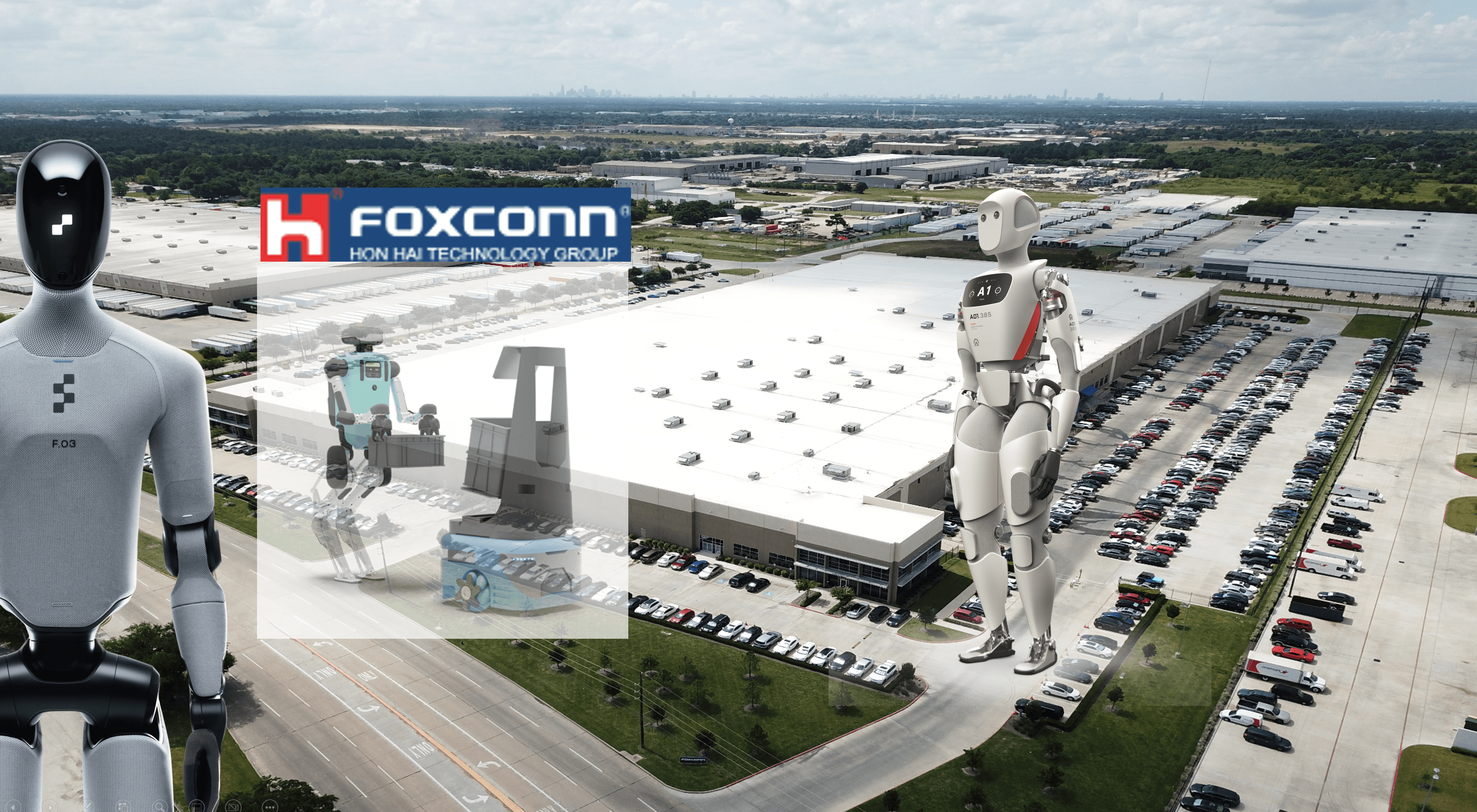
Foxconn’s plan to deploy humanoid robots in its Houston, Texas factory—where it manufactures NVIDIA AI servers—marks one of the most consequential industrial automation pilots in the world. The project is explicitly powered by NVIDIA’s Isaac GR00T N model, a foundation model for humanoid intelligence, and simulated through NVIDIA Omniverse to optimize workflows before physical deployment. Foxconn aims to begin deployment in early 2026, training robots on tasks such as cable insertion, component assembly, and precision handling—jobs previously reserved for skilled technicians.
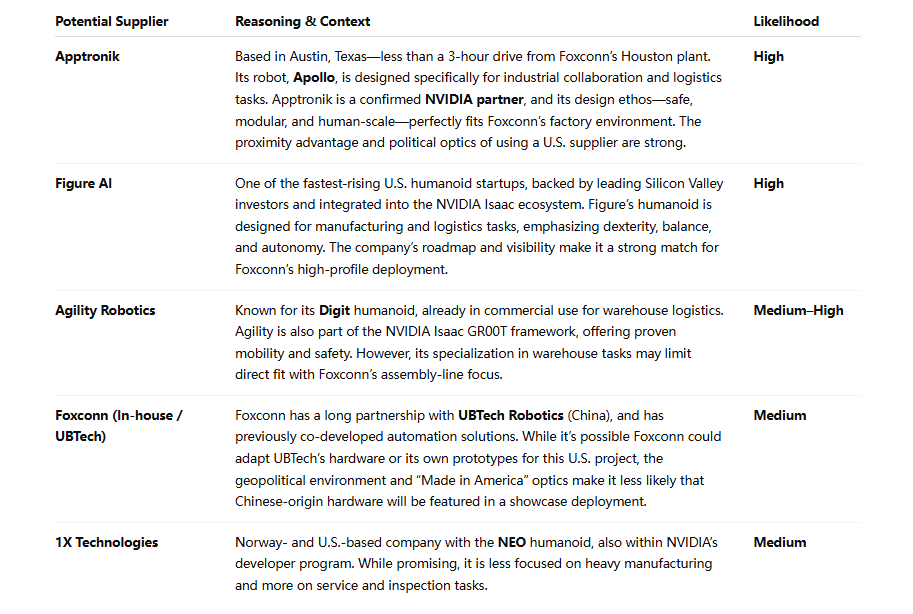
While the AI “brain” is confirmed to be NVIDIA’s, the humanoid hardware supplier has not been disclosed. Based on partnerships, geographic fit, and integration readiness, the leading candidates include Apptronik, Figure AI, and Agility Robotics. This project is more than a factory upgrade—it’s a milestone in shifting automation from fixed industrial arms to general-purpose embodied AI systems built for human environments.
1. Deployment Context
The Foxconn humanoid program is strategically aligned with the explosion of global demand for AI servers, particularly those designed for NVIDIA’s next-generation chips, including the GB300 series. Located in Houston, Texas, this facility represents Foxconn’s most critical North American manufacturing node and is rapidly becoming a key link in the NVIDIA supply chain.
Foxconn’s aim is not just cost optimization—it’s about flexibility. The robots under training are being prepared for high-dexterity tasks such as picking and placing components, inserting cables, tightening connectors, and assisting in final server assembly. These are activities that require fine motor control and adaptive perception—far beyond the reach of traditional industrial robotics.
According to Foxconn’s leadership, the project is scheduled to enter deployment “within six months,” targeting Q1 2026 for initial rollout. The strategic combination of NVIDIA’s Isaac GR00T N model (as the cognitive layer) and the Omniverse digital twin (for simulation and layout optimization) ensures that factory operations can be tested, refined, and optimized virtually before the first humanoid ever steps onto the floor.
2. Who Builds the Body? — Identifying Potential Humanoid Suppliers
While the brain is now publicly known, the body remains a mystery. Foxconn has not disclosed which humanoid platform it plans to deploy in Houston. Yet the choice will likely fall within the NVIDIA Isaac GR00T ecosystem, which already integrates multiple U.S.-based humanoid developers.
Below are the most probable contenders and the rationale for each.
3. Why NVIDIA’s Role Changes Everything
The most transformative revelation in this project is the dominance of AI over hardware. By confirming that the robots will be powered by the Isaac GR00T N foundation model, Foxconn and NVIDIA are effectively decoupling the robot’s intelligence from its physical structure. This modular approach means Foxconn can switch or scale across different humanoid bodies—Apptronik today, Figure tomorrow—without reengineering the entire software stack.
In this new model, the AI defines the robot, not its manufacturer. This shift has enormous implications for global robotics supply chains, as NVIDIA’s ecosystem could become a universal “operating system” for embodied intelligence across industries—from logistics to manufacturing to retail.
4. Why the U.S. Connection Matters
By choosing a U.S. manufacturing plant as the pilot site, Foxconn is making a statement that goes beyond technology—it’s a strategic alignment with American industrial policy. Using a U.S.-based humanoid supplier reinforces supply chain localization and showcases Foxconn’s commitment to American innovation at a time when onshoring and tech sovereignty are political priorities.
A collaboration with Apptronik or Figure AI would send a clear message: that U.S.-made humanoids, powered by NVIDIA’s AI, are ready for prime time in global electronics manufacturing.
5. The Future of Factory Automation
Unlike traditional robot arms—designed for single, repetitive motions—humanoid robots bring a new layer of flexibility. They can walk, balance, see, and manipulate objects in environments already built for humans. This adaptability drastically lowers integration costs and accelerates deployment timelines, as factories no longer need to be redesigned for robots.
In essence, humanoids can enter existing workflows, rather than forcing the factory to evolve around them.
If successful, Foxconn’s Houston experiment could set the blueprint for future manufacturing lines where humanoids perform the bulk of fine assembly, assisted by digital twins, AI-driven scheduling, and predictive maintenance. It is not hard to imagine that within this decade, every NVIDIA server rolling off a Foxconn line may have been assembled—at least in part—by a humanoid powered by NVIDIA’s own AI.
6. Key Takeaways
AI Over Hardware – The NVIDIA Isaac GR00T N model represents a shift where the AI brain is the defining layer; the robot’s body becomes interchangeable.
U.S. Robotics Ecosystem Gains Momentum – Apptronik, Figure AI, and Agility Robotics stand to benefit from domestic manufacturing optics and close NVIDIA integration.
A New Factory Era – This marks the beginning of general-purpose humanoid automation—machines that can learn, adapt, and collaborate in human-designed environments.
Strategic Benchmark – The Houston deployment is not just about efficiency—it’s about global signaling: a demonstration that humanoids are crossing from R&D labs into real, revenue-generating production.









Leave a comment