


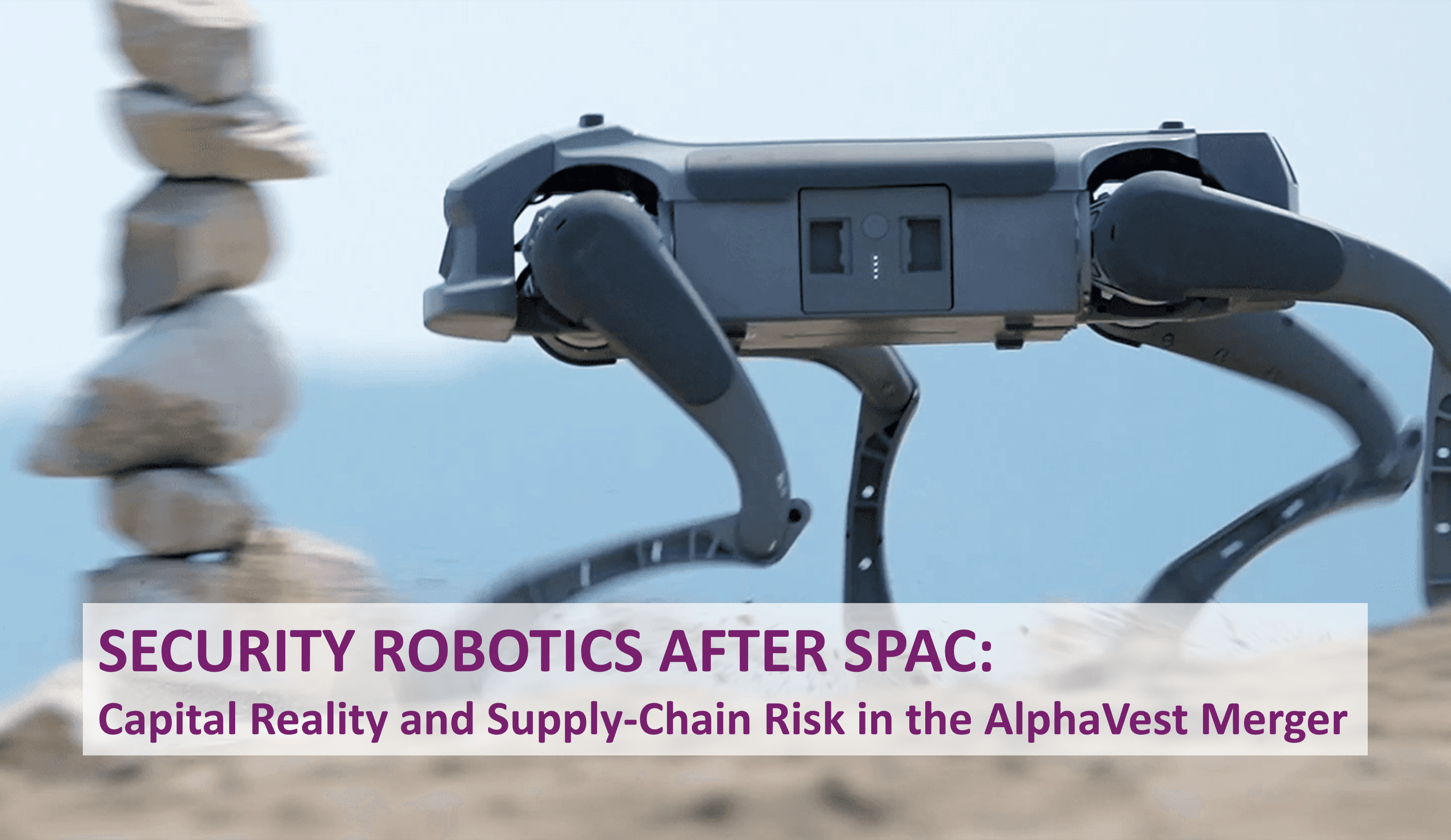
Research Subject: Origin (ACMI) / AlphaVest Acquisition Corp (NASDAQ: ATMV)
Introduction
Amid the surge of robotics companies seeking public listings via SPAC transactions, the completed merger between Origin (ACMI) and AlphaVest offers a particularly valuable case for close examination. Beneath the publicly disclosed enterprise valuation of USD 180 million lies a complex survival narrative typical of robotics startups navigating a prolonged capital downturn: ambitious growth expectations, heavy dependence on concentrated supply chains, and valuation pressure arising from related-party transactions.
This case highlights the widening gap between capital market entry and operational resilience in the security robotics sector.
I. Capital Breakout: A Risky “Listing” Does Not Mean Safe Landing
Origin (ACMI) successfully listed on the Nasdaq market toward the end of 2025. However, the transaction structure and funding outcome reflect the increasingly demanding reality of hard-tech SPAC deals.
Although AlphaVest initially held approximately USD 69 million in its trust account, substantial shareholder redemptions significantly reduced the cash ultimately available to the combined company. As a result, the net capital infusion fell well short of early expectations.
The post-merger enterprise value was fixed at USD 180 million, yet the company’s available cash position — based on an approximately USD 8 million targeted financing outcome — leaves limited margin for error in a hardware-intensive robotics business that requires sustained R&D investment, manufacturing coordination, and inventory turnover. In addition, post-merger ownership disclosures indicate that founders retain roughly 68–73% of outstanding shares. While such concentration can support decisive execution during early growth stages, public-market investors often view this structure as a potential governance risk, particularly with respect to minority shareholder protections and long-term liquidity.
II. The Supply-Chain “Lifeline”: Structural Dependence as a Critical Risk
For RobotToday’s professional readership, Origin’s disclosed supply-chain structure is among the most concerning signals. Public filings indicate that 100% of hardware production currently relies on a single manufacturing partner. In an environment marked by geopolitical uncertainty and ongoing semiconductor and component volatility, the absence of supplier redundancy materially increases the risk of delivery disruption.
Equally noteworthy is the company’s revenue composition. Disclosures show that approximately 26% to 39% of revenue is derived from a related party (Kami). While such arrangements can support early-stage commercialization and initial market entry, capital markets generally place greater weight on a company’s ability to compete and win customers in arm’s-length, open markets. If Origin is unable to meaningfully reduce related-party revenue concentration during 2026, the quality and sustainability of its reported revenue may face increased scrutiny.
III. Financial Projections vs. Market Reality: The Logic Behind Margin Expansion
Origin has presented an ambitious growth outlook:
Revenue is projected to increase from USD 10.2 million in 2024 to USD 27.1 million in 2027. Gross profit is forecast to rise from approximately USD 0.66 million (around 6.5% gross margin) to USD 8.5 million (around 31.4% gross margin) over the same period.
From an industry perspective, a gross-margin expansion of this magnitude typically implies a fundamental business-model shift — away from pure hardware sales and toward Robot-as-a-Service (RaaS) models, software licensing, or recurring AI and cloud-based service fees.
RobotToday readers should closely monitor whether AI algorithm licensing, platform subscriptions, or managed service fees begin to represent a meaningful and growing portion of Origin’s revenue mix. Without such a transition, sustaining the projected margin improvement may prove difficult under competitive market conditions.
IV. Core Risks and Industry-Level Warnings
The Origin case highlights several broader warning signals for the security robotics sector: Regulatory exposure related to VIE structures.
As a company with operational ties to China and a variable-interest-entity (VIE) structure, Origin remains subject to regulatory oversight from both U.S. and Chinese authorities. This exposure extends beyond compliance formalities and may affect data governance, licensing, and operational continuity.
Going-concern uncertainty.
Audit disclosures referencing continued losses and negative working capital are not uncommon among early-stage hard-tech companies. However, whether Origin can secure additional financing — reportedly targeting approximately USD 8 million — during 2026 will be critical to sustaining operations and advancing commercialization.
Pace of technological obsolescence.
Security robotics is transitioning from relatively simple mobile surveillance platforms toward more advanced embodied-AI systems. Based on currently available disclosures, the extent to which Origin controls defensible core intellectual property sufficient to withstand rapid iteration and competitive imitation remains an open question.
V. Conclusion: A Shift in Operational Priorities
Following the merger, Origin’s narrative has shifted decisively — from how to become public to how to remain viable. Its near-term operational focus will likely need to center on three priorities:
First, supply-chain diversification, including the establishment of second and third manufacturing partners within the next 12 months.
Second, SOX and internal-control remediation, particularly with respect to inventory management and material weaknesses identified in disclosures.
Third, independent customer acquisition, demonstrating that Origin’s solutions can win contracts from non-related commercial or government clients under market-based terms.
Disclaimer This article is published by RobotToday for informational and industry analysis purposes only and should not be used as an investment guideline, nor does it constitute investment, financial, or legal advice, or a recommendation to buy or sell any securities. All information cited is based on publicly available sources, including regulatory filings and corporate disclosures available at the time of publication. While RobotToday endeavors to ensure accuracy, it makes no representation or warranty regarding the completeness or reliability of the information.
Any forward-looking statements reflect management expectations at the time of disclosure and are subject to risks and uncertainties that may cause actual results to differ materially. Analytical commentary does not imply misconduct or regulatory findings. RobotToday assumes no liability for decisions made based on this content. Readers are encouraged to conduct independent research and consult relevant professional advisors, and to review the latest official filings for updated information.
Related Analysis | Robotics After SPAC
- Beyond the SPAC Narrative: The Hard Reality of Robotics in the Public Market
Industry-wide performance patterns after robotics companies go public - S-4 Projections vs. 10-K Reality: Robotics After De-SPAC
How forecasted growth diverges from disclosed financials - Security Robotics After SPAC: Capital Reality and Supply-Chain Risk in the AlphaVest Merger
A case study of post-SPAC risk in a capital-intensive vertical









Leave a comment