


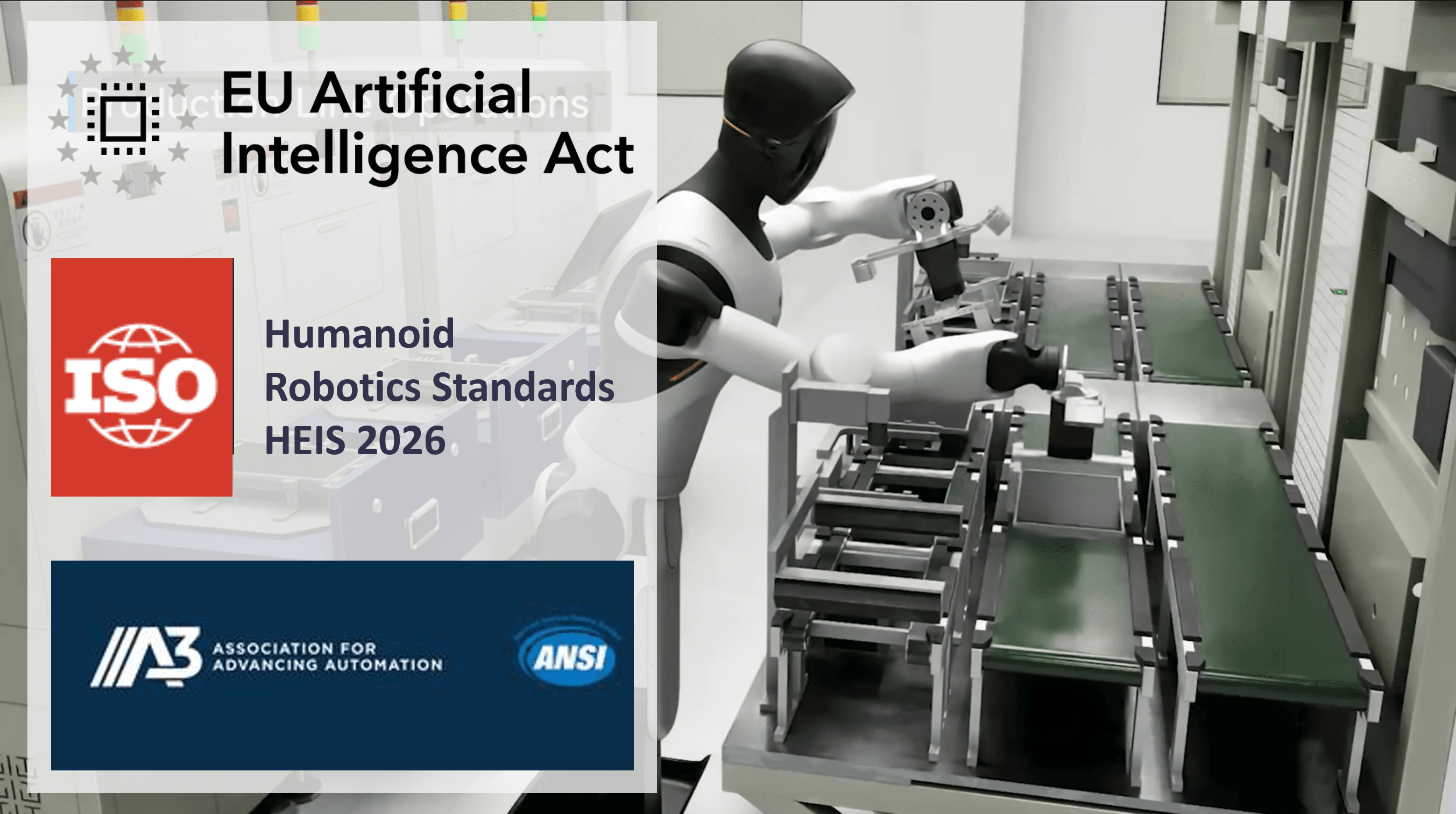
Humanoid Robotics Standards HEIS 2026 vs. the International Landscape
A Comparative Analysis of China, North America, Europe & ISO
Executive Summary
On 28 February 2026, China's Ministry of Industry and Information Technology unveiled the world's first national-level standard system dedicated exclusively to humanoid robots and embodied AI. The Humanoid Robot and Embodied AI Standard System (HEIS 2026 Edition), released at the inaugural HEIS annual conference in Beijing, marks a decisive turning point — transforming an experimental technology sector into one with explicit regulatory lane markings. It arrives at the precise moment that the rest of the world is still retrofitting pre-existing industrial robot frameworks to cover walking, thinking machines.
This briefing offers a deep-dive comparative analysis of HEIS 2026 against the three other major standard-setting systems it must now coexist with: the ISO global framework (led by ISO TC 299), the North American framework anchored by ANSI/A3 R15.06-2025, and the European Union's AI Act regime. The analysis is organized around HEIS 2026's six structural pillars and examines where the frameworks align, where they conflict, and what the gaps mean in practice for manufacturers, regulators, and deployers.
Key Findings at a Glance 1. First-mover advantage: China is the only jurisdiction with a complete, humanoid-specific national standard. All others are still adapting generic industrial or AI frameworks. 2. Fundamental philosophy gap: North America certifies the workspace (the application); HEIS 2026 certifies the robot's intelligence. This is not a minor difference — it creates entirely separate certification pathways. 3. One major area of global convergence: All frameworks now formally treat cybersecurity as a physical safety issue — the first genuine axis of international alignment. 4. ISO's humanoid-specific standard is pending: ISO 25785-1, which will address dynamically stable (walking) robots, remains a Working Draft as of early 2026. HEIS 2026 has already leapfrogged it. |
1. The Standard-Setting Landscape in 2026
1.1 Why Humanoid Robots Demand New Standards
Industrial robots have been regulated since the 1980s. The foundational global standard — ISO 10218 — was first published in 2006 and revised comprehensively in 2025. But ISO 10218 was designed for fixed-base robot arms operating inside guarded cells. Humanoid robots break virtually every assumption built into that standard.
A bipedal robot cannot be bolted to the floor. When power is cut, it falls — introducing a fall-risk hazard category entirely absent from traditional robot safety analysis. Its AI 'brain' makes autonomous decisions that no historical safety standard anticipated. Its dexterous hands can interact with objects and humans in ways that force-limiting collaborative robot guidance (ISO/TS 15066) covers only partially. And its deployment is explicitly intended for unguarded, human-occupied spaces: factory floors, warehouses, hospitals, and eventually homes.
1.2 Four Regulatory Systems, Four Philosophical Traditions
| Jurisdiction | Governing Body | Core Philosophy | Humanoid Coverage (2026) |
| China | MIIT / HEIS TC | Certify the robot's intelligence and capabilities as a product | Full — 6-pillar dedicated framework (HEIS 2026) |
| North America | A3 / ANSI | Certify the collaborative application (workplace + task) | Partial — TR R15.108 bridge doc; ISO 25785-1 tracked |
| Europe (ISO) | ISO TC 299 | Certify risk at system level, harmonised with EU product law | Partial — ISO 25785-1 Working Draft; ISO 10218:2025 applies |
| Europe (AI Act) | EU Commission / AI Office | Regulate AI decision-making by risk tier | Indirect — humanoids likely High-Risk under Annex III |
2. HEIS 2026: Structure and Intent
The HEIS 2026 Edition was developed collaboratively by over 120 research institutions, enterprises, and industry users under the MIIT's technical committee — with notable participation from Unitree Robotics and AgiBot. Released at the inaugural HEIS conference on 28 February 2026, it is the first complete, lifecycle-spanning standard system for humanoid robots anywhere in the world.
The framework is explicitly designed to address the 'assembly trap' — the industry tendency to produce impressive demonstration hardware that fails to deliver industrial utility at scale. HEIS 2026 attempts to impose engineering discipline on a sector that has 140+ manufacturers releasing 330+ models with incompatible interfaces, non-standardised data pipelines, and unverified safety characteristics.
2.1 The Six Pillars
Pillar 1 — Basic Commonality
This foundational pillar establishes shared terminology and a five-level intelligence grading system (Lv1–Lv5) analogous to autonomous vehicle SAE levels. It anchors the entire HEIS framework in the 'humanoid robot' as a distinct product category — a choice with significant regulatory implications discussed in Section 3.
Pillar 2 — Brain-like and Intelligent Computing
Covers specifications for Visual-Language-Action (VLA) models — the large AI models that give humanoid robots their spatial reasoning and task execution capability — and regulates the entire data lifecycle from collection through training and inference. This pillar explicitly includes data privacy protections for domain data and cybersecurity requirements for AI models deployed on physical hardware.
Pillar 3 — Limbs and Components
Standardises motors, harmonic drives, dexterous hands, tactile sensors, and actuator interfaces. AgiBot's co-founder Peng Zhihui specifically cited tactile sensing standardisation as the pillar's most urgent contribution — noting that nearly 80% of tasks where humans outperform traditional automation are strongly linked to tactile feedback, yet no standardised pathway existed previously.
Pillar 4 — Complete Machines and Systems
Covers whole-body control (WBC) stability, MTBF (mean time between failures) targets, gait performance benchmarking, and power management. This pillar addresses the system-level integration questions that component standards (Pillar 3) cannot resolve on their own.
Pillar 5 — Safety and Ethics
Runs through the entire industrial lifecycle. Incorporates functional safety, human-interaction protocols, privacy protections, and explicit 'human-priority' directives for machines operating in public or mixed-use spaces. Acknowledges the depth of ANSI/A3 R15.06-2025 and positions HEIS as reaching toward that level of rigour.
Pillar 6 — Application and Services
Governs scenario-specific deployment: industrial manufacturing, hazardous environments, healthcare, eldercare, and household service. Unlike the North American 'safe cell' approach, HEIS focuses on task-success metrics within each scenario — what does it mean for a robot to perform acceptably in a given context?
3. The ISO Global Framework: Robust on Industrials, Lagging on Humanoids
3.1 ISO 10218:2025 — The Revised Cornerstone
ISO published significantly expanded versions of ISO 10218-1 and ISO 10218-2 in January 2025 — the first major revision since 2011. Part 1 grew from 50 to 95 pages; Part 2 from 72 to 223 pages. The most consequential conceptual shift was the move from certifying 'collaborative robots' to certifying 'collaborative applications'.
This is more than a semantic adjustment. Under the old framework, a robot manufacturer could declare a robot 'collaborative' based on its hardware features (force-limiting joints, speed monitoring). Under ISO 10218:2025, safety depends on the entire deployed system — the robot, the task, the workspace configuration, and the human workflow. A robot that is safe for one task may be unsafe for another, even in the same facility.
3.2 ISO 25785-1 — The Missing Humanoid Standard
ISO 25785-1 is the standard the industry needs most and does not yet have. As of early 2026, it remains a Working Draft, with the working group (led by experts from Agility Robotics, Boston Dynamics, and A3) having held its most recent session in Barcelona in October 2025. Final publication is expected in 2026 or 2027.
Crucially, the working group deliberately chose not to use the word 'humanoid'. ISO 25785-1 instead addresses 'industrial mobile robots with actively controlled stability' — a category defined by the engineering characteristic of requiring continuous power to maintain balance, and encompassing bipeds, quadrupeds, and other dynamically balanced platforms.
The Fall-Risk Problem ISO 25785-1's central innovation is the formalisation of fall-risk as a distinct hazard category. Unlike a conventional robot arm that simply stops when power fails, a dynamically stable robot collapses to the floor. This creates: (a) a direct collision hazard for nearby workers; (b) a payload-drop hazard; and (c) a fire/explosion risk if the robot's lithium battery is compromised on impact. None of these hazard types are addressed in ISO 10218 or IEC 61508 as written. |
3.3 ISO 13482 — Service Robots
For humanoids deployed outside industrial environments (domestic, healthcare, public space), ISO 13482 (Safety requirements for personal care robots) provides the closest applicable framework. However, ISO 13482 was not designed for bipedal locomotion or for AI-driven autonomous decision-making, and its application to humanoid robots involves significant interpretive effort.
4. The North American Framework: Mature on Safety, Developing on Humanoids
4.1 ANSI/A3 R15.06-2025 — The Most Significant US Update in a Decade
Published on 29 October 2025, ANSI/A3 R15.06-2025 is a 403-page comprehensive update to the previous 162-page 2012 standard. It is the US national adoption of ISO 10218-1 and 10218-2:2025, with North America-specific additions. It is widely regarded as the global flagship for industrial robot functional safety.
Key advances in the 2025 edition include:
Explicit functional safety requirements — Requirements previously implied by reference to IEC 61508 are now stated directly, improving clarity for manufacturers and compliance auditors.
Collaborative applications — Consolidates ISO/TS 15066 guidance into the main standard body, eliminating the need to cross-reference a separate technical specification.
Cybersecurity as safety — For the first time in the US robotics standard, cyber threats are formally classified as safety risks requiring risk assessment and mitigation planning.
End-effector and manual load/unload — Guidance from ISO/TR 20218-1 and -2 is incorporated, closing a long-standing gap in the 2012 edition.
Refined terminology — 'Collaborative robot' is replaced by 'collaborative application'; 'safety-rated monitored stop' becomes 'monitored standstill'.
4.2 TR R15.108 — The Legged Robot Bridge Document
TR R15.108 is the North American standard-setting community's most specific response to legged robot hazards. This Technical Report — a non-mandatory but industry-recognised guidance document — provides hazard analysis methodology for bipedal, quadrupedal, and wheeled balancing mobile robots. It explicitly addresses the fall-risk problem that ISO 10218 cannot cover.
TR R15.108's role is essentially to serve as a bridge — providing manufacturers with a documented, defensible approach to fall-risk hazard analysis while ISO 25785-1 completes its formal development. For North American manufacturers filing for CE marking or OSHA compliance, TR R15.108 is the reference that fills the regulatory gap most directly.
4.3 The 'Collaborative Application' vs. 'Humanoid Entity' Divide
The Core Philosophical Conflict North America's standard framework certifies the deployment context — the workspace, the task, and the human-robot interaction scenario. A robot that is safe for Task A in Workspace B receives a 'collaborative application' certification for that specific combination. The same robot in a different task or space requires fresh assessment. HEIS 2026 certifies the robot's intelligence and capability — assigning it a graded intelligence level (Lv1–Lv5) as an intrinsic property of the machine. A robot's HEIS intelligence grade travels with it across deployments, scenarios, and markets. This is not a minor terminological difference. It determines who is responsible for safety certification — the robot manufacturer (HEIS model) or the system integrator/deployer (A3 model) — and has direct implications for product liability, insurance underwriting, and export licensing. |
5. The EU AI Act: A Risk-Governance Layer, Not a Robot Standard
5.1 Structure and Timeline
The EU AI Act entered into force on 1 August 2024. Its implementation is phased: prohibited AI practices applied from February 2025; GPAI model rules from August 2025; the main transparency duties from August 2026; and high-risk AI systems embedded in regulated products face obligations until August 2027.
The AI Act is not a robot safety standard. It does not specify actuator torque limits, fall-zone calculations, or MTBF requirements. Instead, it establishes a risk-tier governance framework for AI decision-making systems that is applied on top of existing product safety legislation.
5.2 How Humanoid Robots Are Likely Classified
Humanoid robots deploying autonomous AI decision-making in consequential environments — factories, hospitals, public spaces — are widely expected to be classified as High-Risk AI Systems under the AI Act's Annex III categories, particularly in employment, critical infrastructure, and education/care contexts. The European Commission was required to publish specific classification guidelines by February 2026.
High-Risk classification imposes obligations including: mandatory risk management systems; data governance requirements for training datasets; human oversight mechanisms; transparency documentation; and registration in an EU database of high-risk AI systems. Non-compliance carries fines of up to €15 million or 3% of global annual turnover (rising to €35 million / 7% for the most serious violations).
5.3 The AI Act's Relationship to ISO and HEIS
The EU AI Act explicitly envisions harmonised standards as the compliance pathway — once CEN-CENELEC publishes standards presumed to confer conformity with the AI Act, manufacturers following those standards gain a legal 'presumption of compliance'. This creates a direct dependency: the AI Act's practical implementation for humanoid robots waits on ISO 25785-1 and any applicable robot AI standards.
From a HEIS perspective, the AI Act's emphasis on AI training data governance and model transparency requirements closely parallels HEIS 2026 Pillar 2 — both frameworks treat AI model provenance and training quality as safety-relevant. This represents a potential future convergence point, even though the two frameworks were developed independently.
6. Pillar-by-Pillar Gap Analysis
| HEIS Pillar | ISO / Global Status | A3 / North America Status | EU AI Act Relevance | Key Gap |
| P1: Basic Commonality (Terminology, Lv1–Lv5 intelligence grading) | ISO 25785-1 avoids 'humanoid' term; no intelligence grading system | R15.06-2025 vocabulary update: 'collaborative application' replaces 'cobot' | Art. 9 mandates risk classification but no intelligence grading | No global equivalent to Lv1–Lv5 grading; conceptual fragmentation in how 'intelligence' is measured |
| P2: Intelligent Computing (VLA models, data lifecycle, AI training) | ISO 10218:2025 silent on AI training; IEC 61508 covers functional safety of SW | R15.06-2025 adds cybersecurity; AI training process unaddressed | GPAI rules (Aug 2025) require data governance; harmonised standards pending | Only HEIS and the EU AI Act explicitly regulate AI training and data provenance as safety issues |
| P3: Limbs & Components (Actuators, tactile sensors, dexterous hands) | Generic IEC/ISO component standards; no humanoid-specific actuator specs | A3 vision standards cover GigE/USB3; no humanoid actuator specifications | Not addressed | Global vacuum: no standardised actuator or tactile sensor interface for humanoids |
| P4: Complete Machines (WBC, MTBF, gait performance) | ISO 25785-1 WD addresses dynamic stability; ISO 10218 mobile robot guidance | TR R15.108 provides legged robot hazard analysis methodology | Robustness & accuracy requirements (Art. 15) apply to AI decisions | TR R15.108 fills the gap pragmatically but lacks mandatory status; MTBF benchmarks undefined globally |
| P5: Safety & Ethics (Functional safety, human interaction) | ISO 10218:2025 + ISO/TS 15066; IEC 61508; ISO 13482 for service robots | ANSI/A3 R15.06-2025 — most comprehensive functional safety standard globally | High-Risk obligations include human oversight, accuracy, robustness, cybersecurity | HEIS P5 acknowledges need to reach A3 depth; ethics provisions go beyond ISO scope; no global ethics standard for humanoids |
| P6: Application & Services (Scenario-specific task success) | ISO 10218-2:2025 covers integrated cells; ISO 13482 for personal care | R15.06 Parts 2 & 3 cover safe cell deployment and user responsibilities | Use-case specific Annex III classifications apply; regulatory sandboxes encouraged | A3 focuses on safe cell design; HEIS focuses on task-success in open scenarios — fundamentally different deployment models |
7. Three Key Fault Lines
7.1 The Terminology Conflict: 'Humanoid Entity' vs. 'Collaborative Application'
The most philosophically significant gap is terminological, but its consequences are practical. HEIS 2026 centres its entire framework on the 'humanoid robot' as a distinct, certifiable entity. This means the standard travels with the robot — a machine certified as Lv3 intelligence in China carries that rating to any deployment.
ANSI/A3 R15.06-2025 and ISO 10218:2025 have both deliberately moved in the opposite direction, replacing 'collaborative robot' with 'collaborative application' to emphasise that safety is a property of the deployment context, not the machine hardware. The ISO 25785-1 working group similarly chose not to define robots as 'humanoid', using engineering-based descriptors instead.
This creates a genuine market friction problem. A Chinese manufacturer exporting a certified HEIS-compliant humanoid to North America will find that its robot's intelligence grade has no recognition in the US certification system. The integrator deploying the robot must conduct a fresh collaborative application risk assessment as if the machine had never been certified at all.
7.2 The AI Governance Divergence: Training Process vs. Deployment Context
HEIS Pillar 2 and the EU AI Act converge on a view that AI training methodology and data provenance are safety-relevant concerns — a 'garbage in, garbage out' principle applied to physically embodied AI systems. ANSI/A3 R15.06-2025 does not yet address this domain, treating cybersecurity as a safety issue (correct and important) but stopping short of regulating how the AI inside the robot was trained.
This divergence has practical implications for compliance in the 2026–2027 horizon. A humanoid deployer operating in both China and the EU will face overlapping documentation requirements on AI training data and model specifications. A deployer operating only in North America will face no equivalent requirements at all — potentially creating an AI safety gap in the world's second-largest robotics market.
7.3 The Cybersecurity Convergence: A Rare Point of Global Alignment
Amid substantial divergence, 2025–2026 produced the industry's first major area of genuine international alignment: all major frameworks now formally recognise that a compromised robot is a physical safety hazard.
HEIS 2026 Pillar 2 — Cybersecurity is part of the AI model governance framework; a hacked robot's behaviour cannot be predicted against its certified intelligence level.
ANSI/A3 R15.06-2025 — Cybersecurity is explicitly included in safety planning for the first time, with guidance aligned to IEC 62443 principles.
EU AI Act — Article 15 requires High-Risk AI systems to be resilient against adversarial attacks, including prompt injection and data poisoning.
ISO 10218:2025 — References cybersecurity considerations, anticipating IEC 62443 integration.
What Convergence Means The cybersecurity alignment matters because it creates the first genuine basis for mutual recognition discussions. If all major frameworks agree on the principle that cyber threats are physical safety threats, and all reference IEC 62443 as the underlying technical standard, then a manufacturer demonstrating IEC 62443 compliance can point to a shared standard that satisfies safety regulators in Beijing, Brussels, and Washington simultaneously. This is the template for future harmonisation — find shared principles and build toward common technical references. |
8. Strategic Implications
8.1 For Manufacturers
Companies building humanoid robots for global markets face a fragmented compliance landscape in 2026. Practically, this means:
Dual documentation will be required: HEIS intelligence grading and lifecycle compliance for Chinese market access; ANSI/A3 R15.06-2025 application safety assessment for North American market access; EU AI Act High-Risk obligations and ISO 10218 compliance for European access.
TR R15.108 adoption is strongly advisable for any manufacturer with North American exposure — it provides documented fall-risk hazard methodology and positions the company ahead of mandatory ISO 25785-1 requirements.
ISO 25785-1 tracking is essential: once published (expected 2026–2027), it will likely become the baseline requirement in both North America (via A3) and the EU.
Cybersecurity investment is the single highest-leverage compliance action: IEC 62443-aligned cybersecurity documentation satisfies multiple frameworks simultaneously.
8.2 For Deployers and Integrators
Organisations deploying humanoid robots in 2026 must understand that:
Under ANSI/A3 framework, the integrator bears primary responsibility for application-level safety assessment — the robot's origin certification does not substitute for local risk assessment.
EU AI Act High-Risk obligations will apply to deployers, not just manufacturers, for systems operating in covered use cases (employment, healthcare, critical infrastructure).
HEIS-certified robots from Chinese manufacturers arrive with intelligence-grade documentation that has no direct regulatory standing in North America or Europe — but can provide useful technical reference material for local risk assessments.
8.3 For Regulators and Standards Bodies
The 2026 landscape reveals that the global standards community is racing to catch up with an industry that has already crossed into mass production. The most urgent priorities:
Accelerate ISO 25785-1: The absence of a mandatory international stability standard for legged robots leaves a serious regulatory gap while humanoid deployments scale.
Develop intelligence-grading harmonisation: HEIS Lv1–Lv5 is the only existing framework for quantifying robot intelligence. ISO TC 299 should evaluate whether a harmonised version can be developed for international use.
Establish AI training standards: The EU AI Act and HEIS P2 both treat training methodology as safety-relevant, but no harmonised technical standard yet exists for AI training quality in safety-critical robotic contexts.
Pursue mutual recognition frameworks: Cybersecurity alignment via IEC 62443 provides the first viable basis for discussing conditional mutual recognition between HEIS and A3 certified systems.
9. Conclusion
HEIS 2026 is a landmark document — not because it resolves all outstanding technical and governance questions in humanoid robotics, but because it is the first national-level framework to attempt to do so systematically. By defining a robot's intelligence as a certifiable property, by regulating AI training as a safety-relevant process, and by addressing the full industrial chain from actuator specifications to ethics, HEIS 2026 has staked out a comprehensive philosophical position.
The international standards community's response — ISO 25785-1 under development, ANSI/A3 R15.06-2025 published, the EU AI Act coming into force — demonstrates serious engagement, but no equivalent breadth. The most likely short-term outcome is a period of structured fragmentation: Chinese manufacturers operating under HEIS, Western manufacturers under ISO 10218 and A3, all eventually converging on ISO 25785-1 when it is finalised.
The cybersecurity convergence offers a model for how that process might go. When all parties agree on a principle (a hacked robot is a safety hazard) and on a shared technical reference (IEC 62443), regulatory alignment follows. The challenge for the 2026–2030 period is to identify and develop similar convergence axes across the remaining fault lines: intelligence grading, AI training governance, and scenario-based performance assessment. Whoever shapes those convergence conversations will largely shape the global humanoid robotics regulatory environment for the decade ahead.
Appendix: Key Standards Reference
| Standard / Document | Issuing Body | Published | Scope | Status re Humanoids |
| HEIS 2026 Edition | MIIT (China) | Feb 2026 | Full humanoid robot & embodied AI lifecycle | Fully applicable — first of its kind |
| ANSI/A3 R15.06-2025 | A3 / ANSI (USA) | Oct 2025 | Industrial robot safety (Parts 1–3) | Partial — application-level; TR R15.108 supplements for legged robots |
| ISO 10218-1/2:2025 | ISO TC 299 | Jan 2025 | Industrial robot design & integrated cells | Partial — framework applies; legged-specific gaps remain |
| ISO 25785-1 | ISO TC 299 | WD (est. 2026–27) | Dynamically stable mobile robots (incl. humanoids) | Working Draft — most critical pending standard |
| ISO/TS 15066:2016 | ISO TC 299 | 2016 | Collaborative robot operation safety | Incorporated into ISO 10218:2025 and A3 R15.06-2025 |
| ISO 13482:2014 | ISO TC 299 | 2014 | Personal care robot safety | Applicable to domestic/healthcare humanoid deployments |
| TR R15.108 | A3 (USA) | 2024/2025 | Legged robot hazard analysis (technical report) | Key US 'bridge' document; non-mandatory but industry-recognised |
| EU AI Act (Reg. 2024/1689) | EU Commission | Aug 2024 (phased) | AI system risk governance (4 tiers) | Indirect — humanoids likely High-Risk; full obligations Aug 2026–27 |
| IEC 61508 | IEC | 2010 (active) | Functional safety of E/E/PE systems | Foundational safety standard referenced by ISO 10218, A3, HEIS P5 |
| IEC 62443 | IEC | 2010–2023 (series) | Industrial cybersecurity | Now referenced by A3 R15.06-2025, EU AI Act, and HEIS P2 |








Leave a comment