


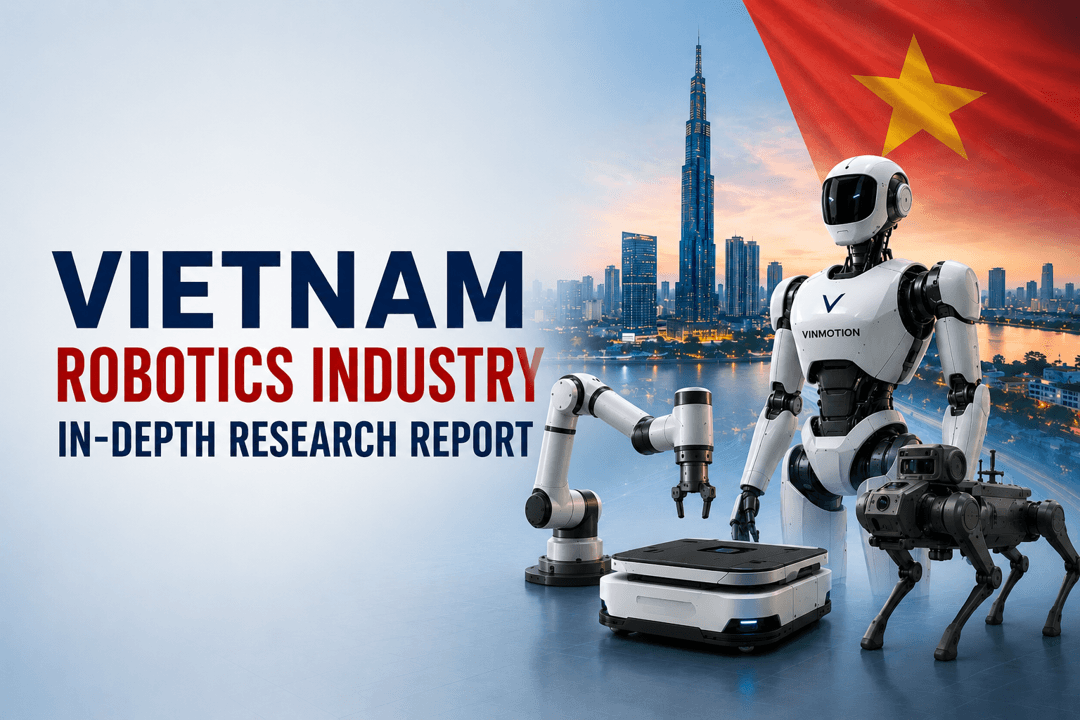
Executive Summary
Vietnam's robotics industry is at a pivotal inflection point, transitioning from a 'manufacturing adopter' toward a 'regional innovator.' Supported by a large young workforce, the government's Industry 4.0 national strategy, and accelerating foreign manufacturing investment, Vietnam is demonstrating strong momentum in robotics application and integration.
However, Vietnam remains heavily import-dependent for core robotics technologies (precision reducers, controllers, high-end sensors), and domestic R&D capacity and talent shortages remain the primary bottlenecks for industrial upgrading.
Amid the US-China competition, Vietnam employs its 'bamboo diplomacy' approach — simultaneously deepening cooperation with China's supply chains while engaging with the US, Japan, and South Korea on high-end semiconductor and AI collaboration — positioning itself as a 'connector economy.'
$286M Industrial Robot Market (2023) | ~$750M+ Broader Ecosystem Market (2030) | ~5.7% Industrial Robot CAGR (2023–2030) | 50,000 Semiconductor Engineers Target (2030) |
I. Market Overview
1.1 Market Size and Growth
Vietnam’s industrial robot market (industrial arms only) reached approximately $286 million in 2023. The broader robotics ecosystem — encompassing industrial arms, AMR/AGV, service robots, and drones — is estimated at $420–480 million in 2024. Applying an 8–10% CAGR to the 2024 mid-point base of $450 million yields a projected broader-ecosystem market of approximately $700–750 million by 2030. The narrower 2.4%–5.7% CAGR cited in mainstream forecasts applies to industrial robot arms specifically; the broader ecosystem grows faster due to AMR, drone, and service-robot segments expanding from a lower base.
| Indicator | Data / Notes |
| Industrial Robot Market (2023) | Approx. $286 million (KenResearch, et al.) |
| Overall Robotics Market Estimate (2024) | Approx. $420–480 million |
| CAGR Forecast (2028–2030) | 2.4%–5.7% (industrial robot arms sub-segment); broader ecosystem (incl. AMR, drones): est. 8–10% CAGR, ~$700–750M by 2030 |
| Dominant Application Sectors | Electronics/Electrical (dominant), Automotive, Logistics |
| Collaborative Robots (Cobots) | Fast-growing; suited for SMEs; active domestic competition |
1.2 Key Growth Drivers
Manufacturing automation demand: large-scale deployments in electronics/electrical sectors including Samsung and Apple supply chains
Rising labor costs and engineer shortages driving corporate substitution demand
Sustained FDI inflows: Foxconn, Intel, Samsung and other factories in Vietnam accelerating robot adoption
Supply chain diversification ('China+1' strategy): global restructuring creating capacity absorption opportunities for Vietnam
Government Industry 4.0 national strategy providing subsidies, tax incentives, and policy support
1.3 Core Challenges
Import dependence for core components: precision reducers, servo motors, and high-end controllers sourced almost entirely from China, Japan, and Germany
Severe talent shortage: manufacturing sector projected to need 1.2 million automation/robotics workers by 2030, with supply far below demand
Low SME adoption rates: high upfront investment and integration complexity
Weak R&D ecosystem: R&D spending approximately 0.4% of GDP
II. Industrial Policy
2.1 National Industry 4.0 and AI Strategies
The Vietnamese government has issued two key policy instruments:
Decision 2289/QD-TTg (December 2020): National Strategy on Industry 4.0 Participation and Development through 2030. Designates robotics, AI, IoT, and big data as priority technologies. Targets: digital economy at 20% of GDP; ASEAN digital leadership.
Decision 127/QD-TTg (January 26, 2021): National Strategy on Research, Development and Application of Artificial Intelligence through 2030. Dedicated AI strategy targeting top 4 in ASEAN and top 50 globally in AI by 2030.
| Policy / Program | Key Content |
| Automation Transformation 2023 | Subsidies and tax incentives (multi-trillion VND budget) driving manufacturing automation |
| Made in Vietnam 4.0 | Supports domestic intelligent manufacturing R&D; emphasizes import substitution |
| High-Tech Investment Tax Incentives | Preferential tax rates for foreign and domestic high-tech companies; targets semiconductor/robotics FDI |
| National AI Strategy (Decision 127/QD-TTg) | AI talent development, basic research, sectoral application promotion |
| Semiconductor Talent Program | Target: 50,000 semiconductor engineers by 2030; government seed budget approximately $100M. Note: at ~$2,000 per head, this figure functions as a public catalytic fund only — actual program delivery relies heavily on co-investment from US partners (e.g., Amkor, Intel) and domestic tech groups (e.g., FPT). Industry observers view the headline figure as a mobilization signal, not a standalone program budget. |
2.2 International Cooperation Frameworks
2023 US-Vietnam Comprehensive Strategic Partnership (CSP) upgrade: foundation for semiconductor, AI, and clean energy cooperation
US CHIPS Act ITSI Fund: supports Vietnam's semiconductor ATP (Assembly, Test, Packaging) capacity and talent training
Japan/South Korea: Samsung, Hyundai, LG large-scale factory investments driving automation ecosystems
EU: Vietnam-EU Free Trade Agreement (EVFTA) driving alignment with advanced manufacturing standards
III. Domestic Robotics Companies
3.1 Leading Domestic Companies
Apicoo Robotics (Hanoi, est. 2020)
Founder: Dr. Vo Gia Loc — PhD in Robotics from Sungkyunkwan University (South Korea); Postdoctoral Fellow at the Italian Institute of Technology (IIT); led the mechanical design team at Neuromeka (South Korea) and was the principal designer of the Indy7 collaborative robot
Core products: SusGrip series intelligent grippers (among the widest stroke range on the market) + collaborative robots for SME pick-and-place applications
Milestones: Selected among top 60 globally at the Korean K-Startup Grand Challenge; investment agreement signed with BK Fund (HUST venture capital) on July 8, 2023; NVIDIA Inception Program member
Phenikaa-X (Phenikaa Group, Hanoi, est. 2020)
Focus: AI-native autonomous robots, AMR (Autonomous Mobile Robots), autonomous vehicles (SAE Level 4)
Deployed in factories, farms, and campuses; supplied to Samsung's Thai Nguyen factory
Representative 'Make in Vietnam' enterprise backed by Phenikaa Group, a major Vietnamese private conglomerate
VNX Robotics (Vietnam Robotics Excellence Center, est. 2025)
Founder: Pham Thanh Huu (background: IVS Corp / ADAI Lab)
Core products: intelligent AMR; quadruped inspection robot (VietRover-T5, civilian and military variants); education robot Rovino
Ambition: to become Vietnam's first robotics unicorn, targeting logistics, industrial inspection, and education segments
Realtime Robotics / RtR (Ho Chi Minh City, est. Vietnam 2017)
Founder: Luong Viet Quoc — born and raised in Ho Chi Minh City; earned a Fulbright scholarship to pursue graduate studies in the US; holds a PhD in Economics; founded Golden Bridge Inc. in San Francisco in 2014; established RtR in Vietnam in 2017 as the first Vietnamese licensed to manufacture drones
Core product: Hera drone — won the Gold Award at Vietnam's 2025 'Make in Vietnam' Digital Technology Product awards; exported to the US including partnerships with US military distributors
Team: approximately 50 Vietnamese engineers covering airframe design, avionics, and control algorithms
Robot3T (Ho Chi Minh City, est. circa 2014, under 3C Machinery)
Focus: industrial robots, collaborative robots, end-effectors, welding/cutting solutions
Serves SMEs seeking low-cost automation; recipient of multiple Ho Chi Minh City innovation awards
3.2 Vingroup Robotics Ecosystem (Featured)
Vietnam's largest conglomerate Vingroup has aggressively entered humanoid robotics through three coordinated subsidiaries (deployments witnessed by senior Vietnamese government leaders):
| Subsidiary | Founded | Capital / Ownership | Mandate | Key Products / Progress |
| VinRobotics | November 2024 | VND 1 trillion (~$37.9M) Vingroup 51%, Pham Nhat Vuong 39%, sons 5% each | Industrial humanoid robot platform + open-source ecosystem | Industrial humanoids; July 2025: deployed at VinFast factory, autonomously completed high-precision car door assembly tasks using teleop-trained RL |
| VinMotion | Early January 2025 | VND 1 trillion (~$38.5M) Vingroup 51% | General-purpose humanoid; large-scale deployment infrastructure (Humanoid of Things) | Motion 1 (debuted within 5 months of founding, June 2025; core mechanical prototype built in approx. 3 months during stealth R&D phase pre-incorporation); Motion 2 (December 2025, lifts 40kg); deployed at VinFast for transport and QC |
| VinDynamics | September 2025 | VND 200 billion | Home/security/patrol humanoid; actuators and dexterous hands | Dyno Gen 1; deployed at Vinpearl Safari as guide robot |
Technology Highlights (Fact-Verified)
Motion control: RL-dominated locomotion with domain randomization (sim-to-real) and curriculum learning; high-precision industrial tasks trained via teleoperation data
Hardware: all mechanical, electronic, and software systems developed in-house; Motion 2 can lift 40kg and self-charge autonomously
AI layer: multilingual (Vietnamese/English) + LLM + ASR integration; distance sensors for balance stability
Open-source strategy: VinRobotics published the Humanoid Platform on GitHub/Hugging Face, including SDK, simulation models (URDF/MJCF), and RL training environment — a notable strategic pivot for a conglomerate rooted in real estate and automotive, widely interpreted as a deliberate move to cold-start its software ecosystem by leveraging the global developer community rather than building in-house depth from scratch
Key partnerships: Schaeffler (planetary gearboxes/actuators); Qualcomm (via acquisition of MovianAI from VinAI, led by Dr. Hung Bui formerly of Google DeepMind; Qualcomm's Vietnam AI R&D Center formally opened June 10, 2025); June 2026 [Breaking, as of report date]: Vingroup approved $12.75M investment in VinMotion USA (California)
IV. Research Institutions and Key Figures
4.1 Major Research Institutions
| Institution | Location | Research Focus |
| Hanoi University of Science and Technology (HUST / Bach Khoa Ha Noi) | Hanoi | Mechatronics; industrial/humanoid/autonomous robots; multiple research groups including Ba Robotics Lab (Bui Dinh Ba) |
| Ho Chi Minh City University of Technology (HCMUT) | Ho Chi Minh City | Automation, AI, robot control platforms; collaboration with VAS Corporation on control systems |
| Hanoi University of Industry (HaUI) | Hanoi | Soft robotics laboratory; student service robot projects (e.g., LumiR) |
| Vietnam National University (VNU-Hanoi / VNU-HCM) | Hanoi / HCMC | Interdisciplinary AI and robotics research |
| University of Science and Technology of Hanoi (USTH) | Hanoi | Internationally oriented; applied science and technology research |
| RMIT Vietnam | Ho Chi Minh City | Robotics and mechatronics research (Dr. Hai-Nguyen Nguyen) |
4.2 Key Domestic Figures
Dr. Vo Gia Loc: Founder of Apicoo Robotics. PhD from Sungkyunkwan University (South Korea). Postdoctoral Fellow, Italian Institute of Technology. Principal designer of the Indy7 cobot at Neuromeka. Pioneer of cobots in Vietnam.
Pham Thanh Huu: Founder of IVS Corp, ADAI Lab, and VNX Robotics. Focus on AI-robotics integration.
Bui Dinh Ba: Lead researcher, HUST Ba Robotics Lab. Humanoid robotics research.
4.3 Overseas Vietnamese Robotics Experts (US Focus)
| Name | Verified Background | Domain |
| Luong Viet Quoc | Born and raised in Ho Chi Minh City. Fulbright scholar (US master's program). PhD in Economics. Founded drone startup in San Francisco 2014; established Realtime Robotics (RtR) in Vietnam 2017 — first Vietnamese licensed to manufacture drones. | Drone R&D and AI applications. Hera drone exported to US including military distributors. All-Vietnamese engineering team (~50). |
| Dr. Thuc Vu (Vu Duy Thuc) | Born 1982, Ho Chi Minh City. B.S. Computer Science, Carnegie Mellon University. PhD in Artificial Intelligence, Stanford University (2010 — among the youngest Vietnamese Stanford PhDs). Serial entrepreneur; Katango acquired by Google. | Co-founder/CEO: OhmniLabs (telepresence robots); Co-founder/CEO: Kambria (open-source AI and robotics platform, est. 2015); Founder: VietSeed Foundation. Currently also Assistant Professor & Research Scientist at John von Neumann Institute, Vietnam. |
V. Geopolitical Context and Vietnam's Positioning
5.1 Industry Chain Absorption Capacity Assessment
| Industry Tier | Absorption Capacity | Notes |
| Apparel / Textiles / Footwear | ★★★★★ Very Strong | Surpassed China as the US's largest apparel supplier; labor cost and FTA advantages compounding |
| Electronics Assembly | ★★★★☆ Mid-tier Success | Samsung/Apple supplier relocation at scale; electronics ~40% of total Vietnam exports |
| Robotics Integration / Applications | ★★★☆☆ Limited Potential | Cobot and AMR integration viable; core components heavily import-dependent |
| AI / Robotics Core Technology | ★★☆☆☆ Very Difficult | Almost no domestic scaled production of reducers, controllers, or precision sensors |
| Semiconductor Design / R&D | ★★☆☆☆ Long-term Goal | ATP (assembly/test/packaging) feasible; chip design not realistic in near term |
5.2 China Cooperation Dynamics
Supply chain complementarity: China is Vietnam's largest import source for intermediate goods and robotics components; Chinese suppliers following clients to Vietnam
AI/robotics know-how transfer: Chinese robot exports growing sharply in 2025, with significant low-to-mid range equipment flows into Vietnamese factories
Risk: over-dependence could compromise Vietnam's 'trusted partner' positioning; Chinese technology export restrictions would directly impact Vietnamese manufacturers
5.3 US Engagement Opportunities
| Opportunity Area | Key Players | Status and Outlook |
| Semiconductor ATP (Assembly/Test/Packaging) | Amkor Technology, Intel Vietnam | Vietnam's ATP capacity steadily expanding; CHIPS Act ITSI Fund supporting talent development |
| AI Infrastructure and Applications | Qualcomm (Vietnam AI R&D Center opened June 10, 2025, via MovianAI acquisition), Google, NVIDIA, FPT | Qualcomm expanding Vietnam R&D through MovianAI; FPT partnering with NVIDIA for AI center |
| Humanoid / Industrial Robots | Vingroup (VinMotion USA — $12.75M investment approved June 2026 [⚠ Breaking]) | Active US market push; participation in ICRA/COMPUTEX 2026; investment in US humanoid AI companies |
| Talent Development | US university partnerships, CHIPS Act funding | Vietnam targeting 50,000 semiconductor engineers by 2030 |
| Rare Earth Resources | Vietnam holds world's 2nd-largest reserves | Strategic leverage in US-China competition context |
Bamboo Diplomacy Logic: Use China's supply chain for cost efficiency + US/Japan/Korea technology for value chain upgrading + EU market access for diversification. If US-China competition further intensifies, the space for 'playing both sides' will narrow.
VI. Future Development Opportunities
6.1 High-Potential Segments
| Segment | Opportunity Rating | Key Drivers |
| Electronics / Automotive Smart Factories | ★★★★★ | Sustained FDI inflows; clear demand from Samsung, LG, etc.; stable automation investment cycles |
| Logistics / Warehouse Automation (AMR/AGV) | ★★★★☆ | E-commerce growth; labor shortages; government logistics modernization initiatives |
| Agricultural Robots / Drones | ★★★★☆ | Vietnam's agricultural-nation status; workforce aging; precision farming policy support |
| Collaborative Robots (Cobots) | ★★★★☆ | Falling prices; accelerating SME penetration; domestic first-mover advantage (Apicoo, etc.) |
| Humanoid Robots | ★★★☆☆ | Vingroup catalyzing domestic ecosystem; intense global competition; mass production 3–5 years away |
| AI Integration and Software Services | ★★★★☆ | Cost-competitive Vietnamese software engineers; growing global demand for robotics software |
6.2 Three-Phase Value Chain Upgrade Path
Near-term (2026–2028): Deepen application and integration — leverage labor cost advantages and FDI factory scale to build scaled capability in cobots, AMR, and smart factory integration
Mid-term (2028–2032): Partial component localization — build on electronics manufacturing base to develop mid-range sensors, simple actuators, and robotics software; extend semiconductor ATP into robotics-specific chips
Long-term (2032+): Regional innovation hub — if talent programs execute, develop export-competitive AI application software, robotics middleware, and vertical-specific solutions
VII. Conclusions and Outlook
Vietnam's robotics industry stands at a genuine inflection point. In the context of global supply chain restructuring, Vietnam's strategic value has transcended the traditional 'low-cost manufacturing' positioning and is evolving toward a regional intelligent manufacturing hub.
In the near term (3–5 years), Vietnam's comparative advantage remains at the application and integration layers. Over the medium and long term (5–10 years), success hinges on three variables: the execution quality of talent development programs; the maturity of the domestic R&D ecosystem (the university-enterprise-government triangle); and the sustainability of 'bamboo diplomacy' as US-China competition intensifies.
For international companies and investors focused on the Vietnamese market, we recommend close attention to: domestic cobot and AMR integrators (Apicoo, Phenikaa-X, VNX Robotics); the commercialization trajectory of Vingroup's humanoid robot subsidiaries; and robotics-specific chip demand driven by semiconductor ATP capacity expansion.
Core Finding: Vietnam can readily absorb low-end industries (apparel, electronics assembly), but independently absorbing high-value AI/robotics tiers is extremely difficult in the near term. The pragmatic path is: use China's supply chain to reduce costs, use US/Japan/Korea technology partnerships to upgrade value, and use domestic talent development to build long-term competitiveness. This 'triangular balance' will determine whether Vietnam can become a genuine regional robotics powerhouse over the next decade.








Leave a comment