


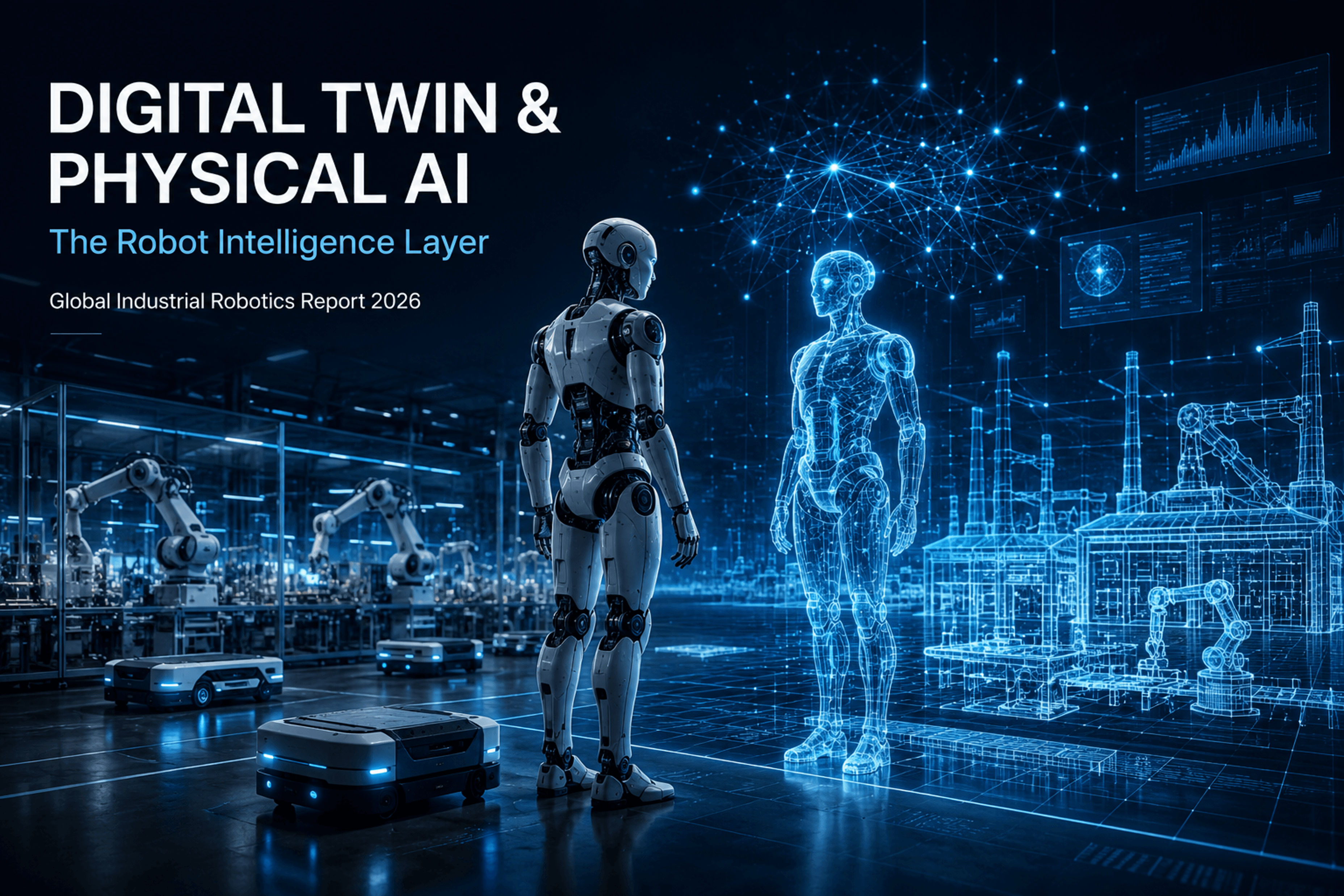
Executive Summary
Three converging technologies are rewriting what it means to program a robot. Digital twins have evolved from visualization tools into physics-accurate training environments — deployed today by a diverse ecosystem spanning NVIDIA Omniverse, Siemens Xcelerator, Dassault Systèmes 3DEXPERIENCE, ABB RobotStudio, Rockwell FactoryTalk, and Hexagon Smart Quality. Physical AI foundation models enable robots to generalize from natural language instructions, but remain subject to real constraints: hallucination, long-horizon planning failure, safety certification gaps, and persistent sim-to-real transfer challenges. And LLM coding agents are compressing robot software development cycles from weeks to hours.
This chapter maps all three layers, treats the digital twin landscape as a genuinely multi-vendor market, analyzes the global Physical AI ecosystem including China's rapidly scaling contribution, confronts the current limitations of Physical AI honestly, and closes with an OEM Readiness Matrix comparing how the world's major robot manufacturers are positioned for the software-defined era.
1. Digital Twin Technology: From Visualization to Physics-Based Intelligence
The digital twin has evolved from a visualization tool into a core element of robot commissioning, training, and predictive maintenance. The concept originated in NASA's Apollo program, but its application to manufacturing at scale has been enabled by GPU-accelerated physics simulation, universal 3D scene description standards (USD), and cloud compute sufficient to run factory-scale simulations in real time.
1.1 Tiers of Digital Twin Maturity
Digital twin implementations exist on a maturity spectrum. Level 1 (Digital Model): a 3D representation without live data — useful for layout planning and offline programming. Level 2 (Digital Shadow): one-way data from the physical system — useful for monitoring and anomaly detection. Level 3 (Digital Twin): bidirectional synchronization — the physical system can be commanded from the digital model, and changes tested before physical implementation. Level 4 (Autonomous Digital Twin): the twin operates autonomously, predicting future states, optimizing trajectories, and recommending maintenance actions without operator intervention — the current frontier pursued by multiple platform vendors.
1.2 The Digital Twin Platform Landscape: A Multi-Vendor Market
No single vendor owns the digital twin market for industrial robotics. NVIDIA Omniverse has emerged as the dominant platform for Physical AI training pipelines, but Siemens Xcelerator / Tecnomatix remains the production factory backbone for European automotive OEMs. Dassault Systèmes 3DEXPERIENCE owns significant share in aerospace and defence through its full PLM lifecycle integration. ABB RobotStudio is the reference platform for ABB robot cells globally. Rockwell's FactoryTalk Digital Twin — with its deep ControlLogix PLC integration — holds strong position in US process and assembly plants. Hexagon's metrology-grade simulation addresses the quality inspection segment that general physics engines cannot match. Schneider Electric's EcoStruxure Machine focuses on energy-aware digital twins in food, packaging, and water treatment.
Documented deployments illustrate the breadth: Wistron used NVIDIA Omniverse to cut factory commissioning from five months to two and a half while improving worker efficiency 50%. BMW and Volkswagen rely on Siemens Tecnomatix for factory-level discrete event simulation. Airbus uses Dassault 3DEXPERIENCE as its aircraft programme digital backbone. GKN Aerospace uses Hexagon Smart Quality for robot-assisted inspection path planning. The technology choice is often determined by the existing PLM and controls stack, not by simulation physics quality alone.
The table below maps the full landscape:
Platform | Provider | Core Capability | Key Deployment | DT Level |
| Omniverse / Isaac Sim | NVIDIA | GPU physics; USD scene; sim-to-real training; Cosmos world model | Foxconn, Wistron, Delta Electronics, BYD | Level 3–4; Physical AI training |
| Xcelerator / NX MCD | Siemens | Mechatronic concept design; virtual commissioning; PLC-in-the-loop testing; full digital thread | BMW, Volkswagen, Bosch; Siemens factory backbone globally | Level 3; virtual commissioning |
| 3DEXPERIENCE / DELMIA | Dassault Systèmes | Full lifecycle PLM; robot process simulation; human-robot collaboration ergonomics; cloud collaboration | Airbus, Renault, Lockheed Martin; aerospace and defence programmes | Level 3; PLM-integrated twin |
| RobotStudio | ABB | ABB virtual controller; exact physics replica; offline programming; OTA deployment | ABB robot cells globally; automotive body shops; OmniCore-enabled remote updates | Level 3; bidirectional sync |
| FactoryTalk Digital Twin | Rockwell Automation | PLC / motion controller emulation; Emulate3D simulation; deep ControlLogix integration | US automotive and CPG plants; GM, Ford control-layer digital twins | Level 2–3; controller-layer twin |
| EcoStruxure Machine | Schneider Electric | Machine-level digital twin with energy monitoring; SoMachine + EOCAD integration | Food & beverage, packaging, water treatment automation globally | Level 2–3; energy + process twin |
| Smart Quality / HxGN | Hexagon | Metrology-grade robot simulation; robot-assisted CMM path planning; quality digital thread | GKN Aerospace, Volvo Cars; precision measurement and robot inspection programmes | Level 3; metrology twin |
| Isaac Lab | NVIDIA | RL + imitation learning for robot policies in sim; GPU-parallel training | GR00T N1 training; humanoid policy research worldwide | Level 4; autonomous policy training |
Sources: NVIDIA Developer; Siemens Digital Industries; Dassault Systèmes; ABB Robotics; Rockwell Automation; Hexagon Manufacturing Intelligence; Schneider Electric. Deployment examples from public customer case studies.
2. Physical AI: When Robots Learn to Act From Observation
2.1 The Vision-Language-Action Model Paradigm
The Vision-Language-Action (VLA) model synthesizes three previously separate AI threads: large language models (semantic understanding and task reasoning), vision transformers (scene and object perception), and robot policy learning (perception-to-action mapping). Google DeepMind's RT-2, published in 2023, established the key architectural insight: robot joint commands can be treated as output tokens of a transformer trained on both web-scale vision-language data and robot demonstration trajectories. The result was zero-shot generalization to manipulation tasks never seen during training — a category change, not incremental progress.
2.2 The Global VLA Model Landscape
The VLA field now spans US, European, and Chinese developers. China's contribution is increasingly significant: AgiBot released the AgiBot World corpus of over one million robot demonstration episodes — the largest China-origin dataset — validated on its A2 humanoid platform. Unitree Robotics has open-sourced a VLA fine-tuning stack compatible with its Go2, H1, and G1 platforms, accelerating community adoption. UBTECH is training bipedal Walker S and Walker X on proprietary demonstration data. China has become the world's largest robot training ground by deployment scale, with domestic OEMs, EV factories, and government-backed research labs generating demonstration data at a rate that no single Western lab can match. This competitive dynamic in training data accumulation will likely shape model capability through 2027–2028.
Model | Developer | Release | Params | Key Advance | Open Source |
| RT-2 | Google DeepMind | Jul 2023 | 55B | First VLA: web VLM + robot trajectories = generalising policy | No |
| OpenVLA | Stanford / Open X | Jun 2024 | 7B | Open-source; 1M+ episodes, 22 robot types; outperforms RT-2 on manipulation | Yes — fully open |
| pi0 | Physical Intelligence | Oct 2024 | Large | Flow-matching action head; 50 Hz continuous generation; Paligemma backbone | No |
| pi0.5 | Physical Intelligence | Apr 2025 | Updated | Open-world generalisation: new environments never seen in training | No |
| Helix | Figure AI | Feb 2025 | Undisclosed | Humanoid-specific VLA; dual-arm coordination; real-time on Figure 02 | No |
| GR00T N1 | NVIDIA | Mar 2025 | Open family | First open humanoid foundation model; Isaac Lab sim-to-real; N1.7 updated | Yes — N1 open |
| AgiBot World | AgiBot | 2025 | Undisclosed | 1M+ episode Chinese dataset from A2 fleet; largest China-origin robot corpus | Partial |
| RoboVLMs | Unitree / community | 2025 | Multiple | Open-source VLA fine-tuning stack for Go2 / H1; strong community adoption | Yes — open |
| UBTECH Walker VLA | UBTECH | 2025 | Undisclosed | Walker S and Walker X bipedal deployment; UBTECH-proprietary training pipeline | No |
Sources: Google DeepMind; Stanford Open X; Physical Intelligence; Figure AI; NVIDIA; AgiBot; Unitree Robotics; UBTECH. Open-source status as of mid-2025.
2.3 NVIDIA's Physical AI Stack and Competitive Context
NVIDIA has assembled the most comprehensive commercial Physical AI platform: Cosmos (world foundation model for synthetic environment generation), Isaac Lab (GPU-accelerated policy training via reinforcement and imitation learning), GR00T N1 and N1.7 (open humanoid foundation models available for community fine-tuning), and Jetson AGX Thor (edge inference module targeting 200 TOPS at under 60W). The integrated workflow — text description → Cosmos environment → Isaac Lab training → GR00T fine-tuning on minimal physical demonstrations → OTA deployment — compresses the classical weeks-long programming cycle to hours.
But NVIDIA's platform is not the only Physical AI infrastructure in play. Physical Intelligence (pi0/pi0.5) is training generalizable manipulation models outside NVIDIA's ecosystem. Google DeepMind continues RT-series research. AgiBot World data and Unitree's open stack are building a parallel China-centric training infrastructure. The Physical AI stack is contested, not consolidated.
2.4 Physical AI: Current Limitations and Honest Assessment
Industrial robots in 2026 remain overwhelmingly programmed through traditional deterministic paradigms — PLC logic, motion control, safety-rated teach pendant programming. FANUC, ABB, KUKA, and Yaskawa collectively derive over 90% of their revenue from systems running classical control architectures. Physical AI is transforming research and pilot deployments; it has not yet transformed the installed base. Key limitations:
Limitation | Current Status (2025–2026) | Path to Resolution |
| Hallucination & action errors | VLA models still produce physically impossible or unsafe joint commands at non-trivial rates outside trained distribution. Failure rates of 5–15% on novel objects remain common in lab evaluations. | Larger, more diverse training datasets; uncertainty-aware action heads; real-time anomaly detection in controller firmware. |
| Long-horizon planning failure | Current VLA models excel at 2–5 step manipulation; tasks requiring 15+ sequential steps with conditional branches remain unreliable without explicit task graph scaffolding. | Hierarchical VLA architectures combining high-level LLM planners with low-level action models; Code-as-policies approaches. |
| Safety certification gap | No IEC 61508 / ISO 10218 pathway exists for neural policy controllers. Learned policies cannot yet be formally verified for worst-case behaviour — a hard requirement for industrial deployment in shared workspaces. | Deterministic safety envelopes wrapping neural policies (Beckhoff SPS approach); modular certification of bounded sub-tasks; ongoing ISO TC 299 working group activity. |
| Training data scarcity | High-quality robot demonstration data remains scarce. AgiBot World's 1M episodes is the largest public corpus — still orders of magnitude below language model training scales. Simulation data helps but sim-to-real gap persists. | Cross-embodiment datasets (Open X-Embodiment); synthetic data from Cosmos-class world models; robot fleet telemetry as training signal. |
| Sim-to-real transfer gap | Policies trained in simulation frequently fail on physical robots due to unmodelled contact dynamics, sensor noise, actuator backlash, and lighting variation — especially for dexterous manipulation. | Domain randomisation; real2sim calibration from point cloud scanning; physics engines with deformable contact (Isaac Sim 4.x, MuJoCo MJX). |
| Inference latency | Large VLA models (10B+ parameters) require dedicated GPU inference hardware to achieve the 50–200 Hz control frequencies industrial robots demand. Edge deployment on robot compute remains power- and cost-constrained. | Distillation to smaller action-specialist models; neuromorphic inference chips; NVIDIA Jetson AGX Thor targeting 200 TOPS at <60W. |
The correct framing is not 'Physical AI will replace traditional programming' but 'Physical AI will complement deterministic control, handling perceptual flexibility while classical architectures retain responsibility for safety-critical and certified functions.' The hybrid architecture that Beckhoff demonstrated at SPS 2025 — neural policies executing as hard-real-time tasks within TwinCAT alongside deterministic safety functions — is the likely production path, not a wholesale replacement.
3. LLM-Driven Robot Programming: The Natural Language Turn
Parallel to end-to-end VLA learning, LLM-based programming is transforming how robots are coded: AI translates natural language instructions into executable programs, augmenting rather than replacing the traditional software architecture. MIT research (2024) demonstrated 23–47% improvement in multi-step manipulation success rates when LLMs provided task decomposition from natural language context. ProgPrompt (Stanford/NVIDIA, 2023) showed LLMs generating executable Python for robot task execution. Code-BT (2025) uses LLMs to generate behavior trees — the hierarchical state machine formalism increasingly used for task execution. The MALMM multi-agent framework (2025) deploys three collaborating LLM agents: Planner, Coder, and Supervisor — mirroring a human software engineering team.
3.1 LLM Coding Agents in the Robot Development Workflow
LLM coding agents — Claude Code, GitHub Copilot, and domain-specific robotics code assistants — operate at multiple levels. At the component level, they accelerate writing of ROS2 nodes, hardware drivers, and sensor processing pipelines — tasks requiring precise knowledge of ROS message types, publisher/subscriber patterns, and launch file syntax. At the architecture level, they assist with MoveIt configuration, URDF generation from CAD specs, point cloud processing scripts, and debugging real-time control loop timing. Stripe's documented deployment across 1,370 engineers — where one team completed a 10,000-line language migration in four days — illustrates the productivity compression available to robotics software teams.
The longer-term structural implication is clear: when natural language interfaces reach production reliability, the teach pendant and proprietary programming language lose their central role. FANUC's TP language was designed for a world where a trained technician specified joint coordinates by hand. Safety certification and institutional inertia will extend the proprietary language era well into the 2030s, but the direction is unambiguous.
4. OEM Readiness: Positioning for the Software-Defined Era
The software architecture choices that robot OEMs made in the 1980s–1990s are being stress-tested by two simultaneous forces: the open-source ROS ecosystem demonstrating superior innovation velocity, and the Physical AI paradigm requiring large, diverse datasets that no single vendor can accumulate alone. The table below assesses readiness across the major global OEMs — a question that enterprise customers and investors are asking with increasing urgency.
OEM | Origin | Digital Twin | Physical AI Readiness | Open Ecosystem | Key Platform |
| FANUC | Japan | Medium | Low | Low | ROS2 driver; TP/KAREL core |
| ABB | Switzerland | High | Medium | High | OmniCore; open API; RobotStudio |
| KUKA | Germany / Midea | High | Medium | High | KR C5; WorkVisual SDK; iiQA |
| Yaskawa | Japan | Medium | Low | Medium | YRC1000; Cockpit DT; ROS-I |
| Estun | China | Medium | Medium | Medium | ER series; cloud DT; domestic AI stack |
| Inovance | China | Medium | Medium | Medium | InoRobot; Huawei Cloud integration |
| Unitree | China | Emerging | Medium | High | Go2 / H1 / G1; open SDK; community VLA |
| AgiBot | China | Emerging | High | Medium | A2; AgiBot World dataset; 1M episodes |
FANUC's conservative posture preserves installed-base loyalty — its primary competitive asset — while gesturing toward open ecosystems via ROS2 GitHub drivers. ABB OmniCore is the most genuinely open architecture among the Big Four, with native Python, open API, and cloud OTA. KUKA's KR C5 and WorkVisual SDK represent the deepest architectural openness among established Western OEMs — maintained rather than reversed after Midea's acquisition. Yaskawa's digital twin capability is functional but lags ABB and Siemens-adjacent competitors. Among Chinese OEMs, Estun and Inovance are investing in cloud-native architectures and Physical AI integration. Unitree and AgiBot represent a new generation of OEMs that are architecturally open by design — their competitive threat to established players will depend on whether their Physical AI leadership translates to industrial reliability.
5. Convergence: When Digital Twin Meets Physical AI
The most consequential near-term development is the convergence of digital twin simulation and Physical AI training into a single unified pipeline. Classical digital twins mirror the physical system but do not generate new capabilities. Physical AI training environments generate capability through neural policy learning. The convergence point is a simulation environment physically accurate enough that trained policies transfer directly to hardware — collapsing the historically expensive sim-to-real calibration step.
This convergence is happening across multiple vendor stacks simultaneously: NVIDIA Cosmos for synthetic environment generation, Siemens Tecnomatix for PLC-in-the-loop validation before physical deployment, Dassault 3DEXPERIENCE for human-robot ergonomics simulation, and Beckhoff's TwinCAT integration of neural policies as hard-real-time controller components. No single platform will own the convergence. The likely outcome is a digital thread spanning design (CAD), simulation (physics twin), policy training (Physical AI), and deployment (OTA update) — with different vendors contributing different segments and integration standards emerging to connect them.
6. Strategic Outlook: The Software-Defined Robot Era
Time Horizon | Programming Paradigm | Digital Twin Role | AI Integration | Key Transition |
| Now–2027 (Hybrid) | Proprietary languages dominant in production; ROS2 for new deployments; LLM code assist widely adopted | Level 3 digital twins standard for new factory design; multi-vendor platforms coexist; Siemens, Dassault, NVIDIA each hold strong verticals | VLA models in research/pilot; LLM code generation in development workflows | Natural language programming enters developer workflow; digital twin mandatory for capital project approval |
| 2027–2030 (Transition) | LLM-generated programs for non-critical tasks; VLA policies in production manipulation; proprietary languages maintained for safety-certified cells | Level 4 autonomous twins; Cosmos-class world models for rapid environment generation; OTA policy updates standard; cross-vendor digital thread emerges | VLA in production manipulation; GR00T / AgiBot-class models fine-tuned per application; AI copilot in controller IDE | Physical AI crosses reliability threshold for mid-complexity tasks; teach pendant becomes legacy; Chinese OEMs close readiness gap |
| 2030+ (Software-Defined) | Natural language as primary interface; AI generates, validates, certifies programs; certified neural policy modules as safety-rated building blocks | Digital twin and physical robot as co-equal system; autonomous continuous optimisation; factory digital thread standard | Foundation model per robot family; continuous learning from fleet telemetry; federated learning across robot networks | Robot programming democratised; OEM value shifts from hardware to software ecosystem; US-China AI stack competition intensifies |
Sources: NVIDIA Developer (Isaac Sim, GR00T N1, Isaac Lab, Cosmos); Physical Intelligence pi0; Google DeepMind RT-2; Stanford OpenVLA; AgiBot; Unitree Robotics; UBTECH; MIT News (LLM robot planning); Anthropic Claude Code documentation; Beckhoff SPS 2025; ABB OmniCore; Siemens Xcelerator; Dassault Systèmes; Rockwell Automation; Hexagon Manufacturing Intelligence; Schneider Electric EcoStruxure. All figures and projections subject to revision.





Leave a comment