

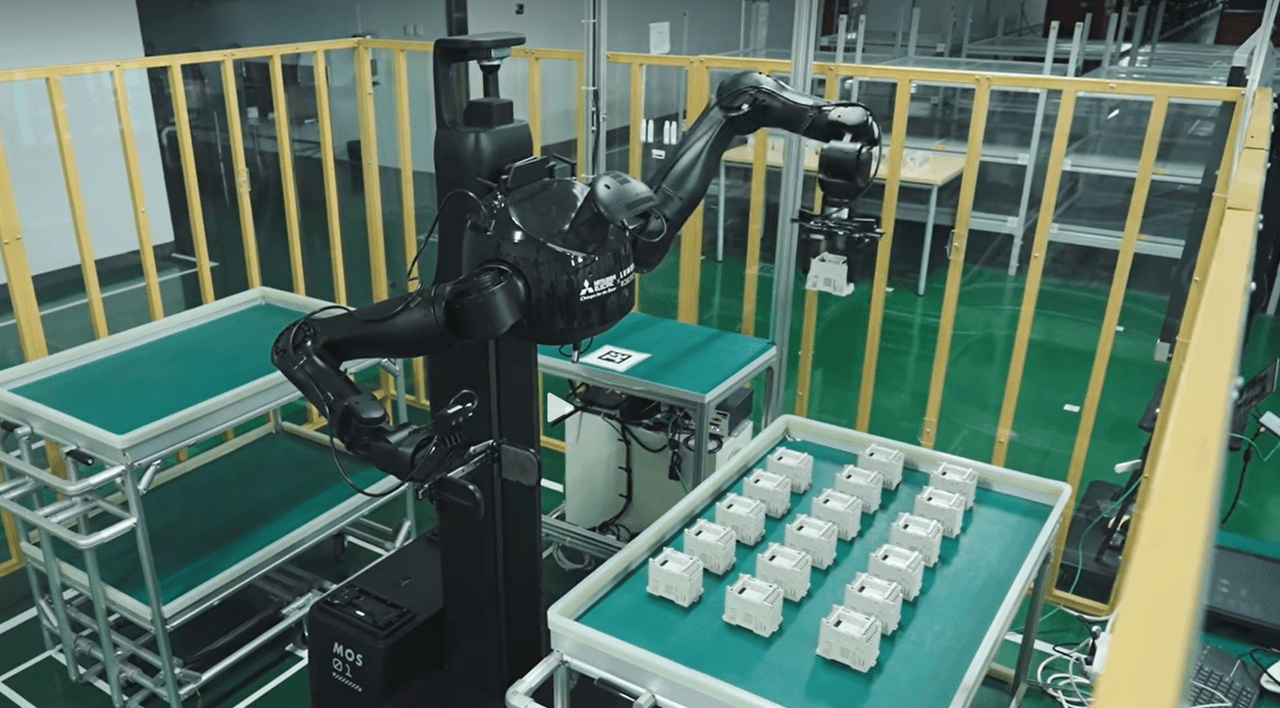
Japanese industrial automation giant leads two consecutive rounds totalling $140M into Chinese embodied AI startup, signalling shift from lab experimentation to real manufacturing infrastructure.
$140M | Total funding A1+A2 | $40B+ | Mitsubishi's annual revenue |
Dual lead investor | Mitsubishi Electric (A1 & A2) | 5× improvement | Data collection efficiency (FastUMI) |
About Lumos Robotics
Lumos Robotics is a Tsinghua University-founded embodied AI company focusing exclusively on industrial and logistics deployment. Founded by CEO Yu Chao, the startup operates three robot platforms: the LUS series (full-size humanoid), MOS series (wheeled dual-arm), and Lumos Mini (compact humanoid). The company generated headlines not through humanoid marketing, but through measurable industrial deployment—inspection, assembly, material handling, and sorting tasks in manufacturing environments.
Core Technical Advantages
FASTUMI PRO DATA ACQUISITION SYSTEM
Lumos' breakthrough data infrastructure decouples data collection from physical embodiment. A single FastUMI Pro system works with 90%+ of existing industrial robot arms, improving training data collection efficiency by 5× while reducing costs to one-fifth of traditional approaches. Precision reaches 1–3mm across manipulation tasks. Adoption is already widespread—approximately two-thirds of leading embodied AI research teams use FastUMI Pro.
NEXCORE PHYSICAL AI ENGINE
Proprietary motion control stack combining world models, Visual Language Actions (VLA), industrial vision optimization, and Mixture-of-Experts networks. Designed for adaptive motion in complex, partially unstructured manufacturing scenarios.
PROPRIETARY ACTUATORS & GEARING
High-torque-density integrated joints and PEEK cycloidal gearing yield 40% weight reduction and 60% torque improvement over industry benchmarks. Custom-built for industrial-grade reliability and precision.
Why Mitsubishi Electric Leads (Not Follows)
Mitsubishi Electric is not a venture capital firm. It is a $40+ billion global industrial automation incumbent with core competencies in factory PLCs, servo systems, CNC platforms, and production-line integration.
Japanese manufacturing faces structural labor pressures: workforce aging, technician shortages, rising operational costs, and existing factories that cannot easily transition to fully automated systems. Mitsubishi's strategic question is not whether automation is necessary, but which architecture can scale fastest to maintain competitiveness over the next decade.
The critical difference: Mitsubishi is not simply investing capital. Joint R&D laboratories have been established in Suzhou and Shanghai, where Lumos MOS robots are currently deployed for live AI-powered visual inspection on PLC production lines. Mitsubishi has validated the technology operationally before committing leadership and capital.
LUMOS ROBOTICS PRODUCT SPECIFICATIONS
Product | Form Factor | Key Specs | Deployment |
LUS Series | Full-size humanoid | 1.7m tall, 1-sec recovery, industrial-grade | Assembly, inspection, handling |
MOS Series | Wheeled dual-arm | 50kg per-arm payload | Warehouse & production logistics |
Lumos Mini | Compact humanoid | Space-constrained deployment | Specialist manufacturing tasks |
Market Implications
INDUSTRIAL AI ENTERS REAL INFRASTRUCTURE
For years, embodied robotics were positioned as research platforms, future consumer products, or speculative ventures. Actual industrial deployment changes this narrative. If Mitsubishi-scale automation leaders begin integrating embodied AI into inspection, logistics, assembly, and maintenance workflows, the industry transitions from prototype experimentation to operational deployment.
COMPETITIVE RESPONSE INCOMING
Watch for embodied AI announcements from ABB, Siemens, Rockwell Automation, FANUC, Yaskawa Electric, Omron, and Stäubli. The emerging competitive question is no longer 'Who builds industrial robots?' but 'Who controls intelligent industrial autonomy?'
Key Milestones to Track
Timeline | Key Event | What It Signals |
Q3 2026 | LUS batch production | Product-market fit validation |
Q3–Q4 2026 | Tier-1 automation partnerships | Industry-wide momentum signal |
H2 2026+ | FastUMI Pro commercial uptake | Full-stack model viability |
Information Quality Note
Financial and technical specifications originate from Lumos Robotics press releases, Mitsubishi Electric subsidiary announcements, and cross-corroborating industry reporting. Joint lab operations and field deployment details have been confirmed by multiple independent sources. All figures should be treated as credible but unverified pending independent confirmation.
RobotToday covers the business and technology of robotics and embodied AI. This briefing is based on publicly available media reporting. For investment decisions, consult a licensed financial advisor.
Sources: Lumos Robotics (May 11, 2026); Mitsubishi Electric press releases; TechDaily; PandDaily; 36Kr; Industry analysis. Exchange rate: 1 USD = 7.15 RMB (May 2026).










Leave a comment