


INDUSTRY FIRST
Robotics Service Framework (RSF) Officially Launches
The First Comprehensive Capability Certification Framework for the Global Robotics Service Industry
RobotToday.com today announced the official release of the Robotics Service Framework (RSF) — the first structured capability certification and service management framework purpose-built for the global robotics service industry. RSF addresses a critical gap that has persisted as robotics deployments have scaled worldwide: while international standards define what a safe robot looks like, no framework has defined who should service it, how, and at what level of competency.
THE PROBLEM RSF SOLVES
A Systemic Gap in the World's Fastest-Growing Industry
The global installed base of industrial and service robots has grown significantly, yet the service workforce has lacked any unified capability standard. Engineering teams at robot operators, OEMs, and third-party service providers have had no common language for competency levels, no structured career progression, and no standardized service procedures that span robot types and brands.
ISO 10218 defines robot safety. IEC 61508 defines functional safety. But no standard answers the essential question: what does a qualified robot service engineer actually know, and how do we verify it?
RSF is the answer to that question.
FRAMEWORK ARCHITECTURE
Six Capability Domains
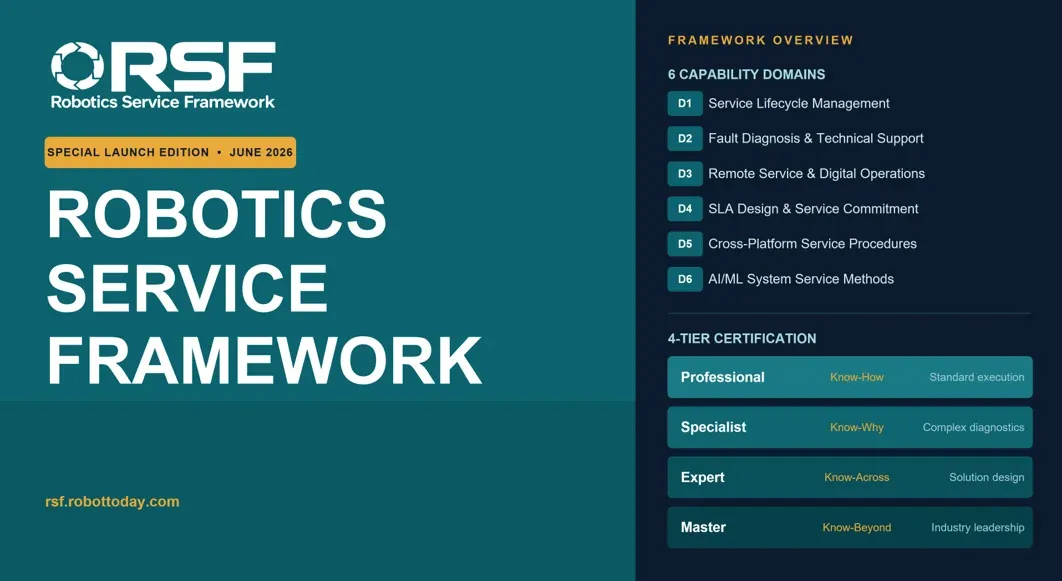
RSF organizes the knowledge and skills required for robotics service into six capability domains spanning the full service lifecycle:
| Domain | Name | Scope |
1 | Service Lifecycle Management | Delivery, maintenance, and retirement of robotic systems |
2 | Fault Diagnosis & Technical Support | Four-layer diagnosis: mechanical, electrical, software, AI |
3 | Remote Service & Digital Operations | Digital twins, predictive maintenance, OTA updates |
4 | SLA Design & Service Commitment | Response times, uptime commitments, KPI frameworks |
5 | Cross-Platform Service Procedures | Unified SOPs across industrial arms, cobots, AMRs, humanoids |
6 | AI/ML System Service Methods | Diagnostics for AI-integrated and learning-based systems |
CERTIFICATION ARCHITECTURE
Four-Tier Certification System
RSF introduces a four-tier certification structure serving both engineer and service manager career tracks:
| Tier | Title | Engineer Track | Manager Track |
| Professional | RSF Professional | Standard execution, routine inspection | Work order dispatch management |
| Specialist | RSF Specialist | Complex fault diagnosis, performance tuning | Cross-region team, P&L responsibility |
| Expert | RSF Expert | Solution design, system integration | System optimization, data analytics |
| Master | RSF Master | Technical roadmap, industry standards | Global strategy, service productization |
POSITIONING
Built on the Shoulders of Proven Frameworks
RSF inherits from three proven industry precedents:
But none of these frameworks cover physical safety, AI-layer diagnostics, cross-platform SOPs, spare parts management, LOTO procedures, or robot-specific SLA metrics. RSF does. |
WHAT'S INCLUDED
RSF Whitepaper 1.0
The RSF Whitepaper 1.0 is the normative framework document, covering the full six-domain architecture, four-tier certification requirements and progression criteria, authorization boundaries by tier, inter-domain relationship maps, and market development pathways for RSF certification.










Leave a comment