


Future Horizons: 2025–2030 & Beyond
The Decade That Decides the Industry
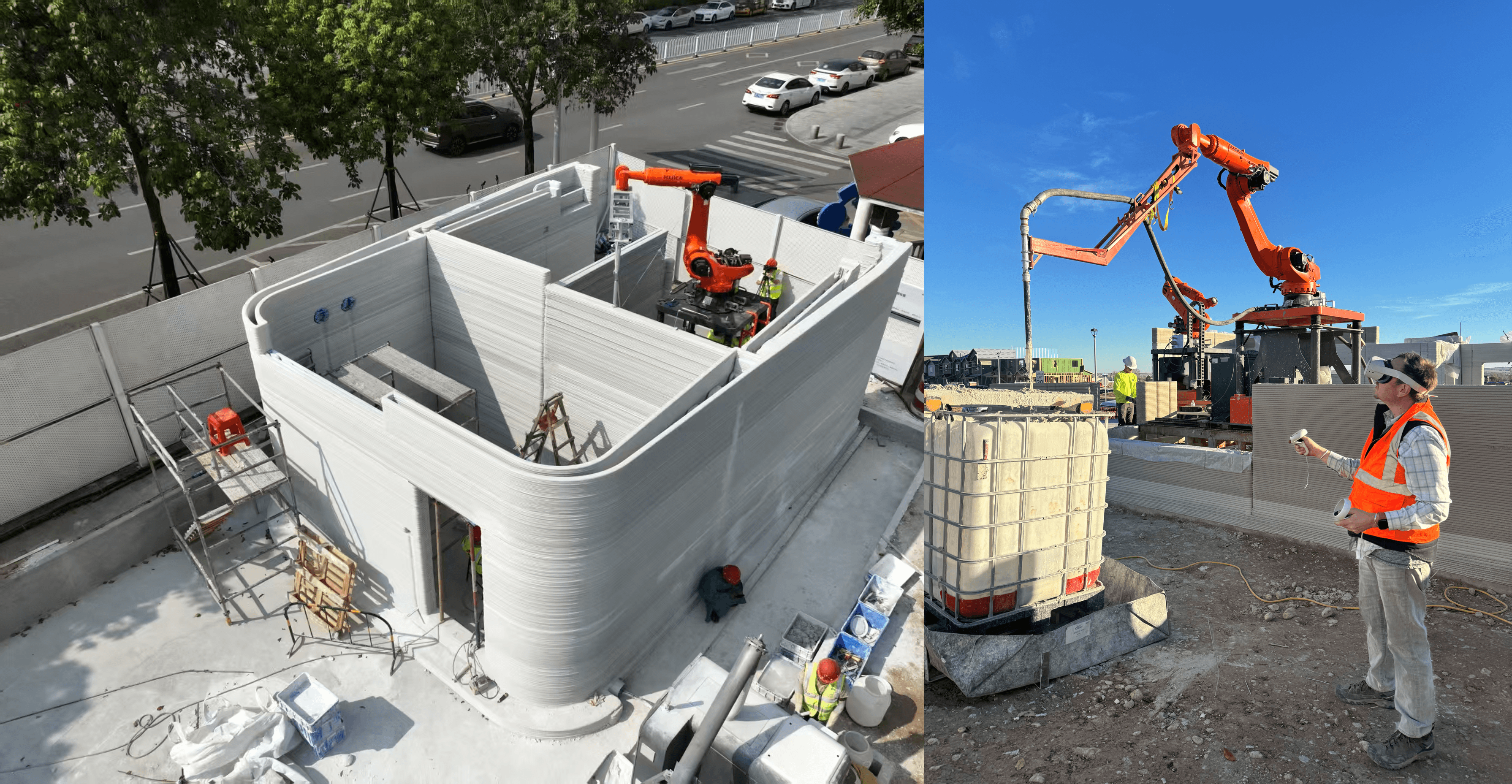
Caterpillar unveiled autonomous excavators at CES 2026. Bedrock Robotics launched from former Waymo engineers. Buildroid raised pre-seed funding backed by Tim Draper. The next five years will not look like the last five.
The Market Numbers That Matter
Construction robotics is not a single market. It is a convergence. Grand View Research pegs narrow construction robots at $1.37 billion in 2024, growing at 18% annually to $3.66 billion by 2030. That is the conservative baseline.
Add adjacent categories. Exoskeletons hit $932 million in 2024. Humanoid robots reach $15.3 billion globally by 2030, per MarketsandMarkets. Built environment tech funding hit $4.4 billion in Q3 2025 alone, per Nymbl Ventures. (These are commercial estimates; treat as directional.)
The $60 billion scenario is not fantasy. It requires counting the full stack: autonomous heavy equipment, multi-robot coordination software, AI platform subscriptions, exoskeletons, inspection drones, and humanoid pilots. Include adjacent infrastructure AI. The number becomes plausible by 2035–2040.
The global robotics market itself hits $205.5 billion by 2030, per GlobalData. Construction captures a small but accelerating share. The question is speed of adoption, not direction.
Table 1: Construction Robotics & Adjacent Market Forecasts 2025–2030
| Segment | 2024-2025 Size | 2030 Forecast | Notes/Source |
| Narrow Construction Robots | $1.37B (2024) | $3.66B (2030) | 18% CAGR (Grand View Research; commercial estimate) |
| Broader Built Env. Tech Funding | $4.4B (Q3 2025 YTD) | Est. $10B+ (2026) | 66% YoY growth; Nymbl Ventures commercial data |
| Global Robotics (all sectors) | $90.2B (2024) | $205.5B (2030) | 15% CAGR; GlobalData forecast |
| Humanoid Robot Market | $2.9B (2025) | $15.3B (2030) | 39% CAGR; MarketsandMarkets; commercial estimate |
| Exoskeleton Market | $0.85B (2025) | $2.0B+ (2030) | 18% CAGR; ABI Research; commercial estimate |
| Construction Robots — $60B Scenario | Baseline: $3.7B | $60B possible by 2040 | Includes adjacent AI, swarm, humanoid at jobsite (directional) |
Source: Grand View Research, GlobalData, MarketsandMarkets, ABI Research, Nymbl Ventures. All figures are commercial market estimates. Not independently verified by governmental statistical bodies.
The Technology Convergence Happening Right Now
Three forces are colliding. Physical AI is maturing. Autonomous systems are leaving pilots. Multi-robot coordination is moving from labs to jobsites.
At CES 2026, Caterpillar unveiled a new generation of autonomous excavators, dozers, and trucks. The company cited 30-plus years of automation research. Its Cat VisionLink and MineStar systems coordinate entire fleets. Machines now share data and respond collectively to changing site conditions.
Bedrock Robotics launched in January 2026. Its four founders are former Waymo engineers. They convert existing construction equipment into fully autonomous machines using AI perception systems. The target: 24/7 earthwork operations at data center sites. Microsoft committed $80 billion to data center construction in 2025 alone. That is the demand signal.
Buildroid AI entered the US market in November 2025. It raised $2 million pre-seed from Tim Draper. The model is simulation-first: thousands of Nvidia Omniverse digital twin runs before any robot touches a site. Buildroid coordinates block-laying robots, material-handling AMRs, and plastering robots in a single platform. Commercial US projects begin Q1 2026.
Swarm Coordination: The Next Frontier
Single robots solve single problems. Swarms solve workflows. That distinction drives the next wave of construction robotics investment.
Swarm drones already conduct synchronized inspections across large infrastructure sites. Multi-robot masonry platforms like Buildroid coordinate up to three specialized robots on a single wall sequence. The software layer — not the hardware — creates the value.
Buildroid uses hierarchical task network planning for high-level sequencing. Behavior trees handle local execution. Digital twins manage real-time replanning when a robot goes offline. This is not a pilot mindset. It is production-grade architecture.
The economic logic is clear. A single bricklaying robot has limited impact. A coordinated system of bricklayers, material AMRs, and QA drones transforms a trade workflow. Blockwork alone is a $13 billion segment globally, per Buildroid. Multi-robot platforms attack the entire segment, not one task.
Full Autonomous Jobsites: Timeline and Reality Check
Full autonomy — no human operators on site — is not a 2025 story. It is a 2030-plus story for most applications. But the trajectory is established.
Caterpillar already delivers Level 4 autonomy in mining. The transition to construction brings structural complexity: irregular terrain, variable blueprints, human workers nearby. These are harder problems than open-pit mining. But they are being solved.
The Association of Builders and Contractors reported 454,000 unfilled US construction jobs in 2025. That is not a temporary shortage. Contractors with chronic labor gaps adopt automation faster than industry averages. Economics overrides hesitation.
The realistic path: semi-autonomous heavy equipment is standard by 2027–2028. Multi-robot interior fit-out platforms reach commercial scale by 2028–2030. Fully autonomous greenfield sites — complete jobsites running without human operators — remain a 2030-plus target for most markets.
Humanoid Robots: Promise, Timeline, and Honest Assessment
Humanoids are the most-discussed and least-deployed category in construction robotics. The gap between narrative and deployment is wide.
Figure AI hit a $39 billion valuation in September 2025. Apptronik raised $350 million in Series A. These are AI infrastructure bets, not construction-specific ones. (Valuations are from company disclosures; not independently verified.)
Humanoid robots cost $5,900 to $100,000 depending on capability. Battery life limits shift duration. Autonomy levels remain insufficient for most unsupervised construction tasks. Most 2025–2026 deployments are pilot programs in controlled environments.
The honest assessment: humanoids reach meaningful construction deployment by 2028–2030 for specific tasks — material handling, inspection, surface finishing. General-purpose construction humanoids are a 2032-plus story. Exoskeletons bridge the gap. They augment workers today, not in five years.
Country-by-Country: Who Leads, Who Follows
Geography shapes adoption speed. Robot density, labor cost, government policy, and project type all determine pace.
China installed 295,000 industrial robots in 2024 — its highest annual figure ever. Robot density hit 470 units per 10,000 workers. The 14th Five-Year Plan for Robot Industry Development runs through 2025. State-backed venture capital funds accelerate adoption across manufacturing and construction.
The US is mobilizing. A White House memo called for a National Robotics Strategy in early 2025. The US spends only 0.1% of GDP on active labor-market programs — below OECD averages. The robotics strategy aims to close the gap before China dominates embodied AI.
Japan passed its AI Promotion Act in May 2025. South Korea's AI Basic Act enforcement began January 2026. Both nations move fast on regulation while maintaining domestic robotics export leadership.
The UAE and Saudi Arabia are the fastest-growing markets per Grand View Research. ALEC launched a formal robotics strategy in November 2024, targeting 5% activity automation by 2030. Dubai Future Labs actively funds unmanned systems R&D.
Table 2: Country-by-Country Construction Robotics Forecast 2026–2030
| Country | Adoption Level | Full-Scale Est. | Key Drivers / Notes |
| USA | High | 2026-2028 | Caterpillar autonomous CES 2026; Bedrock Robotics; 500K job gap driver; national robotics strategy memo |
| China | Very High | 2025-2027 | 54% of global robot installs 2024; 470 robots/10k workers; state-backed funding; BYD humanoid scaling |
| Japan | High | 2026-2028 | 44,500 robots installed 2024; aging population catalyst; AI Promotion Act May 2025; robotics export leader |
| South Korea | High | 2025-2027 | 30,000 robots/yr; MEXO exo-suit pilots; AI Basic Act Jan 2026; highest robot density globally |
| UAE/Saudi Arabia | Fast-Rising | 2027-2029 | ALEC 5% automation by 2030; Dubai Future Labs; Saudi fastest CAGR per Grand View Research |
| Germany/EU | Moderate | 2028-2030 | EU $183M robotics program; 85K installs 2024; focus on human-centric cobot regulation |
| Australia | Moderate | 2027-2030 | Hadrian X (Fastbrick) commercial deployments; PulteGroup house build Feb 2025 |
| India | Emerging | 2029-2032 | 59% robot install growth 2024; PLI scheme incentives; Addverb/Reliance humanoid plans |
Source: IFR World Robotics 2024, Grand View Research, ITIF, company announcements. Adoption level and timeline are analytical estimates, not verified forecasts.
Regulatory Evolution: What to Watch
Regulation is the variable nobody can fully model. But the direction is visible.
The EU's AI Act classifies autonomous heavy machinery as high-risk. Safety certification pathways are under development. The EU has allocated approximately $183 million through end-2025 for robotics work programs. European adoption prioritizes human-centric cobot frameworks over full autonomy.
Japan's approach is instructive. The AI Promotion Act is innovation-first. It issues guidance rather than punitive enforcement. Enterprise buyers respond to reputational pressure, not just legal mandates. Japan's model may become the template for construction-specific robotics regulation globally.
OSHA and equivalent agencies in the US and UK face a harder problem: certifying autonomous heavy equipment near human workers. Clear standards for Level 3 and Level 4 autonomy on open construction sites do not yet exist. This regulatory gap slows adoption more than technology limitations do.
The most pragmatic near-term path: site-specific certification, not blanket approval. Autonomous systems operate in designated exclusion zones. Humans supervise at distance. That hybrid model already works in mining and will transfer to construction by 2027.
Workforce Transition: The Real Stakes
Oxford Economics forecast 20 million manufacturing jobs displaced by robots by 2030. Construction faces a different dynamic. It has a labor shortage, not a labor surplus.
The IFR's top 2026 robotics trend: workforce acceptance. Robots are being framed as allies, not replacements. In construction, that framing is literally accurate. There are 454,000 unfilled US jobs right now. Robots fill gaps that humans cannot.
The transition creates three new job categories. Robot supervisors monitor autonomous systems on site. Data analysts interpret sensor feeds and optimize workflows. Maintenance technicians service increasingly complex equipment fleets. These are better-paid roles than the physical labor they partially replace.
The risk is uneven transition. Workers over 50 face retraining barriers. Apprenticeship programs must pivot faster than they historically have. Caterpillar pledged $25 million over five years for workforce education at CES 2026. That is one signal. The scale required is far larger.
AI + Embodied Intelligence: The Defining Convergence
The deepest shift is not hardware. It is AI entering the physical world at scale.
Physical AI — the integration of AI cognition with hardware that operates in real environments — is the thesis behind SoftBank's $5.375 billion ABB Robotics acquisition. It is the operating premise of Bedrock Robotics, Figure AI, and Physical Intelligence. It is why NVIDIA's Omniverse platform powers construction simulation for Buildroid.
Foundation models for robotics are emerging. Physical Intelligence raised $400 million to build general-purpose robotic intelligence. Unlike task-specific automation, foundation model robots adapt to new environments with minimal retraining. Construction's variable, unstructured environments are exactly the problem these systems target.
The convergence timeline: AI-native construction platforms with foundation model backends reach commercial viability by 2027–2028. By 2030, the distinction between 'construction robot' and 'general-purpose AI robot deployed in construction' collapses. Software becomes the primary competitive moat.
Strategic Implications: The 'So What' for Every Audience
The series has covered 11 prior dimensions of construction robotics. Part 12 closes with the decision framework. Every audience faces different urgency and different leverage.
Table 3: Strategic Implications by Audience
| Audience | Strategic Implication |
| General Contractors | Adopt RaaS models first. Avoid large capex robots until swarm coordination matures. Budget for robot-supervisor roles by 2027. |
| OEMs (Caterpillar, Komatsu, etc.) | Embed autonomy in core product lines. Acquire or partner with AI-native platforms before 2028. Digital twin integration is mandatory. |
| Tech Investors | Back AI-native platforms with recurring revenue models. 39x revenue multiples justify early bets. Watch humanoid cost curves closely. |
| Workforce / Unions | Retrain for robot supervision and data analysis. Exoskeletons augment workers before humanoids replace them. Window: 2026-2030. |
| Regulators | Develop safety certification pathways for autonomous heavy equipment. Japan's AI Promotion Act offers a useful template. |
| Startups | Focus on multi-robot coordination software. Buildroid, Bedrock Robotics model shows: simulation-first beats hardware-first. |
Source: Author analysis based on series research, company disclosures, and market data cited throughout Parts 1–12.
Closing: What the Next Five Years Actually Settle
Five things will be decided by 2030. First: whether autonomous heavy equipment achieves regulatory acceptance for open jobsites. Japan and the US will set the template.
Second: whether multi-robot coordination software produces measurable productivity gains at commercial scale, not just in pilots. Buildroid and Bedrock face this test directly.
Third: whether humanoid robots reach construction-relevant cost and autonomy thresholds before 2030. Current trajectories suggest 2028–2030 for task-specific deployment.
Fourth: whether China's domestic robot ecosystem produces globally competitive construction platforms, replicating its EV industry disruption. Morgan Stanley's 2025 analysis suggests it can.
Fifth: whether workforce retraining scales fast enough to prevent a generation of displaced workers. The technology is arriving faster than the policy response.
The $60 billion scenario is not guaranteed. But the forces driving it — labor scarcity, AI maturation, climate construction demand, and capital concentration — are all accelerating simultaneously. The industry that coordinates those forces first wins the decade.
Market figures marked as commercial estimates are sourced from Grand View Research, Nymbl Ventures, MarketsandMarkets, ABI Research, GlobalData, and DealMaker. These are proprietary commercial datasets and have not been independently verified by governmental statistical bodies. Company-specific data (valuations, funding, product claims) sourced from press releases and media reports; not independently audited.








Leave a comment