

iRobot Didn’t Lose on Engineering — It Lost on Definition
At no point did iRobot’s robots suddenly stop working. Roombas remained reliable, durable, and technically competent. What changed was not engineering quality, but how value was defined in the consumer robotics market.
As the category matured, winning no longer meant “does it clean reliably?” It meant how fast features evolved, how clearly value was communicated, and how well price matched perceived capability. On each of these dimensions, iRobot gradually lost alignment with the market it helped create.
Roomba Solved the Original Problem — Then Stopped Redefining It
Roomba’s original breakthrough was narrow and decisive: autonomous floor cleaning that worked in real, chaotic homes.
Once that problem was solved, iRobot focused on refinement—incremental improvements in reliability, navigation stability, and edge cases. Competitors took a different path. They reframed the problem:
- From cleaning to automation convenience
- From navigation to AI awareness
- From a device to part of a connected home workflow
iRobot optimized the original solution. Others redefined what the solution was supposed to be.
When Features Became Expectations, Not Differentiators
By the late 2010s, the robot vacuum market underwent a rapid feature reset. Auto-empty docks, vacuum–mop combos, LiDAR mapping, obstacle recognition, and app-level customization became baseline expectations.
iRobot eventually adopted many of these features—but usually later than competitors. By the time they arrived, rival brands had already normalized them at lower or similar prices. In consumer hardware, being technically right but late delivers the same market outcome as being wrong.
How iRobot Compared with the Global Market Leaders
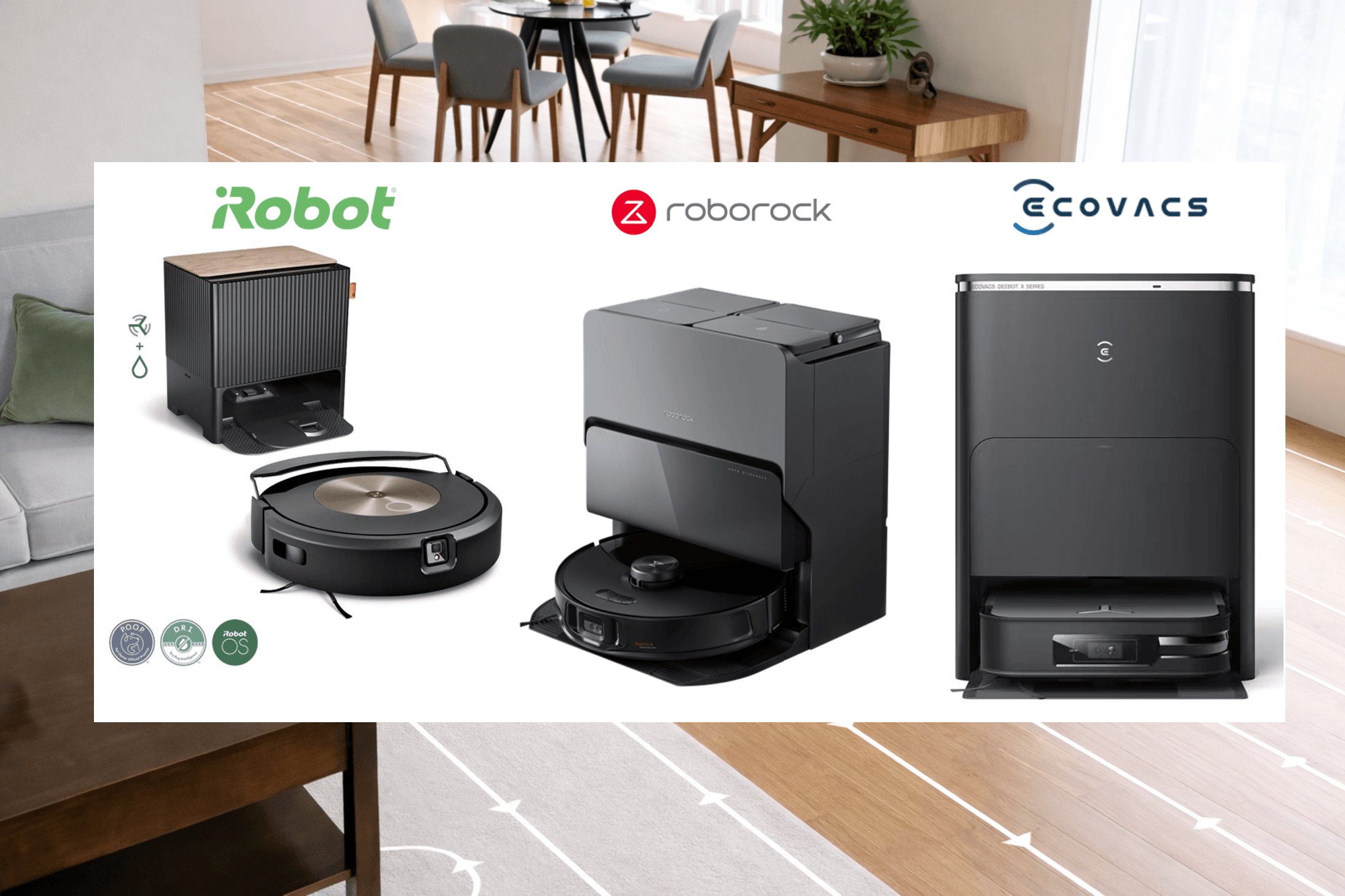
By 2024–2025, the competitive field at the top of the robot vacuum market had consolidated. Roborock and Ecovacs emerged as iRobot’s two most direct global competitors—both with stronger shipment momentum and faster product iteration cycles.
At the flagship level, the contrast was clear.
- iRobot’s Roomba Combo j9+ emphasized system reliability, conservative mechanical design, and software-led cleaning intelligence such as “Dirt Detective.”
- Roborock’s S8 MaxV Ultra focused on high headline performance—10,000Pa suction, aggressive edge cleaning, and fine-grained user control.
- Ecovacs’ Deebot X2 Omni pushed automation and visibility, pairing a square body design with powerful mopping, hot-water dock cleaning, and strong corner coverage.
The result was not a simple performance gap—but a narrative gap.
Roborock and Ecovacs won attention through visible features, faster refresh cycles, and clear demonstrations of “more for your money.” iRobot deliberately avoided suction-number marketing and feature escalation, choosing instead to emphasize durability, trust, and long-term performance consistency. In a market now driven by feature comparison tables, that restraint became a disadvantage.
The Cost of Slow Product Cycles in Consumer Robotics
iRobot’s internal culture prioritized risk minimization. That discipline made sense when robotics failures damaged the entire category. But by the 2020s, the market had changed. Chinese competitors operated on short iteration loops:
- Rapid SKU refresh
- Willingness to ship “good enough” hardware
- Continuous post-launch software tuning
Against this tempo, iRobot’s slower cadence made innovation appear stagnant—even when underlying engineering quality remained high. Speed, not perfection, had become the dominant signal of leadership.
Marketing Without Narrative: When Reliability Stopped Selling
As product differences narrowed, storytelling became critical. This was another area where iRobot struggled. Roomba’s messaging stayed anchored in reassurance:
- Proven reliability
- Long-term durability
- Brand trust built over decades
Those messages still mattered—but they no longer answered the buyer’s central question:
Why should I choose this robot today instead of a cheaper, more feature-rich alternative?
Competitors sold intelligence, automation, and lifestyle integration. iRobot sold continuity. In a fast-moving consumer category, continuity alone was not enough.
How Chinese Brands Reframed Value and Price
The rise of Chinese robot vacuum brands was not simply about lower pricing. It was about reframing the value equation.
Consumers were offered:
- Higher visible feature density
- Faster innovation cadence
- Comparable real-world performance
- Aggressive pricing tiers
This reset expectations. Premium pricing now required premium experience, not just premium engineering. iRobot maintained higher price positioning while its feature narrative weakened—a mismatch that steadily eroded market share.
The Identity Crisis of the Modern Roomba
By the mid-2020s, Roomba faced an identity problem.
It was no longer:
- The most advanced option
- The most automated option
- Or the clearest value proposition
Even loyal users struggled to explain what made Roomba uniquely compelling. Once a category creator, it had become one option among many—often disadvantaged in head-to-head comparisons. In consumer markets, loss of identity precedes loss of sales.
What iRobot’s Product Failure Teaches the Industry
iRobot’s decline was not caused by one bad product or missed feature. It was the result of systemic misalignment between engineering culture, product tempo, marketing narrative, and pricing logic. The lessons for consumer robotics companies are clear:
- Reliability is necessary, but no longer sufficient
- Product cycles must match market tempo
- Features require narrative, not just specifications
- Premium pricing demands constant re-justification
Engineering excellence builds trust. Only market relevance sustains leadership.
Epilogue — The Pioneer’s Paradox
iRobot helped invent consumer robotics—and in doing so, trained the market that would later surpass it. Bankruptcy was not iRobot’s failure point—it was the accounting recognition of a competitive reality the market had already decided.
It taught the world how to build robots for real homes. Its competitors learned how to build businesses for real consumers. In the end, iRobot did not fail because it forgot how to engineer robots. It failed because it stopped redefining what those robots were meant to be.
iRobot vs. Roborock vs. Ecovacs
| Category | iRobot Roomba Combo j9+ | Roborock S8 MaxV Ultra | Ecovacs Deebot X2 Omni |
| Brand Positioning | Reliability-focused premium flagship emphasizing consistent performance and software-led cleaning logic | Performance-driven flagship emphasizing maximum suction, advanced edge cleaning, and high configurability | Automation-focused flagship emphasizing coverage, mopping strength, and hands-free operation |
| Global Market Position | Former category leader; declining market share in recent years | Global market leader by shipments and revenue (2024) | Top-tier global player; strong China and international presence |
| Suction Power (Official) | Not disclosed in Pa; positioned as significantly stronger than previous generations | 10,000 Pa HyperForce suction | 8,000 Pa suction |
| Primary Cleaning System | Dual rubber rollers + side brush; strong anti-tangle performance | Dual roller system with enhanced edge-cleaning module | Main roller + square body design optimized for corner coverage |
| Mopping Technology | Retractable mop module that lifts fully on carpets | Vibrating mop with automatic lift for carpets | Dual rotating mop pads with strong downward pressure |
| Mop Lift Height | Automatic lift on carpet; obstacle climbing up to ~16 mm | Automatic lift during carpet cleaning | 15 mm automatic mop lift |
| Dock / Base Station | Auto dust collection + auto water refill; long maintenance interval | Fully automated dock: dust collection, mop washing, drying, and water refill | OMNI station: auto dust collection, hot-water mop washing, drying, and water refill |
| Navigation System | Vision-based navigation combined with sensors; room recognition and object avoidance | LiDAR + RGB camera–based AI obstacle avoidance | LiDAR + vision hybrid navigation optimized for edge and corner mapping |
| Obstacle Avoidance | Visual recognition for common household objects (cables, shoes, pet waste) | Advanced AI obstacle classification with LiDAR + camera fusion | Visual + LiDAR obstacle avoidance; optimized for narrow spaces |
| Software & App Focus | “Dirt Detective” adapts cleaning priority based on historical dirt patterns; simple, stable UI | Highly granular user controls, zone-level tuning, frequent firmware updates | Strong automation presets; feature-rich but more complex UI |
| Design Philosophy | Conservative, reliability-first, mechanical stability | Performance-first, feature-dense, engineering-forward | Coverage-first, automation-first, spatial optimization |
| Form Factor | Traditional round robot | Round robot with protruding LiDAR turret | Square-shaped, low-profile robot |
| Product Refresh Cycle | Relatively slow and conservative | Fast iteration and frequent flagship updates | Moderate to fast iteration with visible hardware changes |
| Launch Price Band (Approx.) | ~US$1,000 (market and promotion dependent) | ~US$1,500–2,000 (with Ultra dock) | ~US$1,300–1,600 (with Omni dock) |
| Core Strength | Proven durability, consistent cleaning results, strong brand trust | Raw performance, feature leadership, customization depth | Full automation, strong mopping, superior edge and corner coverage |
| Primary Weakness | Weaker feature narrative; slower innovation cadence | Higher price at peak configuration | Complex system increases maintenance and learning curve |
Key Takeaway (Editor’s Note)
This comparison shows that iRobot did not lose on basic engineering quality, but on:
- Feature visibility
- Innovation tempo
- Value narrative relative to price
While Roborock and Ecovacs competed on speed, automation, and specification leadership, iRobot continued to compete on reliability in a market that had already moved on.
RobotToday Series | iRobot: Rise, Strategy, and Market Failure
- From Co-Creation to Collapse: The Rise and Fall of iRobot, the Original Home Robotics Pioneer
How an early consumer robotics leader lost its strategic edge - When the Supplier Becomes the Power Center: How iRobot’s Supply Chain Strategy Backfired
Why outsourcing control reshaped power dynamics in consumer robotics - Why iRobot Failed: How Roomba Lost the Robot Vacuum Market to Faster Rivals
Execution speed, iteration cycles, and competitive pressure







Leave a comment