


Introduction: The First Unmanned Fighters
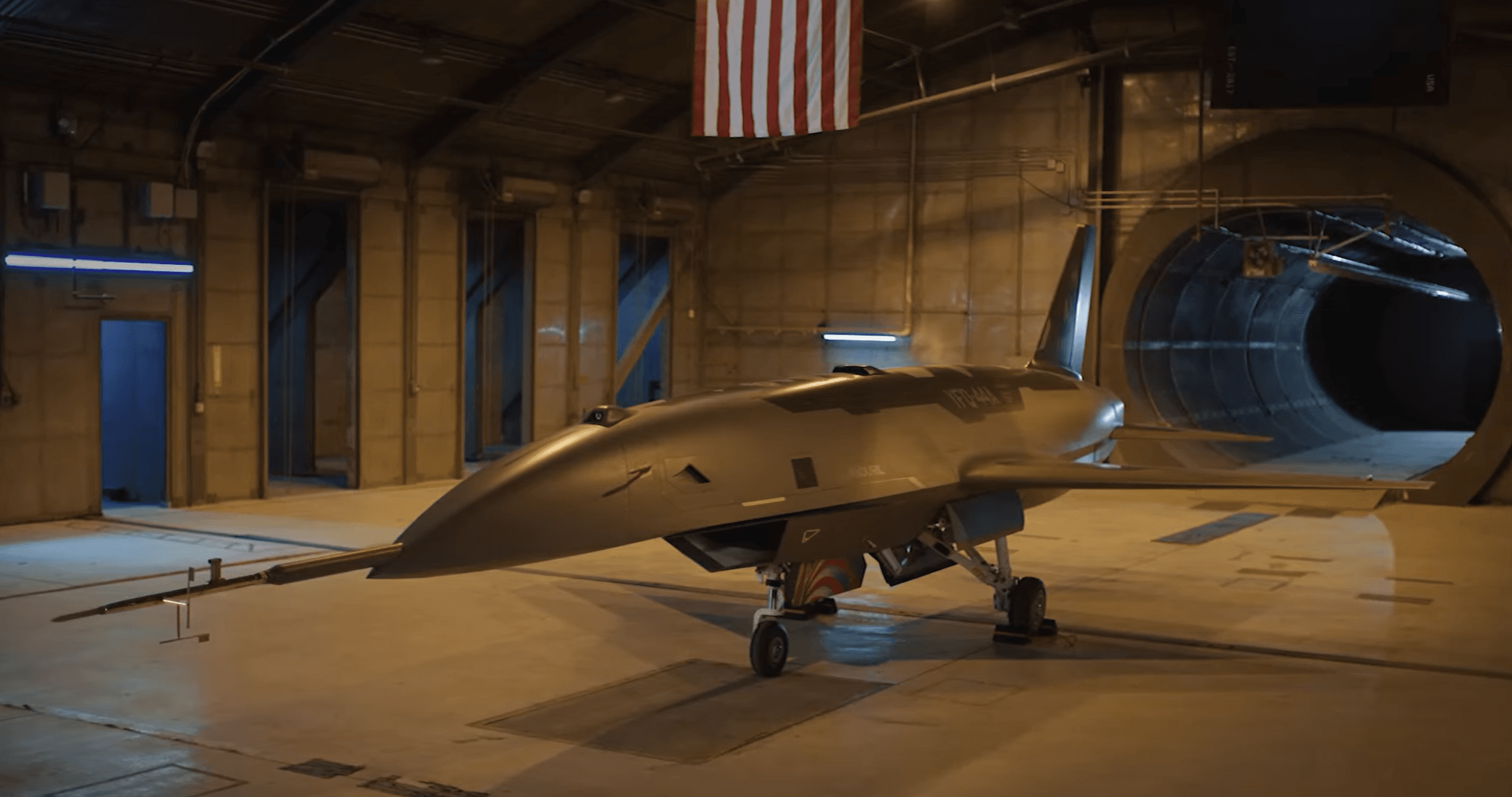
On 31 October 2025, a jet aircraft took off from a California test facility, flew a semi-autonomous mission, and landed. The event attracted less public attention than it deserved, because the aircraft had no pilot. It was Anduril Industries’ YFQ-44A Fury — one of two aircraft that the U.S. Air Force, in March 2025, had designated using the fighter prefix ‘F’ for the first time in history in an unmanned design.
U.S. Air Force Chief of Staff General David Allvin understood the symbolic weight. ‘We have two prototypes of Collaborative Combat Aircraft that were on paper less than a couple of years ago,’ he said at the designation ceremony. ‘For the first time in our history, we have a fighter designation in the YFQ-42 Alpha and the YFQ-44 Alpha — maybe just symbolic, but it’s telling the world that we are leaning into a new chapter of aerial warfare.’
Sixty-one days after Fury’s first flight, on 11 December 2025, China flew the Jiutian — a 16-tonne autonomous drone mothership built by AVIC’s Xian Chida division, capable of carrying over 100 loitering munitions in its internal bay and releasing them in coordinated swarms from a cruising altitude of 15,000 metres. CCTV concept video had already shown Jiutians releasing swarms that overwhelmed U.S. Navy carrier battle groups and cleared the way for follow-on missile strikes. The propaganda framing was intentional. The capability was real.
Between those two flights, the air autonomy competition moved from prototype demonstration to weapons integration, software architecture decisions, institutional restructuring, and export market positioning. This article maps that competition — where it stands in March 2026, what the production decision later this year will determine, and what China’s Jiutian means for anyone planning to defend an airbase in the Western Pacific.
Sources: Air and Space Forces Magazine, March 2025; The Aviationist, October 2025 and December 2025; Wikipedia YFQ-44A
556 Days: Anduril contract to YFQ-44A first flight | 1,000+ Target CCA fleet (USAF, all increments) | 100+ Loitering munitions in Jiutian’s internal bay | FY2026 Competitive production decision deadline | 20+ Companies competing for CCA Increment 2 |
I. The CCA Programme: Affordable Mass at Combat Speed
The Collaborative Combat Aircraft programme is the U.S. Air Force’s most consequential autonomous systems initiative, and its architecture reflects hard lessons from decades of failed attempts to field affordable combat drones. The programme is structured in increments: Increment 1, now in competitive flight testing with two aircraft, focuses on a basic loyal wingman capability — an air-to-air platform designed to extend the reach and increase the lethality of manned fighters by flying ahead of them, sharing sensor data, and carrying additional missiles. Increment 2, for which concept refinement contracts were expected in early 2026, will expand mission applications and integrate emerging technologies. The total programme objective is approximately 1,000 to 2,000 aircraft.
The Air Force’s framing is explicit: it wants ‘affordable mass.’ A single manned F-35 costs roughly $80 million and takes years to procure. A CCA, with recurring unit cost estimates ranging from under $20 million (General Atomics’ stated target for the YFQ-42A) to approximately $25–30 million (early programme estimates), represents a force-multiplication tool that can accompany the F-35 without matching its price tag. In a high-end Pacific conflict, the asymmetric advantage of sending autonomous wingmen ahead into contested airspace — absorbing missiles, confusing adversary targeting systems, and providing forward sensor coverage — could be decisive.
The April 2024 Downselect
The competitive landscape was shaped by the April 2024 downselect, when the Air Force removed Boeing, Lockheed Martin, and Northrop Grumman from funded Increment 1 development and retained only Anduril and General Atomics. The decision was a deliberate signal: the programme would be led by companies building new approaches, not legacy primes optimising existing ones. Northrop Grumman, however, continued CCA development on its own budget through independent R&D, and in December 2025 the Air Force assigned its Project Talon the designation YFQ-48A — a move that keeps Northrop in contention for the Increment 1 production contract alongside ‘more than 20 companies’ pursuing future CCA awards.
The A-GRA: Decoupling Aircraft from Software
The most structurally important innovation in the CCA programme is not a specific aircraft but an architectural decision: the Autonomy Government Reference Architecture, or A-GRA. Under the government’s Modular Open Systems Approach, the A-GRA decouples mission autonomy software from the vehicle platform entirely. The Air Force independently selects the airframe and the autonomy ‘brain,’ preventing vendor lock and enabling the best algorithms to be deployed on any compliant platform at software update speed.
This architecture was validated in dramatic fashion on 26 February 2026, when the YFQ-44A Fury flew with both Shield AI’s Hivemind and Anduril’s own Lattice autonomy software — and switched between the two mid-flight, completing combat-representative test points with each. The demonstration proved that mission autonomy is now an application layer, not a hardwired system property. In practice, this means the Air Force can field a CCA fleet today and upgrade its AI pilot next year without touching the airframe.
Sources: DefenseScoop, May 2025; The War Zone, May 2025; Forecast International DSM, November 2025 and March 2026; The Aviationist, March 2026; Air and Space Forces Magazine, March 2025
“For the first time in our history, we have a fighter designation in the YFQ-42 Alpha and the YFQ-44 Alpha — maybe just symbolic, but it’s telling the world that we are leaning into a new chapter of aerial warfare.”
— General David Allvin, U.S. Air Force Chief of Staff, March 2025
II. YFQ-44A Fury vs. YFQ-42A Dark Merlin: The Competition in Detail
The two Increment 1 aircraft represent meaningfully different design philosophies, and the Air Force’s production decision — due by October 2026 — may result in selecting one, the other, or both.
Anduril YFQ-44A Fury
The YFQ-44A traces its lineage to Blue Force Technologies’ Grackle aggressor platform, originally designed to simulate high-end threats in training. Anduril acquired Blue Force Technologies in 2023 and adapted the design for CCA. It first flew on 31 October 2025 — 556 days after contract award, and semi-autonomously from the outset, reflecting Anduril’s software-first development philosophy. The Fury flies at up to 50,000 feet and Mach 0.95, can pull 9g, and features a bottom-mounted inlet, swept trapezoidal wings, and external weapons hardpoints rather than an internal bay — a deliberate affordability trade-off against pure stealth. Its landing gear is designed for manufacture in ‘any machine shop in America.’
By February 2026, the Fury had progressed to weapons integration: the Air Force released the first images of a YFQ-44A carrying an inert AIM-120 AMRAAM on a captive carry test at a California facility. Live-fire and separation trials are planned for later in 2026. Prototype production is scheduled to begin at Arsenal-1 in Columbus, Ohio, in the first half of 2026 — unusually early for a platform that only just flew, and a deliberate signal about Anduril’s manufacturing intent.
General Atomics YFQ-42A Dark Merlin
The YFQ-42A made its first flight on 27 August 2025, two months before the Fury — and was in semi-autonomous test flights and announced as ‘in rate production’ by General Atomics within weeks. Its design is derived from the experimental XQ-67A Off-Board Sensing Station drone and the broader Gambit family, featuring V-tail stealth geometry, a top-mounted engine intake, an internal weapons bay for lower radar cross-section, and tricycle trailing-arm landing gear for operation from unprepared surfaces. The internal bay gives the YFQ-42A an advantage in contested low-observable environments; the trade-off is higher manufacturing complexity. The autonomy software for the YFQ-42A is Collins Aerospace’s Sidekick; RTX was also selected as a mission autonomy provider. The company has stated a target unit cost of ‘far less than $20 million.’
The Competition Outcome
The production decision, expected before October 2026, will determine initial CCA fielding for between 100 and 150 aircraft. Flight Global’s reporting as of late 2025 indicated the Air Force is likely to select a single winner for Increment 1 hardware while maintaining the A-GRA framework for software competition. The inclusion of the independently funded YFQ-48A Talon (Northrop Grumman) in the designation process, however, suggests the Air Force may use the production contract announcement to signal openness to a broader competitive model for Increment 2 and beyond.
Sources: Wikipedia YFQ-44A; Army Recognition, November 2025; The Aviationist, February 2026; Defense Security Monitor, November 2025 and March 2026; Flight Global, November 2025; Flying Magazine, February 2026
CCA Increment 1: Head-to-Head Comparison
| YFQ-44A Fury (Anduril) | YFQ-42A Dark Merlin (Gen. Atomics) | |
| First flight | 31 Oct 2025 (semi-autonomous) | 27 Aug 2025 (remote piloted) |
| Design origin | Blue Force Technologies Grackle aggressor | XQ-67A OBSS / Gambit family |
| Weapons carriage | External hardpoints (AIM-120 tested Feb 2026) | Internal bay (low-observable) |
| Stealth approach | Some LO features; payload flexibility priority | V-tail stealth; internal bay priority |
| Propulsion | Commercial off-the-shelf business jet engine | Single engine, top intake |
| Target unit cost | Undisclosed; landing gear designed for volume mfg | Stated ‘far less than $20M’ |
| Mission autonomy | Shield AI Hivemind + Anduril Lattice (both tested) | Collins Aerospace Sidekick; RTX |
| Production site | Arsenal-1, Columbus OH (prototype from H1 2026) | General Atomics facility |
| Designation nickname | Fury | Dark Merlin |
| Latest milestone (Mar 2026) | Mid-flight AI software swap; AIM-120 captive carry | Semiautonomous flight with crewed fighters |
III. The Valkyrie’s Second Life: Kratos XQ-58A and the Marines’ CCA
While the Air Force runs its two-horse Increment 1 race, a parallel CCA story has been unfolding within the Marine Corps — and it features a platform that the Air Force designed, tested, and then moved beyond: the Kratos XQ-58A Valkyrie.
The Valkyrie first flew in March 2019 as a low-cost attritable strike demonstrator. Its design is specifically engineered for volume production: runway-independent, capable of rocket-boosted launch from shipping containers or semi-trailer trucks, and manufacturable at a unit cost Kratos has publicly stated could fall below $2 million at production rates above 100 aircraft per year. In its operational configuration the aircraft is stealthy, high-subsonic, and capable of carrying internal weapons including small-diameter bombs and — as demonstrated in 2021 — launching secondary drones from its internal bay.
USMC Programme of Record
In August 2025, Marine Corps Times reported that both the USMC and the Office of the Secretary of Defense had formally designated the Valkyrie as a Programme of Record — the first CCA to achieve that status in the Marine Corps. The service formally selected Kratos and Northrop Grumman to develop an operational version in January 2026, under the Marine Air-Ground Task Force Uncrewed Expeditionary Tactical Aircraft (MUX TACAIR) CCA programme, with Northrop delivering a ‘mission kit’ including its Prism autonomy package, sensors, and integration work under a $231.5 million OTA.
The operational derivative is designated the MQ-58 — the production suffix replacing the experimental X prefix. The USMC is targeting delivery of a first prototype by end of 2026. Where the Air Force’s CCA Increment 1 focuses on air-to-air combat at high performance, the Marines’ Valkyrie variant is oriented toward air-to-ground applications: forward-deployed reconnaissance, SEAD, and electronic warfare to support distributed maritime operations from austere Pacific island bases with limited infrastructure. The two programmes complement rather than compete.
Export Momentum
In July 2025, Airbus announced a partnership with Kratos to develop a German Air Force variant of the XQ-58A, with a combat-ready target date of 2029. The programme is designed around a ‘platform-agnostic system architecture,’ allowing European mission systems to be integrated without dependence on U.S. proprietary software. Kratos CEO Eric DeMarco has indicated additional undisclosed customers in the Pacific region. The Valkyrie’s combination of proven flight record (first flown 2019), volume manufacturability, and runway independence makes it uniquely well-positioned for export to alliance partners who need capable, affordable autonomous aircraft now rather than waiting for the end of the decade.
Sources: Wikipedia XQ-58A; The War Zone, January 2026 and August 2025; Marine Corps Times, August 2025; Flight Global, November 2025; Aerospace Global News, August 2025
IV. The Institutional Response: Experimental Operations Units and the OWA Question
Platforms alone do not constitute a capability. The U.S. Air Force has understood that the CCA revolution requires not just new aircraft but new organisational structures, new tactics, and new doctrine — and it has begun building them.
The First EOU: CCA at Nellis
On 5 June 2025, the Air Force formally activated the first Experimental Operations Unit at Nellis Air Force Base in Nevada, transitioning what had been a detachment since 2023 into a full squadron. The EOU’s mission is to develop the tactics, techniques, and procedures for integrating CCAs into crewed fighter formations: how a single F-35 pilot manages multiple autonomous wingmen simultaneously, what the correct division of labour between human and machine looks like in a suppression of enemy air defences mission, and how CCA behaviour needs to adapt when communications are degraded in an electronic warfare environment. Colonel Daniel Lehoski, commander of the 53rd Wing, described the activation as ‘a pivotal moment for our force.’ The EOU uses Nellis’s 2.9-million-acre Nevada Test and Training Range and Red Flag exercise infrastructure as its proving ground.
The Second EOU: One-Way Attack Drones
The Air Force is standing up a second experimental unit — targeted for mid-2026 — to develop tactics for small, cheap, expendable one-way attack drones of the type that have proven decisive in Ukraine. This second EOU will be a joint effort between the 53rd Wing, Air Force Special Operations Command, and Air Combat Command, with AFSOC likely taking the initial lead because its personnel are already working closely with Ukraine and Taiwan on small drone employment.
The organisational model for the new unit is Task Force Scorpion Strike, the one-way attack drone squadron CENTCOM recently established in the Middle East, equipped with the Low-cost Unmanned Combat Attack System — LUCAS — a reverse-engineered derivative of the Iranian Shahed design. The second EOU will focus on Group 1 and Group 2 drones — small, cheap, attritable platforms meant to be expended in combat. Its planners are designing formations and ‘fire units’ capable of launching swarms over 600 to 1,000 miles against peer adversaries. The explicit goal is to begin incorporating these fighting units into the conventional force by the early 2030s.
The dual-EOU structure reflects a clear-eyed recognition that the Air Force needs two different doctrinal answers to the autonomous air problem: the CCA answer (high-performance semi-autonomous wingmen for air superiority) and the attritable swarm answer (mass, expendability, and low cost for deep strike and SEAD). Ukraine proved both are necessary. The question is execution at scale.
Sources: Bulgarian Military / Air Force activation reporting, June 2025; Air and Space Forces Magazine, December 2025; AeroXplorer, 2025
V. China’s Jiutian: The Drone Mothership That Has No Western Answer
On 11 December 2025, AVIC’s Xian Chida division flew the Jiutian — Chinese for ‘Nine Heavens’ or ‘High Sky’ — for the first time from Pucheng County in Shaanxi Province. The flight lasted long enough to validate aerodynamic performance and stable operation of a 16-tonne unmanned aircraft. The strategic implications arrived before the aircraft did.
Specifications and Capability
The Jiutian is 16.35 metres in length with a 25-metre wingspan and a maximum takeoff weight of 16 tonnes, of which 6 tonnes can be payload. It is powered by a single WS-9 Qinling turbofan, has a 7,000-kilometre ferry range, 12-hour endurance, and an operating ceiling of approximately 15,000 metres — well above most point air defence envelopes. It has eight underwing hardpoints capable of accepting 1,000-kilogram-class guided bombs, anti-ship and air-to-ground missiles, and active radar or infrared air-to-air weapons including the PL-12AE and PL-15.
Its defining feature, however, is the internal ‘isomerism hive’ bay — a modular compartment designed to house and release over 100 small drones or loitering munitions in flight. CCTV concept footage, broadcast in May 2025, showed multiple Jiutians releasing swarms of coordinated quadcopters and winged attack drones over a simulated carrier battle group, with the swarms coordinating autonomously to overwhelm defences and clear corridors for follow-on anti-ship missiles. The platform’s open-architecture modular design allows mission modules to be swapped in roughly two hours, enabling rapid transitions between strike, transport, and electronic warfare roles.
Strategic Implications
The War Zone’s analysis placed the Jiutian in direct context: it is ‘reflective of China’s increasingly dominant position in the uncrewed aviation space globally.’ For the Pacific theatre, the implications are concrete. A formation of Jiutians orbiting over mainland Chinese territory or South China Sea outposts at 15,000 metres — outside the engagement envelopes of most forward-deployed point defences — could release drone swarms that cross the strait or reach Guam, Okinawa, and the Philippines at multiple altitudes simultaneously. The swarms would be designed not necessarily to destroy targets independently but to saturate radar systems, blind missile battery operators, and force point defence expenditures at a rate that exhausts interceptor magazines before the follow-on manned strike.
Defence analysts from Asia Times and Army Recognition have noted that this precisely mirrors the strategic vulnerability identified by RAND in a June 2025 report: U.S. airbase hardening has ‘lagged for years,’ interceptor inventories are limited, and forward-deployed aircraft remain exposed on aprons. Operation Spiderweb — Ukraine’s July 2025 deep penetration strike that destroyed over 40 Russian strategic aircraft on the ground — provided the real-world proof of concept. The Jiutian is the industrial-scale expression of what Spiderweb demonstrated with improvised technology.
There is no direct Western equivalent. The closest U.S. concept is the ACT (Autonomous Collaborative Teaming) and ORIENT (Opportunistic Resilient Network Topology) frameworks for coordinating swarms of hundreds of assets, but these are not yet embodied in a purpose-built mothership platform of Jiutian’s class. The U.S. MQ-9 Reaper has been tested with Altius 600 loitering munitions launched from its hardpoints, but it carries a fraction of the Jiutian’s capacity. Initial operating capability for the Jiutian is estimated by analysts at 2027 if testing continues at its current pace.
Sources: The War Zone, December 2025; The Aviationist, December 2025; Army Recognition, December 2025; Asia Times, December 2025; Interesting Engineering, December 2025; RAND June 2025 report on airbase defence (cited in Asia Times)
| The Jiutian vs. the Western Comparable: The Gap |
The U.S. MQ-9 Reaper carries approximately 1,700kg of payload and has been tested deploying 2–3 Altius 600 loitering munitions from underwing hardpoints. The Jiutian carries 6,000kg and can deploy 100+ loitering munitions from an internal bay at 15,000 metres, 7,000km from base. There is no Western platform in the same weight class with a comparable swarm-release architecture. The closest conceptual equivalents — the USAF’s Gremlins X-61A and the ACT framework — remain developmental. The gap between Chinese swarm mothership capability and any Western equivalent will not close before the late 2020s at the earliest. |
VI. The Global Air Autonomy Landscape
The CCA and Jiutian programmes do not exhaust the global autonomous air competition.
Australia: Ghost Bat and the Alliance Dimension
Boeing’s MQ-28 Ghost Bat, developed in Australia, announced the start of live-fire testing in December 2025. The Ghost Bat is explicitly optimised for Indo-Pacific alliance exportability: it can be configured with different national mission systems, and Anduril’s 26 February 2026 mid-flight AI swap demonstration directly echoes the Ghost Bat’s platform-agnostic design philosophy. Australia’s Ghost Bat is a Five Eyes CCA candidate, and joint Ghost Bat – F-35A operations would extend U.S. alliance CCA density in the Pacific without requiring direct U.S. aircraft sales.
Europe: Airbus and the German Valkyrie
Airbus’s July 2025 partnership with Kratos to develop a German Luftwaffe Valkyrie variant, combat-ready by 2029, is the most concrete European CCA commitment to date. The programme uses a platform-agnostic architecture that can accept NATO mission systems, reflecting European concern about software sovereignty. Airbus’ framing is explicit: they chose Kratos because it has ‘real flying products and aircraft that have flown with the F-35,’ not promises. The programme will be the first European CCA derived directly from a combat-tested U.S. airframe.
Turkey: Kizilelma as the Export CCA
Baykar’s Kizilelma — a carrier-capable jet UCAV in test flights as of 2025 — occupies the export CCA market below the price point of U.S. and European platforms. Deployed in 30-plus countries through the TB2/TB3 family, Baykar is positioning Kizilelma as the affordable autonomous combat aircraft for allies and partners who lack the defence budgets to wait for Western CCAs. Its combat-proven supply chain from the Ukrainian war provides a marketing narrative that no other export CCA can match.
Sources: Flying Magazine, February 2026; Kratos/The War Zone, August 2025; Future Warfare Series Skeleton; Series Part 5 (Geopolitical Landscape)
Key Autonomous Air Platforms: 2025–2026 Landscape
| Platform | Country | Class | Unit Cost (est.) | Key Feature | Status (Mar 2026) |
| YFQ-44A Fury (Anduril) | USA | CCA Increment 1 | <$30M est. | 556-day concept-to-flight; ArsenalOS; mid-flight AI swap | Weapons integration (AIM-120 captive carry) |
| YFQ-42A Dark Merlin (GA) | USA | CCA Increment 1 | <$20M stated | Internal weapons bay; V-tail stealth; rate production claim | Semiautonomous flight with crewed fighters |
| YFQ-48A Talon (Northrop) | USA | CCA (self-funded) | Undisclosed | Designation assigned Dec 2025; still in contention | Independent R&D; Dec 2025 designation |
| MQ-58 Valkyrie (Kratos/NG) | USA/USMC | USMC CCA (PoR) | $2–10M (volume) | Runway-independent; rocket-launch; EW/SEAD/ISR focus | Programme of Record; NG mission kit Jan 2026 |
| XQ-58A Valkyrie (Kratos) | USA | Test/export CCA | $4–$10M+ | Demonstrated F-35/F-22 teaming; German variant in dev. | Airbus partnership Jul 2025; Pacific customers |
| Jiutian (AVIC, China) | China | Swarm mothership | N/A | 100+ loitering munitions; 16t MTOW; 7,000km; 15km ceiling | First flight Dec 2025; IOC est. 2027 |
| MQ-28 Ghost Bat (Boeing) | Australia | Alliance CCA | Undisclosed | Alliance-exportable; live-fire testing Dec 2025 | Live-fire tests; Five Eyes candidate |
| Kizilelma (Baykar) | Turkey | Export UCAV | Undisclosed | First non-major-power carrier-capable UCAV | Test flights ongoing 2025 |
VII. The October 2026 Decision and Its Consequences
The competitive production decision for CCA Increment 1, due by October 2026, will be the most consequential U.S. air acquisition decision since the F-35 programme of record. But its significance extends beyond which company wins a contract.
First, it will validate or refute the venture-funded defence model. Anduril raised $2.5 billion in June 2025 at a $30.5 billion valuation specifically to finance Arsenal-1 and CCA production tooling. If the YFQ-44A wins the production contract, it validates the thesis that a seven-year-old company with no legacy defence manufacturing infrastructure can out-execute Northrop Grumman, Lockheed Martin, and Boeing in a combat aircraft competition. If General Atomics wins, it demonstrates that traditional aerospace engineering experience retains irreplaceable value even in the software-first era.
Second, the A-GRA framework means the production decision is not final. The Air Force can select a YFQ-42A airframe and then deploy Shield AI’s Hivemind on it. It can select the YFQ-44A and later replace Anduril’s Lattice with a different autonomy provider. The software and the hardware compete on separate, parallel tracks indefinitely. This is structurally unprecedented in U.S. military aviation and will force every autonomy company in the sector to compete continuously, not just at initial contract award.
Third, the decision will signal U.S. industrial base capacity to allies. Kratos’s CEO has said that a hypothetical 15-unit initial Valkyrie order for the Marines at $10 million each would generate $150 million in immediate revenue from a programme already in production. That is the kind of ramp rate that Australia, Germany, and unspecified Pacific partners need to see before committing to joint production or co-development arrangements. The October 2026 decision is not just a U.S. programme milestone. It is the opening signal for a decade of allied CCA procurement.
Sources: Forecast International DSM, March 2026; Aerospace Global News, August 2025; Flight Global, November 2025; Part 1 (Economics of Attrition) cross-reference for Anduril valuation data
| STORY ANGLE |
Two test pilots — one at Edwards Air Force Base watching a YFQ-44A Fury climb away from the runway, and one at Nellis running the Experimental Operations Unit’s simulation of a twelve-drone CCA formation engaging a simulated Chinese J-20 threat package over a contested strait. Neither of them is physically in an aircraft. One is developing trust in a machine that can swap its own AI mid-flight. The other is writing the doctrine that determines how many autonomous wingmen a single F-35 pilot can credibly manage in combat before the human becomes the bottleneck. The production decision in October 2026 will determine which aircraft goes into that doctrine. What the doctrine itself looks like — how much autonomy is too much, how little human control is too little — is being decided in Nevada right now, one Red Flag exercise at a time. |
Key Sources & Expert References
Air and Space Forces Magazine: CCA designation announcement (March 2025); one-way attack drone EOU (December 2025) — airandspaceforces.com
DefenseScoop: CCA ground testing milestone (May 2025); FY2026 budget autonomy breakdown (June 2025) — defensescoop.com
The Aviationist: YFQ-44A first flight (November 2025); YFQ-44A AIM-120 captive carry (February 2026); YFQ-44A Hivemind/Lattice mid-flight swap (March 2026) — theaviationist.com
The War Zone: YFQ-42A first look (May 2025); XQ-58A Valkyrie USMC programme (August 2025, January 2026) — twz.com
Forecast International Defense Security Monitor: U.S. CCAs field breakdown (November 2025); Air Force CCA wingman drones update (March 2026) — dsm.forecastinternational.com
Army Recognition: YFQ-44A Fury first flight analysis (October 2025); Jiutian mothership maiden flight / analysis (December 2025); A-GRA open autonomy deployment (February 2026) — armyrecognition.com
The Defense Post: Shield AI Hivemind selected for YFQ-44A (February 2026) — thedefensepost.com
Flight Global: YFQ-44A first flight (November 2025); USMC Valkyrie plans (November 2025); CCA winner selection by end 2026 (2026) — flightglobal.com
Marine Corps Times: Valkyrie Programme of Record announcement (August 2025) — marinecorpstimes.com
Wikipedia: XQ-58A Valkyrie; YFQ-44A Fury articles (updated through January 2026)
The War Zone: China Jiutian drone mothership first flight (December 2025) — twz.com
The Aviationist: Jiutian swarm mothership (December 2025) — theaviationist.com
Asia Times: Jiutian strategic implications for Pacific (December 2025) — asiatimes.com
Interesting Engineering: Jiutian specifications and CCTV footage analysis (December 2025) — interestingengineering.com
Flying Magazine: CCA autonomous drones flight testing overview (February 2026) — flyingmag.com
Aerospace Global News: Kratos XQ-58A USMC CCA / Valkyrie production economics (August 2025) — aerospaceglobalnews.com








Leave a comment