


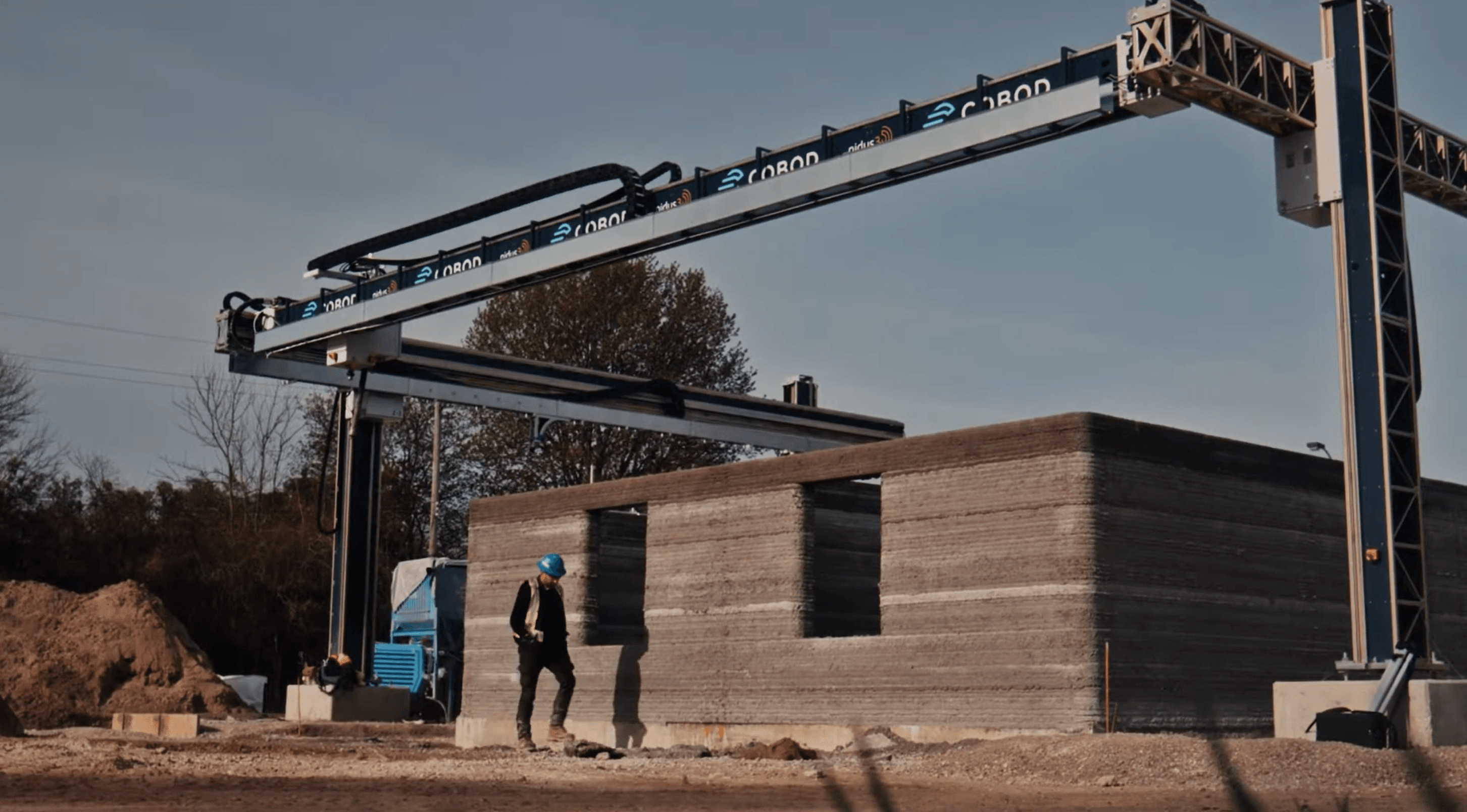
Modular, Prefab & 3D Printing:
The Paradigm Shift That Moves Construction Off-Site
ICON has 3D-printed nearly 200 homes and structures. PERI-COBOD completed Germany's first serial 3D housing project 30% faster than conventional builds. WinSun is back as Gaudi Tech, now printing in the US. The paradigm shift is not coming. It is already operating.
Market Snapshot: The Shift to Factory Construction
The construction industry builds the same way it did 50 years ago. This is changing. Modular, prefab, and 3D printing are moving production from exposed job sites into controlled factories.
The US prefabricated construction market was valued at USD 176 billion in 2024. It is projected to reach USD 257 billion by 2029, per a February 2026 industry report. That is 46% growth in five years.
The 3D printing construction market is growing faster. One estimate places it at USD 3.59 billion in 2025, with a projected CAGR of 81% through 2035. These projections vary wildly across providers. Direction and pace both signal urgency.
Note: Market size figures are commercial research estimates. They have not been independently verified by governmental statistical bodies. The 81% CAGR figure reflects early-stage market modeling and should be treated as directional only.
USD 257B US prefabricated construction projected market by 2029 (industry estimate; not independently verified)
Three forces drive the shift. Labor shortfalls are structural and deepening. Site variability creates quality variance. Factory-controlled environments remove both problems simultaneously.
Key Players: Modular, Prefab & 3D Printing (2025–2026)
| Company / Origin | Approach | Key Product / Stat | Status |
| ICON (USA) | Onsite 3D concrete printing | Phoenix multi-story printer; 200 homes/structures printed; $56M raised Feb 2025 | Commercial — US, expanding |
| PERI 3D Construction (Germany) | Onsite 3D concrete printing via COBOD | DREIHAUS: 30% faster, 10% cheaper; 1m² wall in 5 min | Commercial — EU, serial housing |
| COBOD (Denmark) | 3D printer manufacturer & distributor | BOD3: 36 student apartments in Denmark; 85+ printers globally | Commercial — 6 continents |
| WinSun / Gaudi Tech (China/USA) | Factory & onsite 3D printing | Mobile printer deploys in 1hr; 2-to-4-story buildings | Commercial — China; US entry 2024 |
| AUAR / ABB (UK) | Robotic timber micro-factories | Shell of home in 12hrs; 180 homes/yr per factory | Commercial — UK, EU, US pilot |
| BotBuilt (USA) | Robotic prefab assembly | Wall, roof, structural element automation | Commercial — BuiltWorlds Top 50 2025 |
| Promise Robotics (Canada) | Factory-as-a-Service robotics | BIM-to-robot push-button manufacturing | Commercial — North America |
| Autovol (USA) | Volumetric modular automation | 400,000 sq ft factory; multi-unit daily output | Commercial — US West |
Sources: Company disclosures, BuiltWorlds 2025 Robotics Top 50, TechCrunch (Feb 2025), COBOD press releases (Oct–Nov 2025). All performance claims are company-stated and have not been independently verified unless noted.
ICON: The 3D Printing Pioneer Pivots to Platform
ICON (Austin, Texas) is the most recognizable name in additive construction. It has printed nearly 200 homes and structures across the US and Mexico since 2018. Projects range from affordable housing to US Army barracks to a luxury lakefront community in Texas.
In February 2025, ICON raised $56 million in a Series C led by Norwest Venture Partners and Tiger Global. Total funding now exceeds $500 million. The company plans to raise up to $75 million additional. This capital targets one product: Phoenix.
Phoenix is ICON's next-generation multi-story printer. Its current Vulcan system is single-story and gantry-based. Phoenix uses a hybrid robotic arm and concrete boom. It prints taller, faster, and with fewer operators. It is in prototype operation and preparing for field deployment, per ICON's SVP of Engineering Evan Jensen.
ICON also launched Vitruvius, an AI system for designing 3D-printed homes. Users input budget, preferences, and location. Vitruvius generates floor plans, interior renders, and exterior designs in minutes. ICON expects Vitruvius to produce permit-ready designs and full construction documents by end of 2025.
In January 2025, ICON laid off approximately 114 employees — 25% of its workforce. This was framed as a strategic realignment. The company is shifting from being a direct builder toward being a platform. Builders will operate Phoenix. ICON will supply the technology, material, and AI design tools.
Its proprietary material, CarbonX, is a low-carbon cementitious compound. A white paper co-authored with MIT's Concrete Sustainability Hub found that 3D-printed CarbonX homes have lower embodied and operational carbon than stick-frame construction. ICON makes CarbonX available to third-party projects.
"We've entered a phase where homebuilders and developers seeking differentiation are embracing the technology. It's moved beyond novelty — builders now view it as a viable, permanent option. — Bungane Mehlomakulu, ICON senior director, building and construction science"
PERI 3D and COBOD: Serial Housing in Europe
PERI Group (Germany) is the world's leading manufacturer of formwork and scaffolding systems. Its 3D printing division, PERI 3D Construction, has completed 17 prior 3D printing projects across Europe. In November 2025, it completed the most significant: DREIHAUS.
DREIHAUS — German for 'three-house' — is Germany's first reference project for serial 3D printed housing. Located in Heidelberg, it comprises three multi-unit building variants delivering 21 residential units. The largest building's walls were printed in 26 working days.
| Metric | DREIHAUS Result | Source / Note |
| Speed vs. conventional | 30% faster | PERI 3D Construction claim; not independently audited |
| Cost vs. conventional | ~10% more cost-effective | PERI 3D Construction claim; not independently audited |
| Wall printing speed | 1 m² in 5 minutes | COBOD BOD2 printer spec |
| Largest building print time | 26 working days | Project documentation |
| Crew required | 2–3 people + tablet/computer | COBOD / PERI disclosure |
| Material | evoZero net-zero cement + evoBuild | Heidelberg Materials; first use in Germany |
Source: COBOD and PERI 3D Construction press releases, November 2025. Performance figures are company-reported and have not been independently verified by a third party.
COBOD's BOD3 printer delivered Europe's largest 3D printed housing project in Denmark in October 2025. 3DCP Group printed 36 student apartments totalling 1,654 m² using a 3-person team. Printing time dropped from several weeks for the first building to five days for the last — one apartment per day.
COBOD has now distributed over 85 printers across all six inhabited continents. Shareholders include General Electric, CEMEX, Holcim, and PERI. This investor profile signals that major materials companies view 3D printing as a structural threat to conventional concrete delivery.
WinSun Returns: Gaudi Tech Targets the US Market
WinSun (Yingchuang Building Technique, Shanghai) pioneered construction 3D printing. In 2013, it printed 10 houses in 24 hours. It built the world's first 3D-printed office building in Dubai in 2016. Then it went quiet for years.
In 2024, WinSun re-entered public markets via a US subsidiary: Gaudi Tech. The company abandoned its original gantry system. Its new mobile units deploy from a 40-foot trailer. Setup takes one hour. Teardown takes one hour.
Gaudi Tech currently has four printer models. Two are commercially available. The first prints two-story buildings. The second reaches four floors. Two more are in development — including a model targeting structures up to 32 stories, which would be unprecedented in additive construction.
WinSun's competitive advantage is volume experience. It has operated in China, the Middle East, Japan, and Korea for over a decade. Its factory-printed modular approach uses construction waste in printing ink, reducing material cost and environmental impact. US regulatory approval remains the primary near-term barrier.
Robotic Modular Factories: The Quieter Revolution
3D printing generates headlines. Robotic modular factories generate delivery. These factory-based systems are less visible but often more commercially mature.
AUAR (Automated Architecture, London) deploys robotic micro-factories that assemble timber-frame panels. Each micro-factory arrives on-site in a shipping container with a fully assembled ABB robot. It can erect the shell of a wood-frame home in under 12 hours. One factory produces up to 180 homes per year. AUAR claims no robotics expertise is required from operators.
BotBuilt (USA) automates assembly of walls, roofs, and structural elements in prefab settings. It appeared in the BuiltWorlds 2025 Robotics Top 50. Promise Robotics (Canada) offers a Factory-as-a-Service model. BIM data converts directly into robot instructions. Builders do not purchase equipment — they rent manufacturing capacity.
Autovol (Nampa, Idaho) operates a 400,000 sq ft volumetric modular factory combining human and robotic functions. It produces fully enclosed residential units with finished interiors. Units ship up to 95% complete — windows, flooring, painted drywall, plumbing, and kitchen cabinets installed at the factory.
Japan's Sekisui House operates fully automated housing factories. Robots handle everything from assembling room modules to applying finishes. AI vision systems perform quality checks against digital designs. This is the most mature example of what fully industrialized residential construction looks like.
| Company | Model | Key Metric | Market |
| AUAR (UK/ABB) | Robotic micro-factory (timber) | 12hrs for home shell; 180 homes/yr per factory | UK, EU, US pilot |
| BotBuilt (USA) | Robotic prefab assembly | Wall, roof, structural automation | North America |
| Promise Robotics (Canada) | Factory-as-a-Service | BIM-to-robot; push-button manufacturing | North America |
| Autovol (USA) | Volumetric modular automation | 400k sq ft factory; 95% complete on delivery | US West |
| Sekisui House (Japan) | Fully automated housing factory | Robot assembly + AI vision quality control | Japan (established) |
| Gropyus (Germany) | Robotic timber prefab factory | 250,000 m² capacity per year | EU |
Sources: Company disclosures, BuiltWorlds 2025 Top 50, BD+C (January 2025), Modular Building Institute. Performance claims are manufacturer-stated and have not been independently verified.
AI and Robotics: The Technology Stack Enabling the Shift
Generative AI for Design and Compliance
ICON's Vitruvius uses generative AI to produce architectural designs from budget and preference inputs. The system targets permit-ready construction documents — compressing design timelines from months to days.
This matters because permitting is one of the longest bottlenecks in residential construction. AI-generated permit-ready drawings could reduce pre-construction time by 60 to 80% on standard residential projects.
Computer Vision for Quality Control
Factory-based manufacturing enables AI quality control that job sites cannot. Cameras at production stations scan panels and frames in real time. AI flags dimensional inaccuracies in wall panels on the fly.
One off-site manufacturing facility reported AI-controlled image processing catching errors immediately — identifying dimensional inaccuracies that human inspection misses. This quality consistency is the core advantage of factory production over site construction.
BIM-to-Robot Direct Integration
Promise Robotics and BotBuilt both convert BIM data directly into robot instructions. No manual programming is required between the digital design and the physical manufacturing step.
When the BIM model updates, robot instructions update automatically. This eliminates a translation step that historically introduced error and delay between design and fabrication.
Digital Twins for Off-Site and On-Site Synchronisation
Digital twins coordinate offsite fabrication with onsite assembly in real time. If a design change occurs or a delivery delay emerges, the digital twin updates both teams simultaneously.
3D-printed projects run into scheduling slowdowns when waiting for traditional trades to handle MEP and interior finishes. Digital twin coordination addresses exactly this handoff problem.
| Technology | Application in Prefab / 3D Printing | Commercial Status |
| Generative AI design | ICON Vitruvius: permit-ready designs from inputs | Commercial (open beta, 2024) |
| AI vision quality control | Factory panel scanning; real-time defect detection | Commercial in advanced factories |
| BIM-to-robot integration | Promise Robotics, BotBuilt: design-to-manufacturing automation | Commercial (North America) |
| Digital twin synchronisation | Off-site/on-site coordination; change propagation | Commercial in high-end deployments |
| Low-carbon printable materials | ICON CarbonX; COBOD evoZero integration | Commercial (2024) |
| Mobile 3D printing platforms | Gaudi Tech trailer-mounted; 1hr setup/teardown | Early commercial (US entry 2024) |
Assessment based on company disclosures, press releases, and academic literature as of February 2026.
Challenges: The Gaps That Still Slow the Sector
MEP Integration and Trade Sequencing
3D-printed walls solve the shell problem. They do not solve the fit-out problem. Mechanical, electrical, and plumbing trades still work to traditional methods.
As one construction innovator noted, 3D-printed concrete buildings face scheduling slowdowns waiting on traditional MEP trades after printing. HiveASMBLD's response — combining 3D-printed first floors with prefab upper floors — illustrates one hybrid solution.
Transport Economics and Urban Access
Volumetric modular units ship at up to 95% completion. That creates a size constraint. Units must fit on trucks and through streets.
Urban infill sites — where housing shortfalls are worst — often cannot accept large volumetric modules. This limits the addressable market for full volumetric modular to projects near accessible roads.
Regulatory Fragmentation
Building codes vary by state and municipality. What receives code approval in Texas may require additional scrutiny in California. FBR solved this for bricklaying in Florida. ICON operates primarily in Texas.
COBOD's BOD3 operated in Denmark. PERI's DREIHAUS is in Germany. Each market requires separate regulatory engagement. Global scaling requires either harmonised standards or market-by-market compliance work.
Financial Model Maturity
Mighty Buildings sought a buyer in January 2025. Diamond Age entered liquidation. These failures followed significant venture funding. The gap between technology proof-of-concept and profitable commercial operation is real.
The capital structure of construction — thin margins, project-based cash flows, long payment cycles — does not fit the VC-funded hardware startup model well. Factory-as-a-service models, like Promise Robotics, convert capex to opex. This is the correct structural response.
| Challenge | Severity | Current Response |
| MEP / trade integration after 3D printing | High | Hybrid construction (3D shell + prefab fit-out); digital twin trade coordination |
| Transport limits for volumetric modules | Medium | Panelised prefab for urban; volumetric for accessible suburban/rural sites |
| Regulatory fragmentation across markets | Medium-High | Market-by-market approval; industry push for model codes |
| Capital structure mismatch | High | Factory-as-a-Service, RaaS models; subscription manufacturing capacity |
| Sector financial distress (Mighty Buildings, Diamond Age) | High | Consolidation; platform models replacing direct-build startups |
| Design standardisation vs. architectural freedom | Medium | Parametric design tools (ICON CODEX library); customisable modular systems |
Assessment based on industry analysis, company disclosures, and press reports as of February 2026.
Regional Dynamics: Where the Shift Is Fastest
The US leads in 3D printing commercialisation by deployed volume. ICON's Texas operations are the most concentrated cluster of residential 3D printing globally. The Southwest expansion is underway.
Germany leads in serialised production. PERI's DREIHAUS is the first proof that serial 3D printed housing works in a regulated European market. The parallel print-while-pour workflow is the key productivity innovation.
China operates at a different scale. WinSun has been active in the Middle East, Japan, and Korea for years. Its return to Western markets via Gaudi Tech brings two decades of volume experience that US startups cannot replicate.
Japan is the most advanced in volumetric modular. Sekisui House's automated factories are the benchmark for what industrialised residential construction looks like at full maturity. Japanese GCs are also adopting 3D printing via COBOD partnerships (JGC is a COBOD partner).
| Region | Primary Driver | Key Development (2024–25) | Market Stage |
| USA | Housing deficit; tech capital | ICON $56M raise; Phoenix printer; Wimberley Springs; Canyon Club | Commercial — leading |
| Germany / EU | Safety regulation; serial housing | DREIHAUS serial housing; COBOD BOD3 Denmark 36 apartments | Commercial — scaling |
| China | State-directed volume; export | WinSun relaunch as Gaudi Tech; mobile printer US entry | Established domestically; US early-stage |
| Japan | Labour collapse; GC investment | Sekisui automated factories; JGC-COBOD partnership | Most mature volumetric modular globally |
| Middle East | NEOM; construction mandate | COBOD UAE/Saudi deployments; Dubai 3D printing strategy | Policy-driven; growing |
Regional characterisation based on company disclosures, government sources, and market research reports.
Editorial Assessment: The Platform Moment Is Here
The most important strategic signal in this sector is ICON's pivot. It is moving from a builder to a platform provider. This is the same transition that Built Robotics made in earthmoving and Canvas made in drywall finishing.
Platform providers win at scale. Direct builders win early. When a technology is proven, the profitable position shifts to those who supply the tools, the materials, and the design intelligence — not those who do the physical work themselves.
PERI's DREIHAUS result is the most commercially significant data point in the sector. It shows serial 3D housing is not experimental. One square metre of wall in five minutes. 30% faster than conventional. 10% cheaper. A three-person team. These are not pilot metrics. They are production metrics.
"Serial 3D housing construction in the German market is not just a vision for the future, but can be implemented immediately. — Christian Schwörer, CEO, PERI Group, November 2025"
The Factory-as-a-Service model is the correct financing structure for this market. Promise Robotics and AUAR both charge per unit of manufacturing capacity, not per machine sold. This converts capital barriers into operating cost. It opens the technology to mid-market builders who cannot absorb a robot factory on their balance sheet.
The failure of Mighty Buildings and Diamond Age should be read carefully. Both failed as direct-build companies, not as technology platforms. The technology they proved — UV-cured 3D printing, robotic homebuilding — remains valid. Their business models were wrong. The sector learns from that distinction.
AI is becoming the connective tissue of this segment. Generative design compresses pre-construction timelines. Computer vision at factory stations catches errors humans miss. BIM-to-robot integration eliminates manual programming between design and production. Digital twins synchronise off-site and on-site teams in real time.
The next five years will determine which platform companies capture the industrialisation of residential construction. The evidence from ICON, PERI-COBOD, AUAR, and Promise Robotics all points in the same direction. The factory is the construction site of the future.
Key Findings at a Glance
| Finding | Implication |
| ICON has printed nearly 200 structures; raised $56M for multi-story Phoenix printer | Platform shift: from direct builder to technology provider for third-party builders |
| PERI-COBOD DREIHAUS: 30% faster, 10% cheaper, 3-person crew (company data) | Serial 3D housing is production-ready in European regulatory environment now |
| COBOD BOD3: 36 Denmark apartments; 5 days for final building vs. weeks for first | Learning curve in 3D printing is steep — productivity compounds with experience |
| WinSun relaunch as Gaudi Tech: mobile printer, 1hr deploy, US market entry | Two decades of volume experience entering a market still building its first projects |
| Mighty Buildings and Diamond Age failed; Mighty Buildings seeking buyer (Jan 2025) | Direct-build model fails; platform and FaaS models are the correct commercial structure |
| AUAR: 12-hour home shell; 180 homes/yr per micro-factory; no robotics expertise required | Democratising factory construction — the unit economics work without specialist operators |
| AI design-to-permit (ICON Vitruvius) targets permit-ready documents | Pre-construction compression could be as valuable as construction speed improvement |
| MEP trade integration remains unsolved after 3D printing | Hybrid construction (3D shell + prefab fit-out) is the near-term production model |
Methodology Note
Primary sources: ICON company announcements and TechCrunch (February 2025), Engineering News-Record (September 2025), COBOD International press releases (October–November 2025), PERI 3D Construction press releases (November 2025), 3DPrint.com (February–March 2025), BuiltWorlds 2025 Robotics Top 50, Building Design + Construction (January 2025), GlobalNewsWire prefabricated construction report (February 2026), Modular Building Institute, Offsite Construction Network.
Where data originates from company press releases, self-reported contractor testimonials, or manufacturer performance claims, this has been noted inline. Market sizing figures across different research providers vary substantially. Readers should treat all market projections as directional estimates. Company performance claims have not been independently audited unless otherwise noted. The DREIHAUS 30% faster / 10% cheaper figures are PERI 3D Construction claims and have not been independently verified by a third party.







Leave a comment