


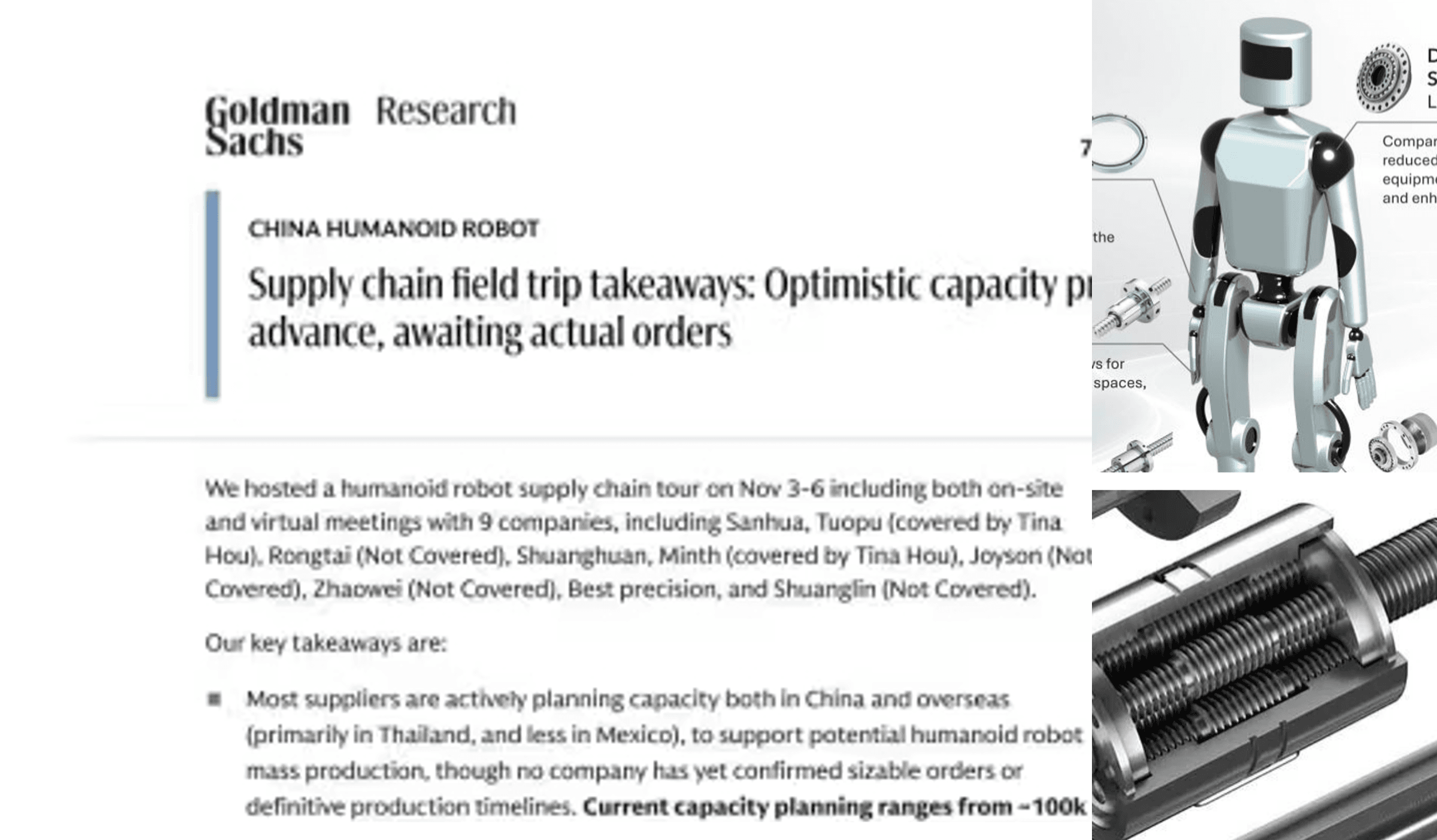
1. The Goldman Sachs Roadshow: Inside China’s Humanoid Machine Room
Between 3–6 November 2025, Goldman Sachs analysts conducted a rare, on-the-ground inspection of China’s humanoid supply chain, visiting nine publicly listed companies providing core hardware:
Actuators & precision modules
Harmonic/planetary reducers
Joint drives
“Electronic exterior” structures
Dexterous hands and micro-transmission components
The suppliers included Sanhua Intelligent Controls, Best Precision, Top Group, Shuanghuan Driveline, Shuanglin, Minth Group, Joyson Electronics, Rongtai Health, and Zhaowei Machinery.
Key Finding #1 — China Is Building Capacity Before Demand
Every supplier—large or small—confirmed the same message:
Massive production lines are being built now, even though no OEM has issued large, binding orders.
Examples:
Top Group (Thailand campus): planning capacity for up to 1 million humanoids/year, with RMB 7–8B CAPEX.
Multiple suppliers are shifting from machining parts to producing full joint-module lines.
Expansions are happening not only in China but also Thailand, Mexico, and the U.S., anticipating global export requirements.
This is not a reaction to existing demand—it is a bet that humanoids will be the next EV-scale industrial wave.
Key Finding #2 — The Order Book Remains Thin
Despite social-media hype and heavy investor enthusiasm:
No supplier could confirm large batch orders from Tesla Optimus, XPeng IRON, Xiaomi, or any emerging domestic OEM.
Almost all shipments today are samples or small pilot batches.
Most OEMs have no locked-in production schedules.
This aligns with RobotToday’s industry tracking:
the hardware is nearly ready, but real deployment has not begun.
Key Finding #3 — The Real Timing Anchor Is 2H26
Suppliers told Goldman they are preparing for mass production “once someone announces a real number.”
The entire chain is waiting for two key catalysts:
Tesla Optimus Gen-3, expected Feb–Mar 2026.
Chinese OEM shipment targets, typically released around year-end 2025 or Chinese New Year 2026.
This signals that the supply chain expects:
Initial commercial deployment: 2026–2027
Real volume inflection: 2028+
2. Stock Market Reaction: A Hot Trade Cools—Temporarily
Goldman’s report landed on 7 November 2025, immediately pressuring humanoid-linked equities.
Humanoid/Robotics Indices (7–11 Nov 2025)
Robotics Concept Index (884126.WI): –1.15%, –0.32%, –0.24%
Humanoid Robot Index (8841699.WI): –1.36%, –1.23%, –0.44%
On 11 November:
74 out of 110 humanoid-related stocks closed down.
Most of the Goldman-surveyed names fell; Rongtai, Shuanglin, and Minth posted mild gains.
Yet — Investors Remain Structurally Bullish
Before the correction, the humanoid index had risen ~35% YTD, outperforming both CSI 300 and Shanghai Composite.
Chinese brokerages maintain “Recommended” or “Overweight” ratings, based on the industry’s expected cycle:
2024–2026 → Tech breakthroughs
2026–2028 → Cost-down cycles
2028–2032 → Scenario penetration & industrial adoption
Translation:
The pullback was valuation digestion, not a reversal of the long-term thesis.
3. The Bigger Question: Is China Rushing Humanoids to Solve Its Labour Crisis?
3.1 China’s Demographic Pressure Is Unprecedented
China’s workforce is shrinking at the fastest rate on record.
Working-age population tightening is the top business concern
Fertility rate is at historic lows
By 2035, more than 40% of China’s population will be over age 60
Studies consistently show:
Ageing societies adopt industrial automation faster.
China’s industrial automation boom (2012–2024) was driven not by high wages, but by labour scarcity.
Humanoids are increasingly viewed as the next logical phase.
3.2 Government Policy Strongly Signals a Long-Term Humanoid Push
Since 2023, MIIT and provincial governments have:
Declared humanoids a “strategic disruptive technology”
Set a target for batch production capability by 2025
Provided R&D subsidies for joint modules and dexterous hands
Funded humanoid trials in manufacturing, logistics, municipal services, elder care, and education
Introduced governance frameworks for humanoid safety & testing
Launched “humanoid 4S centres” for future sales, maintenance & upgrades
China is currently the only country openly aiming to industrialize humanoids at EV-industry scale.
3.3 Supply Chain Behaviour Confirms National Intent
The behaviour of Chinese suppliers—building million-unit lines before orders—makes sense only in the demographic context:
If China wants to remain the world’s manufacturing centre while having fewer young workers each year,
the only solution is machines that can perform human-sized general tasks.
Japan: older, but far smaller industrial base
U.S.: younger, but high labour costs
China: massive industrial base + massive labour shortage
Humanoids are therefore not optional.
Inside Chinese policy circles, they are increasingly framed as a strategic necessity.
4. Will Humanoids Replace Workers in Chinese Factories? (RobotToday’s View)
Not immediately — but sooner than many expect.
Based on RobotToday’s tracking of China’s OEMs, suppliers, and policy activity:
2025–2026: Technology Stabilization Phase
Lower-cost actuators
Safer balancing, whole-body control
30–70 kg load handling
Reliable 24/7 operation
First practical dexterous hands for industrial tasks
2026–2028: Line-Side Pilot-Scale Deployment
Factories run multi-month humanoid pilots
Use cases: logistics, palletizing, picking, inspection
Deployment in semi-structured industrial environments
Unit cost expected to fall below USD 25,000–30,000
2028–2032: Industrial Deployment Phase
China targets tens of thousands of humanoids yearly
Adoption across electronics, appliances, auto parts
20%–30% of incremental labour demand could be offset
Significant usage in elder care and service sectors
China may avoid publicly stating that humanoids “replace workers,” but in practice:
Humanoids will fill roles that no longer have enough human applicants.
5. What This Means for Investors, OEMs & the Global Robotics Landscape
1. China Is Positioning to Dominate Humanoid Supply Chains
China aims to control:
Reducers
Joint modules
Actuators
Dexterous hands
Structural components
Automotive-grade electronics
Once major orders land, China will scale faster than any other region.
2. The Biggest Risk Today Is Not Technology — It’s Timing
Suppliers are investing billions before revenue visibility.
If deployments slip beyond 2027, earnings pressure will rise.
3. The “Apple Moment” Will Come From Either Tesla or a Chinese OEM
The first player to announce ≥100,000 humanoids/year will define the global tempo for the industry.
4. Demographics Ensure Long-Term Demand
Humanoids are not a speculative trend.
They address a structural, irreversible economic need.
This gives the sector a long-term demand floor.
Conclusion: Goldman’s Report Didn’t Deflate the Story — It Clarified It
Goldman Sachs’ trip confirmed:
China’s humanoid ecosystem is real, industrial, and accelerating
Capacity is being built at EV-scale before commercial demand
The market reaction was realism, not derailment
China’s strategy is tied to demographics + competitiveness + national policy
For RobotToday readers:
Humanoids are evolving from research projects into macroeconomic instruments.
China plans to manufacture them at global scale — and the countdown to deployment has begun.
RobotToday will continue tracking:
Tesla Optimus development
XPeng IRON factory pilots
Xiaomi CyberOne 2.0
China’s Thailand/Mexico humanoid manufacturing buildout
These milestones will determine how fast the humanoid era arrives.









Leave a comment