

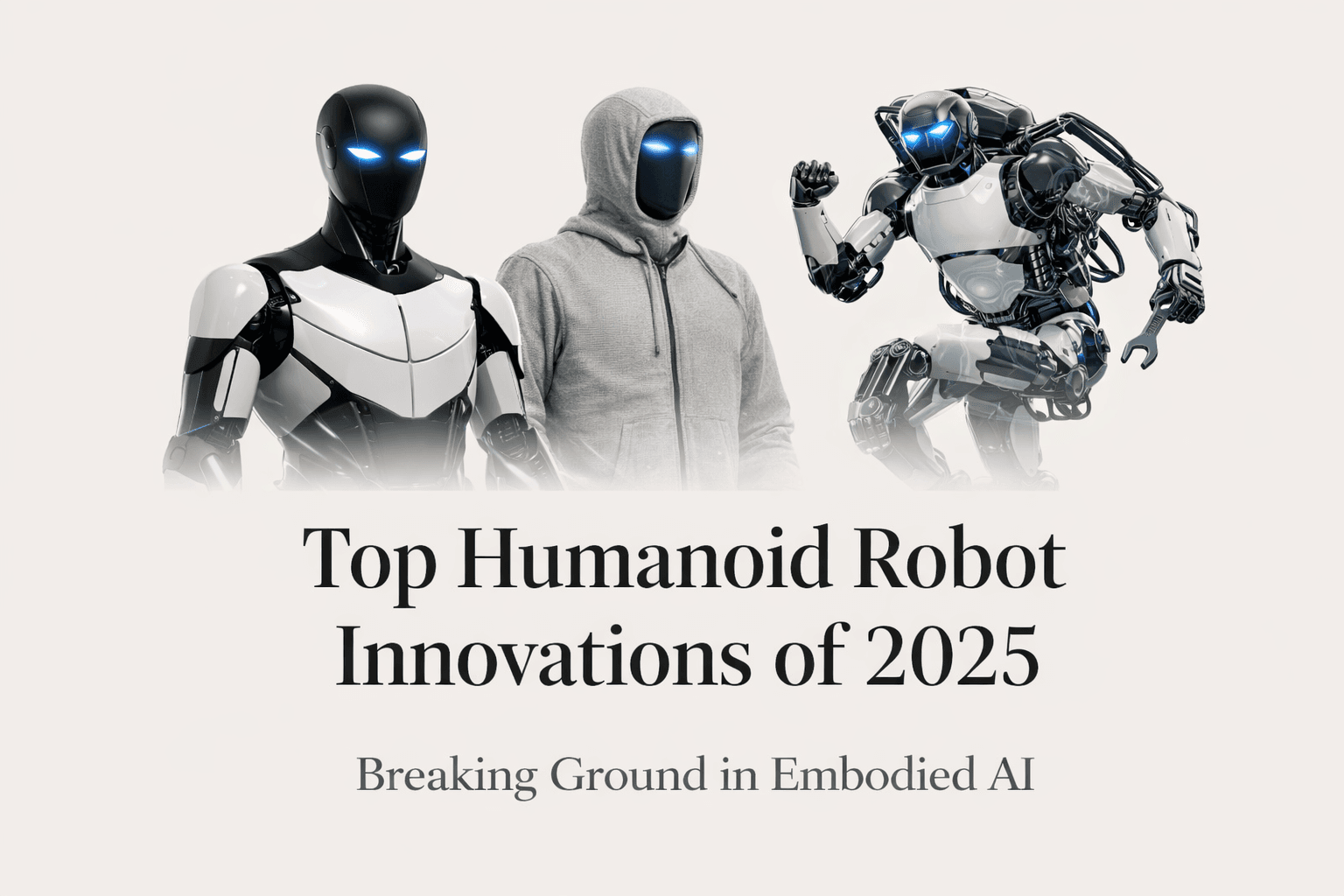
The first half of 2025 has been a breakout period for "Physical AI," where the focus shifted from robots that can merely walk to robots that can reason. We’ve seen the "ChatGPT moment" for robotics, characterized by massive scaling in manufacturing and the introduction of advanced reasoning models into bipedal bodies.
Here are the six most noteworthy humanoid innovations from the first half of 2025.
1. Tesla Optimus: The "Grok-3" Brain Integration
In early 2025, Tesla integrated its Grok-3 AI model into the Optimus Gen 2. This introduced "chain-of-thought" reasoning, allowing the robot to troubleshoot tasks in real-time. Instead of requiring a pre-programmed path, Optimus can now look at a cluttered workspace and "decide" the order of operations to clean it. Tesla also signaled its transition to mass production, posting hundreds of engineering roles at the Fremont factory to hit its target of 5,000–12,000 units by year-end.
2. 1X Technologies: NEO Beta & The "Redwood" Model
The NEO Beta, released in early 2025, moved away from the "clunky metal" aesthetic toward a soft, textile-covered body designed for home safety. The innovation lies in its Redwood AI model, which allows the robot to learn from "human-in-the-loop" teleoperation. If NEO doesn't know how to use your specific coffee machine, a remote human operator can "possess" the robot once to teach it, and the AI generalizes that skill across its entire fleet instantly.
3. Boston Dynamics: The Fully Electric Atlas Pivot
Moving away from its legendary hydraulic systems, Boston Dynamics debuted the All-Electric Atlas in commercial pilots. This version features 360-degree swiveling joints, allowing it to move in ways that defy human biomechanics (e.g., standing up by rotating its legs backward). This innovation removes the risk of "oil leaks" in sensitive environments like microchip factories, making it the most agile and clean industrial humanoid to date.
4. Figure AI: Figure 02 & The Helix Neural Network
Figure AI’s Helix Neural Network became a cornerstone innovation in Q1 2025. This end-to-end AI system handles everything from vision to motor control in a single model. Unlike traditional robots that use separate "modules" for seeing and moving—which causes lag—Figure 02 uses Helix to achieve near-zero latency, allowing it to catch falling objects or react to a human's sudden movement with millisecond precision.
5. Unitree G1: The "Combat-Ready" Stability Algorithms
At the 2025 World Robot Conference, Unitree demonstrated the G1 "Humanoid-Agent," showcasing a breakthrough in dynamic recovery. Using advanced reinforcement learning, the G1 can endure kicks, slips, and even "combat" sparring without falling. Its most notable innovation is its price point—approximately $16,000—democratizing humanoid research for smaller universities and startups that were previously priced out of the $100k+ market.
6. UBTECH: The Walker S1 "Collaborative Fleet"
UBTECH innovated in multi-agent coordination. During deployments in early 2025, groups of Walker S1 robots were seen working as a "swarm" in automotive assembly lines. Using a shared digital twin platform, the robots communicate their intent to each other to avoid collisions and hand off parts mid-stride—a level of orchestration that proves humanoids can work as a team rather than just isolated units.
Summary Table: Innovation Comparison
Robot | Primary Innovation | Key 2025 Milestone |
|---|---|---|
Tesla Optimus | Grok-3 Reasoning | Mass production scale-up |
1X NEO | Soft-body / Home safety | Remote "Teaching" sessions |
Electric Atlas | Non-humanoid joint rotation | Transition to 100% electric |
Figure 02 | Helix Neural Network | Sub-millisecond reaction time |
Unitree G1 | Low-cost high-stability | First sub-$20k research bot |
Walker S1 | Fleet Intelligence | Swarm coordination in factories |







Leave a comment