


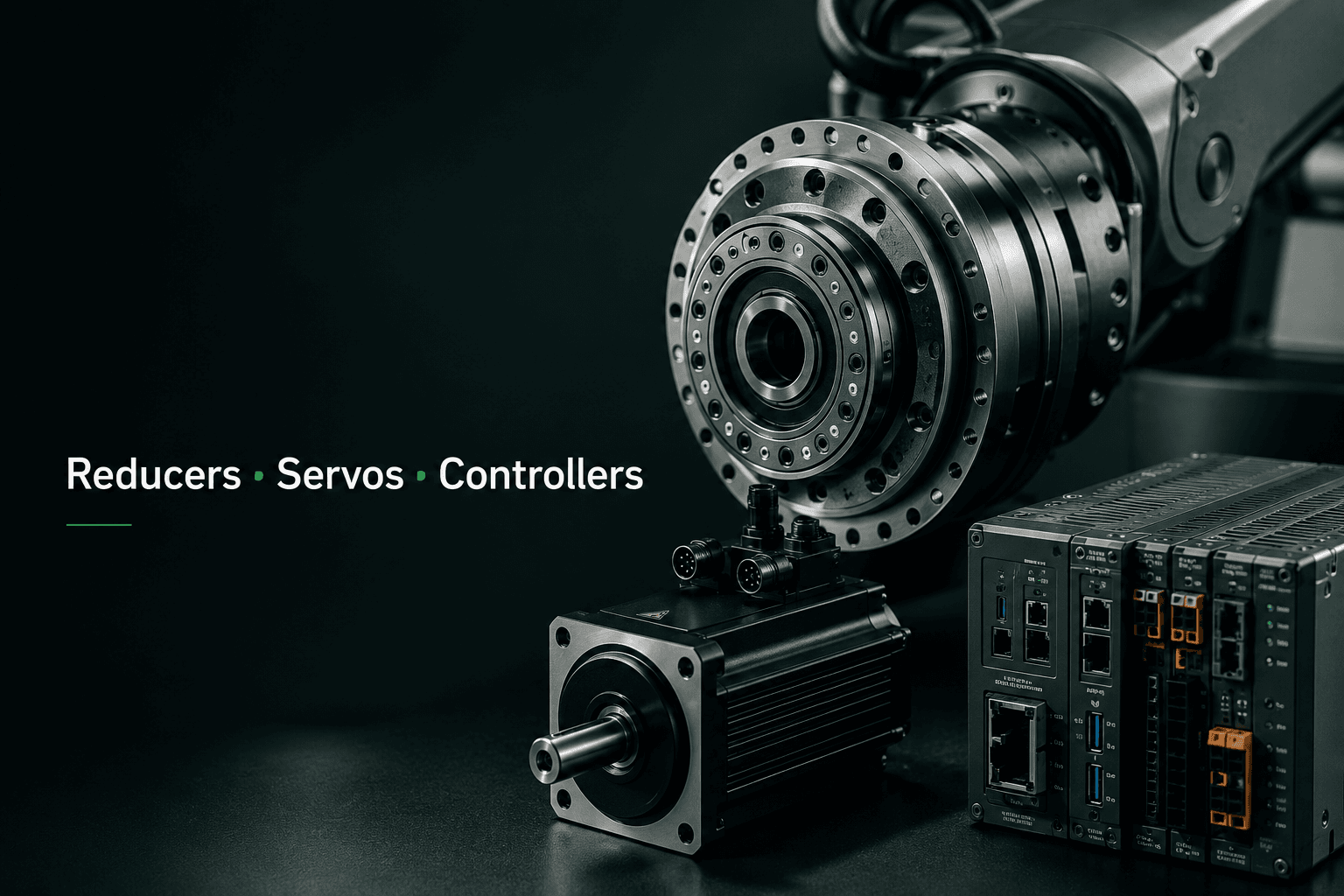
Executive Summary
The performance ceiling of any industrial robot is set not by the arm geometry or payload rating on its datasheet, but by the precision and reliability of three internal component systems: the precision reducers that control joint motion, the servo motor systems that generate and regulate that motion, and the motion controller that orchestrates the whole. Together, these three pillars account for approximately 70–75% of a robot's bill-of-materials cost — and they form the deepest layer of the global robotics technology competition.
This chapter maps the full global product ecosystem across all three component categories. The analysis covers Japan's entrenched leaders (Nabtesco, Harmonic Drive Systems, Yaskawa, FANUC), Europe's increasingly prominent contributors (Schaeffler, WITTENSTEIN, Beckhoff, maxon, Bosch Rexroth), and China's rapidly advancing challengers (Leaderdrive, Inovance, Laifual). Rather than a simple ranking exercise, the chapter examines how each supplier's product architecture fits into the broader robot integration chain, where the genuine technology frontiers lie, and what the next generation of component innovation looks like across all three regions.
1. The Three-Pillar Architecture: Cost and Integration Logic
A standard 6-axis industrial robot with 20 kg payload carries a BOM where precision reducers consume approximately 35%, servo motor systems 25%, and the motion controller 15%. The remaining 25% covers structural members, end-effectors, cabling, sensors, and integration. This cost distribution is not arbitrary — it mirrors the technology density and IP concentration of each subsystem. A robot OEM that achieves 30% cost reduction on reducers can reprice its end product by roughly 10%, which is decisive in volume segments.
But cost share alone understates the integration complexity. The three components are not independent — they form a coupled system where reducer stiffness shapes servo bandwidth requirements, servo bandwidth limits achievable controller update rates, and controller algorithm quality determines how much of the hardware capability is actually exploited. This coupling is why the most advanced robot OEMs (FANUC, Yaskawa, ABB) design their entire drive trains as tightly integrated vertical stacks rather than assembling best-of-breed third-party components. It is also why the modular, ecosystem-based approach emerging from European suppliers like Beckhoff and Schaeffler represents a structurally different — and potentially disruptive — architecture philosophy.
| Pillar | BOM Share | Global Market 2024 | CAGR to 2033 | Integration Role |
| Precision Reducers | ~35% | $2.84B | 8.2% | Sets joint stiffness, backlash, and torque capacity — the physical foundation of accuracy |
| Servo Motor Systems | ~25% | $13.7B | 7.4% | Generates, regulates, and measures joint motion — the energy-to-movement interface |
| Motion Controllers | ~15% | ~$1.8B | 9.1% | Plans trajectories, closes feedback loops, enforces safety — the computational brain |
| Structure / Other | ~25% | N/A | — | Structural frames, cabling, sensors, end-effectors — the integration layer |
Sources: IFR World Robotics 2025; Mordor Intelligence 2025; GlobalInfoResearch 2025; company filings.
2. Precision Reducers: Technology Architecture and Global Ecosystem
Precision reducers perform the mechanical translation between a servo motor's high-speed, low-torque output and the joint's requirement for low-speed, high-torque, high-precision motion. The critical specifications are: transmission backlash (target ≤1 arc-minute), transmission accuracy (±30 arc-seconds for highest-grade harmonic units), torsional stiffness (10,000–58,000 N·m/rad), efficiency (≥90%), and rated service life (L10 ≥10,000 hours). Two mechanical architectures serve distinct robot joint roles.
2.1 RV (Rotate Vector) Reducers — Cycloidal Architecture for Heavy Joints
RV reducers use a two-stage architecture combining a spur gear pre-reduction stage with a cycloidal disc stage. The cycloidal mechanism distributes load across multiple tooth contacts simultaneously, achieving exceptionally high shock-load tolerance (up to 500% of rated torque momentarily) and rigid torsional stiffness. This makes RV reducers the standard choice for robot base, waist, shoulder, and elbow joints — any joint that must transmit high torques and resist external disturbances.
Nabtesco Corporation (Japan) remains the world's definitive RV reducer manufacturer, holding approximately 21% of the global industrial robot reducer market and an estimated 60%+ of the pure RV segment. Its RV-C and RV-E product families cover rated torques from 27 N·m to 6,258 N·m, with backlash below 1 arc-min and L10 bearing life at or above 10,000 hours. Nabtesco's manufacturing process integrates ultra-precision grinding (tooth profile accuracy at ISO Grade 4), advanced heat treatment metallurgy, and decades of matched-component assembly know-how that cannot be replicated quickly. Sumitomo Drive Technologies' Cyclo BBB series offers an alternative cycloidal architecture with particularly strong performance under shock loads, targeting the heavy-payload welding and press-tending robot segment.
2.2 Harmonic (Strain Wave) Reducers — Compact Architecture for Light Joints
Harmonic reducers use three concentric elements: a rigid circular spline, a flexible spline (flexspline), and an elliptical wave generator. The elastic deflection of the flexspline produces zero-backlash mesh engagement with inherent compliance that dampens vibration — making harmonics ideal for wrist joints, SCARA arms, and collaborative robots where compactness, zero-backlash, and weight matter more than absolute stiffness. Harmonic Drive Systems (Japan) pioneered this technology and held over 80% global market share as recently as 2021. By 2024, its China market share combined with NIDEC-SHIMPO had fallen to approximately 45%, with Chinese manufacturers — principally Leaderdrive and Laifual — capturing the difference.
2.3 The European Contribution: From Components to Integrated Actuators
Europe's most significant reducer-ecosystem development in the past three years is the shift from supplying gearbox components to delivering fully integrated joint actuator modules. Schaeffler (Germany), long known as a world-leading bearing and precision drivetrain manufacturer, unveiled its planetary gear actuator platform at CES 2026 — a compact assembly combining a two-stage planetary gearbox, electric motor, encoder, and local controller in a single sealed unit. The actuator platform covers a torque range of 60 to 250 N·m and incorporates both planetary and strain wave gear variants depending on application requirements. Schaeffler has formalized a strategic technology partnership with Hexagon Robotics for supply of these actuators to humanoid robot platforms, targeting deployment of at least 1,000 humanoid systems by 2032.
WITTENSTEIN (Germany), with over 15 years of robotics gearbox experience, supplies its alpha series precision planetary gearboxes to industrial and collaborative robot manufacturers globally. WITTENSTEIN's approach differs from Japanese harmonic or RV specialists: its planetary architecture prioritizes thermal stability and high back-drive-ability, making its actuators well-suited for delta robots and high-cycle pick-and-place cells where continuous duty heat management is the binding constraint. WITTENSTEIN has increasingly moved toward mechatronic integration, pairing gearboxes with motor, brake, and feedback elements for direct OEM supply.
| Supplier | Region | Architecture | Global Position | Product Signature / Technology |
| Nabtesco | Japan | RV Cycloidal | #1 RV global; ~21% total reducer market | RV-E/RV-C; L10 ≥10,000 hr; ISO Gr.4 tooth profile |
| Sumitomo Drive Tech | Japan | Cyclo (BBB) | ~19% total market; heavy-load specialty | Cyclo BBB; 500% shock tolerance; automotive validated |
| Harmonic Drive Sys. | Japan | Strain Wave | ~18%; wrist-joint global standard | CSG/CSD; ±30 arc-sec accuracy; zero backlash |
| NIDEC-SHIMPO | Japan | Strain Wave | ~8%; compact hollow-shaft niche | CVHA series; through-hole cable routing |
| Schaeffler | Germany | Planetary + SW | Emerging; humanoid/cobot focus | Integrated actuator; 60–250 N·m; motor+encoder+ctrl |
| WITTENSTEIN | Germany | Precision Planetary | Established; delta/SCARA specialty | alpha series; thermal stability; back-driveable design |
| Leaderdrive | China | Strain Wave | ~6%; #2 global by volume | SHG/SHF; first domestic mass producer; 40% ASP gap |
| Laifual Drive | China | Strain Wave | ~4%; cobot market focus | LHD series; aggressive pricing; SE Asia export |
| Zhongda Leva | China | RV Cycloidal | ~2%; domestic automotive pilot | ZRRD series; L10 ~6,000–8,000 hr; qualification ongoing |
| Hanzhen Harmonic | China | Strain Wave | ~2%; emerging export player | Mid-range cobot/SCARA; domestic substitution |
Market shares are estimates based on GlobalInfoResearch 2025, IFR 2025, and company disclosures. China's domestic share of reducer consumption within China's own robot production: approximately 30% by volume (2024).
2.4 Technology Frontier: Where the Next Generation Is Being Built
Three technology vectors are reshaping the reducer landscape beyond traditional RV/harmonic competition. First, integrated joint modules: Schaeffler, maxon (Switzerland), and Chinese startup teams are packaging gearbox, motor, encoder, and driver into a single IP67-sealed unit, eliminating the mechanical interface tolerances that accumulate across separately assembled components. maxon's HEJ (High Efficiency Joint) series — delivering up to 140–180 N·m peak torque in EtherCAT-connected, thermally monitored packages — is already deployed in mobile and surgical robot applications and is entering the industrial cobot supply chain.
Second, material innovation: current flexsplines are machined from specialized steel alloys requiring tight hardness gradients. Research teams at Tohoku University and KAIST are exploring metallic glass and topology-optimized additive-manufactured flexsplines that could extend fatigue life by 30–50% while reducing mass. Third, AI-assisted wear compensation: leading OEMs are beginning to embed reducer-state estimators in controllers that continuously adapt motor current profiles to compensate for predictable backlash growth over the lifecycle — effectively extending the functional precision life of a reducer beyond its physical wear point.
3. Servo Motor Systems: The Three-Region Ecosystem
The global servo motor and drive market reached $13.72 billion in 2024, with approximately 28 million units shipped worldwide. AC servo motors captured 68% of revenue, driven by wide-speed-range performance and regenerative braking that yields up to 40% energy savings. The robot-specific servo motion control sub-market was valued at $631 million in 2024, with CAGR of 8.8% projected to 2032. In robot applications, servo systems must deliver low cogging torque at near-zero speeds (for smooth slow-motion assembly), high peak torque for dynamic acceleration, and encoder resolution of 20-bit or above for sub-arc-minute joint positioning.
3.1 Japan: Vertical Integration as Competitive Strategy
Yaskawa Electric, as the world's largest servo motor manufacturer with over 16.3 million units shipped in 2024, exemplifies the Japanese approach of deep vertical integration. Its Sigma-X series, launched in 2024, embeds predictive analytics and self-diagnosing firmware directly in the servo drive — closing the feedback loop between drive health and maintenance scheduling without requiring external software infrastructure. 210,000 Sigma-X units were sold within six months of launch. Mitsubishi Electric's MR-J4 series, with approximately 14.9 million units annually, dominates semiconductor manufacturing and precision packaging; its SafetyLogic integrated SIL 2 safety certification is increasingly required for automotive cell certification. Panasonic's MINAS A6 series is differentiated by active vibration suppression using a real-time mechanical resonance filter — critical for long-reach arms where end-effector oscillation limits cycle times.
FANUC occupies a unique position: its servo systems are proprietary, captive to its own robot platforms, and designed as an inseparable part of the complete electromechanical stack. The αi/βi servo series uses a common communication bus with FANUC's controller, enabling microsecond-level synchronization that third-party servo-controller combinations cannot match. This architectural lock-in is a deliberate design choice — and a formidable moat.
3.2 Europe: Communication Standards as Integration Philosophy
European servo suppliers have largely organized around open communication standards rather than proprietary ecosystems. Beckhoff Automation (Germany) built its servo strategy around EtherCAT, the high-speed industrial Ethernet protocol it developed and contributed to IEC standardization. The AX5000 and AX8000 servo drive series combine cycle times of 62.5 microseconds with distributed clock synchronization across hundreds of axes — enabling robot cells with 20 or more coordinated axes to achieve nanosecond-level timing alignment that proprietary fieldbuses cannot easily replicate.
Beckhoff's ATRO (Automation Technology for Robotics) modular robot system takes this philosophy further: each joint module embeds an EtherCAT servo drive, motor, brake, and gearbox, creating a fully reconfigurable robot architecture where axis count and kinematic configuration are determined at system setup rather than fixed at manufacture. This is a fundamentally different product philosophy from traditional robot OEMs — one that appeals to machine builders who want to integrate robot axes into larger automated systems without adopting a separate robot controller ecosystem.
Bosch Rexroth's IndraDrive and ctrlX DRIVE servo platforms similarly leverage openness: ctrlX DRIVE supports a Linux-based app architecture where drive-level functions can be extended with user code or third-party algorithms — a model that converges servo drive and edge computing. Siemens SIMOTICS S servo motors, paired with SINAMICS S120 drives, are deeply embedded in KUKA robot cells through the shared PROFINET/PROFISAFE communication layer that both companies standardized for automotive manufacturing. maxon's SOMANET servo drives, built around EtherCAT and CiA 402 motion profiles, are designed specifically for cobot and mobile robot joint control, emphasizing compact form factor and low heat dissipation per Newton-meter of torque produced.
3.3 China: From Substitution to Structural Leadership
China's servo ecosystem transition is the most consequential component-level shift of the past five years. Inovance Technology, founded by former Huawei engineers in 2003, reported $5.2 billion in total revenue for 2024 with servo systems as the central growth driver. Its SV660 and SV680 series achieved 28.3% of China's total servo market — ahead of any single Japanese competitor domestically. A 70% penetration rate among domestic Chinese robot arm manufacturers validates Inovance's technical adequacy for mainstream industrial applications. The ASP is approximately 35% below Japanese equivalents, not as a result of inferior quality, but of lower certification overhead, local supply chain efficiency, and absence of import tariff layers.
Estun Automation's servo strategy is tightly coupled with its own robot arm development: EMJ and EMP series servo systems are co-developed with Estun's mechanical team, producing matched drive-train stiffness profiles that allow its control software to push tighter trajectory tolerances than is possible with off-the-shelf servo components. Delta Electronics (Taiwan) targets the SMT, packaging, and 3C electronics segment with ASDA-B3, maintaining its position as the dominant mid-range servo supplier for non-robot automation before cross-selling into robot joint applications.
| Supplier | Region | Key Product Line | Technical Differentiator | Primary Robot Segment |
| Yaskawa Electric | Japan | Sigma-X | Predictive analytics; self-diagnosing drive | Standard in FANUC, Motoman, Kawasaki |
| Mitsubishi Electric | Japan | MR-J4 | Integrated SIL2; semiconductor-grade smoothness | ABB, OTC, Nachi; semiconductor |
| Panasonic | Japan | MINAS A6 | Active vibration suppression; resonance filter | Cobot; light assembly; long-reach arm |
| FANUC | Japan | alphai/betai | Captive; microsecond bus sync with R-30iB | FANUC robots only; full vertical |
| Beckhoff | Germany | AX5000/AX8000 | EtherCAT 62.5 us; distributed clock sync | Modular machines; multi-axis cells |
| Bosch Rexroth | Germany | ctrlX DRIVE | Linux app-extensible drive; open algorithm API | Mixed-brand automation cells |
| Siemens | Germany | SIMOTICS S + S120 | PROFISAFE certified; automotive SIL 3 | KUKA cells; heavy automotive |
| maxon | Swiss | SOMANET + HEJ | EtherCAT CiA402; IP67; cobot-optimized thermal | Cobot joints; surgical; mobile robot |
| Inovance | China | SV660/SV680 | 28.3% China share; 70% domestic robot penetration | Estun, EFORT, Rokae; domestic OEMs |
| Estun | China | EMJ/EMP | Co-developed with arm; matched stiffness profile | Estun robot arms; captive integration |
| Delta Electronics | Taiwan | ASDA-B3 | 3C/SMT dominance; mid-range positioning | SMT, packaging; 3C electronics |
3.4 Servo Technology Frontier: Encoder Resolution, Thermal Management, AI Tuning
The next servo generation is being shaped by three converging technology vectors. First, encoder resolution: Yaskawa's Sigma-X introduced 24-bit absolute encoders, delivering 16.7 million counts per revolution. Domestic Chinese servos are primarily shipping 23-bit (8.4 million counts); the gap translates to approximately 1.5× lower positioning noise at low speeds. Closing this gap requires not just higher-count encoder hardware but improved signal-conditioning ASICs — a 2–3 year manufacturing maturation cycle for Chinese suppliers already on this path.
Second, thermal management density: as servo motors shrink toward integrated joint modules, heat flux per unit volume increases dramatically. maxon's HEJ series uses copper winding with a thermal resistance optimized for continuous 140 N·m at a package diameter below 100 mm — a power density that requires precision winding machines and thermal-interface materials not yet widely available in Chinese supply chains. Third, AI-assisted tuning: Beckhoff and Yaskawa have both shipped servo drives with embedded reinforcement-learning tuning engines that automatically identify mechanical resonance frequencies and adapt gain scheduling in real time, eliminating the multi-hour manual commissioning process. This shifts servo value from hardware to embedded intelligence — a domain where European and Japanese suppliers currently hold the algorithmic edge.
4. Motion Controllers: Architecture, Ecosystem, and the Software Frontier
The motion controller is the system that converts a robot's task program — a sequence of Cartesian positions and process commands — into the microsecond-level joint torque commands that servo drives execute. Its quality is determined not by processor speed alone but by the accumulated software intelligence embedded in four functional layers: kinematic modeling, trajectory planning, feedback control, and functional safety. The controller is the component most difficult to benchmark with a single number, and the one where the gap between leading and following suppliers is most underappreciated.
4.1 Japan: Deep Proprietary Stacks with Decades of Production Validation
FANUC's R-30iB Plus controller represents the pinnacle of 50 years of continuous controller development. Running FANUC's proprietary real-time operating system on custom RISC hardware, it achieves servo loop closure at 1 millisecond, interpolation at 0.1 ms, and path accuracy of ±0.02 mm under full rated payload at 1 m/s trajectory speed. The iRVision integrated vision system, the DCS (Dual Check Safety) architecture certified to SIL 3 / PL e, and the zero-downtime FANUC FIELD system that connects all robot controllers in a factory to a central AI-model update pipeline — these are not isolated features but an integrated software ecosystem built on millions of production robot-hours of field data.
Yaskawa's YRC1000 offers a compact dual-arm coordination architecture that enables two Motoman arms to be controlled as a single kinematic system, with synchronized path accuracy of ±0.05 mm — critical for human-robot collaborative assembly where both arms handle the same workpiece. The YRC1000micro variant, at 7.5 kg controller weight, brings full-capability control to cobot applications where panel space is constrained. DENSO's RC8 and RC9 controllers are purpose-optimized for small high-speed arms (Gamma through VS series) with 0.5 ms interpolation cycles that support high-speed PCB assembly at 200+ picks per minute.
4.2 Europe: Open Architecture as a Technology Philosophy
European controller suppliers have staked their competitive position on architectural openness — the belief that the robot controller should be a platform for third-party software integration rather than a closed appliance. KUKA's KR C5 controller runs KUKA System Software on a Windows-based industrial PC, with the WorkVisual programming environment providing a complete development toolchain including safety editor, I/O configuration, and simulation integration. KUKA's MXAUTOMATION OPC UA server exposes the robot's full state to any SCADA or MES system in the factory — enabling integration without proprietary gateways.
Beckhoff's TwinCAT 3 represents perhaps the most ambitious European controller architecture: a software-only real-time execution engine running on standard x86 hardware, transforming any industrial PC into a deterministic motion controller. TwinCAT's object-oriented IEC 61131-3 programming environment supports all five PLC languages plus C/C++ and MATLAB/Simulink function blocks, enabling control engineers to implement custom kinematic solvers and trajectory algorithms as native controller extensions. At SPS 2025, Beckhoff demonstrated physical AI integration in TwinCAT — reinforcement-learned motion policies executing as hard-real-time tasks alongside deterministic safety functions — signaling where the European open-controller platform is heading. ABB's OmniCore C30, introduced in 2024, adopts a similar PC-based architecture with cloud OTA update capability and ABB Ability API exposure, enabling digital twin synchronization and remote monitoring at the controller level.
4.3 China: Growing Capability, Real Remaining Gaps
Chinese controller development has accelerated substantially since 2020, driven by the strategic imperative to reduce dependence on foreign controller platforms following geopolitical technology controls. Siasun's proprietary controller, validated in major automotive paint and assembly plants in China, has achieved the most credible domestic performance record. EFORT's eC3 controller, with an installed base exceeding 20,000 units, provides a Linux real-time foundation that supports growing third-party application development. Inovance's IS800 series integrates servo drive control and motion sequencing in a unified stack — reducing the number of communication hops between motion command and torque execution, which improves response latency for small, fast-motion tasks.
The performance gap is real and quantifiable. A 2024 Chinese Academy of Sciences benchmark across 12 industrial controller platforms measured path deviation at 1 m/s TCP speed under 80% of rated payload. Top domestic Chinese controllers achieved ±0.08–0.12 mm; FANUC and ABB equivalents achieved ±0.02–0.04 mm — a 3–6× gap under dynamic conditions. The gap narrows to approximately 2× at slow-motion speeds (below 200 mm/s) and widens beyond 6× in highly dynamic multi-axis interpolated paths. The root causes are layered: kinematic model accuracy (temperature-compensated joint elasticity models require millions of calibration data points), servo bandwidth optimization (requires matched controller-servo co-design), and safety firmware depth (SIL 3 PL e certification requires independent FMEA audit and formal proof of safety response times, a 24–36 month process per product generation).
| Controller | Supplier / Region | Architecture | Signature Capability | Openness |
| R-30iB Plus | FANUC / Japan | Custom RISC + FANUC OS | ±0.02 mm path; SIL3; iRVision integrated | Closed — proprietary ecosystem |
| YRC1000 | Yaskawa / Japan | DSP + INFORM language | Dual-arm sync ±0.05 mm; SIL3 DCS safety | Partial — ROS2 bridge available |
| RC8 / RC9 | DENSO / Japan | ARM + PacScript | 0.5 ms interp; 200+ picks/min PCB assembly | Low — captive use |
| KR C5 | KUKA / Germany | x86 IPC + Windows + KSS | OPC UA full-state exposure; MXAUTOMATION gateway | High — full SDK published |
| TwinCAT 3 | Beckhoff / Germany | x86 IPC + RT software | Physical AI in hard-RT; all IEC61131 + C/C++ | High — open algorithm extension |
| OmniCore C30 | ABB / Switzerland | PC-based + ABB OS | Cloud OTA; multi-robot orchestration; Ability API | High — ABB Ability open |
| Siasun Ctrl | Siasun / China | x86 + custom RTOS | Automotive validated; ROS-compatible | Medium — growing ecosystem |
| IS800 | Inovance / China | ARM + RTOS; servo-integrated | Unified servo-controller stack; low latency | Medium — open API roadmap |
| eC3 | EFORT / China | IPC + Linux RT | 20,000+ installed; growing ISV ecosystem | Medium — third-party apps growing |
5. Technology Gap Analysis: Honest Assessment Across All Three Pillars
The following matrix assesses the current state of the three-region competition across seven critical technical dimensions. The assessment is calibrated against 2024 independent benchmark data and product specification disclosures, not marketing claims.
| Technology Dimension | Japan / Europe Benchmark | China Current State | Estimated Convergence |
| RV reducer L10 service life | Nabtesco ≥10,000 hr (ISO Gr.4 tooth) | 6,000–8,000 hr in field; volume production established | 2028–2030 for full parity |
| Harmonic transmission accuracy | HD Systems ±30 arc-sec; stiffness 58,000 N·m/rad | ±45–60 arc-sec; cobot-grade achieved; industrial-grade in progress | 2026–2027 for mid-grade parity |
| Servo encoder resolution | Yaskawa 24-bit (16.7M cpr) Sigma-X | 23-bit (8.4M cpr) mainstream; 24-bit in development | 2026 for hardware parity |
| Servo low-speed cogging torque | Yaskawa <0.5% rated torque ripple | ~1%–1.5% rated; 1.5–2× higher at <100 RPM | 2027 for high-end servo parity |
| Controller path accuracy (1 m/s) | FANUC/ABB ±0.02–0.04 mm at rated load | ±0.08–0.12 mm; 3–6× gap in dynamic conditions | 2029–2032 for full parity |
| Safety firmware (SIL 3 / PL e) | FANUC, Yaskawa, ABB, Siemens: certified | SIL 2 achieved; SIL 3 in progress by leading OEMs | 2027–2028 for top-tier OEMs |
| Controller algorithm depth | Kinematic libs for 500+ tool configs; AI-adaptive gain | Own-family kinematic libs; limited adaptive control | 2030+ for comparable breadth |
| Integrated joint module (actuator) | Schaeffler / maxon: IP67; EtherCAT; 140–250 N·m | Early-stage; academic prototypes; no volume production | 2028–2030 for equivalent modules |
| MTBF field data depth | Nabtesco / FANUC: 15+ year field datasets | <8 year field datasets; insufficient for automotive qual | Structural 5–8 yr lag; time only |
Sources: Chinese Academy of Sciences Robotics Lab benchmark (2024); IFR World Robotics 2025; independent testing agencies; company technical specifications.
6. Ecosystem Integration: Where the Three Pillars Are Converging
The most significant structural trend in the core components landscape is the dissolution of the traditional boundary between the three pillars. The integrated joint module — a single sealed unit combining reducer, motor, encoder, drive electronics, and local control logic — represents a fundamentally different supply-chain architecture than the classical approach of sourcing three independent components and assembling them at robot OEM level.
Schaeffler's planetary gear actuator platform, maxon's HEJ series, Beckhoff's ATRO joint modules, and multiple Chinese university spinouts are all converging on this architecture. The integration benefits are substantial: elimination of mechanical interface tolerances that accumulate across separately assembled components, reduction of the cable count from dozens to a single EtherCAT bus daisy-chain, and enablement of joint-local condition monitoring (temperature, vibration, estimated remaining life) without requiring additional sensors. For humanoid robots — where 25–30 joints must fit within strict mass and volume budgets — the integrated module architecture is not optional: it is the only viable supply-chain model.
A second convergence is happening at the software layer: AI-native motion control. Physical AI — large motion models trained on billions of robot trajectory data points — is beginning to supplement or replace deterministic trajectory planners in research settings. FANUC's integration of ROS2 support in its latest controllers, Beckhoff's physical AI demonstration at SPS 2025, and ABB's cloud-connected OmniCore all point toward a future where controller software updates are deployed as model checkpoints rather than firmware releases. This shifts the controller competition from hardware architecture to data flywheel: whoever collects the most diverse, highest-quality robot operation data builds the most capable motion models. Here, FANUC's 500,000+ installed robot base is a structural data-collection advantage that Chinese OEMs, with their shorter deployment history, cannot replicate in the near term — but AI training compute can partially compensate for data breadth.
7. Future Development Directions by Component Pillar
| Pillar | Near-Term (2025–2027) | Mid-Term (2027–2030) | Long-Term (2030+) |
| Reducers | Metallic glass flexspline prototypes; China RV L10 validation programs; Schaeffler actuator volume ramp | China harmonic precision parity; integrated module standard in cobot; topology-optimized additive gearbox | AI wear-compensation extends life 2×; AM-produced RV cycloidal disc adoption; digital-twin lifecycle tracking standard |
| Servo Systems | 24-bit encoder mainstream in China; AI commissioning auto-tuning ships; maxon/Beckhoff cobot module growth | Thermal density parity China vs. Japan in cobot range; SIL3 servo drive certification domestic China | Embedded reinforcement-learning gain scheduling standard; servo-reducer thermal co-management in unified module |
| Controllers | SIL3 certification by top China OEMs; ROS2 integration widespread; Beckhoff physical AI in production | China path accuracy narrows to 1.5× gap; open-source kinematic libraries reduce model breadth gap | AI-native motion planning displaces deterministic trajectory planner for unstructured tasks; controller = data flywheel |
This chapter is part of the Global Industrial Robotics Report 2026 series. Primary data: IFR World Robotics 2025 (September 2025, based on 2024 field data), GlobalInfoResearch, Mordor Intelligence, Beckhoff/Schaeffler/maxon technical publications, and Chinese Academy of Sciences (2024 benchmark). All market figures subject to revision as full-year 2025 data becomes available.









Leave a comment