


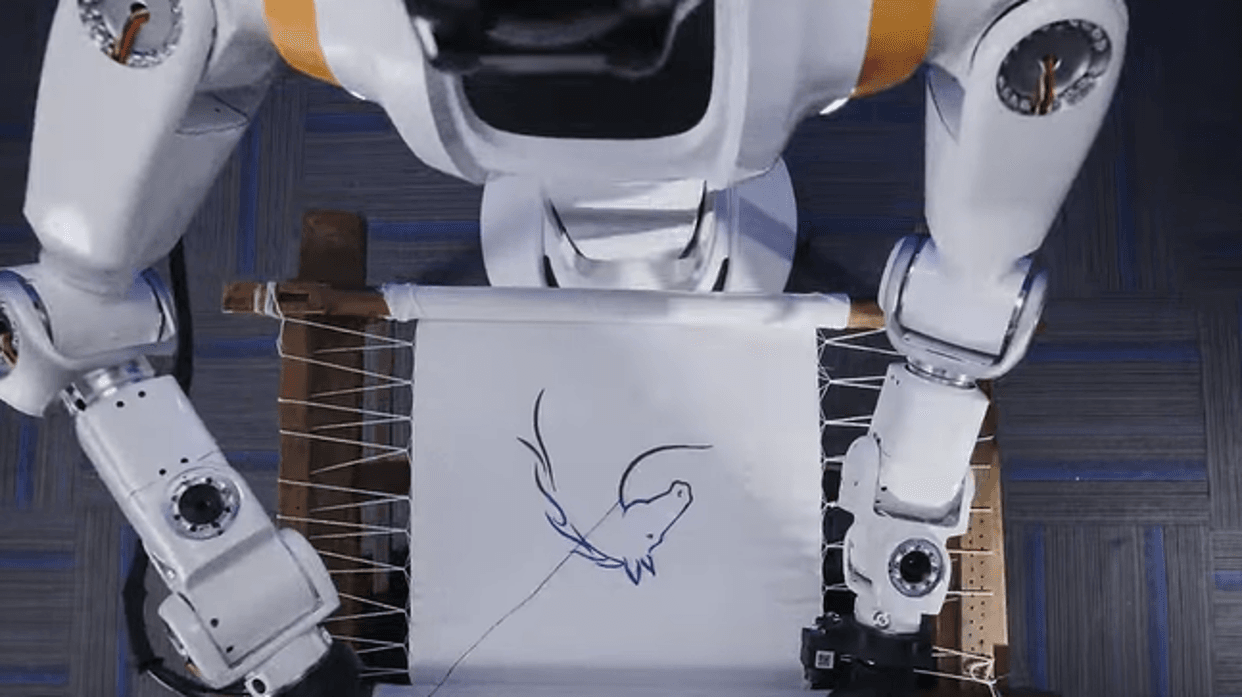
Hillhouse, Sequoia China and Meituan co-lead an oversubscribed round that values the 14-month-old Shanghai startup among China’s top-tier embodied intelligence players — as state capital enters the sector for the first time.
Deal Snapshot
| Company | TARS AI (Tashi Zhihang) |
| Round | Pre-A |
| Amount | USD 455 million (oversubscribed) |
| Announced | 16 April 2026 |
| Lead investors | Hillhouse Ventures, Sequoia China, Meituan Strategic Investment |
| Record set | Largest single funding round in China embodied-AI history; largest Pre-A in China embodied AI |
| Use of proceeds | Proprietary embodied foundation model (AWE); global talent acquisition |
| Founded | 5 February 2025, Shanghai |
| Stage | Pre-revenue / industrial pilot |
Investor Syndicate
| Tier | Investors |
| Financial (new) | Hillhouse Ventures, Sequoia China (co-leads); Meituan Longzhu, CICC Capital, Kailuan Capital, Orient Rich, Junshan Investment (follow-on) |
| Strategic (existing) | Meituan Strategic Investment (anchor; co-lead); Qiming Ventures, Linear Capital, Lanchi Ventures, Xianghe Capital, Hongtai Fund (all re-upped) |
| Industrial | TCL Ventures, Futeng Capital, Chengcheng Holdings (0697.HK), Jianfa Emerging Investment, Hengxu Capital, Guoqi Investment |
| State capital | Beijing Robot Industry Development Fund; Shanghai State Investment Pioneer — both making their first-ever embodied-AI investment |
Company Background
TARS AI (officially Tashi Zhihang) was formally incorporated on 5 February 2025 in Shanghai. The company positions itself as a full-stack embodied intelligence company: it develops proprietary large foundation models, designs its own robot hardware, and manages software-hardware integration in-house.
The founding team is drawn almost exclusively from China’s autonomous-driving industry, a sector that generated transferable expertise in sensor fusion, end-to-end neural networks, and large-scale data operations — all directly applicable to physical-AI development.
Leadership
| Name | Role | Background |
| Chen Yilun | Co-founder & CEO | Former CTO of Autonomous Driving, Huawei; Chief Engineer of Machine Vision, DJI; Chief Scientist of Intelligent Robotics, Tsinghua AIR |
| Li Zhenyu | Co-founder & Chairman | Former President of Intelligent Driving Group, Baidu; led development of Apollo autonomous driving platform and the ‘Luobo Kuaipao’ robotaxi service |
| Ding Wenchao | Chief Scientist | Researcher, Fudan University Robotics Institute; former Huawei ‘Genius Youth’ recruit; led Huawei’s end-to-end autonomous driving decision network; built Fudan’s first humanoid robot |
| Chen Tongqing | Chief Architect | Former Head of Intelligent Navigation, Huawei ADS; Chief Technical Expert in Spatial Perception |
Funding History: Three Rounds in 14 Months
| Round | Date | Amount | Lead Investors |
| Angel | Mar 2025 | $120M | Lanchi Ventures, Qiming Ventures |
| Angel+ | Jul 2025 | $122M | Meituan Strategic Investment |
| Pre-A ★ | Apr 2026 | $455M | Hillhouse Ventures, Sequoia China, Meituan Strategic |
| TOTAL | ~14 months | ~$697M | ★ = record for China embodied AI, any stage |
Technology Stack
TARS AI differentiates itself by pursuing a Vision-Language-Tactile-Action (VLTA) paradigm rather than the widely adopted Vision-Language-Action (VLA) approach. Company executives have publicly characterised VLA as a technology that originated outside China and does not fully suit industrial deployment requirements — an implicit critique of architectures derived from OpenAI and DeepMind research. TARS instead prioritises tactile sensing as a first-class modality.
The company’s full-stack architecture has three layers:
Data — WIYH (World In Your Hands): the world’s first large-scale open-sourced multimodal embodied dataset, covering vision, language, tactile and action signals from real-world environments. Data is collected using the company’s proprietary Human-centric acquisition paradigm.
Foundation model — TARS AWE (AI World Engine) 3.0: launched March 2026, described by the company as the first commercially deployable general-purpose embodied foundation model. AWE 3.0 includes OmniVTA, a vision-tactile world model designed to give robots sub-millimetre physical perception.
Hardware — A-series and T-series robot platforms: fully self-developed, integrating the proprietary sensor suite. The A1 model holds a Guinness World Record for the highest number of sub-millimetre wiring harness assemblies completed by a robot in one hour.
The flagship use case is flexible wiring harness assembly, long regarded as an unsolved problem (‘the Goldbach conjecture of industrial automation’) due to the deformable, tactile-dependent nature of the task. TARS claims to be the first company to achieve reliable, repeatable performance in this application.
Analysis: What This Round Signals
The $455M Pre-A is notable for several reasons beyond its headline size.
State capital entering for the first time. The participation of the Beijing Robot Industry Development Fund and Shanghai State Investment Pioneer marks the first direct state-capital investment into an embodied-AI startup at this stage in China. This is an alignment signal: the Chinese government’s 15th Five-Year Plan (2026–2030) explicitly names embodied intelligence as a national priority industry, and the inclusion of state funds indicates that TARS AI is being positioned as a national champion candidate in the sector.
Meituan as an anchor strategic. Meituan’s continued escalation across all three rounds — follower in Angel, lead in Angel+, co-lead and ‘cornerstone strategic shareholder’ in Pre-A — reflects a concrete last-mile and logistics automation thesis. Meituan operates one of China’s largest food-delivery and instant-commerce networks, and has a structural incentive to automate warehouse picking, sorting, and potentially delivery tasks. The depth of Meituan’s commitment suggests it is treating TARS as a captive supplier rather than a passive portfolio investment.
Automotive and electronics supply chain buy-in. The participation of TCL Ventures and Guoqi Investment (BAIC Group’s investment arm) in the industrial investor tier suggests that consumer electronics manufacturing and automotive assembly are seen as the near-term commercial battleground. Both sectors face acute skilled-labour shortages in China and are already deploying early-stage automation. The wiring harness focus maps directly onto automotive production.
Speed and oversubscription. TARS AI raised nearly $700M in 14 months without disclosed revenue. The oversubscribed Pre-A indicates that investor demand outstripped the allocation — a structural feature of late-2025 to 2026 China embodied-AI fundraising that mirrors earlier dynamics in large-language-model funding. Chairman Li Zhenyu has stated that the next round will be focused on production scale-up rather than pure R&D, suggesting a shift toward revenue-generating milestones.
Industry Context
China’s embodied-intelligence sector recorded 744 investment events totalling approximately CNY 73.5 billion (c. USD 10 billion) in 2025 alone, according to the China Academy of Information and Communications Technology and Tsinghua University. The sector was included in China’s Government Work Report for the first time in 2025.
TARS AI’s closest funded peers in China include Zhujidong (Limx Dynamics, $200M Series B closed 2026), Xinghaifu (Star Sea Atlas, CNY 1bn+ Series B), and Zibianliang Robotics (CNY 1bn Series A, Alibaba Cloud participation). TARS’s $455M Pre-A materially outpaces all of these, though direct valuation comparisons are not available given the absence of disclosed post-money figures.
What to Watch
Commercial deployment timelines: TARS has not yet announced revenue or customer names. Chairman Li has signalled that the next fundraise — presumably a Series A — will be tied to demonstrated production capacity. Watch for customer announcements in automotive or electronics manufacturing.
AWE model licensing or open-source strategy: TARS open-sourced the WIYH dataset but has not clarified the commercial status of the AWE 3.0 model. A licensing model could generate early revenue; a fully open approach would prioritise ecosystem building.
International expansion: TARS has stated intent to recruit globally. Western market entry — particularly in automotive supply chains with shared Tier 1 suppliers — could bring the company into direct competition with Figure AI, Physical Intelligence (Pi), and 1X.
State champion designation: If confirmed as a lead enterprise (链主企业) under Beijing or Shanghai’s robotics industrial cluster programmes, TARS could gain access to subsidised land, preferential procurement, and talent pipeline agreements with state universities.
Valuation disclosure: No post-money valuation has been disclosed. Given the $455M raise at Pre-A stage with a team of less than 200, any eventual valuation disclosure will be a significant benchmark for the sector.




Leave a comment