

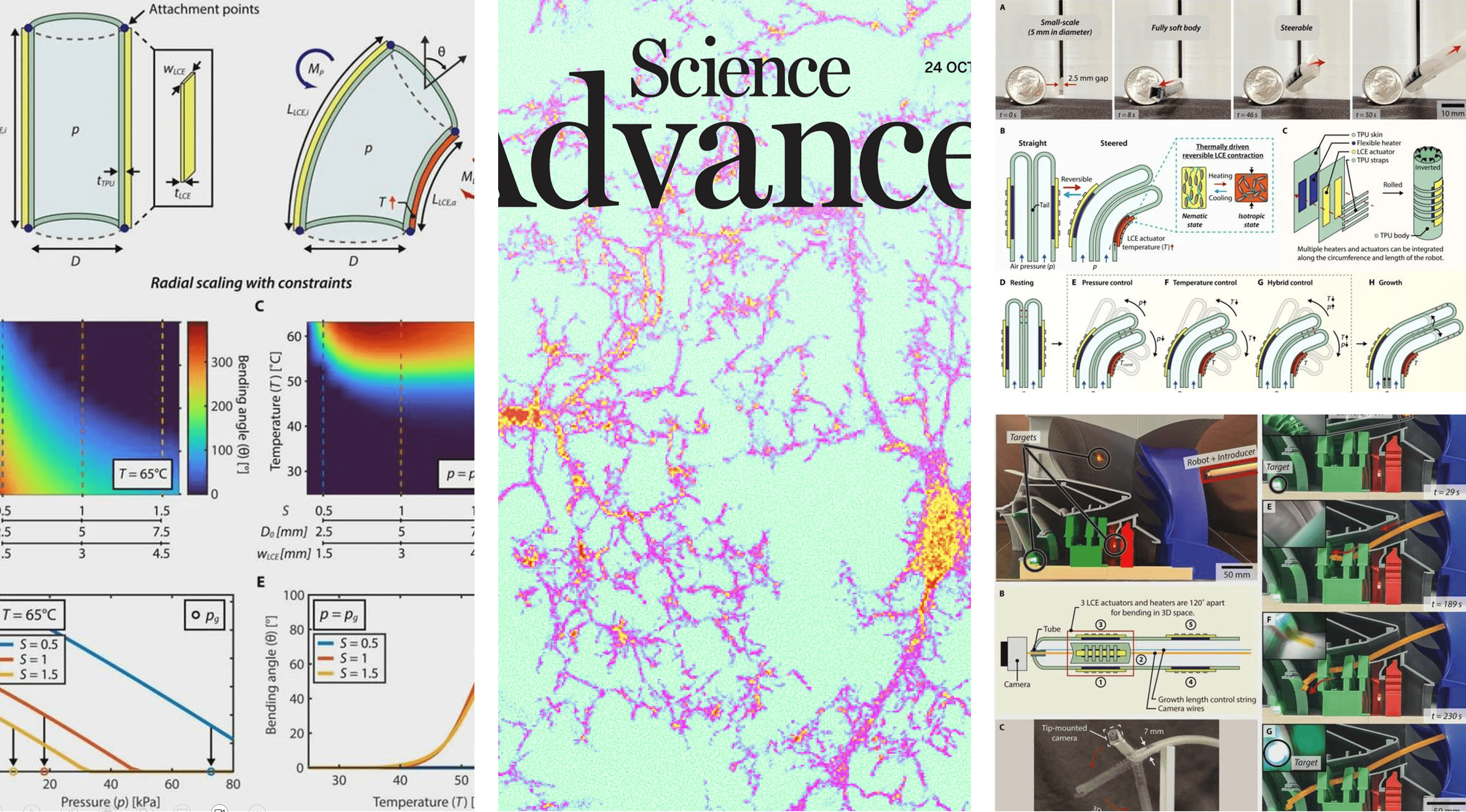
Published in Science Advances (October 2025)
Key Point Summary
1. Innovation in Miniature Soft Robotics
The research introduces a breakthrough in the design of "everting" (vine) robots by functionalizing their skin with Liquid Crystal Elastomer (LCE) actuators.
2. Functionalized LCE Skin
The core advancement is the integration of LCEs directly into the robot's skin.
3. Dual-Input Control System
The robot utilizes two primary control inputs:
Internal Pressure: Regulates the eversion process, allowing the robot to grow and elongate from the tip.
Thermal Activation: Controls the steering. By precisely managing the temperature of specific LCE segments, operators can trigger localized contractions that result in controlled, sharp bends.
4. Enhanced Dexterity and Navigation
Because the steering mechanism is distributed throughout the skin rather than concentrated at the tip or base, the robot can form complex, multi-curve shapes. This "hyper-redundant" flexibility is essential for "follow-the-leader" navigation, where the robot must thread through sinuous, constrained paths without putting pressure on the surrounding environment.
5. Real-World Applications
The study emphasizes the potential for these robots in high-stakes, constrained environments:
Medical Procedures: Their millimeter-scale and inherent softness make them ideal for endovascular surgery or navigating delicate anatomical ducts.
Industrial Inspection: They can traverse tiny, complex piping systems or machinery where traditional rigid or larger soft robots would fail.
6. Conclusion
Functionalizing robot skins with LCEs represents a paradigm shift in soft robotics. By moving the "muscles" of the robot into its very surface, the researchers have created a scalable path for developing smarter, smaller, and more capable autonomous systems for delicate navigation.










Leave a comment