


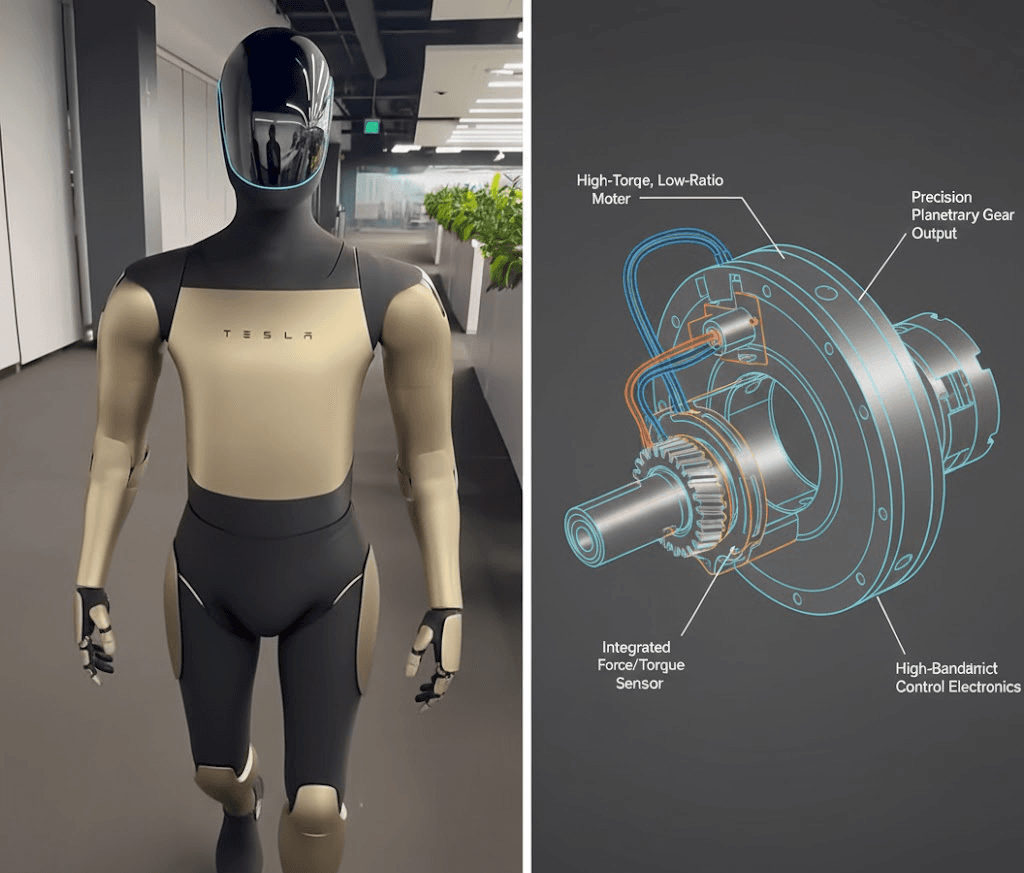
The High-Friction Bottleneck in Traditional Actuators
The global robotics actuators market for industrial automation and collaborative robots (cobots) is still significantly defined by Harmonic Drive (HD) strain wave gears. These precision reduction gears are highly valued for their unmatched high torque density, compactness, and zero backlash. However, the rapidly expanding field of next-generation robotics—including advanced exoskeletons and dynamic humanoid robots—is exposing the intrinsic limitations of HD's high internal friction. This friction, inherent to the strain wave gearing mechanism, restricts backdrivability and leads to substantial energy consumption and thermal dissipation, complicating the critical requirement for safe, compliant, and high-fidelity torque control in human-robot interaction (HRI). The bottleneck is a clear demand for electric actuators that are transparent, efficient, and easily back-driven without sacrificing torque output.
AILOS R2poweR: The Low-Friction Hybrid Approach
The European-based AILOS R2poweR gearbox is emerging as a formidable technical challenger directly targeting these friction limitations. Utilizing an innovative, potentially Wolfrom-based, kinematic structure that heavily prioritizes rolling contact over sliding, AILOS aims to deliver near-zero friction torque. By maximizing mechanical efficiency, R2poweR promises high backdrivability and enhanced energy regeneration capabilities, making it ideal for battery-powered systems demanding energy-efficient actuation. Crucially, this low-friction actuator seeks to achieve this performance while maintaining the compact size and high reduction ratios (e.g., 50:1 to 160:1) that robot builders rely on, allowing them to use smaller, more efficient motors for compact motion solutions.
"With R2poweR, we combine the smoothness of quasi-direct drives with the power of advanced acceleration systems. This removes one of the biggest technological barriers to lightweight, agile, and safe robots," noted an AILOS spokesperson.
The Rise of Quasi-Direct Drive and Alternative Systems
Beyond AILOS, the industry is witnessing parallel developments aimed at solving the same compliance problem. Traditional precision gear manufacturers are refining product lines, such as optimizing Cycloidal Reducers (RV Reducers) and Planetary Gearbox designs for reduced backlash and improved load distribution. Simultaneously, Quasi-Direct Drive (QDD) systems—epitomized by high-torque, low-ratio electric actuators used by companies like Tesla and MIT—are gaining traction. QDD achieves supreme backdrivability and torque transparency by minimizing the gear ratio (e.g., 5:1), relying instead on sophisticated control algorithms and motor power. Magnetic gears also remain a long-term potential disruptor, offering perfect zero-contact, friction-free transmission, provided they overcome current challenges in achieving competitive high torque density.
Bridging the Gap: The Future Market Challenge
The crucial challenge in the robotics actuators market is whether high-ratio, low-friction actuator technologies like AILOS can genuinely challenge the QDD paradigm. QDD is a systemic choice, sacrificing torque multiplication for maximum force transparency and high bandwidth. The R2poweR approach offers a compelling compromise for next-generation robot actuators: achieving QDD’s core advantages in low friction and backdrivability without sacrificing the high reduction ratio. If AILOS and similar hybrid-drive innovators can scale production with the requisite ultra-high precision, they could offer the best of both worlds, bridging the gap between the high torque density of traditional reducers and the high dynamic performance essential for the next decade of advanced service robotics and humanoid robot design.






Leave a comment