


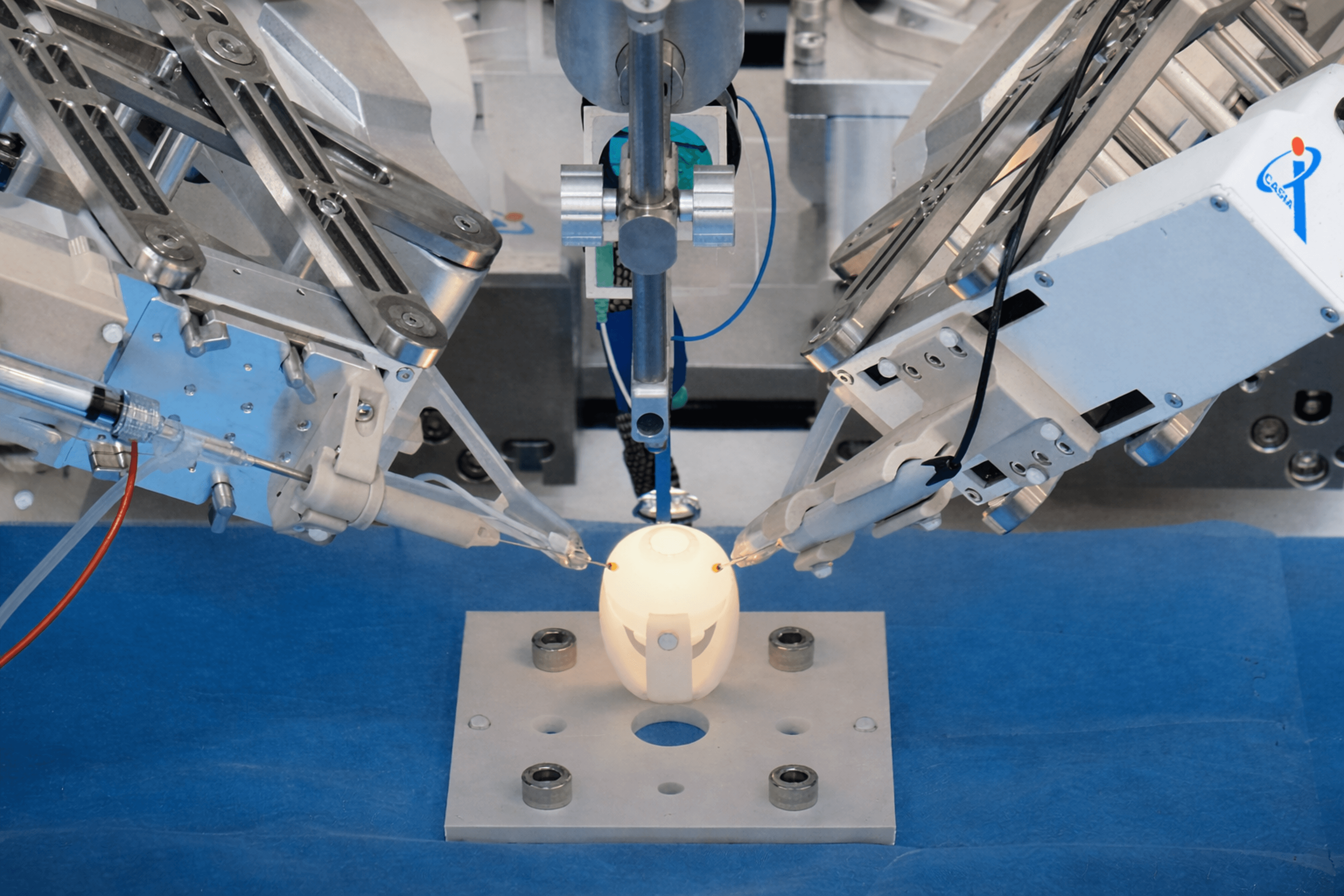
Science Robotics reports autonomous intraocular surgery—revealing a different future for Surgical Physical AI.
A study published in Science Robotics by a research team from the Chinese Academy of Sciences has demonstrated autonomous performance in intraocular surgery—one of the most constrained environments in medical robotics. The ARISE (Autonomous Robotic System for Intraocular Surgery) system achieved reliable, high-precision execution without relying on large-scale data-driven training, challenging prevailing assumptions about how Physical AI should evolve in surgical settings.
As Physical AI gains momentum across robotics, a common assumption has emerged: if general-purpose robots advance through data-driven autonomy, surgical robots should follow the same trajectory. The ARISE results suggest otherwise, revealing a structural divide between medical robotics and general-purpose Physical AI. Rather than lagging behind, surgical robotics may be progressing along a fundamentally different technological path.
A System Shaped by Clinical Constraints
ARISE does not pursue general intelligence. Its objective is narrowly defined: repeatable, high-precision targeted injections within the intraocular space.
The system relies on two tightly scoped mechanisms. Multiview spatial fusion aligns visual inputs across heterogeneous imaging conditions while compensating for subtle ocular motion. Criterion-weighted multisensor fusion dynamically integrates data streams with different spatial coverage, error characteristics, and sampling rates.
The design prioritizes perceptual consistency and positional stability over policy learning. In general Physical AI, this approach may appear conservative. In intraocular microsurgery, it reflects the dominant constraint: execution reliability.
Performance Measured in Consistency, Not Complexity
ARISE’s contribution is quantitative rather than conceptual.
In reported experiments:
- Ex vivo porcine eye studies achieved a 100% success rate for subretinal, central retinal vein (CRV), and branch retinal vein (BRV) injections (n = 20 each).
- In vivo animal experiments reported the same 100% success rate across all three injection types (n = 16 each).
Localization error was reduced by 79.87% compared with manual surgery and 54.61% compared with teleoperated robotic systems. At micrometer-scale precision, autonomous execution delivered higher consistency than both human operation and conventional robotic teleoperation.
Training-Centric Physical AI Meets Structural Limits
General-purpose Physical AI advances through repetition, failure tolerance, and large-scale data accumulation. Surgical robotics operates under opposite conditions. A failure represents irreversible clinical risk rather than a degraded reward signal. Data acquisition is constrained by ethics review, animal models, and clinical protocols. Real surgical environments cannot be reset or replayed at scale.
Under these conditions, learning paradigms dependent on extensive trial-and-error face inherent limits. ARISE responds by compressing uncertainty through engineered perception and fusion rather than absorbing risk through repeated training.
In surgical contexts, the bottleneck is not model capacity, but permissible failure.
Control Allocation as a Design Choice
Control allocation remains a central fault line in surgical robotics. Human-in-the-loop systems prioritize continuous surgeon control, supported by shared autonomy and virtual fixtures. Other approaches pursue higher procedural autonomy. ARISE assigns autonomy to a narrow but critical execution window—where human physiological limits are most pronounced.
This choice reflects a risk-management strategy rather than a claim of superior intelligence. It diverges from both persistent manual control and fully learning-driven autonomy.
ARISE suggests that engineered autonomy—built through modular, interpretable design—may represent a more realistic entry point for Physical AI in surgical settings than end-to-end learning.
Intraocular Surgical Robotics: ARISE vs. Preceyes vs. IRISS
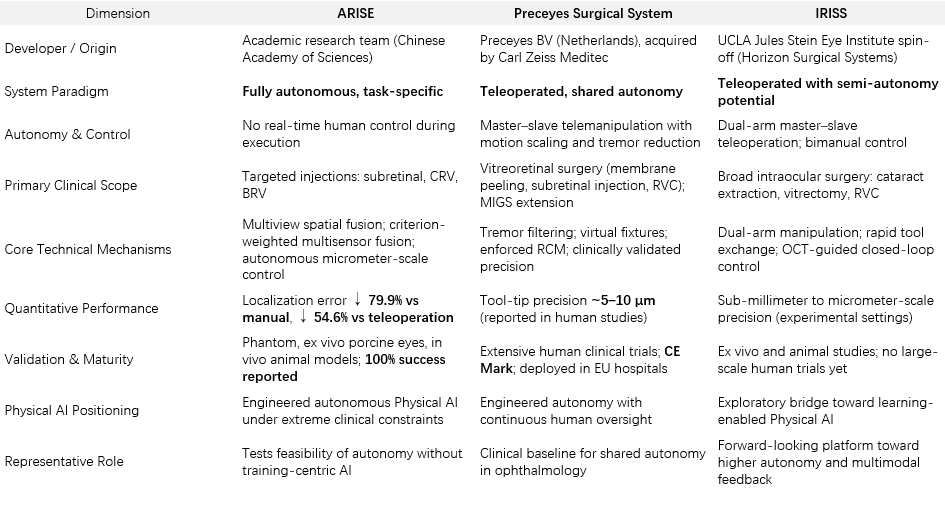
Taken together, ARISE, Preceyes, and IRISS illustrate three distinct autonomy strategies emerging in intraocular surgical robotics. ARISE represents the most radical departure from current clinical practice: a fully autonomous, task-specific system designed to execute targeted intraocular injections without real-time human control. Its reported performance—reducing localization error by nearly 80% compared with manual procedures and over 50% versus teleoperation—demonstrates that autonomy is technically feasible even under extreme micrometer-scale constraints. However, this capability is validated primarily in phantom, ex vivo, and animal models, positioning ARISE as a proof point rather than a near-term clinical solution.
By contrast, Preceyes embodies the most mature and clinically grounded approach. As a CE-marked system deployed in European hospitals, it relies on shared autonomy, combining master–slave teleoperation with motion scaling, tremor filtering, and virtual safety constraints to achieve tool-tip precision on the order of 5–10 μm in human surgery. IRISS occupies an intermediate, forward-looking position, pairing dual-arm teleoperation with OCT-guided closed-loop control and rapid tool exchange. While still preclinical, it signals how multimodal feedback and partial autonomy may gradually expand surgical automation without abandoning human oversight.
RobotToday Editorial Perspective ARISE marks a viable starting position for Surgical Physical AI—one aligned with clinical realities where controllability outweighs generality.
Much of today’s Physical AI narrative originates in domains where failure is tolerable and repetition is feasible. Surgical robotics exists at the opposite extreme.
ARISE shows how embodied intelligence may enter clinical practice: through engineered autonomy first, followed by selective integration of learning-based capabilities. This progression is incremental rather than radical, yet it may define the most durable intersection between Surgical Robotics and Physical AI.




Leave a comment