


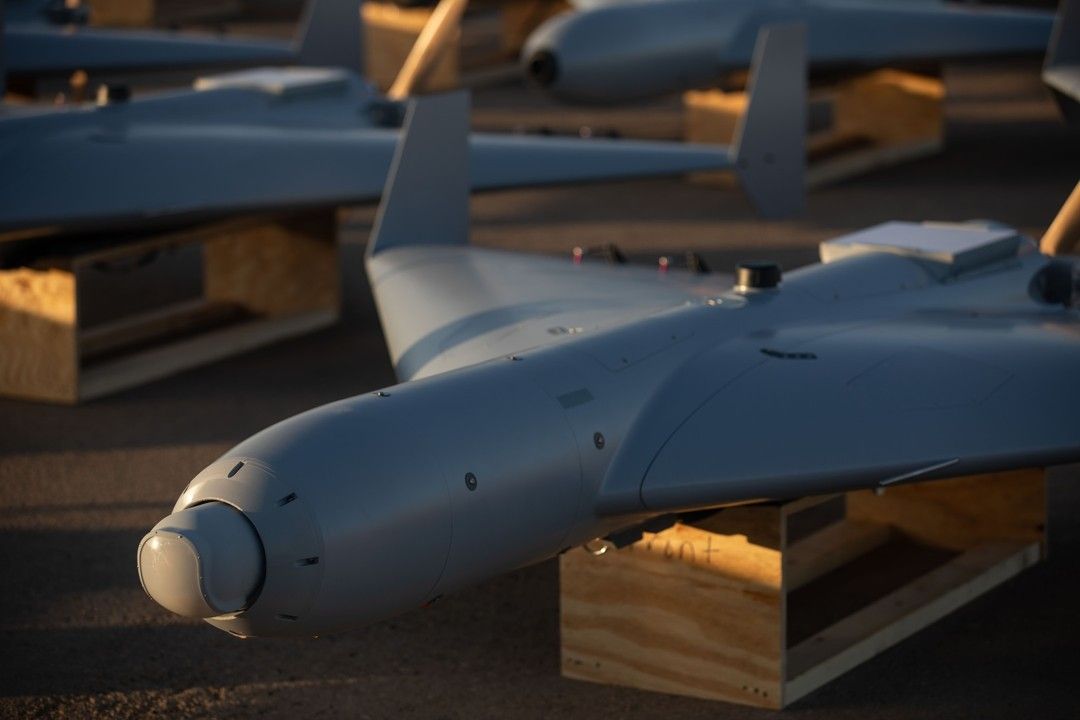
How the U.S. Adapted Iran's Shahed-136 Design for Domestic Low-Cost Strike Operations
The Historic First
On February 28, 2026, U.S. Central Command made history. For the first time in U.S. military operations, American forces deployed one-way attack drones — loitering munitions — in active combat. The system was the LUCAS: Low-Cost Unmanned Combat Attack System. CENTCOM's official statement confirmed the debut without ambiguity:
"CENTCOM's Task Force Scorpion Strike — for the first time in history — is using one-way attack drones in combat during Operation Epic Fury. These low-cost drones, modeled after Iran's Shahed drones, are now delivering American-made retribution."
Confirmed targets included IRGC command and control facilities, Iranian air defense systems, missile and drone launch sites, and military airfields. The deployment was notable given that Shahed-class drones had previously been used extensively by Iranian-backed groups against U.S. and allied assets across the region.
What Is the LUCAS Drone?
LUCAS is a one-way attack drone — also called a loitering munition or, colloquially, a 'kamikaze drone'. Unlike conventional drones that return to base, LUCAS flies to a target area, loiters to identify the right moment, then dives and detonates. There is no recovery. It is designed to be used once, at low cost, in high volume.
The drone was developed by SpektreWorks, an Arizona-based defense company, under the Pentagon's Replicator Initiative — a program specifically designed to field thousands of attritable (expendable) autonomous systems rapidly. SpektreWorks built LUCAS on the foundation of its FLM-136, a target drone designed to simulate the Shahed-136 for counter-drone training. The step from simulation to weapon was a short one.
The Shahed Connection
LUCAS is, by design, a direct reverse-engineering of Iran's HESA Shahed-136 — the same delta-wing, pusher-propeller drone Russia has used tens of thousands of times against Ukraine under the name Geran-2, and which Iranian-backed groups deployed against U.S. assets in Iraq and Syria from 2021 to 2023.
Those engagements gave U.S. forces detailed insight into the Shahed design. Recovered components were analyzed by defense engineers who mapped the drone's architecture — its navigation systems, structural design, propulsion, and guidance electronics. CENTCOM confirmed the lineage explicitly in its official statement. The underlying rationale was to adapt low-cost, proven drone architectures for U.S. operational requirements rather than developing new systems from scratch.
Key improvements over the original Shahed-136 include:
U.S.-sourced components for supply chain reliability and anti-jamming resilience
Enhanced autonomous guidance and swarm coordination capability
Flexible multi-mode launch systems requiring no fixed infrastructure
Tighter integration with U.S. C2 networks and AI targeting platforms
Technical Specifications
The following specifications are based on CENTCOM statements, DoD releases, and defense reporting as of March 2026. Some figures (range, weight) represent estimates pending full official disclosure.
| Specification | Detail |
|---|---|
| Full Name | Low-Cost Unmanned Combat Attack System |
| Type | One-way attack drone (loitering munition) |
| Developer | SpektreWorks (Tucson, Arizona) |
| Program Origin | Pentagon Replicator Initiative |
| Based On | Iran's HESA Shahed-136 (reverse-engineered) |
| Length | ~10 ft (3 m) |
| Wingspan | ~8 ft (~2.4 m) |
| Takeoff Weight | ~150–200 kg (330–440 lbs) |
| Warhead | ~40–50 kg explosive payload |
| Range | 1,000–2,000 km (est., payload-dependent) |
| Cruise Speed | ~150–185 km/h (93–115 mph) |
| Terminal Dive Speed | Up to ~300 km/h |
| Loiter Time | 4–6 hours |
| Launch Method | Catapult, RATO, or mobile/vehicle-mounted (no runway) |
| Guidance | GPS/INS; autonomous BLOS operation; swarm networking |
| Unit Cost | ~$35,000 (vs. ~$2M+ per Tomahawk) |
| Combat Debut | Operation Epic Fury, Feb 28, 2026 |
Operational Role in Epic Fury
In Operation Epic Fury, LUCAS functioned as the opening attritable strike layer — complementing Tomahawk cruise missiles fired by Navy destroyers, carrier-based F-35 strike packages, and AI-coordinated drone swarms managed via Anduril's Lattice platform. Its core operational value was economic and volumetric: at roughly $35,000 per unit versus over $2 million per Tomahawk, LUCAS could be deployed in quantities that overwhelm and exhaust air defense systems before more expensive assets engaged.
The drone's 4–6 hour loiter time allowed it to persist over a target area, identify time-sensitive targets or confirm destruction, and strike at the optimal moment — a capability no cruise missile can replicate. Launch required no airfield: catapults, rocket-assisted takeoff (RATO), or mobile vehicle-mounted systems allowed deployment from forward positions with minimal logistics footprint.
Iran responded to the LUCAS-inclusive strikes by deploying its own Shahed-136 drones against U.S. Fifth Fleet headquarters in Bahrain and other regional targets — initiating what Defense One described as the first drone-vs.-drone warfare exchange at this scale outside of the Russia-Ukraine theater.
Why LUCAS Matters for the Robotics Industry
1. The Attrition Economics Shift
The $35,000 LUCAS vs. the $2M+ Tomahawk comparison is the headline statistic, but the deeper shift is doctrinal. U.S. defense procurement has historically prioritized exquisite, low-volume platforms. LUCAS — and the Replicator Initiative behind it — signals a formal reversal: mass, expendable, software-upgradable systems that accept some losses as part of the operational model. This mirrors the approach of smaller defense tech firms like Anduril, Shield AI, and Saronic, all of which attracted record venture capital in 2026.
2. The Asymmetric Cost Equation
Low-cost loitering munitions present a structural economic challenge for air defense systems: intercepting a $35,000 drone with a $3M Patriot missile is an unfavorable exchange for the defender. LUCAS addresses this from the offensive side — deploying the same class of weapon at comparable cost, in volume, to stress adversary air defense inventories. Ukraine's $2,500 interceptor drone — now being evaluated by U.S. planners — reflects the same logic applied defensively, and represents the next iteration of this cost-optimization dynamic across both sides of drone warfare.
3. Swarm Integration as the Next Step
LUCAS was not deployed in isolation. Task Force Scorpion Strike operated it alongside Anduril's Lattice-networked drone swarms and Shield AI's Hivemind-piloted CCA platforms. The A-GRA (Autonomous Government Reference Architecture) standard that enabled mid-flight AI stack switching on the Anduril YFQ-44A also creates the framework for LUCAS to be networked into future collaborative swarm operations — where dozens of LUCAS units share targeting data, adapt formation, and execute coordinated terminal dives without centralized human intervention on each individual strike.
4. Ethical and Legal Dimensions
CENTCOM confirmed human oversight 'in the loop for key decisions' — but the degree of autonomy in LUCAS terminal guidance remains publicly unspecified. As loitering munitions with onboard target recognition operate at machine speed in contested environments, the gap between 'human in the loop' and 'human on the loop' narrows. This is the core tension the industry — and international law — has yet to resolve.
Sources & Verification
All technical and operational claims in this article are sourced from: CENTCOM official statements (Feb 28, 2026); U.S. Department of Defense releases; FlightGlobal; Defense One; Military Times. Specification ranges reflect estimates from defense reporting where official figures have not been declassified. This article does not draw on unverified secondary analysis.









Leave a comment