


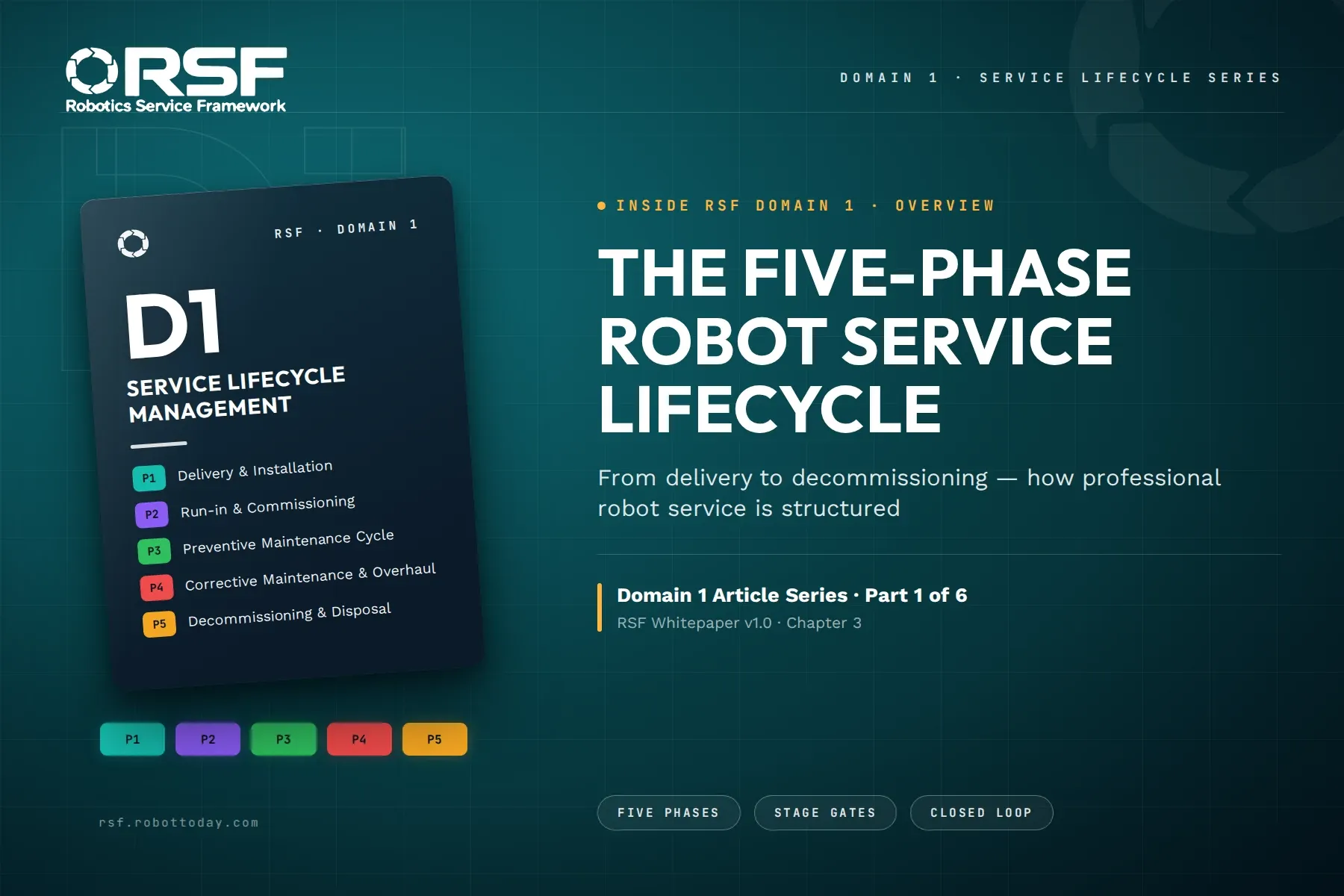
Domain 1 Service Lifecycle Management · Part 1 of 6 | RSF Whitepaper v1.0 · Chapter 3
The value of a robot system is not delivered at a single moment in time. It is delivered continuously across its entire useful life — from the day it is unboxed to the day it is decommissioned. This judgment is the starting point of RSF Domain 1 Service Lifecycle Management, and it is what separates lifecycle management from a traditional equipment-maintenance manual.
With the release of RSF Whitepaper v1.0, Chapter 3 makes the first systematic attempt to define what professional service lifecycle management looks like for industrial robots: five sequential phases, enforced transition gates, a documentation architecture built around comparison baselines, and a closed-loop mechanism that turns individual fault events into systemic improvement.
This article — the first in a six-part series — introduces the structure of Domain 1 and answers the question every standards-literate reader will ask first: how does this relate to ISO 55001, ISO 10218, and the other frameworks the industry already uses?
The Five-Phase Model at a Glance
RSF defines the robot service lifecycle as five sequential phases. Each phase has an explicit service objective, a defined value output, a principal risk focus, and — critically — entry and exit conditions that determine when a system may move to the next phase.
| Phase | Name | Core Service Objective | Principal Risk Focus |
| P1 | Delivery & Installation | Safely and accurately complete the full process from unboxing to power-on readiness | Installation error; wiring error; omitted safety-function verification |
| P2 | Run-in & Commissioning | Verify performance against application specifications; establish traceable accuracy and parameter baselines | Lifetime erosion from improper parameter configuration; residual integration defects |
| P3 | Preventive Maintenance Cycle | Convert random fault risk into planned maintenance activity | PM strategy mismatched to operating intensity; overlooked wear parts |
| P4 | Corrective Maintenance & Overhaul | Restore or enhance performance through targeted repair; extend effective asset life | Over-maintenance; missing safety re-verification after overhaul |
| P5 | Decommissioning Assessment & Disposal | Close the asset lifecycle safely and compliantly on combined technical-economic assessment | Non-compliant hazardous-material disposal; incomplete data erasure |
Two structural features distinguish this model from a conventional maintenance-planning document.
First, phase transitions are state-triggered, not time-triggered. RSF calls these Stage Gates: explicit condition sets that must be satisfied before a system moves forward. The transition from Phase 1 to Phase 2, for example, requires a completed and signed safety-function verification report, an archived Initial Parameter Record, and verified wiring identification. The whitepaper is unambiguous about what happens when a gate is not satisfied: stop. Without verified safety functions, dynamic commissioning is forbidden — a direct application of ISO 10218 requirements.
Second, the model treats documentation as diagnostic infrastructure, not administrative overhead. The Initial Parameter Record established at delivery — payload parameters, per-axis current baselines, accuracy baselines, software versions, safety parameters — becomes the reference frame against which every future anomaly is judged. A vibration reading means little in isolation; compared against a commissioning-time baseline, it becomes evidence.
The Closed Loop: Where “Fixing” Becomes “Improving”
Running through the operating phases is a three-tier mechanism the whitepaper calls the Incident Response → Root Cause Analysis → Service Improvement loop. Incident response solves the immediate downtime. RCA — triggered by explicit criteria such as a repeated fault mode within twelve months, unplanned downtime exceeding four hours, or any safety-function failure — prevents recurrence. Service improvement converts the RCA finding into controlled change: a revised PM interval, an updated SOP, a spare-parts policy adjustment, applied not just to the machine that failed but to all equipment of the same model and environment.
The whitepaper's framing is worth quoting in spirit: completing only incident response solves a problem; completing the full closed loop elevates the system. A service organization's maturity is largely measured by how many fault events trigger the full loop instead of stopping at the first tier. |
How Domain 1 Relates to Existing Standards
RSF is explicit that Domain 1 is built on top of — not in place of — the existing standards landscape. The whitepaper names three reference standards for Domain 1 and defines the relationship precisely.
| Standard | What It Provides | What RSF Domain 1 Adds |
| ISO 55001 | Asset lifecycle management framework: requires organizations to establish a maintenance strategy and track asset status | Defines who executes that strategy, the phase model it follows, and how execution quality is documented and assessed |
| ISO 10218 (2025) | Safety requirements for industrial robots and integration; requires maintenance by “competent persons” | Defines the competence tiers, the stage-gate discipline that enforces safety verification, and the LOTO and re-verification procedures that operationalize the requirement |
| ISO 45001 | Occupational health and safety management baseline | Embeds OH&S requirements into phase-specific procedures: LOTO establishment at installation, safety re-verification after overhaul, controlled energy isolation at decommissioning |
This is the three-layer nesting model that structures the entire RSF framework: an outer layer of ISO/IEC compliance baseline that sets the floor, a middle layer of RSF framework content that fills the capability gaps, and an inner layer of operational patterns — robotics-native, consistent with how mature service industries (automotive service, IT service management) solved the same problems..
The Global View: How Four Markets Handle the Service Lifecycle
Domain 1's reference standards — ISO 55001, ISO 10218, ISO 45001 — are international. But how each major robotics market operationalizes lifecycle management and maintenance-personnel requirements differs substantially. A comparison across the United States, Japan, China, and Germany — confined strictly to the lifecycle-management scope of Domain 1 — shows four different mechanisms addressing the same underlying problem.
United States: National Adoption Plus a User-Layer Supplement
ANSI/A3 R15.06-2025 is the U.S. national adoption of ISO 10218-1:2025 and 10218-2:2025, replacing the 2012 edition. Its scope spans the robot system lifecycle from installation through operation, maintenance, and decommissioning — from a safety perspective. Notably, the 2025 revision adds a third part, ANSI/A3 R15.06-3-2025 (Use of Industrial Robot Cells), developed in the United States with Canadian input, providing guidance specifically for the users of robot cells — a user-layer document that extends beyond what ISO itself publishes. Like ISO, however, the U.S. framework requires competent maintenance without defining competence tiers, assessment methods, or a certification pathway.
Japan: The Only Market Where Robot Maintenance Education Is Written into Law
Japan is the single most instructive comparison for Domain 1, because it is the only major market where robot maintenance personnel qualification is a statutory requirement. Under the Industrial Safety and Health Act (Article 59), workers engaged in designated hazardous operations must receive special education (特別教育). Article 36 designates two robot-specific categories: item 31 covers teaching operations, and item 32 covers inspection, repair, and adjustment of industrial robots — the exact activities of Domain 1's preventive and corrective maintenance phases. The Ordinance on Industrial Safety and Health (Articles 150-3 to 150-5) adds operational safety requirements for teaching and inspection work. At the standards level, JIS B 8433-1/-2 correspond to ISO 10218-1/-2.
The Japanese case proves two things at once. First, that legislators can and do consider robot service personnel qualification important enough to mandate. Second, that a legal minimum is not a capability framework: the special education requirement is a compliance floor measured in hours of instruction — it does not distinguish an engineer qualified for routine inspection from one qualified to lead an overhaul, and it defines no progression path. The question of tiered capability remains open in the world's most legally advanced market for robot maintenance qualification.
China: State Standards, Market Access, and Lifecycle Assessment in Development
China's national standards system (administered through TC591) has adopted the core international safety standards: GB 11291.1 corresponds to ISO 10218-1, and GB/T 20867.1-2024 requires risk assessment across the robot's full lifecycle — setup, commissioning, teaching, operation, and maintenance. Two lifecycle-specific national standards are in development, including a lifecycle risk-assessment methodology and a lifecycle environmental-impact (LCA) evaluation method. At the policy layer, MIIT's Industrial Robot Industry Standard Conditions (2024 revision) requires enrolled enterprises to maintain deployment, operations, and upgrade service systems and to operate complete after-sales service systems including operator training — service systems must exist, but engineer competency tiers are not defined.
Germany: General Vocational Excellence, No Robot-Service Specialization
Germany's approach to maintenance competence runs through its dual vocational education system — the Mechatroniker qualification produces excellent general electro-mechanical technicians — and through DGUV occupational-safety rules. What Germany does not have is a robot-service-specific competency framework or certification tier: robot service capability is treated as a subset of general mechatronics competence. For Domain 1 purposes, the German case confirms the pattern rather than breaking it.
| Dimension | United States | Japan | China | RSF Domain 1 |
| Core mechanism | ISO adoption (ANSI/A3 R15.06-2025) + user-layer Part 3 | Statutory special education for teaching and inspection/repair | GB adoption + market-access conditions + lifecycle standards in development | Five-phase capability framework + four-tier certification |
| Legal force | Voluntary (OSHA references indirectly) | Mandatory (Industrial Safety & Health Act Art. 59/36) | Mandatory GB + MIIT enterprise conditions | Voluntary |
| Maintenance personnel requirement | “Competent” — undefined | Legally required education — no tiers | Service systems mandated — no tiers | Four tiers with authorization boundaries |
| Lifecycle phase discipline | Safety requirements install→decommission | Teaching/inspection work rules | Full-lifecycle risk assessment required | Stage Gates: state-based transition conditions |
| Decommissioning | Covered in safety scope | Not specifically addressed | Environmental LCA standard in development | Scoring matrix + data-erasure + hazmat procedure |
The pattern across all four markets is consistent, and it is the pattern RSF was built to address: every major robotics market has concluded that robot maintenance matters enough to standardize, legislate, or condition market access on — and no market has built a tiered, lifecycle-spanning service capability framework. The United States adopted the safety standard and extended it toward users. Japan wrote maintenance education into law and stopped at the compliance floor. China mandated that service systems exist and is building lifecycle assessment methods. Germany trusts general vocational excellence. Four mechanisms, one shared gap — the gap Domain 1 fills.
What This Series Will Cover
Over the coming weeks, this series will walk through Domain 1 phase by phase — not as a summary of the whitepaper, but as a working introduction to the concepts a service professional needs before entering the RSF Professional certification course:
Part 2 — Phase 1 and the Initial Parameter Record: why the data captured on installation day determines diagnostic capability for the next decade
Part 3 — Phase 2 and Stage Gates: what commissioning must prove, and why the gate between commissioning and operation is a hard stop
Part 4 — Phase 3: the three-tier preventive maintenance structure and the three PM strategy models
Part 5 — Phase 4 and the closed loop: the eight-step corrective process and how corrective events improve preventive strategy
Part 6 — Phase 5 and lifecycle KPIs: the decommissioning scoring matrix, compliant disposal, and measuring service performance across all phases
Each article maps directly to a section of RSF Whitepaper v1.0 Chapter 3, and to the corresponding module content in the RSF Professional certification course now in preparation.
Read the full Domain 1 specification RSF Whitepaper v1.0, Chapter 3 — the complete five-phase model, stage-gate conditions, documentation specifications, and KPI framework. Free download. |
RSF (Robotics Service Framework) is an initiative of RobotToday.com. International standards cited are referenced for descriptive purposes; the official published text of each standards organization remains authoritative. This article does not constitute a compliance certification document.








Leave a comment