


Introduction: The Submarine in the Harbour
At 16:00 local time on 15 December 2025, a small underwater drone navigated through the heavily defended harbour of Novorossiysk on Russia’s Black Sea coast. Russia had erected floating pontoons and barrier systems across the port entrance specifically to stop Ukraine’s uncrewed surface vessels — the Sea Baby kamikaze boats that had, over the previous three years, driven the Russian Black Sea Fleet from its historical base in Sevastopol. The barriers worked against surface drones. They were not designed for what came next.
Ukraine’s ‘Sub Sea Baby’ — an autonomous underwater vehicle whose full technical specifications remain classified — navigated past those barriers below the surface. It turned through the confined channels of the submarine pen, acquired its target, and detonated against the stern of an Improved Kilo-class submarine: a vessel capable of launching four Kalibr cruise missiles and valued at approximately $400–500 million. The explosion, captured on SBU-hacked port security cameras, was confirmed by satellite imagery from Colorado-based firm Vantor showing blast damage to the pier. Ukraine claimed critical damage; Russia denied it. The physical evidence supported Ukraine.
It was, as defence.info noted in a detailed post-operation analysis, the first successful combat strike by an unmanned underwater vehicle against a submarine in military history. Benjamin Jensen of CSIS framed the strategic question it posed: ‘The real question is how the system got into position undetected and acquired and tracked its target.’ For naval planners from Washington to Beijing to London, that question now has no reassuring answer.
Sources: Naval News, December 2025; The War Zone, December 2025; CNN / NBC News / Defense News, December 2025; Defense.info, December 2025; CSIS via NBC News
$5.3B Navy FY2026 unmanned request (+70% YoY) | $1.7B Autonomous USV allocation | $734M UUV allocation | $392M Saronic Corsair production contract | < 12 mo Corsair prototype-to-production timeline |
I. Ukraine’s Maritime Drone Campaign: Three Years, One Fleet Displaced
To understand the current state of autonomous maritime systems, it is necessary to understand what Ukraine accomplished with almost nothing. When Russia launched its full-scale invasion in February 2022, Ukraine had no functional navy to speak of — the bulk of its surface fleet had been captured or scuttled during Russia’s 2014 seizure of Crimea. What it did have was engineers, desperation, and an extraordinary willingness to iterate fast and fail cheap.
The Sea Baby Surface Campaign (2022–2025)
Ukraine’s first Sea Baby uncrewed surface vessels — jet-ski-sized kamikaze boats loaded with explosives — appeared in operational use in October 2022, when they attacked Sevastopol harbour in a coordinated strike that damaged the frigate Admiral Makarov. Over the following three years, the campaign escalated from single-vessel harassment into a systematic effort to make Crimean ports untenable for the Russian Black Sea Fleet. The Rostov-on-Don, an Improved Kilo submarine, was severely damaged in a combined missile and USV attack on Sevastopol in September 2023. By 2024, Russia had been forced to withdraw the bulk of its Black Sea Fleet from Crimea to Novorossiysk — a port 350 kilometres further from Ukrainian territory, located inside Russia itself.
By the end of 2025, Sea Baby USVs had also begun targeting Russia’s shadow-fleet tankers in the Black Sea: the Virat and Kiaros were disabled on 28 November, and the Dashan was struck on 10 December, disrupting Russia’s oil-smuggling operations and demonstrating that the campaign had evolved from anti-naval to economic warfare.
The Sub Sea Baby: The Underwater Escalation
The December 2025 Novorossiysk strike was not merely a tactical development — it was a doctrinal one. Russia had adapted its port defences against surface drones. Ukraine’s response was to go underwater. The Sub Sea Baby appears to operate as an autonomous torpedo: guided to the general vicinity of a target via pre-programmed waypoints, then switching to its own guidance for terminal approach. This architecture would explain how it navigated the confined, multi-turn channel of the Novorossiysk submarine pen without real-time human input — a form of guidance that, in a jamming-contested environment, is more reliable than radio-link control.
The SBU’s statement differentiated clearly between the surface Sea Baby and the underwater Sub Sea Baby, suggesting the latter is a distinct developmental programme. Its technical specifications remain deliberately classified. What is known is its operational effect: Russia lost one of four Kalibr-carrying submarines at Novorossiysk, in a port previously considered a strategic sanctuary. The Black Sea Fleet now has no safe harbour.
Ukraine’s Brave1 programme has also published designs for a family of dedicated military UUVs: the TLK-150, TLK-400 (4–6 metres), and TLK-1000 (up to 12 metres, four thrusters). The direction of travel is toward larger, longer-range, higher-payload underwater systems — the same trajectory that DARPA, Boeing, and the U.S. Navy are following on the other side of the Atlantic, but at a fraction of the cost and on a timeline compressed by active war.
Sources: Naval News, December 2025; The War Zone, December 2025; Defense.info, December 2025; Wikipedia UUV article; Army Recognition, December 2025
II. Saronic Technologies: Prototype to Production in Under 12 Months
The most significant single event in U.S. autonomous surface vessel procurement in 2025 was not a weapon test or a fleet exercise. It was a contract announcement at the Reagan National Defense Forum on 8 December 2025, when Secretary of the Navy John Phelan posted on X: ‘Prototype to production in under 12 months. The Saronic OTA proves how we’ll build a hybrid manned–unmanned Fleet: open competition, real contracts, real hardware for Sailors and Marines, not slides. This is now the standard.’
The Company and the Corsair
Saronic Technologies, founded in Austin, Texas in 2022 by military and technology veterans, has built its entire operational model around rapid maritime innovation and in-house manufacturing. It operates as a software-driven company that also builds ships: all vessels share a unified autonomy stack, enabling mission profiles to be updated through software rather than hardware modification. The company has purchased multiple drone manufacturing facilities across the U.S. and, in late 2025, acquired a shipyard from Gulf Craft in Franklin, Louisiana, which it is now expanding by 300,000 square feet in a project expected to create approximately 1,500 jobs.
The Corsair — a 24-foot modular autonomous surface vessel capable of carrying 1,000 pounds over 1,000 nautical miles at 35-plus knots — was originally developed for the Pentagon’s Replicator initiative. The $392 million production OTA, with $200 million obligated at award, covers multiple production batches for delivery by mid-2031 and represents the fastest prototype-to-production timeline for a U.S. naval vessel in modern procurement history.
The Full Fleet: From Spyglass to Marauder
Saronic now offers a fleet of eight autonomous surface vessels ranging from the six-foot Spyglass collaborative ASV to the 180-foot Marauder, its flagship logistics platform. The Marauder can carry 150 metric tonnes of payload over 4,100 nautical miles at a maximum load, or 25 tonnes over 5,400 nautical miles at a 12-knot cruise with optional 25-knot sprint. Saronic completed the hull flip of its first Marauder at the Franklin facility in December 2025, with a second in production reporting a 25 percent efficiency gain over the first, and a third — incorporating an evolved 180-foot design — planned for construction from January 2026.
The Mirage (40 feet) and Cipher (60 feet) sit in the mid-range of the fleet, providing scalable options between the Corsair’s strike and ISR roles and the Marauder’s logistics and multi-domain mother-ship capability. The vision articulated by Saronic co-founder Doug Lambert is ultimately commercial as well as military: autonomous vessels operating maritime supply chains. For now, the military is the primary customer — and the Pacific theatre the primary rationale.
Saronic’s Funding Trajectory
Saronic raised a $175 million Series B in July 2024 at a $1 billion valuation, led by Andreessen Horowitz. Sacra equity research estimated Saronic’s early 2026 funding round talks at a valuation representing approximately 38 times 2025 revenue, reflecting the premium investors are placing on companies that can actually deliver hardware at the speed DoD leadership is demanding. The comparison with Anduril is instructive: both companies are software-first, manufacturing-integrated, and explicitly positioning themselves as the replacement for the legacy prime contractor model in their respective domains.
Sources: Naval News, December 2025; Defense Post, December 2025; DefenseScoop, August 2025; WorkBoat, December 2025; gCaptain, December 2025; Sacra equity research, February 2026
“The Navy isn’t admiring problems from the sidelines, we’re moving at war-footing speed. With Saronic, we went from prototype to production in under a year. That’s rapid innovation, real competition, and combat power in sailors’ and marines’ hands, not on PowerPoints.”
— Secretary of the Navy John C. Phelan, Reagan National Defense Forum, December 2025
III. The U.S. Navy’s Unmanned Maritime Programmes: A $5.3 Billion Bet
The FY2026 budget request marks a structural inflection point in U.S. naval unmanned investment. Total Navy unmanned systems spending rises to $5.3 billion — up $2.2 billion, or 70 percent, from FY2025. The breakdown signals where the service believes the capability gaps are most urgent: $1.7 billion for autonomous USVs, $1.2 billion for autonomy software across all platforms, and $734 million for UUVs. Pentagon autonomy spending across all services totals $13.4 billion — the first year it has been called out as its own budget line.
The MASC Programme: Non-Exquisite by Design
In 2025, the Navy merged its Large Unmanned Surface Vessel (LUSV) and Medium Unmanned Surface Vessel (MUSV) programmes into a single new programme: the Modular Attack Surface Craft (MASC). The consolidation reflects a deliberate philosophical shift. The Navy’s stated priority for MASC is a vessel that is ‘non-exquisite,’ adheres to commercial standards, and will be easy to build and repair in large numbers. Captain Matthew Lewis, the Navy’s programme manager for unmanned systems, has described the MASC as a marked departure from previous large-USV visions: the goal is to use the Defence Innovation Unit’s stripped-back requirements process — a ‘narrative explanation of the problem’ rather than prescriptive specifications — to attract commercial solutions that can actually be built fast.
A prototype production contract was targeted for early FY2026. The procurement language mirrors what worked with Saronic’s Corsair: open competition, Other Transaction Authority contracting, and hardware delivery as the success metric.
Mine Countermeasure USVs: A Quiet Success
Among the least-publicised but most operationally mature of the Navy’s unmanned maritime programmes is its mine countermeasure USV fleet. Bollinger Shipyards is building MCM-USVs that will replace the Navy’s retiring Avenger-class minesweepers and MH-53E helicopters, carrying minesweeping payloads from Textron and mine-hunting payloads from Raytheon. These vessels are the Navy’s first non-prototype Programme of Record for unmanned surface vessels, with up to 18 planned. They represent exactly the kind of dull, dangerous, and dirty mission — operating in mined waters to clear paths for manned ships — that autonomous platforms are best suited to take over from humans.
The Experimentation Problem
Inside Unmanned Systems, in its November 2025 analysis of the FY2026 budget, delivered the most precise diagnosis of the Navy’s structural challenge: ‘The Navy is eagerly testing USVs and UUVs, but its love of experimentation is failing to transition platforms to large-scale operational capabilities — a tendency which chafes current DoD leadership with its materialist emphasis on platforms delivered rather than experiments conducted.’
The Saronic contract is the most visible attempt to break that pattern. But the broader programme landscape — multiple overlapping prototype efforts, a newly merged MASC programme still seeking its first production contract, and UUV programmes at various stages of development — suggests that the experimentation culture remains the dominant mode, even as the operational urgency of the Pacific theatre demands a different one.
Sources: Inside Unmanned Systems, November 2025; DefenseScoop, June 2025 (FY2026 budget briefing); CRS Report R45757, January 2026; DefenseScoop, April 2025 (CAMP)
U.S. Navy FY2026 Unmanned Systems Budget Breakdown
| Budget Line | FY2026 Request | Notes |
| Total Navy Unmanned Systems | $5.3 billion | +$2.2B (+70%) vs FY2025 |
| Autonomous USVs | $1.7 billion | Includes MASC programme & Saronic OTA |
| Autonomy Software (cross-platform) | $1.2 billion | Central autonomy stack, JADC2 integration |
| Unmanned Underwater Vehicles | $734 million | Orca XLUUV ($113M), CAMP, LDUUV R&D |
| MQ-25 Stingray (UAV) | $1.04 billion | First 3 LRIP aircraft + R&D |
| Orca XLUUV (procurement) | $113 million | 1 unit/year rate through FY2029 |
| Project Liberator (containerised torpedo launcher) | $50 million | For USV/UUV deployment |
IV. The UUV Competition: From Manta Ray to CAMP
While surface vessels have dominated the near-term maritime unmanned news cycle, the undersea domain is where the most consequential long-term competition is playing out. The U.S. Navy’s UUV strategy spans four distinct tiers — from small sub-launched vehicles to extra-large pier-deployed platforms — and is being pursued through multiple parallel programmes at different stages of maturity.
Boeing Orca XLUUV: The Troubled Workhorse
Boeing’s Orca Extra-Large Unmanned Underwater Vehicle — an 85-foot, 50-tonne diesel-electric robot submarine capable of autonomous operations for months at ranges of up to 7,500 nautical miles — arrived in Navy hands in December 2023, three years late and $242 million over its original $274 million contract value. Risk-reduction testing off Southern California commenced in March 2024. The Navy is procuring Orcas at one per year through FY2029 at approximately $113–120 million per unit.
The Orca’s primary planned mission is to covertly deploy the Hammerhead mine — a seabed-tethered weapon armed with an anti-submarine torpedo — in contested waters that would be too dangerous to enter with manned submarines. Its modular payload section can accommodate 8 tonnes of alternative payloads for anti-surface, electronic warfare, or strike missions. The programme’s delays and cost overruns illustrate the same procurement pathology that has afflicted the RCV on land: complex platform development within institutional acquisition structures not designed for rapid iteration.
DARPA Manta Ray: Towards Unlimited Endurance
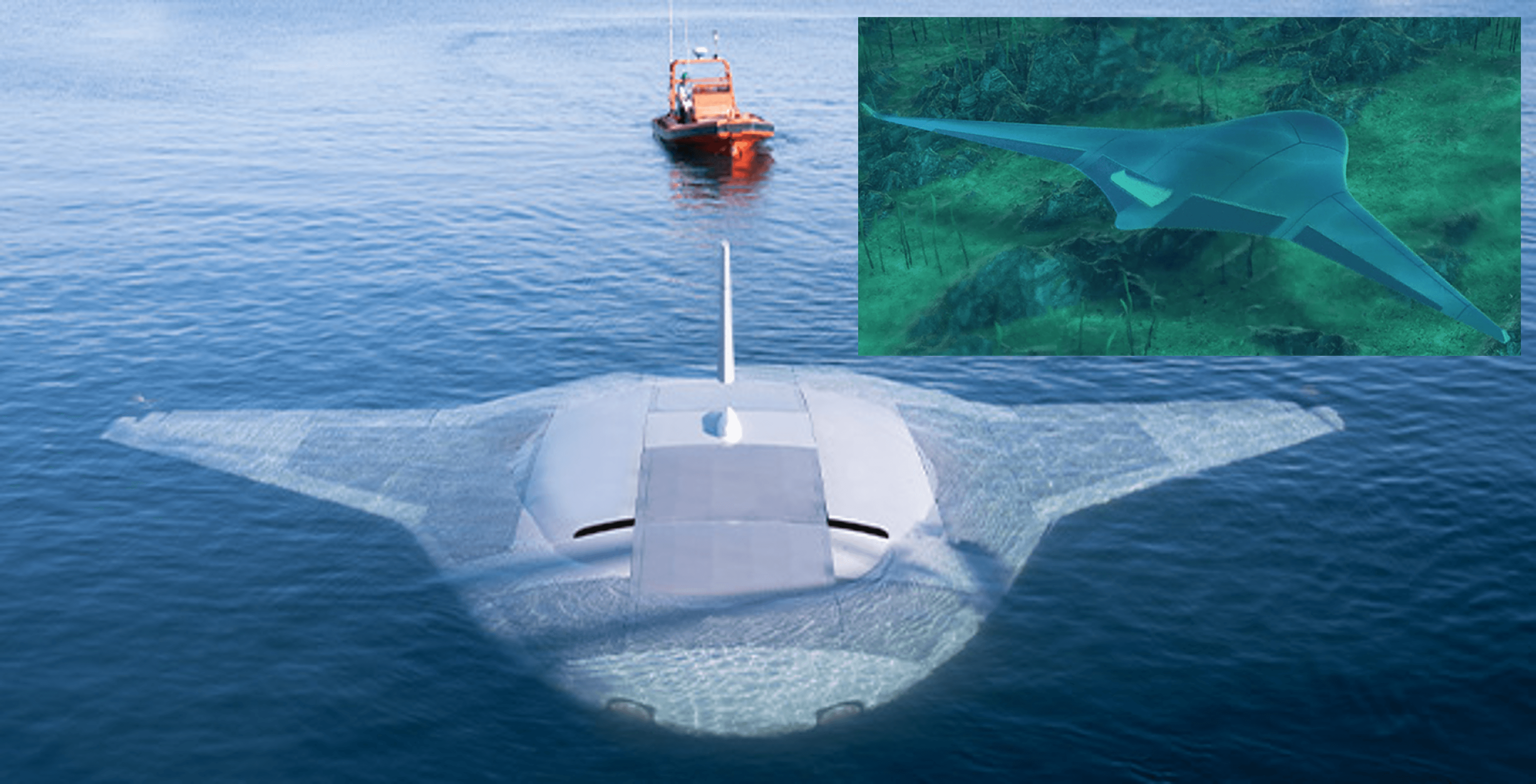
DARPA’s Manta Ray programme, led by Northrop Grumman, represents a different class of ambition: an extra-large UUV designed not merely to operate for months, but potentially for near-unlimited durations through undersea energy harvesting. The Manta Ray prototype completed full-scale in-water testing off Southern California in February and March 2024, demonstrating submerged operations using all three propulsion and steering modes: buoyancy, propellers, and control surfaces. ‘Our successful, full-scale Manta Ray testing validates the vehicle’s readiness to advance toward real-world operations,’ said DARPA programme manager Dr Kyle Woerner.
The Manta Ray’s key innovations are: modular construction enabling cross-country transport and field assembly without pier infrastructure; multi-mode propulsion including variable buoyancy for energy-efficient gliding; and a ‘Mission Unlimited’ seabed anchoring and energy harvesting concept that would allow the vehicle to hibernate on the seafloor and recharge from ocean thermal gradients — in principle enabling indefinite deployment. A second performer, PacMar Technologies, is continuing parallel testing of its own energy harvesting system. DARPA is in active discussions with the Navy on transition to operational use.
DIU CAMP: The Combat UUV Solicitation
The most strategically significant UUV procurement signal of 2025 was the Defence Innovation Unit’s Combat Autonomous Maritime Platform (CAMP) solicitation, issued in April 2025. CAMP seeks something qualitatively different from the Orca and Manta Ray programmes: combat-capable autonomous underwater vehicles armed with heavyweight torpedoes, pier-launched, with an order-of-magnitude increase in size and range over existing Large Displacement UUV prototypes.
A DIU spokesperson described the distinction precisely: ‘Think of LDUUV as a sprinter van and CAMP as a moving truck.’ LDUUV prototypes were awarded to Anduril Industries, Oceaneering International, and Kongsberg Discovery in February 2024; the CAMP solicitation builds on that foundation with larger platforms specifically designed for offensive subsea and seabed warfare. The Navy is also pursuing Project Liberator, a $50 million programme to develop containerised undersea torpedo launchers suitable for deployment from USVs and UUVs — extending the offensive reach of unmanned maritime platforms to heavyweight anti-ship and anti-submarine weaponry.
Anduril Copperhead: The Loitering Munition UUV
In April 2025, Anduril Industries announced the Copperhead family of autonomous UUVs, which explicitly includes a loitering munition variant — a one-way-attack underwater drone designed to autonomously prosecute underwater targets. The Copperhead family extends Anduril’s Lattice autonomy software into the undersea domain, enabling UUV coordination through the same command architecture used for its counter-drone and CCA platforms. It also represents the most direct U.S. commercial equivalent to Ukraine’s Sub Sea Baby: a small, expendable, autonomous underwater weapon.
Sources: DefenseScoop, May 2024 and April 2025 (CAMP); DARPA Manta Ray programme page; Naval Technology (Orca); Inside Unmanned Systems, November 2025; Wikipedia UUV; DIU LDUUV announcement, February 2024
V. The Global Autonomous Maritime Race
The maritime autonomous systems competition extends well beyond the Black Sea and the Pentagon’s acquisition office.
China: Volume, Range, and Strategic Ambition
China’s People’s Liberation Army Navy (PLAN) has invested heavily in UUV and USV development under the civil-military fusion framework. In May 2025, naval analysts photographed what appeared to be a large armed UUV — potentially the UUV-300 design capable of hosting torpedoes, missiles, and mines — being transported under wraps in China, suggesting an advanced-development or production stage programme. China’s UUV strategy is primarily ISR-oriented: Sea Wing (Haiyi) gliders have been recovered in Indonesian and Pacific waters, documenting oceanographic data collection on submarine routes. The PLAN is also developing USV swarm concepts and has demonstrated coordinated USV-UAV operations in exercises.
China’s Type 076 Sichuan amphibious assault ship — launched in 2024 — is specifically designed to operate mixed USV-drone-manned air wings, incorporating a catapult launch system for unmanned aircraft alongside a well deck for surface and underwater unmanned systems. It is the clearest single expression of China’s multi-domain autonomous maritime doctrine in a production platform.
Australia: Ghost Shark and the Indo-Pacific Posture
Anduril Industries’ Ghost Shark extra-large UUV, developed in Australia in partnership with the Australian Department of Defence, is designed specifically for long-range Indo-Pacific operations: extended-range ISR, intelligence collection, and modular payload delivery in the vast distances between islands and contested chokepoints. It represents the most direct Five Eyes equivalent to the Orca XLUUV and is further evidence that the autonomous underwater competition is becoming a coalition capability, not merely a bilateral U.S.–China one.
Europe: Mine Hunting and the Undersea Infrastructure Gap
European navies have focused their autonomous maritime investment on mine countermeasures, given NATO’s historical reliance on the Baltic and North Sea approaches. The UK’s Project Cetus UUV, France’s autonomous mine hunting programmes, and NATO-wide exercises integrating USV-UUV-UAV sensor networks through 5G mesh communications reflect a defensive orientation shaped by proximity to Russia’s Baltic Fleet. The December 2024 sabotage of undersea communications cables in the Baltic Sea — attributed by NATO members to Russian-affiliated actors — has dramatically elevated the priority of undersea infrastructure protection as a UUV mission set, with European navies now explicitly considering seabed warfare as an operational domain requiring unmanned persistent surveillance.
Sources: Wikipedia UUV article; Army Recognition; NATO 5G UUV exercise reporting; WorkBoat, December 2025
Key Autonomous Maritime Platforms: 2025–2026 Landscape
| Platform | Type | Country | Size / Endurance | Primary Mission | Status |
| Saronic Corsair | USV | USA | 24ft / 1,000nm | Strike, ISR, MDA | $392M OTA, production 2025 |
| Saronic Marauder | USV | USA | 180ft / 4,100nm | Logistics, multi-domain | Hull flip complete Dec 2025 |
| Saronic Cipher | USV | USA | 60ft / undisclosed | Strike, EW, ISR | Prototype stage 2025 |
| MASC (LUSV/MUSV merged) | USV | USA | Patrol craft-size | Weapons + sensors | Proto contract FY2026 |
| MCM-USV (Bollinger) | USV | USA | Patrol craft | Mine countermeasures | Programme of Record |
| Boeing Orca XLUUV | UUV | USA | 85ft / 7,500nm | Mine deploy, strike, ISR | 1/yr FY2026–2029 ($113M ea) |
| DARPA Manta Ray | UUV | USA | Extra-large / unlimited (goal) | Long-endurance persistent ISR | Sea trials complete 2024; Navy transition talks |
| Anduril Copperhead | UUV | USA | Small / expendable | Loitering munition, USW | Announced April 2025 |
| DIU CAMP | UUV | USA | Very large / long-range | Combat, heavyweight torpedo | Solicitation April 2025 |
| Ukraine Sea Baby | USV | Ukraine | Jet-ski scale | Kamikaze strike, tanker attack | Operational 2022–present |
| Ukraine Sub Sea Baby | UUV | Ukraine | Unknown | Autonomous torpedo, sub strike | Combat debut Dec 2025 |
| Anduril Ghost Shark | UUV | Australia | Extra-large / Indo-Pacific | Long-range ISR, payload | Development ongoing |
| China UUV-300 (probable) | UUV | China | Large / undisclosed | Torpedo, missile, mine deploy | Possible production 2025 |
VI. The Strategic Implications: What the Black Sea Taught the World
Ukraine’s maritime drone campaign has generated a body of operational lessons that every navy on earth is now studying. They can be stated concisely.
First: a low-cost autonomous surface fleet can deny sea control to a conventional navy. Russia’s Black Sea Fleet is the most capable naval force ever driven from its home port by unmanned systems operated by a country with no blue-water navy. The Sea Baby campaign was not a lucky tactical success — it was a systematic strategic operation executed with commercial technology, improvised autonomy, and extraordinary operational creativity.
Second: port defences calibrated for one type of unmanned threat will be penetrated by the next. Russia’s barrier systems stopped surface drones. Ukraine went underwater. This adaptation cycle — which in conventional procurement terms takes years — is happening in Ukraine on a timescale of months. The lesson for any navy relying on static harbour defences is that they are investments in fighting yesterday’s drone, not tomorrow’s.
Third: the cost asymmetry in the maritime domain is at least as severe as in land and air. A Kilo-class submarine costs $400–500 million. An autonomous torpedo that can disable it costs, by available inference, a small fraction of that. The Kalibr cruise missiles that submarine can launch cost approximately $6.5 million each. The exchange rate favours the autonomous attacker.
Fourth: the Pacific is not the Black Sea, and the distances involved require a different scale of platform. Ukraine’s Sea Babies operate over tens of kilometres; the Pacific theatre demands thousands. The Marauder’s 4,100-nautical-mile range, the Orca’s 7,500-mile endurance, and the Manta Ray’s theoretical unlimited duration are all responses to this geographic reality. The strategic competition in autonomous maritime systems will ultimately be decided not in the Black Sea but in the Western Pacific, and the platforms capable of operating there are still in development.
Sources: Defense.info, December 2025; Naval News, December 2025; Inside Unmanned Systems, November 2025
Key Sources & Expert References
Naval News: ‘Saronic Wins Contract for Corsair Autonomous Surface Vessel Production,’ December 2025 — navalnews.com
Naval News: ‘Ukraine Strikes Russian Submarine with Sub Sea Baby Drone,’ December 2025 — navalnews.com
The War Zone: ‘Ukraine Claims World’s First Underwater Drone Attack on Russian Submarine,’ December 2025 — twz.com
The War Zone: ‘Aftermath of Ukraine’s Underwater Drone Attack Seen in Satellite Imagery,’ December 2025 — twz.com
Defense News / Elisabeth Gosselin-Malo: ‘Ukraine’s First Underwater Drone Strike Caught on Hacked Cameras,’ December 2025 — defensenews.com
Defense.info: ‘Ukraine’s Sub Sea Baby Strike: A Strategic Inflection Point,’ December 2025 — defense.info
DefenseScoop: ‘Navy Moves to Buy Autonomous Maritime Drones from Saronic via $392M OTA,’ August 2025 — defensescoop.com
DefenseScoop: ‘DoD FY2026 Budget Request: Autonomy and Unmanned Systems,’ June 2025 — defensescoop.com
DefenseScoop: ‘DIU Soliciting Industry for Supersized Underwater Drones (CAMP),’ April 2025 — defensescoop.com
Inside Unmanned Systems: ‘Report: What Unmanned Systems is America’s Military Buying in 2026?’ November 2025 — insideunmannedsystems.com
WorkBoat: ‘Saronic Awarded $392 Million Navy Contract’ and ‘Uncrewed Ships Coming to an Ocean Near You,’ December 2025 — workboat.com
gCaptain: ‘U.S. Navy Awards Saronic $392M Contract in Under-12-Month Turnaround,’ December 2025 — gcaptain.com
DARPA: Manta Ray UUV Prototype Completes In-Water Testing, May 2024 — darpa.mil
Defense-Update / Army Recognition: Orca XLUUV programme; Manta Ray programme, 2024 — defense-update.com, armyrecognition.com
Congressional Research Service: ‘Navy Large Unmanned Surface Vessels (USVs),’ R45757, January 2026 — congress.gov
Sacra equity research: Saronic Technologies, February 2026
DIU: ‘U.S. Navy Selects Vendors for Unmanned Undersea Vehicle Program (LDUUV),’ February 2024 — diu.mil
Related Articles:
8 FUTURE WARFARE | The Geopolitical Competitive Landscape
7 FUTURE WARFARE | The Swarm Revolution - Decentralised, Resilient, and Too Numerous to Stop
4 FUTURE WARFARE | Sea - Autonomous Surface Vessels & Unmanned Underwater Vehicles — The Hybrid Fleet Takes Shape
3 FUTURE WARFARE | Land - Unmanned Ground Vehicles — From Logistics Mules to Front-Line Robots









Leave a comment