


Lowering the Barrier to AI and Robotics: A Conversation with DFRobot Founder Ricky Ye
Introduction:
Today, using AI tools like ChatGPT is as simple as typing a sentence—interacting with advanced intelligence feels as natural as having a conversation. But what about building a robot? When will it become just as easy?
Ricky Ye, founder of DFRobot and a PhD in Robotics Engineering from the University of Nottingham, has spent the past fifteen years tackling this very challenge: how to lower the traditionally high barriers to entry in robotics, enabling people without deep technical backgrounds to build their own robots that can move, act, and even perceive and make decisions.
“I first realized that ‘barriers to entry’ were a real problem when I was doing my PhD at the University of Nottingham,” Ricky Ye recalls.
“I had always wanted to build my own robot since I was a kid. During my PhD, I started working on one in my spare time, but I quickly got stuck at the very first step—I needed an ultrasonic sensor.
At that time, importing one cost more than £100, and a single robot would require six of them. As a student, that was simply unaffordable. So I decided to build one myself.
Over three months, I repeatedly tested and debugged my setup, exchanged ideas with people on online forums, and eventually made a working ultrasonic sensor.”
That experience stayed with him. A single, low-level component had nearly brought an entire PhD-level project to a halt. It led him to a broader realization: for passionate young students, interdisciplinary engineers, and even artists around the world, how many brilliant ideas never get off the ground—simply because the first step is blocked by the complexity and cost of underlying hardware? It was this question that ultimately became the starting point for DFRobot.
Three Shifts in AI for Education: From Rules to Learning Systems
“Later, I realized that this ‘barrier’ wasn’t just about hardware cost—it was closely tied to the stage of development of AI itself,” Ye says. “If you look at it over time, AI in education has gone through several clear transitions.” In his view, this reflects not just technical evolution but also how we define intelligence.
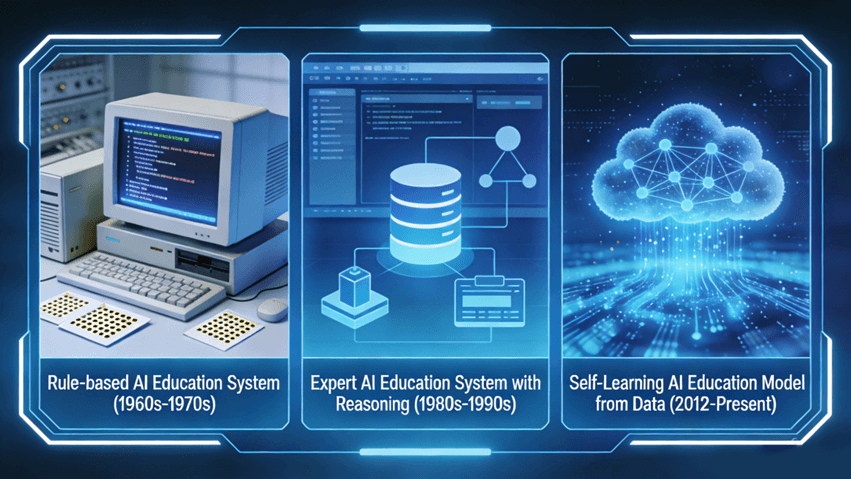
In the 1960s and 1970s, systems like SCHOLAR relied on predefined rules. “At that stage, it was about encoding a teacher’s expertise into rules and letting the machine execute them step by step.” These systems followed fixed paths and failed outside predefined scenarios.
In the 1980s and 1990s, expert systems introduced reasoning. “It started to feel somewhat intelligent, but the knowledge system still had to be fully built by humans in advance,” Ye explains.
“The real turning point came after 2012,” he notes, referring to AlexNet’s breakthrough. “Models began learning directly from data rather than relying on manually defined features.” This shift made AI far more effective in dealing with real-world complexity—and quickly pushed it into practical use.
“From Gradescope to Coursera to today’s generative AI, it’s all part of the same trajectory,” Ye points out. “AI is no longer just executing—it is beginning to understand and generate, but the barrier to using it has also increased.”
Making Robots Easier to Build
Facing the challenge of “not being able to get started,” Ye returned to China in 2008 to found DFRobot. Instead of building proprietary, closed-source kits, he chose to rethink how robots are developed from the ground up.
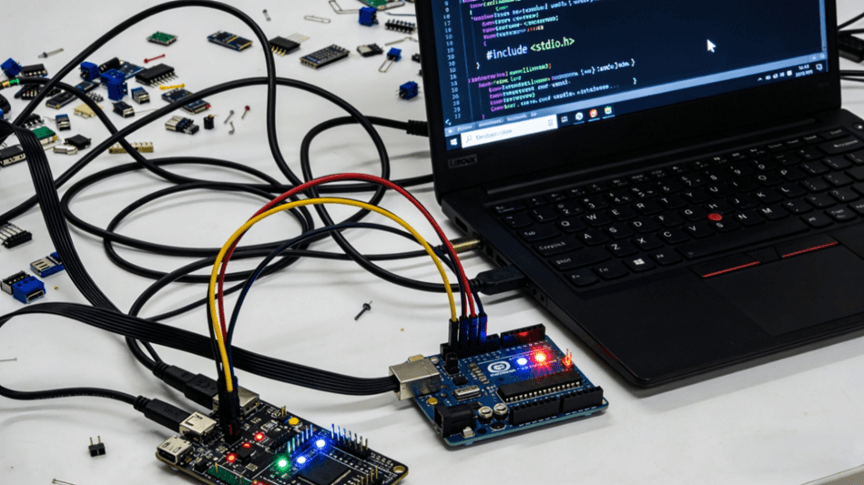
At the time, developing a robot meant starting from scratch—circuit design, driver development, and mechanical structure. Projects could take years, with uncertainty at every stage. For beginners, the biggest obstacle was not a lack of ability, but not knowing where to start. Based on this, the team rethought the development approach from the ground up.
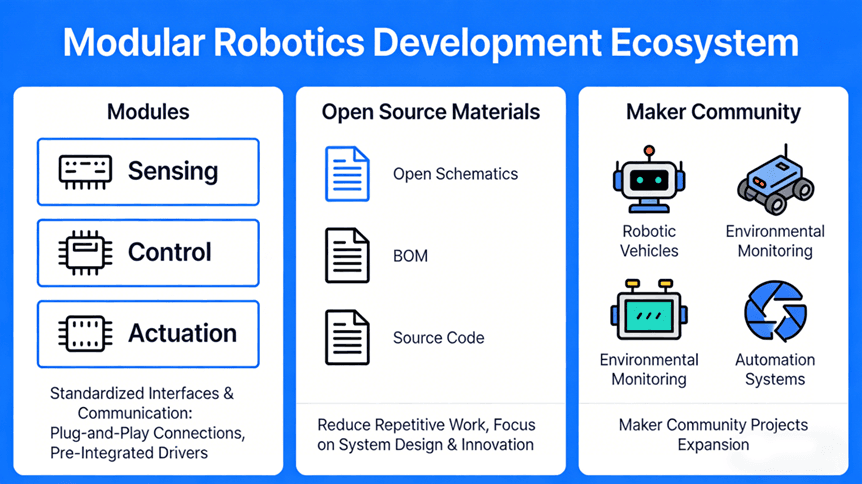
On one hand, they modularized sensing, control, and actuation, with standardized interfaces and communication methods—including plug-and-play connections and pre-integrated drivers—to reduce the complexity of low-level hardware and protocols.
On the other hand, they made schematics, BOM, and source code open. This reduced repetitive work and allowed developers to focus on system design and real application innovation, instead of rebuilding the same components.
As these foundations took shape, a maker community began to form. Projects expanded from simple robotic vehicles to environmental monitoring and automation systems.
“We don’t want developers to spend their time repeatedly debugging low-level circuits,” Ye explains. Guided by this philosophy, DFRobot developed the Gravity series into a comprehensive library of hundreds of standardized modules, significantly lowering the barrier to building functional systems.
Today, more than 300,000 makers and developers across over 170 countries and regions are using DFRobot’s open-source hardware. The value DFRobot creates lies not in any single technological breakthrough, but in making the very act of building systems replicable and scalable.
Making AI Easier to Use: From Complex Setup to Simple Interaction
The rise of deep learning brought robots new capabilities in perception and understanding—but it also raised the barrier to entry.
“If a student wants to build a small vehicle that can recognize faces, they have to go through a full pipeline: learning Python, using computer vision libraries, handling datasets, training models, and deploying them,” Ye explains. “This involves not just algorithms, but also engineering challenges like environment setup, dependency management, and compute constraints.”
At the time, the industry mainly offered two approaches: cloud-based APIs and high-end development kits. The former depended on network connectivity, while the latter was costly—neither worked well for beginners.
Based on this, the HUSKYLENS team defined a clear direction: AI needed to run locally to reduce reliance on networks and latency, while the interaction had to be simplified to avoid complex setup.
This led to the AI vision sensor. Users can train and run models through simple interaction, without writing code. “The hardest part is not building the algorithm, but hiding the complexity,” Ye says. Instead of exposing parameters, the team relied on pre-trained models and fixed configurations to ensure stable, out-of-the-box performance.
This design answers a key question: what do first-time AI users actually need? “It’s not the math behind neural networks, but the moment of surprise when you teach a machine to do something for the first time,” Ye says. The strongest feedback didn’t come from engineers, but from people who once felt far from technology—like artists building interactive installations.
“For millions of makers, the first step is not understanding—it’s experience.” Ye recalls.
From Using AI to Building Your Own Models
By 2023, things began to change again. The rapid rise of large language models (LLM) showed more people what AI could be capable of—and for makers around the world who had gotten started with HUSKYLENS, simply being able to use it was no longer enough.
Ye observed that some makers started asking deeper questions: “I can get it to recognize my face—but how exactly is it doing that? And if it gets it wrong, can I correct it myself?”
In his view, these questions point to a more fundamental shift. Once makers cross the threshold of being able to use a technology, they naturally begin to want to understand it. They are no longer satisfied with operating a black box—they want to become people who can intervene in it, improve it, and even create it.
The launch of HUSKYLENS 2 was a direct response to this need. Its most important change is that it allows users to train models from scratch. Instead of relying on a pre-built “black box,” users can now collect their own data, train their own models, and deploy them—participating in the full lifecycle of an AI system.
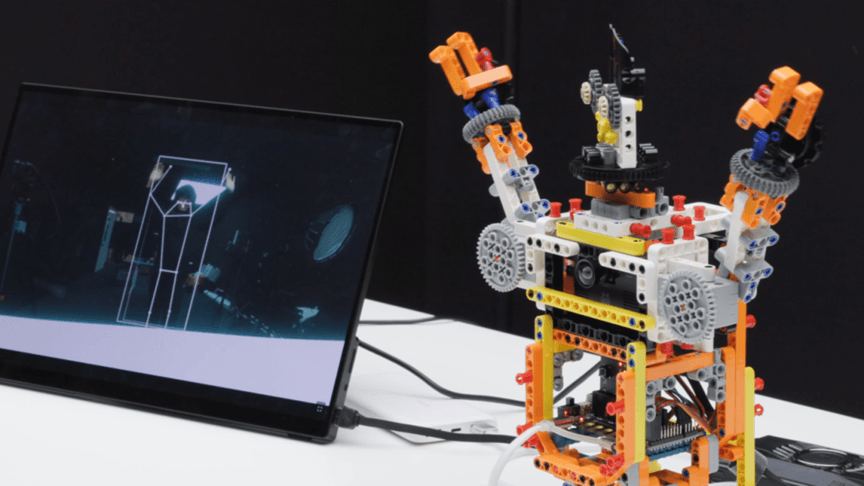
When the recognition accuracy is only 70%, users can analyze the errors, add more training samples, retrain the model, and improve it to 90%—by their own hands. As one maker put it after trying it: “It used to be a magic box. Now I can build the box myself.”
Ye believes this shift is significant. It transforms makers from “users” into “creators”—they are no longer just looking into the system from the outside, but stepping inside and engaging directly with how it works.
Reconstructing the Physical World with AI
At the end of the interview, Ye spoke about an exciting turning point the entire industry is now facing.
Today, AI has become a critical bridge between abstract ideas and physical hardware. As the powerful reasoning and planning capabilities of large language models (LLMs) converge with DFRobot’s mature ecosystem of open-source sensing and actuation modules, the barrier for individual developers to explore embodied AI is being significantly lowered. “We can not only use AI to generate control logic, but also directly embed it into physical structures. This represents a new kind of AI-assisted capability for ‘physical reconfiguration.’”
“The keyboard is an extension of thought, but the screwdriver is where change begins,” Ye emphasized. In the age of AI, the ultimate purpose of technology education is no longer to train people to adapt to a predefined digital world, but to empower them to reshape the physical environment with their own hands and tools—so that even the most imaginative ideas can take root and come to life in the real world.



Leave a comment