


From insect agility to intelligent autonomy
One of the grand frontiers in robotics is to build microscale robots that match the agility and autonomy of insects — capable of navigating cluttered, unstructured environments that defy conventional engineering.
Whether exploring collapsed buildings for survivors or inspecting narrow industrial pipelines, such robots must seamlessly combine terrain adaptability, real-time sensing, and on-board decision-making.
For soft robots, however, integrating all three functions — locomotion, perception, and computation — within a tiny and lightweight body has long remained a formidable challenge.
A research team from Huazhong University of Science and Technology (HUST) and collaborators has now bridged that gap by fusing flexible electronics with oscillatory actuation into a unified intelligent platform.
Their achievement, published in Nature Communications under the title “AI-embodied multi-modal flexible electronic robots with programmable sensing, actuating and self-learning,” represents a significant step toward embodied AI in soft robotics.
Rearch Team: Junfeng Li, Zhangyu Xu, Nanpei Li, Kaijun Zhang, Guangyong Xiong, Minjie Sun, Chao Hou, Jingjing Ji, Fan Zhang, Junwen Zhong & YongAn Huang
The FEBot: Modular design meets flexible intelligence
At the heart of this breakthrough is the Flexible Electronic Robot (FEBot) — a modular, reconfigurable system that merges structural adaptability with embedded computation.
Unlike legged robots that rely on precise gait control, FEBots use distributed setae arrays — micro bristle structures inspired by insect feet — to achieve motion through asymmetric friction rather than complex joint coordination.
This minimalist approach simplifies control while dramatically improving adaptability to uneven terrain.
Each FEBot consists of two main parts:
- Programmable Flexible Electronic Modules, including:
- Strain-sensing actuators
- Temperature and humidity sensors
- Proximity sensors
- A central controller integrating an NRF52832 microchip and MPU6050 IMU
These modules are linked via conductive adhesive pads, enabling true plug-and-play functionality and rapid reconfiguration.
- Distributed Setae Arrays, made of superelastic shape memory alloy (SSMA), offering excellent elasticity, corrosion resistance, and durability.
These bristles are not passive — they serve as the core of the robot’s actuation mechanism.
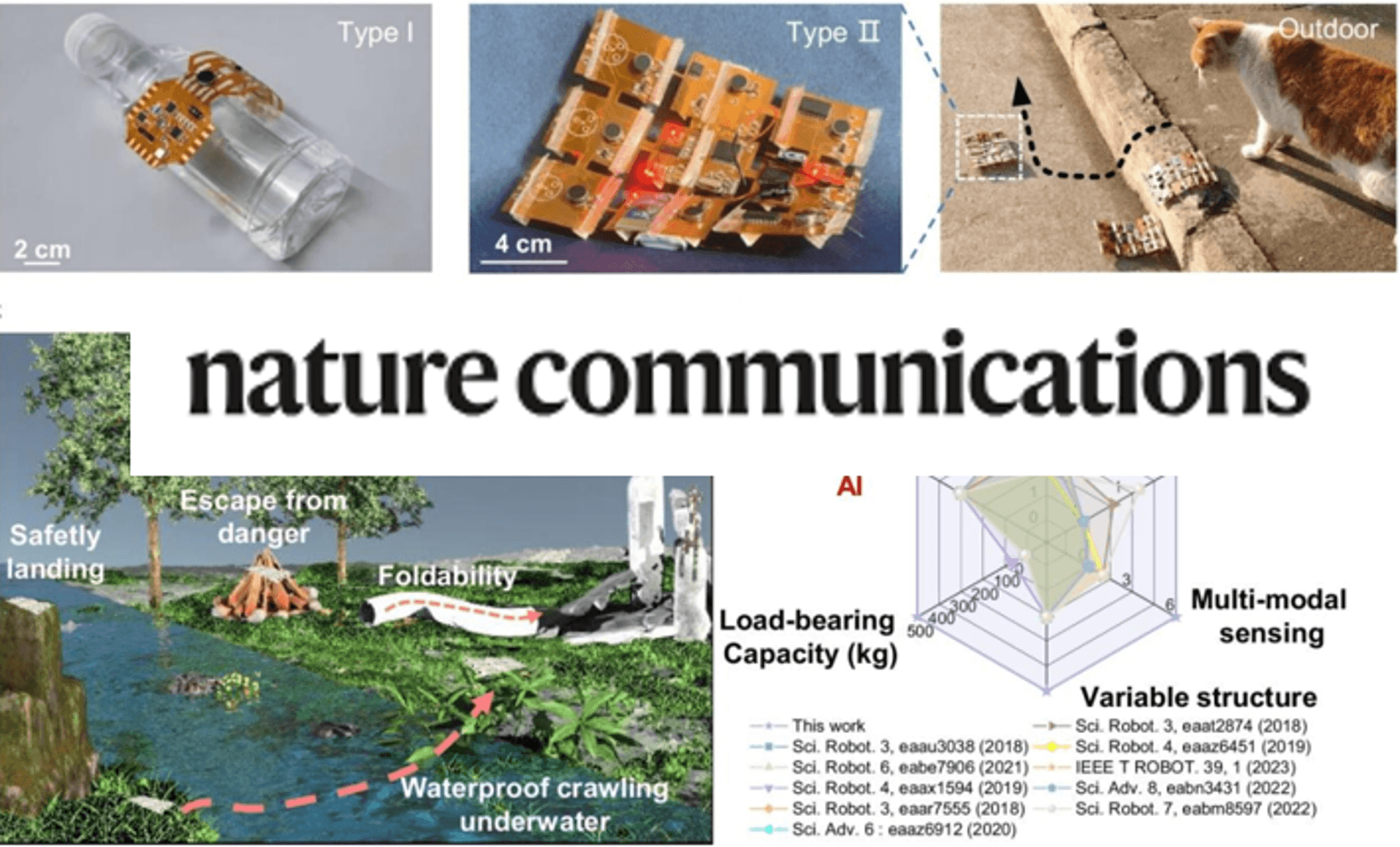
By combining these modules, researchers can rapidly prototype robots with different morphologies — such as a millipede-like Type I design optimized for confined spaces, and a square Type II model designed for stable outdoor navigation.
Oscillatory actuation and the physics of asymmetric friction
The FEBot’s locomotion stems from a biomimetic oscillation mechanism driven by periodic deformation and recovery of its SSMA bristles.
The key lies in directional friction asymmetry: friction differs when the robot slides forward versus backward.
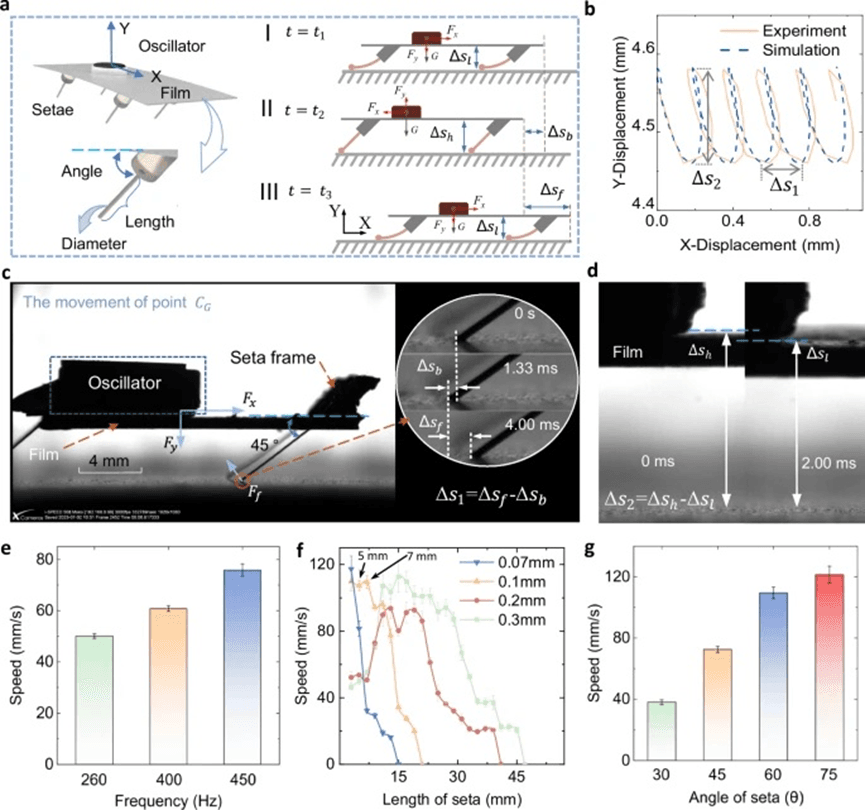
Through both modeling and high-speed imaging (3,000 fps), the team mapped a complete actuation cycle:
- Compression phase (State I) – Bristles are fully pressed down.
- Backward slip (State II) – As the unit rises, backward friction briefly dominates, producing a tiny rearward displacement (~0.085 mm).
- Forward slip (State III) – During descent, lower forward friction allows a larger forward step (~0.265 mm).
This imbalance yields a net forward motion per cycle.
Using Cosserat rod theory and a spring-damper model, simulations matched experimental trajectories with remarkable precision.
Parameter sweeps revealed that bristle geometry critically determines speed and stability.
An optimal configuration — length L = 7 mm, diameter d = 0.1 mm, contact angle θ = 60° — delivered a peak velocity of 109.5 mm/s and a maximum climbing angle of 18°, achieving the best balance among speed, stability, and terrain adaptability.
Multi-modal motion and environmental awareness
What truly sets FEBots apart is their multi-modal mobility and environmental intelligence.
Their modular architecture enables Lego-style reconfiguration for mission-specific behavior.
The Type I millipede-inspired robot, for instance, can crawl at 87.6 mm/s through narrow vertical channels, carrying loads up to 5.1 times its body weight — and squeezing through gaps only 70 % of its body width (14 mm).
Meanwhile, the Type II square configuration supports omnidirectional motion, capable of turning or spinning in place.
Encapsulated with a waterproof coating, it even traverses underwater surfaces at 9 mm/s, showcasing cross-medium locomotion.
An ingenious foldable bristle mechanism — driven by thermal actuation of shape-memory alloy springs — allows the bristle angle to shift from 0° to 45°, reversing movement direction on command.
This mechanical design endures pressure up to 250,000 times the robot’s weight without damage, demonstrating exceptional resilience.
Beyond locomotion, FEBots are equipped with a multi-sensor suite — inertial, strain, temperature, humidity, and proximity sensors, and even miniature cameras — enabling simultaneous monitoring of internal state and external environment.
Coupled with embedded computation and adaptive control algorithms, these robots exhibit primitive self-learning behavior, adjusting their motion based on sensor feedback.
Toward embodied AI at the microscale
The FEBot platform illustrates how embodied intelligence — computation physically interwoven with material and structure — can empower soft robots to function autonomously in the wild.
By uniting programmable sensing, adaptive actuation, and data-driven self-learning in a single flexible form, HUST’s team brings robotic autonomy closer to the insect scale — where intelligence is not only coded, but also materialized.
This research opens pathways for next-generation field robots, from medical microrobots to disaster-response swarms, where miniature intelligence meets material adaptability.








Leave a comment