

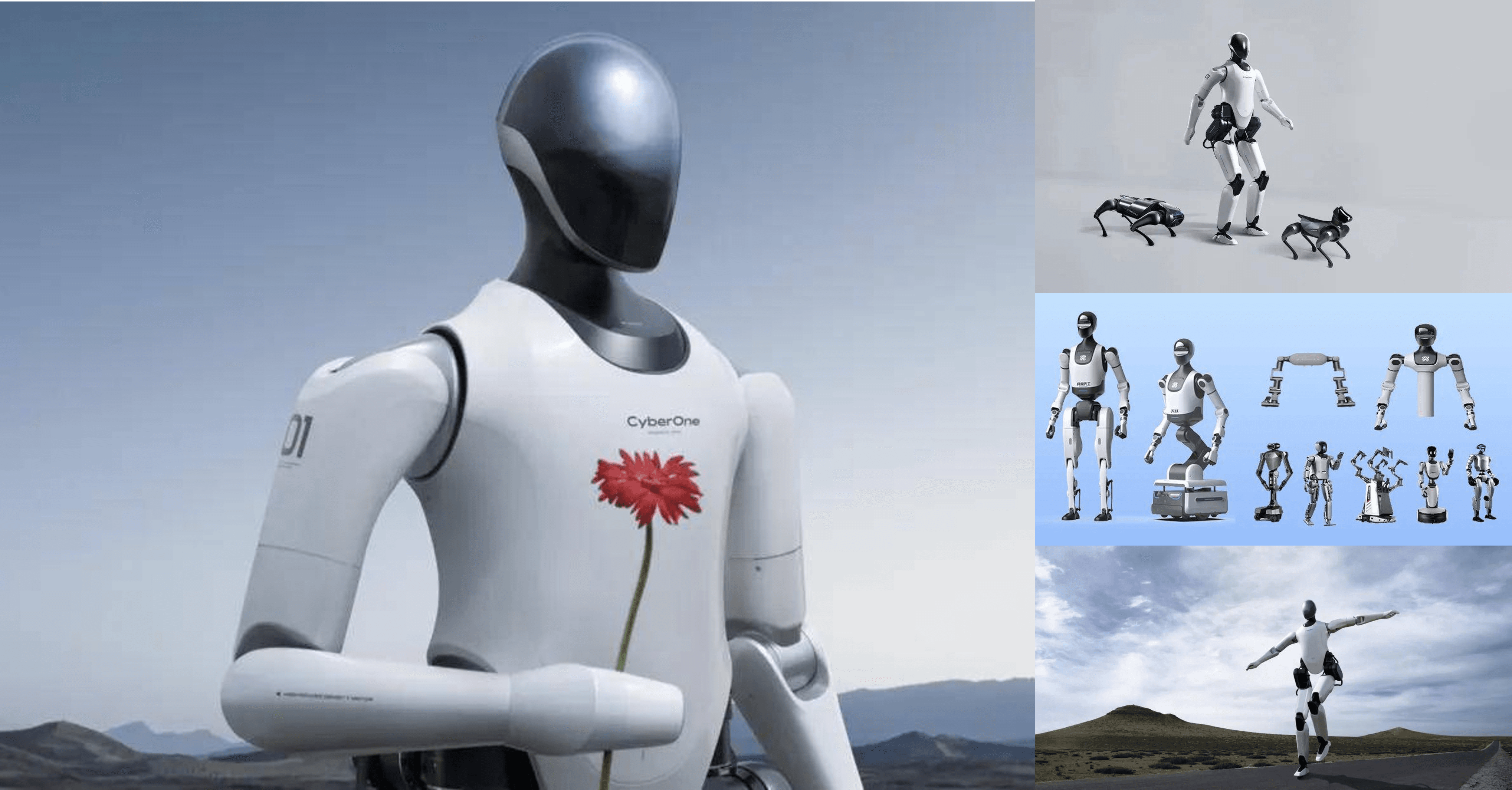
Xiaomi bets on humanoid robots in race to define next era of AI hardware
Chinese tech group unveils CyberOne, its first full-scale humanoid platform, as competition intensifies among global technology companies to commercialise embodied AI.
Introduction
Xiaomi CyberOne humanoid robot represents the first full-scale humanoid platform developed by Xiaomi, signaling the company’s entry into embodied AI and advanced robotics. Designed with human-like proportions and sophisticated AI perception capabilities, the robot demonstrates Xiaomi’s ambition to expand beyond consumer electronics into intelligent machines that can interact with the physical world.
CyberOne integrates perception, locomotion, and interaction technologies to explore future applications ranging from smart manufacturing to human-robot companionship.
CyberOne at a glance
177 cm Height | 21 DOF Degrees of freedom | 300 Nm Peak hip torque | 3.6 km/h Walking speed |
These specifications allow the robot to perform stable bipedal locomotion and coordinated limb movements, enabling more natural interactions within environments built for humans.
High-performance joint actuators provide the mechanical power required for humanoid mobility. Hip joints can deliver peak torques approaching 300 Nm, while lightweight motors in the upper limbs enable dexterous manipulation tasks.
AI-Driven Perception
CyberOne combines multiple sensing technologies to interpret its surroundings.
Core perception components include:
Mi-Sense depth vision system for 3D spatial mapping
RGB-D cameras for object and gesture recognition
Environmental audio detection
Human emotion recognition
Through Xiaomi’s AI algorithms, the robot can recognize 85 environmental sounds and classify 45 categories of human emotion. This capability allows CyberOne to respond empathetically during interactions and interpret social cues.
Such features position the platform as an experimental testbed for emotion-aware human-robot interaction.
Motion Control and Balance
CyberOne’s locomotion relies on Xiaomi’s proprietary humanoid control algorithms. These systems coordinate sensor feedback, joint actuation, and dynamic balancing to produce stable walking patterns.
The robot’s 21-degree-of-freedom architecture allows coordinated arm and leg motion, while high-speed control loops maintain posture stability during movement.
The system enables walking speeds of roughly 3.6 km/h, approaching natural human walking speed.
Interaction and Communication
The robot features a curved OLED display on its face, enabling visual communication with humans. Gesture recognition and voice interpretation further enhance its interaction capabilities.
Together with emotion recognition, these systems allow CyberOne to:
recognize people and gestures
interpret emotional states
provide responsive feedback
interact through visual cues and movement
Strategic Significance
CyberOne is not yet a commercial product. Instead, it serves as a technology demonstrator showcasing Xiaomi’s research capabilities across robotics, AI, and mechanical engineering.
The project integrates advances from multiple fields:
artificial intelligence
biomechatronics
visual navigation
big data and cloud computing
According to Xiaomi leadership, the technologies developed for CyberOne are expected to influence future robotics platforms, industrial automation, and intelligent consumer devices.
Outlook
Humanoid robots remain one of the most complex engineering challenges in robotics. While CyberOne is currently a research prototype, it highlights Xiaomi’s long-term interest in the sector and reflects broader global competition in humanoid systems.
As perception algorithms, actuation systems, and AI models mature, platforms like CyberOne could eventually transition from demonstration systems to real-world assistants across manufacturing, services, and daily life.








Leave a comment