


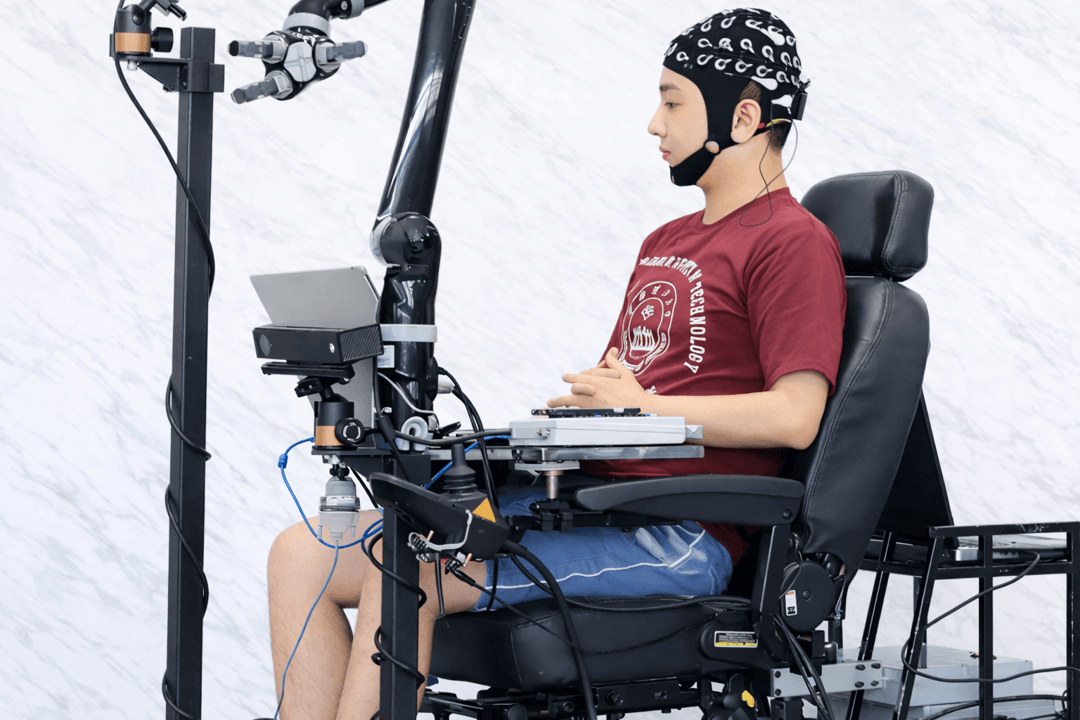
Neuracle Technology’s implant wins regulatory clearance in Shanghai, marking a pivotal moment in the global race to commercialise neural interface medicine.
SHANGHAI, 13 March 2026
CHINA has beaten Elon Musk’s Neuralink to a landmark that many in the neuroscience community once assumed would be claimed in California. On Friday, China’s National Medical Products Administration formally approved the world’s first invasive brain–computer interface (BCI) device for commercial medical use—a hand-function restoration system developed by Neuracle Technology (known in Chinese as 博睿康, Borèikāng), a Shanghai-based neuroengineering company founded in 2011.
The ruling ends years of clinical development and places China at the frontier of an emerging medical technology that many analysts regard as a generational inflection point—one with implications not just for medicine, but for human–machine interaction and the longer-term trajectory of robotics.
“We walked a road no one had walked before.”
— Xu Honglai, Chairman, Neuracle Technology
What the Device Does
The approved system—Neuracle’s NEO platform—is a fully implantable device roughly the size of two stacked coins. Surgeons position the unit beneath the skull, where electrode arrays sit outside the dura mater, the membrane that envelopes the brain. From that epidural position, the device captures electrical signals generated by neurons in the motor cortex—the region that governs voluntary movement.
Those signals are decoded in real time by onboard algorithms and transmitted wirelessly to an external actuator: in current clinical use, a pneumatic glove that translates decoded movement intention into physical grip. The system requires no transcutaneous wires, eliminating a principal infection risk that has shadowed earlier generations of neural implants.
The epidural placement represents a deliberate engineering trade-off. Neuralink’s approach threads fine electrode needles directly into the cortex, yielding higher-bandwidth signal capture but accepting commensurately higher biological risk. Neuracle’s team concluded that subdural penetration was unnecessary for the rehabilitation task at hand.
"We are a medical product company," said chairman Xu Honglai. "We must find the balance between risk, efficacy and patient compliance."
The Clinical Evidence
Regulatory approval followed a multi-centre confirmatory trial—the first of its kind globally to meet Good Clinical Practice (GCP) standards for an invasive BCI—spanning eleven hospitals across China. Surgeons completed 32 implant procedures.
KEY FACTS
■ 100% assistive grasp response rate at three months post-implant
■ 9.06 pts average improvement in upper-limb action score (ARAT scale)
■ 10.71 pts average improvement in bare-hand function score
■ ~8,000 days total cumulative implant-days across the trial cohort
■ 2.5 yrs longest individual implant duration recorded
Among the most striking outcomes reported by clinicians at Huashan Hospital, affiliated with Fudan University, was the case of a young man from Henan province who suffered high cervical spinal cord injury in a road accident five years ago. Implanted in November 2024, he regained the ability to grasp objects within weeks. Fourteen months later, he could hold a pen and write his own name. Neurologists noted what they described as a neuroplastic effect: even when the device was switched off, some bare-hand grip function had returned, suggesting the interface may have catalysed biological rewiring rather than merely substituting for it.
A Six-Year Sprint
Neuracle was founded fifteen years ago with a focus on non-invasive neuroengineering tools—EEG research platforms and clinical diagnostic equipment—that gave it an unusually deep base of signal-processing expertise before the invasive BCI project began. The company launched the implant programme in 2019, when chairman Xu originally projected a ten-year development horizon.
The actual timeline was compressed to six years. Xu attributes the acceleration in part to Shanghai’s “Future Industry Project Manager” scheme, an institutional mechanism through which the city government embedded dedicated coordinators inside the company’s development process—facilitating cross-departmental regulatory navigation, accelerating clinical site recruitment, and pushing the trial from a sequential to a parallel enrolment model.
The parallel trial design alone, according to the company, recovered months from what would otherwise have been a “one surgery, one observation” protocol. Shanghai regulators also had to construct an entirely new approval category: invasive BCI devices did not previously exist as a product class in China’s medical device registry.
Strategic Context
The approval arrives at a moment of unusual policy salience for the technology. China’s government work report, presented at the National People’s Congress earlier this month, included “brain–computer interface” as a named future industry priority for the first time—placed alongside embodied intelligence and next-generation energy systems.
Shanghai already hosts close to sixty BCI-related companies. The city accounted for 36 per cent of domestic BCI funding rounds last year and more than half of total investment by value. Three of the roughly ten companies worldwide that have reached invasive BCI clinical trials are based there: Neuracle, StairMed, BrainCo and Neuroxess (Naohu Technology).
The competitive landscape beyond China remains active. Neuralink received US Food and Drug Administration approval for its first human trials in 2023 and has since proceeded with a small cohort of participants, reporting promising early results in patients with ALS and quadriplegia. Precision Neuroscience and Synchron are also advancing clinical programmes in the United States and Australia respectively.
The significance of Friday’s Chinese ruling, however, lies less in scientific novelty than in regulatory precedent: it is the first time any government has granted full commercial marketing authorisation for an invasive BCI product.
“In two years, domestic brain–computer interfaces will very likely have their own DeepSeek moment.”
— Li Xue, Founder, StairMed
What Comes Next
Neuracle has said it intends to complete its first post-approval patient procedure within the 2026 calendar year and will pursue cost reductions to improve access. Subsequent product generations are already in development.
Li Xue, founder of rival Shanghai firm StairMed, predicted that Chinese developers would demonstrate world-class competitiveness in key technical domains within two years—a trajectory she compared to the trajectory of the DeepSeek large language model, which surprised Western AI researchers with its performance efficiency earlier this year. StairMed is pursuing a more aggressive cortical electrode design and plans to begin large-scale trials in 2026.
For the global robotics and human–machine interface industry, the commercial approval of an invasive BCI—however narrowly defined in its initial indication—establishes a regulatory template and a clinical evidence base that did not previously exist. Whether the technology propagates into assistive robotics, prosthetics, or eventually broader computing interfaces depends on a chain of further clinical, regulatory, and commercial steps that remain years away.
Additional reporting: Shangguan News, Shanghai Municipal Science and Technology Commission
Neuracle Technology (Borèikāng) • Founded 2011, Shanghai • neuracle.cn
Stay ahead with real-time robotics and AI news in our Industry Briefing









Leave a comment