


The international standards community has done impressive work on robotics safety. ISO 10218 tells manufacturers what a safe robot looks like. IEC 61508 provides a mathematical framework for functional safety. ISO 9001 gives organizations a quality management baseline. ISO 55001 covers asset lifecycle management.
These are serious, well-built standards. Robotics deployments around the world depend on them.
And yet, if you ask the people who actually service robots — the engineers who show up when a production line goes down, who fly out at 2 a.m. because a cobot tripped a safety circuit, who are handed a new AMR fleet and told to 'keep it running' — a different picture emerges.
The standards tell you what a robot must be. They say nothing about who should maintain it, what they should know, or how you measure whether they did it well.
That gap — structural, persistent, and until now unfilled — is the reason RSF exists.
The Core Contradiction
A Systemic Gap in the World's Fastest-Growing Industry
There is a fundamental mismatch in the robotics industry today: the hardware side has rigorous global standards, and the service side has none.
This isn't a minor inconvenience. As global robot installations continue to grow — across automotive, logistics, electronics manufacturing, and increasingly healthcare and hospitality — the service workforce is scaling without any unified benchmark for what 'qualified' actually means.
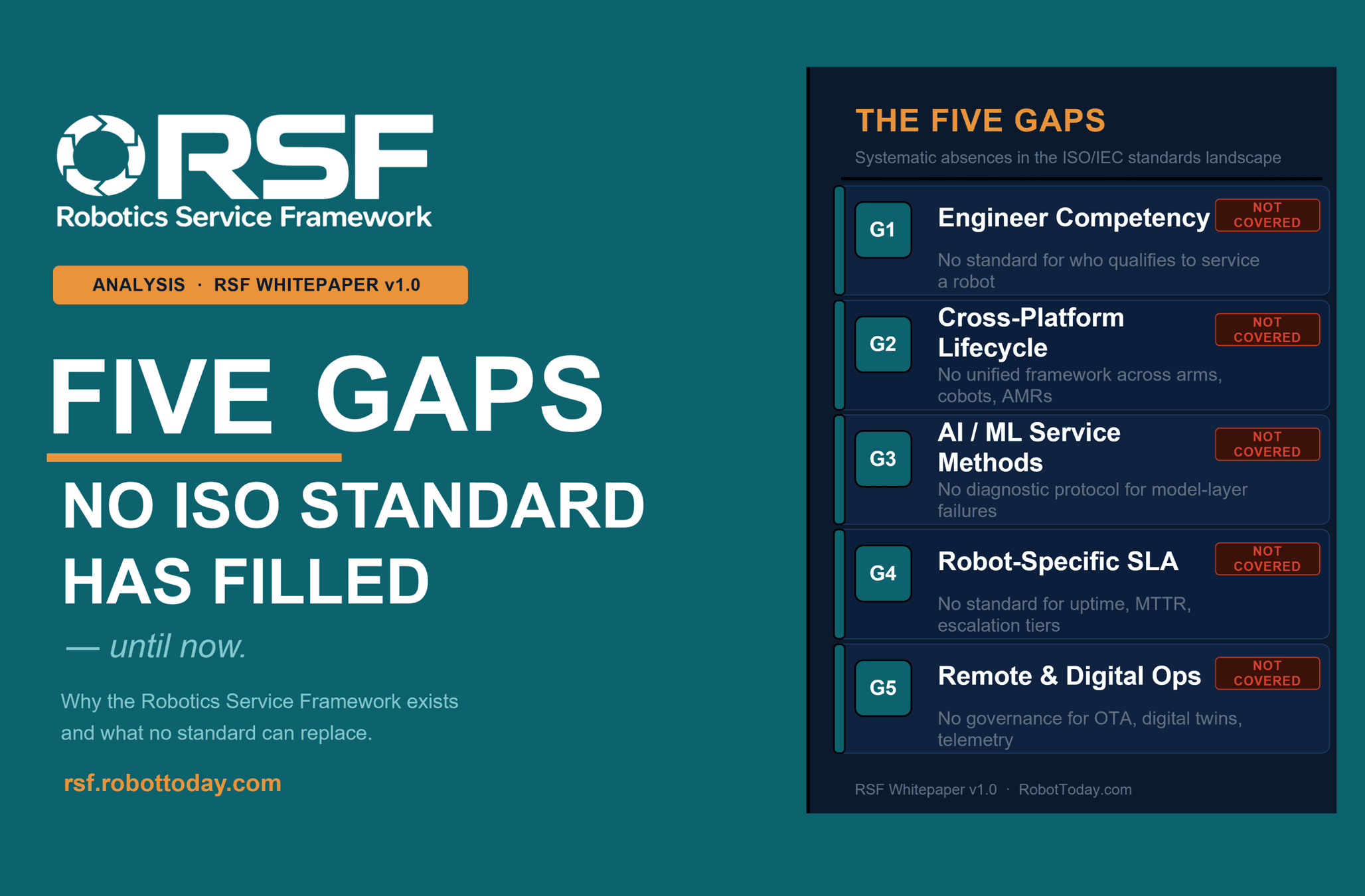
The RSF Whitepaper v1.0 identifies five specific gaps where this absence is most consequential.
The Five Gaps at a Glance
| Code | Gap | What is Missing |
| G1 | Engineer Competency | ISO 10218 requires competent personnel but defines no competency levels, assessment methods, or certification path. |
| G2 | Cross-Platform Lifecycle | No unified framework covers industrial arms, cobots, AMRs, and humanoid robots in a single service management system. |
| G3 | AI / ML Service Methods | ISO 10218:2025 updated functional safety but provides no diagnostic protocol for AI perception or learning-layer failures. |
| G4 | Robot-Specific SLA | No ISO/IEC standard defines response times, uptime commitments, escalation protocols, or KPI frameworks for robot service. |
| G5 | Remote & Digital Ops | ISO 27001 covers information security but not remote diagnostic authorization, digital twin governance, or OTA update procedures. |
Gap 1: No Standard Defines Who Is Qualified to Service a Robot
ISO 10218 — the primary international standard for industrial robot safety — requires that maintenance personnel be 'competent.' It does not define what competence means, how it should be assessed, or what certification path should exist.
The result is that two engineers can both claim to service the same robot brand, with radically different actual capability. One may have formal training and years of documented field experience. The other may have watched a vendor tutorial and read a manual. There is currently no industry mechanism to tell them apart — or to tell their customers apart.
The automotive industry solved this problem decades ago with ASE certification: tiered, tested, and linked to the specific scope of work an engineer is authorized to perform. Robotics has no equivalent.
RSF fills this gap with a four-tier certification system — Professional, Specialist, Expert, Master — tied directly to what each tier is authorized to do independently. Certification isn't just a credential. It's a defined boundary of authorized competency.
Gap 2: No Unified Lifecycle Framework Covers All Robot Types
ISO 10218 was written for industrial robotic arms. ISO/TS 15066 covers collaborative robots. ISO 31101 addresses service robots. ISO 3691-4 handles autonomous mobile robots.
Each standard is written for a specific platform. But the facilities running modern robotics operations don't get to choose a single type. A single production floor may operate six-axis arms, cobots, AMRs, and increasingly humanoid robots — each with different safety profiles, different maintenance requirements, and different failure modes.
There is no existing standard that tells a service organization how to manage this mixed reality: how to create a unified lifecycle framework, how to build SOPs that travel across machine types, how to train engineers who will be handed unfamiliar hardware on short notice.
RSF's Domain 5 — Cross-Platform Service Procedures — addresses this directly. It identifies the common service logic across all robot types while systematically cataloging the platform-specific requirements that must be maintained. The result is a framework a service engineer can actually use across a mixed fleet.
Gap 3: No Standard Addresses AI/ML System Service
ISO 10218:2025 updated its coverage of functional safety for modern robotic systems. But the standard still contains no guidance on what to do when the failure isn't in the mechanical, electrical, or classical software layer. When the failure is in the AI.
This matters because AI is no longer peripheral in robotic systems. Motion planning, grasping strategies, spatial perception, and task generalization are increasingly executed by trained neural networks rather than deterministic algorithms. And neural networks fail in ways that traditional diagnostics simply cannot address.
Traditional failures have error codes. AI failures have symptoms. Model degradation doesn't look like a broken servo. Distribution shift doesn't throw an error code. Adversarial interference to a vision system won't appear in a relay test. An engineer trained entirely on classical diagnostics is systematically unprepared for an entire category of modern failure modes. |
RSF's Domain 6 — AI/ML System Service Methods — builds the diagnostic vocabulary for this new landscape: how to distinguish AI failures from hardware failures, how to run model performance evaluations, when to initiate a rollback versus a retrain, and how ISO/IEC 42001's AI governance framework applies in a service context. No existing ISO standard touches any of this.
Gap 4: No Standard Defines What a Robot Service SLA Should Look Like
Search every ISO/IEC standard in the robotics domain. You will not find a single definition of what a robot service response time should be. No uptime commitment baseline. No escalation protocol structure. No framework for what KPIs a service contract should track.
This absence is not academic. It means that every time a manufacturer signs a service contract with an end customer, they are negotiating in a void — with no industry baseline for what is reasonable, what is standard, or what constitutes a defensible commitment.
ITIL has well-developed SLA structures for software services. But ITIL was designed for logical failures that can be diagnosed and resolved remotely. Robot service involves physical systems: parts fail, bearings seize, sensors drift. Response time must account for travel. Recovery time must account for parts availability.
RSF's Domain 4 — SLA Design and Service Commitment — builds the first purpose-designed SLA framework for robotics service, defining response time tiers calibrated to production impact (S1 through S4), availability metrics built around OEE and MTTR, and escalation protocols that account for the physical realities of robot maintenance.
Gap 5: No Standard Governs Remote Service and Digital Operations
ISO 27001 covers information security. ISO 23247 covers digital twin frameworks. But neither standard addresses what happens when a service engineer remotely accesses a robot's control system to diagnose a fault — who is authorized to do so, what data they can see, how that access is logged, and what the protocol is when an OTA update fails.
As remote service becomes operationally central — reducing travel costs, enabling faster response, and supporting predictive maintenance at scale — the absence of a governing framework creates real risk. Remote diagnostic sessions touch production systems. OTA updates can introduce new failure modes if managed poorly. Digital twin data contains proprietary process information.
RSF's Domain 3 — Remote Service and Digital Operations — establishes the operational framework for this environment: authorization protocols for remote access, data governance structures for diagnostic telemetry, decision logic for predictive maintenance triggers, and rollback procedures for failed OTA deployments.
What RSF Is — and Isn't
A Capability Layer, Not a Replacement
RSF is not a replacement for any existing ISO standard. It is a capability and service management framework that operates in the space those standards intentionally leave open.
Three-Layer ArchitectureOuter layer: ISO/IEC compliance standards — the legal and technical baseline Middle layer: RSF framework — who does the work, how it is done, how quality is measured Inner layer: Operational models — robotics-specific, consistent with the service practice familiar from automotive 4S/ASE and from IT service management (as standardized in ITIL and ISO/IEC 20000). RSF does not replace ISO/IEC standards. It is the service capability layer built above them. |
The five gaps described above are not failures of the standards bodies. ISO and IEC operate in their lane, and they do it well. These gaps exist because nobody had yet built the framework specifically designed for the service layer of the robotics industry. RSF is that framework.
RSF Whitepaper v1.0 — Download Free
The full framework: six capability domains, four-tier certification system, inter-domain relationship maps, and global market development pathway.






Leave a comment