


Executive Summary
The humanoid robotics industry stands at a critical inflection point. While public discourse emphasizes timelines and demonstrations, the fundamental question remains: which companies will successfully transition from technological spectacle to operational viability? Gartner's January 2026 projection that fewer than 20 companies will reach production-scale deployment by 2028 is not a ceiling—it's a filter. This report examines why this small cohort could reshape the industry far more than raw shipment numbers suggest, and what separates viable systems from pitch-deck scaling.
Key Findings:
- 2025 global shipments: ~13,000 units (80%+ from China)
- Western players: 150-500 units each in controlled pilots
- Cost barrier: $30-150K per unit vs. specialized alternatives
- Operational reality: 40-70% uptime, frequent human intervention
- China's volume-first strategy vs. West's perfection-before-scale approach
This report is intended for enterprise operators, investors, and robotics companies evaluating humanoid deployment between 2026–2028.
The Industry Is Not Waiting for Mass Adoption
Public narratives around humanoid robots often imply an imminent transition to large-scale deployment. High-profile demonstrations and aggressive roadmaps have reinforced the impression that humanoids are on the brink of widespread industrial use.
Industrial buyers, however, operate under a different set of constraints. Adoption decisions are driven not by form factor or novelty, but by repeatability, cost discipline, operational reliability, and long-term service responsibility. As a result, most enterprises remain cautious, prioritizing controlled pilots over open-ended rollouts.
This divergence between public optimism and industrial reality explains why humanoid robots have not yet crossed the threshold from experimentation to routine operations.
Gartner's Forecast as a Filtering Signal
Against this backdrop, Gartner projected in January 2026 that fewer than 100 companies worldwide would advance humanoid robot projects beyond proof-of-concept by 2028—and that fewer than 20 would reach production-scale deployment, particularly in manufacturing and supply-chain environments. The forecast does not deny the technical feasibility of humanoid robots. Instead, it highlights persistent constraints around cost, reliability, safety certification, and service readiness—factors that determine whether robots can operate sustainably outside pilot conditions.
Viewed in context, Gartner's projection functions less as a ceiling and more as a filter, identifying how few companies are likely to cross the operational threshold required for scale.
CASE STUDY 1: Figure AI's BMW Pilot
The Reality Behind the Headlines
In March 2024, Figure AI announced a deployment agreement with BMW's Spartanburg plant in South Carolina, generating significant media attention and reinforcing perceptions that humanoids were ready for automotive manufacturing. By January 2026, however, the project reveals critical lessons about the gap between pilot announcements and production readiness.
The Initial Promise
Figure AI's humanoids were positioned to handle sheet metal placement, quality inspection, and parts assembly—tasks traditionally performed by human workers on BMW's production lines.
The Operational Reality
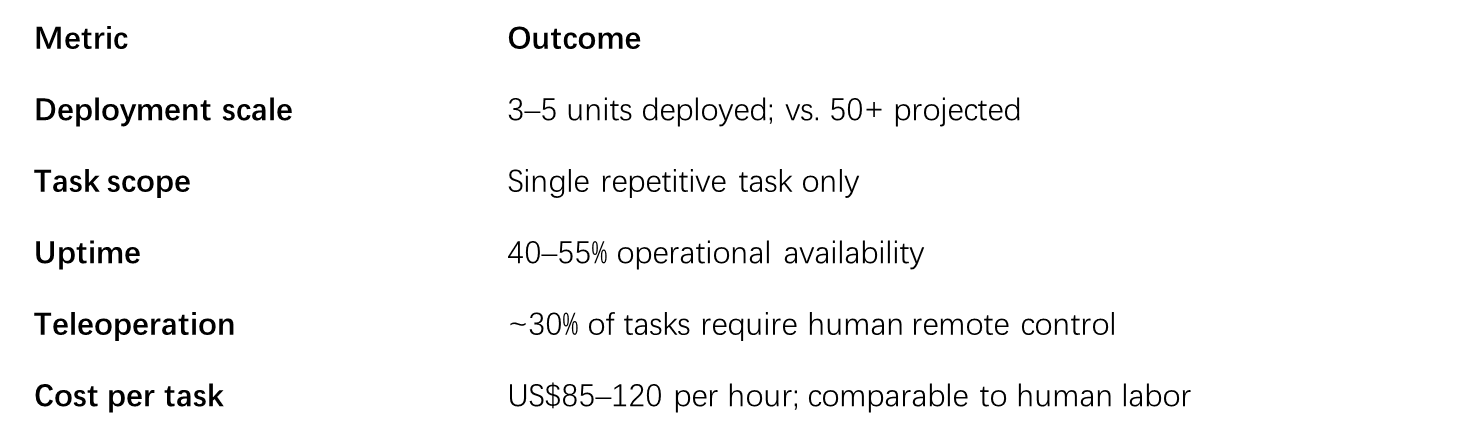
Key Takeaway: Companies counting on automotive manufacturing as an early adopter market should recalibrate expectations. The path from demo to deployment is measured in years of iteration, not quarters.
CASE STUDY 2: UBTech Walker S2 Factory Deployments
China's Volume-First Strategy
In contrast to Figure AI's approach, UBTech's Walker S2 deployments in Chinese manufacturing facilities demonstrate a fundamentally different commercialization philosophy: accept current limitations, deploy at volume, and improve through operational data.
Deployment Profile (Q4 2025)
- Scale: 200+ units across 8 manufacturing facilities
- Price Point: $30,000-40,000 per unit (less than half Western competitors)
- Task Assignment: Narrowly defined, repetitive operations with high error tolerance
Measurable Outcomes
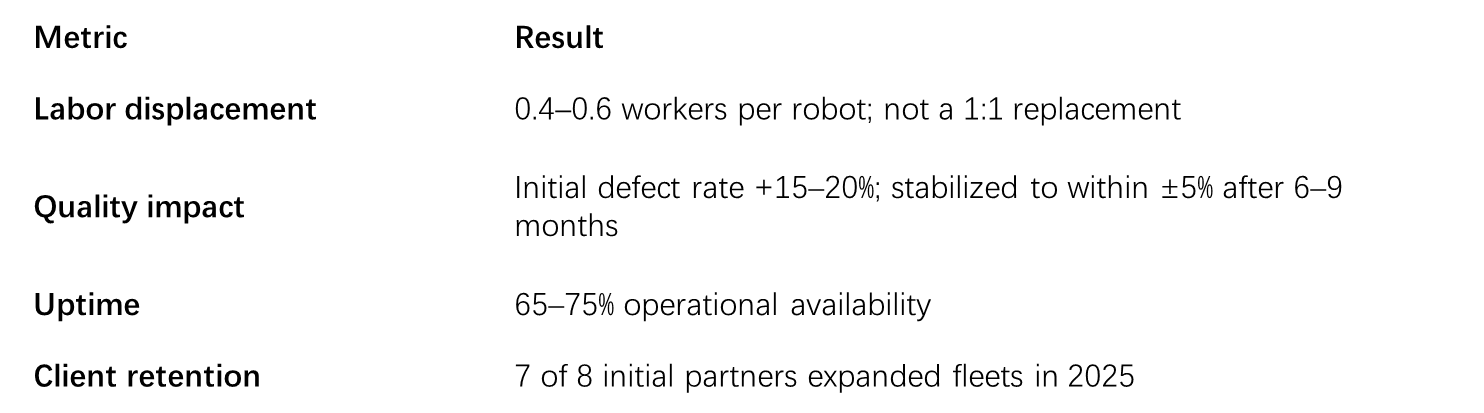
Key Takeaway: UBTech is not building superior robots—they're building a scalable deployment model that accepts current technological limitations. This 'ship and iterate' approach may accumulate operational data faster than Western 'perfect before deploying' strategies.
THREE VERIFIABLE PREDICTIONS FOR 2026-2028
Based on structural analysis of current deployment patterns, cost trajectories, and competitive dynamics, the following predictions offer testable claims about the humanoid robotics industry:
Prediction 1: The 'Deployment Cliff' by Q2 2027
The Claim: By mid-2027, at least 12 currently prominent humanoid robotics companies will either pivot away from humanoid form factors, merge with competitors, or cease active development. The market will consolidate around 6-8 primary players globally.
Verification Criteria:
- Track the 25 most-discussed humanoid companies as of January 2026
- Monitor: funding announcements, deployment partnerships, unit shipment disclosures
- Company 'exited' if: no new funding for 12+ months, no shipments for 9+ months, or explicit pivot
Why This Will Happen:
The cost to maintain credible humanoid development programs ($50-150M annually) will exceed investor willingness to fund companies without clear revenue paths. The 'hype cycle collapse' will occur as 2024-2025 pilot projects fail to convert to production contracts.
Prediction 2: 45,000-65,000 Units by EOY 2027 (85%+ in China)
The Claim: Despite Western media focus, the vast majority of deployed humanoid robots through 2027 will be Chinese-manufactured units operating in Chinese facilities. Western deployments will remain under 8,000 units globally.
What Success Looks Like:
- UBTech, AgiBot, and Unitree collectively shipping 35,000-50,000 units
- Tesla Optimus reaching 2,000-4,000 units (significant for Western player)
- Figure AI and Agility Robotics combined under 1,500 units
Implications: By 2028, 'humanoid robotics' will be synonymous with Chinese industrial automation, similar to how solar panels and batteries became Chinese-dominated industries.
Prediction 3: Major Company Cancels Pilot by EOY 2026
The Claim: A Fortune 500 company currently partnered with a humanoid robotics firm will either publicly terminate the partnership or reduce scope from 'production deployment' to 'extended research collaboration.'
Most Likely Candidates:
- BMW (if Figure AI deployment remains below 10 units with no scaling path)
- Any major logistics company attempting warehouse humanoid deployments
Significance: Such an announcement would serve as a major 'reality check' moment for the industry, forcing more realistic timelines and expectations. However, it would not kill the sector—it would separate serious long-term players from overhyped ventures.
FIVE ACTIONABLE RECOMMENDATIONS
For Corporate Buyers & Operations Leaders
Recommendation 1: Adopt a 'Dual-Track' Automation Strategy
What to Do: Maintain small-scale humanoid pilots (1-5 units) as technology scouting investments while aggressively scaling proven polyfunctional automation in parallel.
Implementation:
- Allocate no more than 5-10% of annual automation budget to humanoid experiments
- Set strict 12-month evaluation gates: pause if humanoids don't match 70% of specialized robot performance
- Document learnings to build internal expertise for future deployment waves
Why This Works: Avoids the risk of 'waiting for humanoids' while missing near-term efficiency gains from proven technologies. Positions the organization to move quickly if/when humanoids cross viability thresholds.
Recommendation 2: Demand 'Operational Transparency' Clauses
What to Do: Require humanoid vendors to provide detailed operational metrics as a condition of pilot partnerships.
Key Metrics to Contractually Mandate:
- Uptime percentage (excluding scheduled charging/maintenance)
- Teleoperation ratio (% of time requiring human remote control)
- Task completion rate (successful executions / total attempts)
- Mean time between failures (MTBF)
- True cost per productive hour (including supervision, maintenance, infrastructure modifications)
Why This Matters: Most current pilots hide poor performance behind vague 'proof of concept' language. Operational transparency forces honest assessment and prevents prolonged investments in non-viable systems.
For Investors & Strategic Acquirers
Recommendation 3: Prioritize 'Deployment Infrastructure' Over Technology
What to Look For: When evaluating humanoid robotics investments, assess deployment and service capabilities more heavily than technical specifications.
Key Questions:
- How many technicians can the company deploy for maintenance and support?
- What is the average response time for robot failures in customer facilities?
- Does the company manufacture in-house or rely on contract manufacturers?
- How many software engineers are dedicated to deployment support vs. R&D?
Why This Wins: The 2026-2028 winners won't be determined by who has the best robot in a lab—but by who can deploy, maintain, and iteratively improve robots in real-world conditions at scale.
Recommendation 4: Consider Chinese Manufacturers for Defensive Positioning
What to Do: Western companies should evaluate partnerships with leading Chinese humanoid manufacturers (UBTech, AgiBot, Unitree) for cost-sensitive applications.
Strategic Rationale:
- Cost advantage ($30-40K vs. $80-150K) enables experimentation at scale
- Faster iteration cycles generate operational data
- Risk mitigation: if Chinese manufacturers dominate by 2028, early partnerships provide optionality
For Humanoid Robotics Companies
Recommendation 5: Pursue 'Application-Specific' Rather Than 'General-Purpose'
Strategic Pivot: Companies should narrow focus to 2-3 specific industrial applications where humanoid form factor provides defensible advantages.
Target Applications with Humanoid Advantage:
- Hazardous environment inspection (nuclear facilities, chemical plants)
- Sparse, distributed maintenance tasks (building facility management, utility infrastructure)
- Human-interaction service roles (hospitality, healthcare assistance)
Why This Wins: 'General-purpose' humanoids compete with specialized robots on cost and performance—and lose. Application-specific humanoids compete on unique value propositions and can command premium pricing.
Conclusion: From Exciting Technology to Reliable Infrastructure
The central issue facing humanoid robotics is not whether the technology will exist, but when—and under what conditions—it will justify large-scale deployment.
Gartner's forecast suggests that fewer than 20 companies will cross that threshold by 2028. History indicates that even such a limited group could define standards, shape supplier alignment, and reset enterprise expectations long before humanoids become widespread. The two case studies examined—Figure AI's BMW pilot and UBTech's factory deployments—reveal fundamentally different paths to market. One prioritizes technological sophistication and seeks transformative capability before scaling. The other accepts current limitations and scales production to drive iterative improvement. Both approaches have merit, but the latter appears better positioned for near-term market creation.
The three predictions offered provide testable claims against which the industry's progress can be measured. If they prove accurate, they will validate the thesis that humanoid robotics in 2026-2028 is fundamentally a 'filtering period' rather than a 'mass adoption phase.' For companies navigating this landscape, the five actionable recommendations provide concrete frameworks for engagement: maintain strategic optionality without over-committing capital, demand operational transparency, prioritize deployment infrastructure, consider geographic arbitrage, and focus on application-specific value.
In industrial robotics, scale is rarely the first inflection point. Trust is. And trust is built through consistent operational performance, not through demonstrations or projections. The fewer than 20 companies that achieve production scale by 2028 will do so not because they built the most impressive robots—but because they built robots that work reliably enough to become operationally boring.
That transition from 'exciting technology' to 'reliable infrastructure' is the true measure of success.







Leave a comment