


Executive Summary
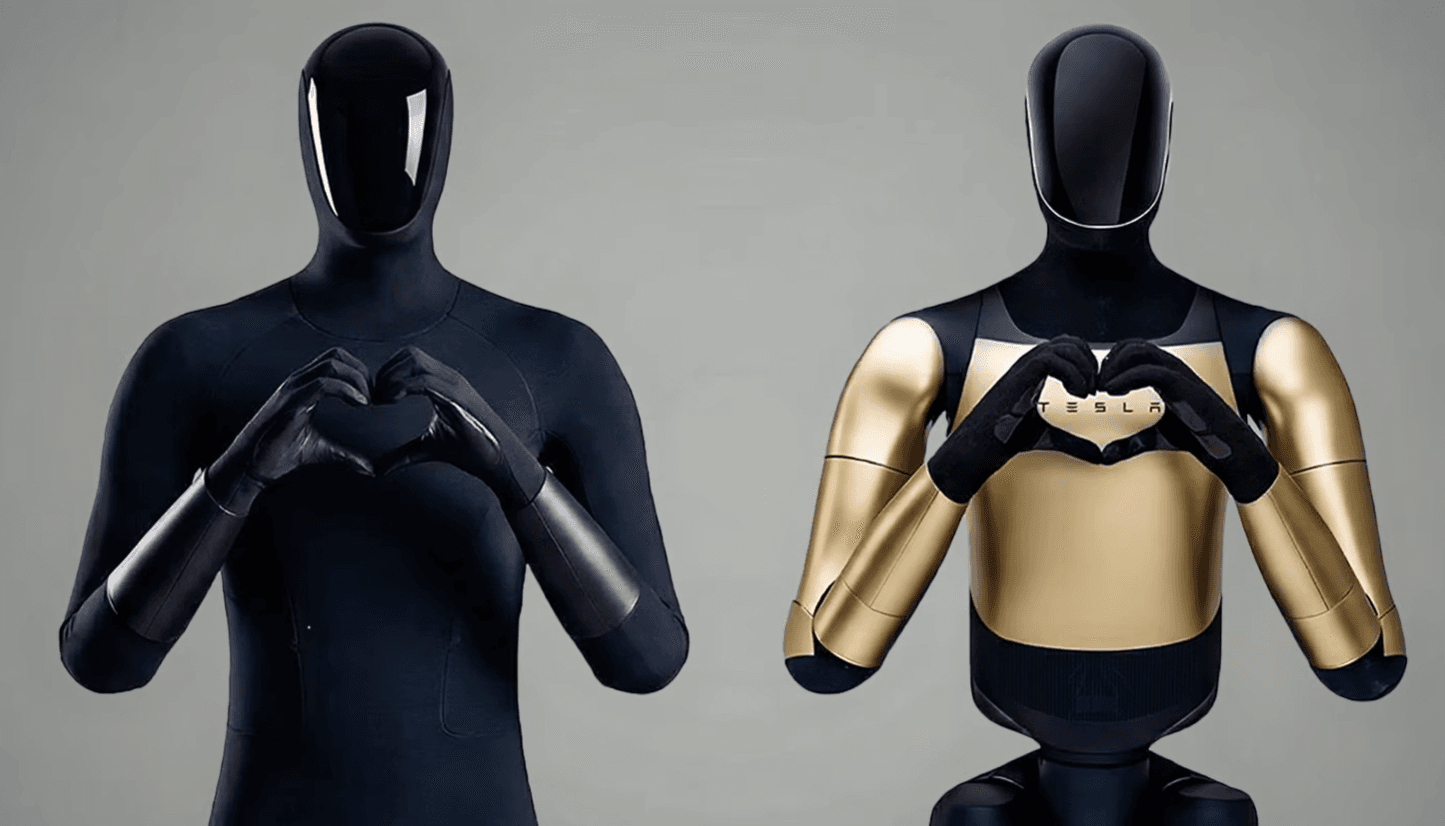
Tesla's Optimus programme has placed the dexterous hand at the centre of humanoid-robot development — Elon Musk has publicly stated that the hand alone accounts for roughly half the engineering effort across the entire robot. Tactile sensing is the linchpin of that effort, and among the available technologies, vision-based tactile (VBT) sensing is emerging as the most compatible with Tesla's camera-first perception strategy.
VBT sensors encode contact geometry, shear force, slip onset, surface texture and object pose into high-resolution images. Because that output is structurally identical to ordinary camera frames, it plugs directly into the vision-language-action (VLA) models that now drive robot decision-making — with no modal conversion overhead. GelSight's commercial unit price of USD 350 and a five-minute integration time make deployment economics realistic at scale.
China's domestic VBT ecosystem has emerged rapidly. Six start-ups — backed by a mix of leading carmakers, consumer-electronics giants, robotics integrators and strategic industrial investors — are pursuing differentiated technology paths, with several already delivering sensors to humanoid-robot production lines. This briefing examines the technology, the competitive landscape and the investment signals emerging from the sector.
1. How Vision-Based Tactile Sensing Works
VBT sensors replicate — in miniature — the photographic workflow. A soft elastomer gel coated with a reflective or marker layer is pressed against an object. Internal LEDs illuminate the contact zone, and a small camera captures the resulting light-and-shadow pattern as the gel deforms. An image-processing algorithm then reconstructs the full tactile state: normal force to millinewton resolution, shear force vector, slip direction, contact pose and surface microgeometry.
The sensor hardware comprises four functional modules: a contact module (the gel layer), an illumination module (typically multi-colour LEDs), an image-capture module (miniature camera), and an information-processing module (embedded compute running the reconstruction algorithm). The optical signal path makes the device inherently immune to electromagnetic interference — a meaningful advantage in welding stations, motor-assembly lines and nuclear environments where capacitive and resistive sensors perform poorly.
Three limitations remain active engineering challenges. First, the optics, illumination path, and gel layer together produce a sensor that is physically larger than competing technologies — a critical constraint for fingertip integration. Second, flexible gel materials wear and contaminate, degrading image quality over extended duty cycles. Third, continuous image reconstruction is compute-intensive, adding latency and on-board processing requirements.
1.1 Six Technical Milestones
The technology has matured through a series of research advances spanning roughly four decades:
| Period | Development | Significance |
| c.1987 | TIR Foundations | Research groups demonstrate that total internal reflection (TIR) imaging can convert contact patterns into spatial tactile maps — establishing the optical principle underlying all modern VBT sensors. |
| 2005 | GelForce (Tokyo Univ.) | Susumu Tachi's lab introduces colour-marker displacement to quantify 3D force vectors — the first demonstration that a camera behind a soft gel can decode shear, not just normal, force. |
| 2009 → 2011 | GelSight (MIT → Company) | Edward Adelson's CSAIL team applies photometric stereo to a gel surface, achieving micron-level 3D texture reconstruction — resolution exceeding the human fingertip. GelSight Inc. is spun out in 2011 and remains the global category leader. |
| 2017 | FingerVision | Transparent-elastomer design lets the fingertip simultaneously image the external scene and read contact pressure — an early proof-of-concept for vision-tactile fusion. |
| 2020 | OmniTact (UC Berkeley) | Multiple micro-cameras embedded around a fingertip provide 360° tactile coverage with no blind spots — a key step toward whole-hand sensing. |
| 2022 → now | Commercial scale-up | Meta and GelSight co-release the DIGIT sensor (hardware list price: USD 300); GelSight Mini targets inspection at USD 350. Chinese start-ups DieDongKeJi, Daimon, VITAI, PaXiNi and others emerge, compressing the gap with Western incumbents. |
Table 1: Key VBT milestones. Sources: academic literature; Kaiyuan Securities research (August 2025
2. Why Tesla's Dexterous Hand Is Likely to Use VBT
Tesla's Gen2 Optimus dexterous hand carries 22 degrees of freedom across both hands (11 per hand), with tactile sensors installed across all fingers. The robot's broader perception architecture is built on a camera-first / vision-only philosophy, a strategy carried over from the Full Self-Driving programme, and extended to embodied AI through end-to-end VLA models trained on visual and action data.
Four attributes make VBT the most natural fit for that architecture:
(i) High-dimensional contact perception
Most conventional tactile sensors measure only normal (perpendicular) force. VBT sensors simultaneously resolve normal force, shear force, slip vector, object pose, surface texture, and hardness — a dimensionality approaching the human fingertip. This enables manipulation capabilities that are impossible with pressure-array sensors alone, including stable egg-grasping (balancing grip force against shell fragility in real time) and multi-object dynamic transfer with mid-air regrasp corrections.
(ii) Native AI compatibility
VBT output is an image. That is not an analogy: the sensor literally produces JPEG-compatible frames that can be concatenated with RGB camera feeds in a standard tensor pipeline. State-of-the-art VLA models — which accept image, language and action-trajectory inputs — can therefore ingest tactile data without any modal-conversion layer. Training data generation, domain adaptation and model fine-tuning all proceed with existing computer-vision toolchains.
(iii) Cost and integration economics
GelSight's commercial VBT sensor (the DIGIT, co-developed with Meta) lists at USD 300–350 per unit — a fraction of the price of a six-axis force-torque wrist sensor. Integration time from unboxing to first data is approximately five minutes; the DIGIT SDK supports ROS, Python and C++ across standard Linux distributions, with documented compatibility across several major robot platforms.
(iv) Environmental robustness
Optical signal propagation is immune to the interference sources that degrade electrical-signal sensors: temperature fluctuation (which causes resistance drift in piezoresistive types), surrounding conductive objects (which distort edge-capacitance in capacitive types), and electromagnetic fields (relevant in welding, motor assembly and medical-imaging environments). VBT sensors have been demonstrated operating reliably in metallurgical high-heat zones, cryogenic logistics warehouses, welding bays, motor-assembly lines and proximity to nuclear plant equipment.
3. Tactile Sensor Technology Comparison
Six principal sensing modalities are commercially deployed or in active development for robotic tactile applications. The table below summarises operating principles, key trade-offs and typical deployment contexts:
| Technology | Key Advantages | Key Limitations | Primary Applications |
| Piezoresistive | Robust, wide range; MEMS-scalable | High hysteresis; temperature drift; poor shear sensing | Industrial grippers, prosthetics |
| Capacitive | High spatial resolution; 3D-force capable | Edge-capacitance crosstalk; complex readout; poor load capacity | Collaborative robots, prosthetics |
| Piezoelectric | No external power; excellent dynamic range | Cannot measure static force; limited shear quantification | Vibration detection, slip onset |
| Vision-based tactile (VBT) | Simultaneous normal force, shear, slip, pose, texture; no EMI; AI-native image output | Bulky optics; flexible layer wear; high compute demand | Dexterous hands, fine assembly, surgical robotics |
| Magnetic / Hall-effect | Millisecond response; true 3D force | Poor generalisation; magnetically sensitive; complex structure | Force-torque wrists |
| Fibre-optic | Fast response; stable; immune to EMI | High optical-system cost; long-term signal drift | Hazardous environments (nuclear, MRI) |
Table 2: Tactile sensor modality comparison. Compiled from multiple sources including Kaiyuan Securities (August 2025) and published literature.
4. Global Competitive Landscape
The VBT market is led by US incumbents but is being actively contested by a cohort of Chinese start-ups. The following table covers the ten most relevant organisations, including two non-VBT companies included for competitive context:
| Company | Origin / Founded | First VBT Product | Technology | Key Details |
| GelSight, Inc. | USA | 2011 | VBT — photometric stereo | Category founder; GelSight Mini ($350), DIGIT ($300 w/ Meta). Standard reference platform for academic and industrial VBT research worldwide. |
| Meta AI (DIGIT) | USA | 2022* | VBT — open-hardware | Open-sourced hardware accelerates academic adoption. DIGIT360 successor adds multi-directional coverage. (*partnership with GelSight from 2022) |
| XELA Robotics | Japan | 2016 | Magnetic (Hall-effect) array — uSkin | Flexible, stretchable sensor sheets; 3-axis force per taxel; strong commercial traction in collaborative-robot wrists across Japan and Europe. |
| SynTouch | USA (dissolved ~2022) | 2008 | Biomimetic — BioTac fluid | Gold standard for texture/vibration/temp discrimination; widely cited in academic literature. Acquired and wound down; successor products unclear. |
| DouDong | China (founded 2022) | 2022 | VBT + MEMS fusion | World's first MEMS-process VBT sensor at millimetre scale; Geneva Invention Award (Gold, 2024). Strategic partner of A-share listed Longsheng Technology (5% stake). |
| PaXini | China (founded 2021) | 2025* | Multimodal (ITPU array + AI vision) | DexH13 dexterous hand: 1,956 ITPU sensing units, 7,824 signal channels, 15 physical attributes, 0.01 N force resolution, 5 kg load. BYD strategic investor (~13% stake, >CNY 100 M). (*first VBT product 2025) |
| Daimon | China (HKUST, founded 2021) | 2022 | VBT — monochromatic light | DM-Tac W: 40,000 sensing units/cm² vs <100 for conventional array sensors — claimed 400× density advantage. Three angel rounds totalling several hundred million CNY. |
| VITAI | China (founded 2024) | 2024 | VBT — hand-eye coordination | Founder Dr. Li Rui co-created GelSight at MIT (with Adelson); ~20 years R&D experience. Angel + angel+ rounds (~CNY 100 M total); Xiaomi Ventures led angel round. |
| QianJue | China (founded 2024) | 2024 | Multimodal VBT | G1-WS sensor deployed on Zhiyuan 'Expedition A2-D' data-collection robot. Founder's postdoc at MIT Mcube Lab. Zhiyuan Robotics holds ~1.45% equity. |
| OneView | China (founded ~2021) | 2025* | Full-stack VBT system | World's first full-stack tactile system designed for fine manipulation (bionic multimodal VBT sensor + neural-network world model + adaptive learning). D-round several hundred million CNY; Songlin Technology invested. (*first VBT product 2025) |
Table 3: Global VBT and multimodal tactile sensing companies. Sources: company websites, Kaiyuan Securities (August 2025), public filings. Note: SynTouch is included for historical context; the company ceased trading circa 2022.
5. Notable Research Figures
The VBT field has been shaped by a relatively small number of researchers whose work is directly traceable in today's commercial products:
Edward Adelson (MIT CSAIL) — Created the GelSight sensor and the photometric-stereo methodology that underpins the majority of modern VBT designs. His former student Dr. Li Rui founded WeiTi Robotics; GelSight Inc. commercialises his lab's work.
Susumu Tachi (University of Tokyo) — Pioneered force-vector quantification via colour-marker displacement in soft tactile media; the GelForce sensor (2005) established shear-sensing as a tractable problem.
Wenzhen Yuan (UIUC, formerly CMU) — Led key work on miniaturising VBT sensors and making them manufacturable; her research bridged the gap between lab prototypes and field-deployable hardware.
Russ Tedrake / MIT Mcube Lab — The MIT manipulation group has produced multiple researchers now leading Chinese VBT start-ups, including the founder of QianJue Robotics.
Li Rui (VITAI) — Co-inventor of GelSight; brings nearly two decades of end-to-end product experience from academic prototype through industrial application; now the most prominent VBT expert active in China's robotics market.
Fei-Fei Li (Stanford HAI) — While not a VBT researcher per se, her group's work on embodied AI and foundation models for manipulation is accelerating the demand for high-quality tactile training data — a key downstream driver for VBT sensor adoption.






Leave a comment